
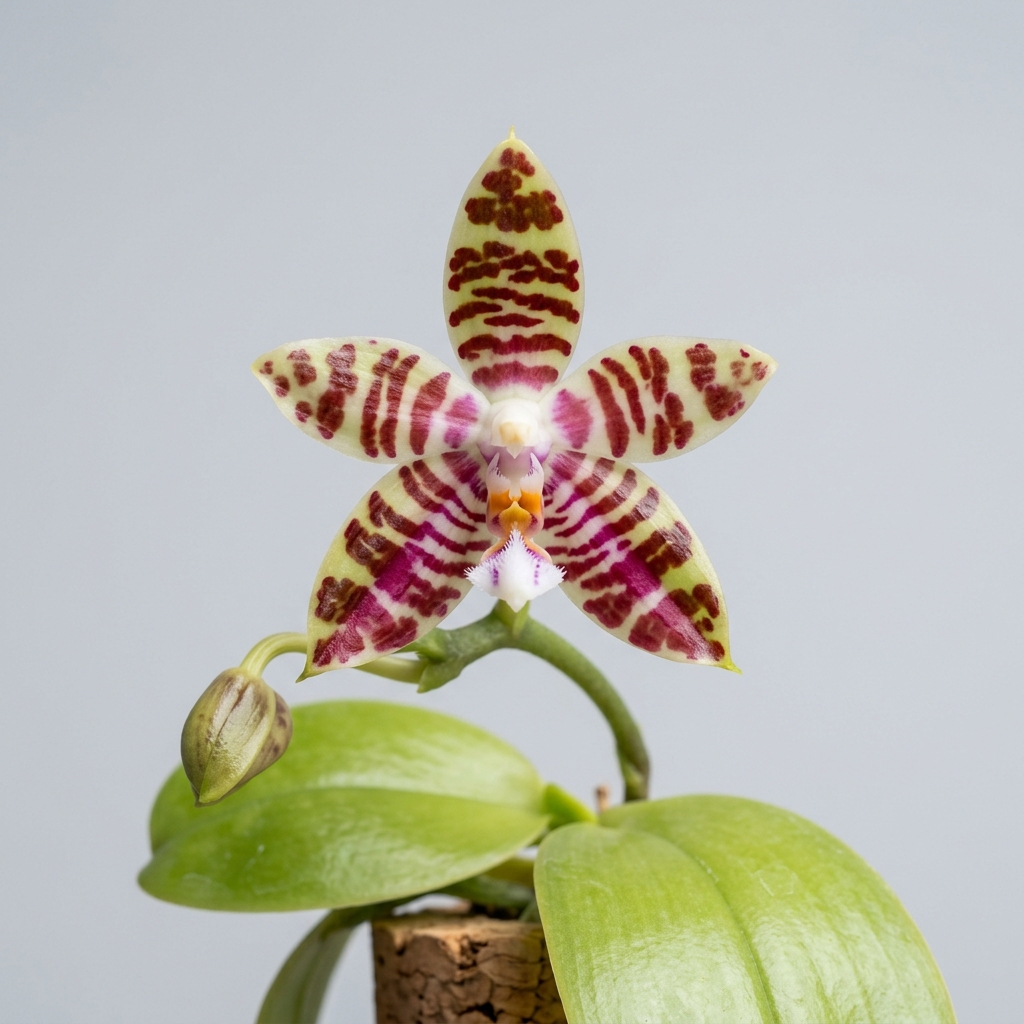
Phalaenopsis Corningiana is a highly prized species orchid native to the primary rainforests of Borneo, specifically Sarawak. Renowned among collectors for its striking, star-shaped blossoms and intense, sweet fragrance, this warm-growing epiphyte represents a classic member of the Polychilos subgenus. Unlike mass-market hybrid moth orchids, this species shows a more pendulous growth habit and demands specific environmental conditions that mimic its humid, shaded forest canopy origins.
Orchid enthusiasts value Phalaenopsis Corningiana for its glossy, light green foliage and sequential blooming habit, where flowers open successively on relatively short, arching inflorescences. While it requires a bit more attention to humidity and temperature than common grocery store hybrids, the reward of its deeply saturated, patterned blooms and rich, spicy aroma makes it a crown jewel in any serious indoor or greenhouse collection.
💡 Did You Know?
Phalaenopsis Corningiana is named in honor of Erastus Corning, an influential 19th-century American businessman and avid orchid collector who founded the famous Corning Preserve. This species is highly valued by modern hybridizers because it reliably passes its intense, sweet-spicy and heavy, waxy flower substance down to its hybrid offspring.
🌿 Botanical Overview
Phalaenopsis Corningiana is an epiphytic orchid species native to the island of Borneo, where it typically grows on moss-covered tree trunks and branches in wet, shaded riverine forests at low elevations. It features relatively large, glossy, obovate-elliptic leaves that grow in a pendulous fashion, a natural adaptation that helps shed excess rainwater from the crown to prevent rot in its native habitat.
Botanically, it belongs to the section Zebrinae within the subgenus Polychilos. This classification is characterized by fleshy, star-shaped flowers that often feature intricate transverse banding or barring. Because of its specific evolutionary adaptation to high-humidity, low-light forest understories, it lacks pseudobulbs and relies entirely on its thick, fleshy roots and succulent leaves to store moisture and nutrients.
🌸 Flower Characteristics
The flowers of Phalaenopsis Corningiana are highly distinctive, measuring approximately two to two and a half inches in diameter. They feature a star-like shape with thick, waxy sepals and petals that provide excellent bloom longevity. The base color of the segments ranges from cream to pale greenish-yellow, heavily overlaid with bold, concentric bars or solid washes of deep reddish-brown, mahogany, or rich magenta-red.
The lip, or labellum, is relatively small and complex, featuring a white and purple midlobe adorned with a dense cushion of fine hairs, a characteristic feature of its section. The flowers are borne on short, pendulous inflorescences that emerge from the leaf axils, often producing one to three flowers simultaneously in a sequential manner over an extended period.
Fragrance & Bloom Profile
One of the primary reasons growers seek out Phalaenopsis Corningiana is its exceptional fragrance profile. The blooms emit a powerful, complex scent that is frequently described as a blend of sweet clover, cinnamon, and ripe grapes. This fragrance is most intense during the morning hours and early afternoon, filling a growing space with a rich, spicy aroma.
The blooming cycle is typically sequential, meaning the plant will produce flowers one after another on the same spike. It is crucial for growers to avoid cutting green flower spikes, as they can remain active and produce new buds for multiple seasons. A single spike may continue to bloom intermittently for several years if it remains green and healthy.
Parentage & Hybrid Lineage
As a distinct, naturally occurring species rather than a man-made hybrid, Phalaenopsis Corningiana possesses a pure genetic lineage. It was formally described in the late 19th century and named in honor of Erastus Corning, a prominent American orchid collector. In orchid breeding, it is highly valued for passing down its intense fragrance, heavy flower substance, and rich red-brown pigmentation to its offspring.
It has been used extensively in primary hybridizing, crossing with other species such as Phalaenopsis violacea to produce Phalaenopsis Corinthia, and Phalaenopsis lueddemanniana to produce Phalaenopsis Luedde-corning. When evaluating hybrids derived from this species, growers can generally expect a strong influence on fragrance and a preference for warm, humid growing conditions.
🌱 Growing Conditions
To cultivate Phalaenopsis Corningiana successfully, growers must replicate its warm, humid tropical habitat. Light levels should be kept low to moderate, equivalent to deep shade or the lower end of standard Phalaenopsis lighting. Direct sunlight will quickly scorch the delicate, glossy leaves, while insufficient light may prevent the plant from blooming.
💡 Care Tip
Because Phalaenopsis Corningiana naturally grows on damp, mossy tree trunks, it thrives when grown in a hanging basket or mounted on a cork plaque. If you choose to pot this orchid, use a highly breathable plastic pot with side slits to ensure excellent root aeration and prevent stagnant moisture.
Temperature control is critical for this species. It thrives in warm conditions, with daytime temperatures ideally ranging between 75°F and 85°F, and night temperatures not dropping below 65°F. Prolonged exposure to temperatures below 60°F can cause severe physiological stress, leaf drop, and render the plant highly susceptible to pathogens. High humidity of 60% to 80% coupled with gentle, continuous air movement is essential to prevent stagnant air and fungal issues.
Watering, Feeding & Potting Media
Unlike many hybrid Phalaenopsis that prefer to dry out slightly between waterings, Phalaenopsis Corningiana prefers to remain consistently moist but never waterlogged. The potting medium should be highly breathable yet water-retentive. High-quality New Zealand sphagnum moss in clay or slotted plastic pots works exceptionally well, as does a fine-grade fir bark mix blended with perlite and charcoal.
Watering frequency depends heavily on the growing environment, but the medium should feel damp to the touch, like a wrung-out sponge, before watering again. Feed the orchid with a balanced, water-soluble orchid fertilizer diluted to one-quarter strength every second or third watering during the active growing season. Flush the pot thoroughly with pure water periodically to prevent harmful mineral salt buildup.
Blooming Season & Care Notes
The primary blooming season for Phalaenopsis Corningiana occurs from late spring through summer and into early autumn, though healthy plants in stable greenhouse conditions may bloom at almost any time of year. Because the flower spikes are pendulous and grow downward or horizontally, many experienced growers prefer to mount this species on cork bark or tree fern plaques, or grow it in hanging baskets to allow the spikes to drape naturally.
If grown in a traditional pot, care must be taken not to stake the spikes too rigidly, as this can stress the stem. Repotting should be performed only when the potting medium begins to break down, typically every one to two years, and is best done in the spring when active new root growth is visible.
⚠️ Common Issues
⚠️ Common Mistake
A frequent mistake is cutting off green, leafless flower spikes after the initial blooms have faded. Phalaenopsis Corningiana is a sequential bloomer, meaning it can produce new buds on the same green spike for several consecutive seasons. Only prune spikes that have turned completely brown and dry.
- Root Rot:
Caused by overwatering, poor drainage, or decomposing potting media that suffocates the roots. - Crown Rot:
Occurs when water pools in the crown of the plant overnight; always water early in the day and ensure good airflow. - Bud Blast:
Sudden dropping of buds before opening, usually triggered by rapid drops in humidity, drafts, or temperature fluctuations. - Spider Mites and Mealybugs: Common pests that thrive in dry conditions; regular inspection and maintaining high humidity help deter them.
- Leaf Scorch: Yellow or brown patches on leaves caused by exposure to direct sunlight or excessively high light levels.
❓ Frequently Asked Questions
Can Phalaenopsis Corningiana be grown mounted?
Yes, mounting Phalaenopsis Corningiana on cork bark or tree fern plaques is highly recommended. This method accommodates its natural pendulous growth habit and allows the flower spikes to drape downward. However, mounted plants require daily watering or misting to maintain adequate moisture levels.
Why are the flower buds on my orchid falling off before opening?
This issue, known as bud blast, is typically caused by environmental stress. Sudden drops in humidity, cold drafts, dry indoor air, or moving the plant to a new location while buds are developing can cause the plant to abort its flowers. Maintaining stable, humid conditions is key.
How do I know if my orchid is getting the right amount of light?
The leaves of a healthy Phalaenopsis Corningiana should be a vibrant, glossy, light-to-medium green. If the leaves turn dark green, the plant is likely receiving too little light to bloom. If they turn yellow or develop bleached, papery patches, the light is too intense.
Should I cut the flower spike off after the blooms fade?
No, do not cut the flower spikes unless they turn completely brown and dry. Phalaenopsis Corningiana has a sequential blooming habit and can produce new flowers on the same green spike for multiple years. Cutting a green spike removes future blooming potential.
⭐ Final Growing Notes
Phalaenopsis Corningiana is an exquisite species that rewards patient growers with some of the most fragrant and beautifully patterned flowers in the orchid world. By prioritizing consistent warmth, high humidity, gentle air movement, and careful moisture management, you can successfully cultivate this Bornean treasure and enjoy its captivating, spicy aroma for years to come.
⚕️ Health, Safety & Edibility
Understanding how a plant interacts with people, pets, and the surrounding environment is part of responsible cultivation. This section uses conservative, general guidance and does not replace professional medical or veterinary advice.
Human Safety: No published evidence currently identifies species-specific toxicity concerns for Phalaenopsis Corningiana during normal handling. As with most ornamental plants, it should not be intentionally consumed.
Pet Safety: Published information does not indicate that this orchid commonly poses a toxicity concern for cats or dogs. However, chewing leaves, flowers, roots, or potting media may still cause mild digestive upset.
Edibility: This orchid is cultivated for ornamental display rather than food. Ornamental plants may carry fertilizers, pesticides, or other horticultural treatments that make them unsuitable for consumption.
Skin Contact: Routine handling is not generally associated with skin irritation. Gardeners with sensitive skin may prefer wearing gloves when repotting, pruning, or handling potting media.
🌱 Propagation Tip
While this species is primarily propagated through professional tissue culture, mature plants may occasionally produce a 'keiki'—a genetically identical baby plant—along an active flower spike. Allow the keiki to develop several healthy roots at least two inches long before carefully detaching and potting it.
⭐ Expert Advice
To trigger robust blooming, maintain a consistent differential of about 10 degrees Fahrenheit between day and night during the spring. Ensure daytime temperatures reach the low 80s while nights drop to the low 70s, all while keeping relative above 60 percent.

Leave A Comment