
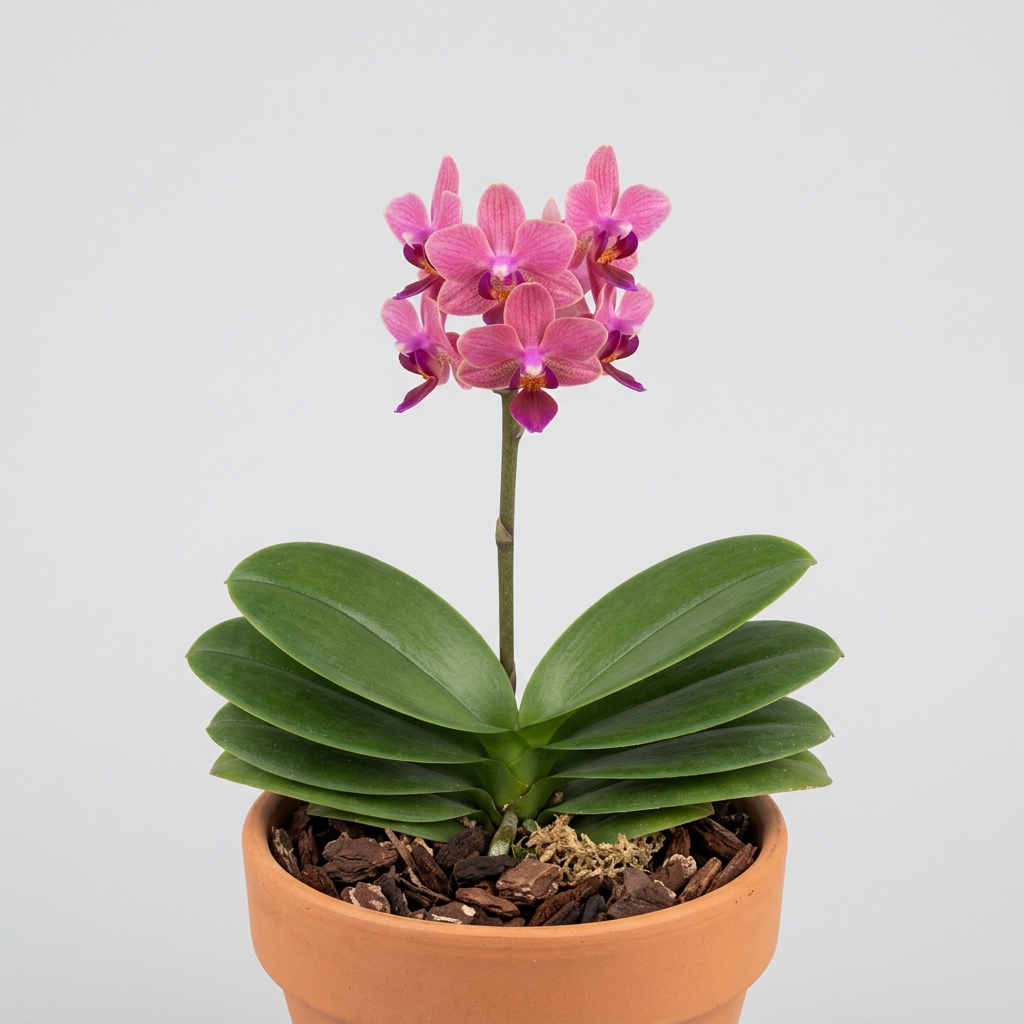
Phalaenopsis Regnieriana is a highly valued species orchid prized by collectors for its compact growth habit and charming, colorful blossoms. Belonging to the diverse genus Phalaenopsis, this orchid offers a delightful departure from standard complex hybrids, showcasing a more wild and elegant form that appeals to both novice and experienced growers.
Native to regions of Southeast Asia, particularly Thailand and Vietnam, this orchid is celebrated for its resilience and its ability to produce upright, densely clustered flower spikes. Its manageable size makes it an excellent candidate for windowsill cultivation or dedicated orchid terrariums, where its distinct botanical features can be appreciated up close.
💡 Did You Know?
Phalaenopsis Regnieriana is closely related to Phalaenopsis pulcherrima, a species famous for its terrestrial-like growth habit. Unlike many other Phalaenopsis that grow hanging downward from tree branches to shed water, this species often grows more upright, a trait it passes on to its hybrid descendants, resulting in exceptionally sturdy, vertical flower spikes.
🌿 Botanical Overview
Phalaenopsis Regnieriana is a monopodial epiphytic orchid characterized by its compact stature and thick, leathery leaves. The leaves are typically elliptic-oblong, deep green, and arranged in a tight fan-like pattern close to the potting medium. This growth habit allows the plant to conserve moisture and nutrients efficiently in its natural habitat.
In the wild, this species is found growing on tree trunks and branches in deciduous forests, where it experiences seasonal variations in moisture and light. Its robust root system is adapted to clinging to bark and absorbing atmospheric moisture, making it highly responsive to proper humidity and airflow in cultivation.
🌸 Flower Characteristics
The flowers of Phalaenopsis Regnieriana are relatively small but striking, usually measuring around one to one and a half inches in diameter. They are borne on upright or slightly arching inflorescences that can carry multiple blooms simultaneously. The petals and sepals typically exhibit shades of soft pink, rose, or deep magenta, creating a vibrant display.
A defining feature of this orchid is its distinct three-lobed lip, or labellum, which often features darker purple or reddish-purple coloration, sometimes contrasted with subtle yellow markings near the column. The flowers are presented beautifully along the spike, opening sequentially to extend the overall blooming period.
Fragrance & Bloom Profile
While some growers report a very faint, sweet scent during the warmest hours of the day, fragrance in Phalaenopsis Regnieriana is not consistently documented or prominent across all specimens. The primary appeal of this orchid lies in its visual presentation rather than its scent.
The blooms are long-lasting, often remaining fresh on the spike for several weeks. Because the flowers open in succession, a single spike can provide an attractive display for a month or more, especially when the plant is grown under stable environmental conditions.
Parentage & Hybrid Lineage
As a naturally occurring species rather than a man-made hybrid, Phalaenopsis Regnieriana does not have a complex parentage of different cultivars. It is sometimes classified by taxonomists as a variety or close relative of Phalaenopsis pulcherrima, sharing many vegetative and floral similarities.
In orchid breeding, this species and its close relatives have been used to introduce compact growth habits, upright flower spikes, and intense pink-purple coloration into modern intergeneric hybrids. However, pure specimens of Phalaenopsis Regnieriana remain highly sought after by species purists.
🌱 Growing Conditions
To thrive, Phalaenopsis Regnieriana requires warm to hot temperatures, ideally ranging from 70°F to 85°F during the day, with a slight drop at night to stimulate healthy growth. It is less tolerant of cold drafts than some standard complex hybrids, so keeping it away from air conditioning vents is recommended.
💡 Care Tip
Provide this orchid with slightly brighter indirect than standard hybrid Phalaenopsis. A gentle purple tint on the undersides of the leaves is a good indicator that the plant is receiving the optimal amount of to stimulate robust blooming.
Light levels should be bright but indirect. While it can tolerate slightly more light than standard moth orchids—often showing a light purple tint on the leaf undersides when light is optimal—direct midday sun will scorch the foliage. Good air circulation is essential to prevent stagnant air around the leaves and roots.
Watering, Feeding & Potting Media
Watering should be adjusted according to the potting medium and environmental conditions. If grown in a bark-based mix, the orchid should be watered thoroughly and then allowed to dry out almost completely before the next watering. If grown in sphagnum moss, the medium should remain damp but never soggy.
During the active growing season in spring and summer, apply a balanced, highly diluted orchid fertilizer weekly, often referred to as the weakly weekly method. Flush the pot with pure water once a month to prevent salt buildup. A well-draining medium of fine to medium fir bark mixed with perlite or charcoal works exceptionally well.
Blooming Season & Care Notes
The typical blooming season for Phalaenopsis Regnieriana is late summer through autumn. As the days begin to shorten, the plant initiates its flower spikes. Once the spike begins to emerge, maintain stable conditions and avoid moving the plant to prevent bud drop.
After the flowers have faded, the spike can be cut back to the base if it turns brown and dry. Repotting is best done in the spring, just as new root tips begin to emerge, ensuring the plant has ample time to establish itself in fresh media before the next blooming cycle.
⚠️ Common Issues
⚠️ Common Mistake
The most common mistake is overwatering or allowing the orchid to sit in standing water. This species has sensitive roots that require excellent oxygen flow; keeping the potting medium constantly saturated will quickly lead to root rot and the decline of the plant.
- Root rot caused by overwatering or compacted, decaying potting media.
- Bud blast, where developing buds yellow and drop, often triggered by sudden temperature fluctuations or low humidity.
- Spider mites and mealybugs, which can hide in the tight leaf joints and under leaves.
- Leaf scorch from exposure to direct, unfiltered sunlight.
- Dehydration, indicated by wrinkled, limp leaves and dry, silvery roots.
❓ Frequently Asked Questions
How often should I water Phalaenopsis Regnieriana?
Watering frequency depends on your home environment and potting medium. Generally, water once the potting mix is nearly dry and the roots turn a silvery-gray color. This typically translates to once every 7 to 10 days for bark mixes, but always check the moisture level of the media rather than relying on a strict calendar schedule.
Can I grow Phalaenopsis Regnieriana mounted on bark?
Yes, this species is an excellent candidate for mounting on cork bark or tree fern plaques due to its natural epiphytic habit. Mounted plants require high humidity (above 60%) and must be misted or watered daily, as they dry out much faster than those grown in pots.
Why are the leaves on my orchid turning yellow?
Yellowing leaves can indicate several issues. If the oldest bottom leaf turns yellow and drops, it is likely natural shedding. However, if multiple leaves yellow quickly, it may be a sign of overwatering, root rot, or excessive direct sunlight. Inspect the roots immediately to assess their health.
Does Phalaenopsis Regnieriana require a winter rest?
This species does not require a severe dry winter rest, but watering and feeding should be reduced slightly during the cooler winter months when plant growth naturally slows down. Maintain warm temperatures and ensure the plant still receives adequate indirect light during this period.
⭐ Final Growing Notes
Phalaenopsis Regnieriana is a rewarding and charming species that brings a touch of wild elegance to any orchid collection. By mimicking its natural warm, humid environment and providing bright, indirect light, growers can enjoy its vibrant pink-purple blooms year after year. Its compact size and resilient nature make it a perfect choice for those looking to expand their collection beyond standard hybrid moth orchids.
⚕️ Health, Safety & Edibility
Understanding how a plant interacts with people, pets, and the surrounding environment is part of responsible cultivation. This section uses conservative, general guidance and does not replace professional medical or veterinary advice.
Human Safety: No published evidence currently identifies species-specific toxicity concerns for Phalaenopsis Regnieriana during normal handling. As with most ornamental plants, it should not be intentionally consumed.
Pet Safety: Published information does not indicate that this orchid commonly poses a toxicity concern for cats or dogs. However, chewing leaves, flowers, roots, or potting media may still cause mild digestive upset.
Edibility: This orchid is cultivated for ornamental display rather than food. Ornamental plants may carry fertilizers, pesticides, or other horticultural treatments that make them unsuitable for consumption.
Skin Contact: Routine handling is not generally associated with skin irritation. Gardeners with sensitive skin may prefer wearing gloves when repotting, pruning, or handling potting media.
🌱 Propagation Tip
While propagation from seed requires sterile laboratory conditions, mature plants may occasionally produce adventitious offsets, known as keikis, along the flower spike or at the base of the plant. Allow the keiki to develop several healthy roots at least two inches long before carefully detaching and potting it.
⭐ Expert Advice
To encourage successful blooming in the late summer, ensure there is a slight drop of about 10 to 15 degrees Fahrenheit between day and night during the late spring and early summer. This natural fluctuation signals the plant to initiate its flower spikes.

Leave A Comment