
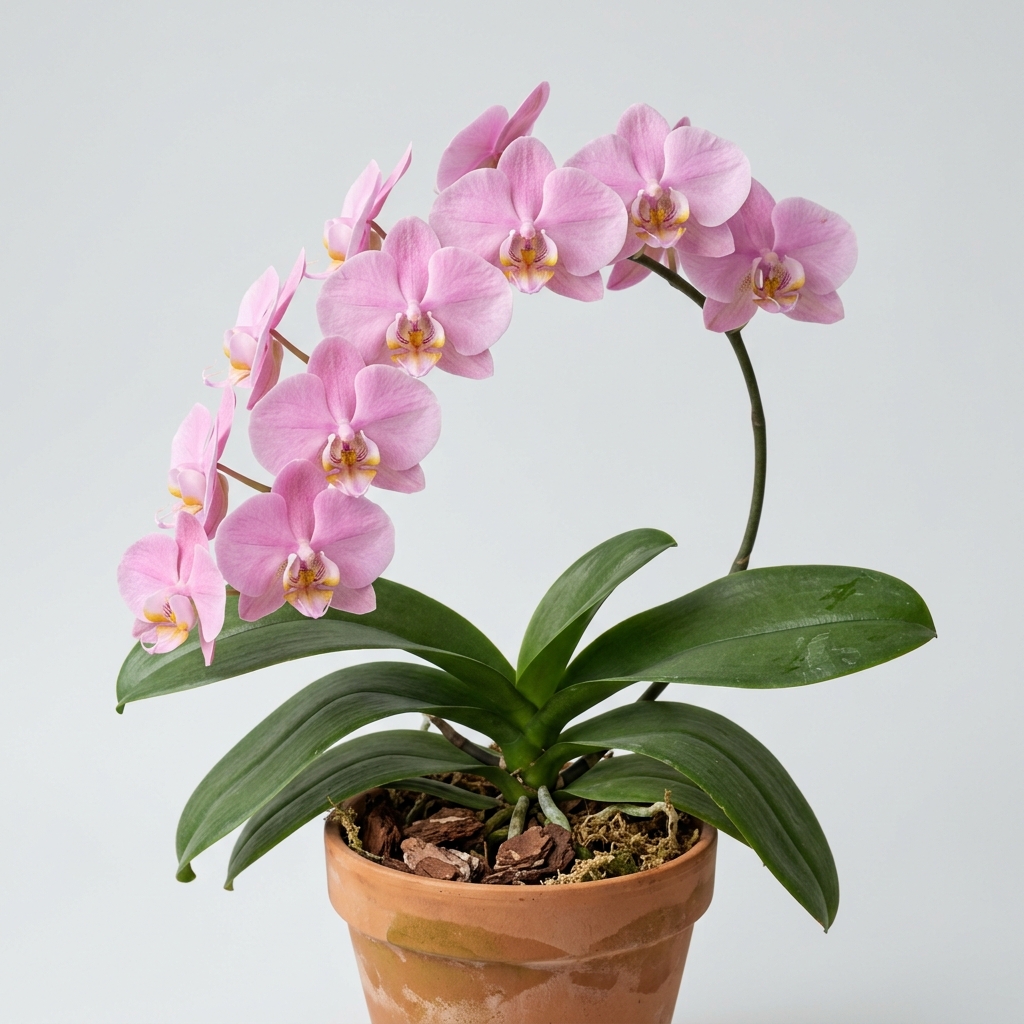
Phalaenopsis Sanderiana is an elegant and historically significant orchid species native to the Philippines, particularly the island of Mindanao. Highly prized by collectors, this species is celebrated for its graceful, arching sprays of soft pink to rose-colored blossoms that bring a delicate, refined aesthetic to any indoor garden. As a foundational parent in orchid horticulture, it has played an indispensable role in breeding programs, passing down its desirable floral form and pastel coloration to countless modern hybrids.
This epiphytic orchid features a robust growth habit characterized by broad, leathery, dark green leaves and a vigorous, clinging root system adapted for securing itself to tree bark. While it requires slightly more attention to humidity and temperature than mass-market complex hybrids, Phalaenopsis Sanderiana is a deeply rewarding plant for intermediate growers who wish to experience the authentic beauty of a classic wild species.
💡 Did You Know?
Phalaenopsis Sanderiana is named in honor of Henry Frederick Conrad Sander, a prominent nineteenth-century German-English nurseryman often referred to as the Orchid King. This species played a foundational role in orchid history, serving as one of the primary genetic building blocks used by early hybridizers to create the large, round, pink-flowered Phalaenopsis hybrids popular in homes today.
🌿 Botanical Overview
Phalaenopsis Sanderiana is native to the warm, humid lowland forests of the southern Philippines. In its natural habitat, it grows as an epiphyte, clinging to the trunks and branches of trees where it is shielded from direct sunlight by the dense forest canopy. This environment provides the plant with consistent warmth, high atmospheric moisture, and excellent air movement around its roots.
The vegetative structure of this species consists of a short stem clothed in alternating, fleshy leaves. The leaves are oblong-elliptic, deep green, and can sometimes exhibit a very subtle, faint silvery mottling when young, though this typically fades as the leaves mature. Its root system is highly adapted to its epiphytic lifestyle, featuring thick, silvery-green roots covered in velamen, a specialized spongy tissue that absorbs moisture and nutrients directly from the air and passing rainwater.
🌸 Flower Characteristics
The flowers of Phalaenopsis Sanderiana are highly regarded for their delicate symmetry and soft, pleasing coloration. Individual blooms typically measure between 7 and 10 centimeters in diameter, presenting a flat, well-proportioned shape. The petals and sepals are typically a uniform shade of soft rose-pink, though some specimens may display lighter, almost white variations.
The lip, or labellum, is the most intricate part of the flower, featuring three distinct lobes. It is usually adorned with complex markings of yellow, white, and fine reddish-brown or purple stripes, which serve as guides for natural pollinators. These flowers are produced on long, arching inflorescences that can carry numerous blooms simultaneously, creating a spectacular, cascading floral display.
Fragrance & Bloom Profile
Unlike some of its highly fragrant relatives in the Phalaenopsis genus, Phalaenopsis Sanderiana is primarily grown for its visual elegance. A noticeable fragrance is not consistently documented among cultivated specimens. Some growers report a very faint, sweet, or clean scent under warm, humid conditions, but for most practical purposes, it should be considered a non-fragrant or minimally fragrant orchid.
What it lacks in scent, it more than makes up for in bloom longevity. A healthy, mature plant can maintain its flowers for several weeks, often lasting up to two months under optimal indoor conditions. The blooming cycle typically peaks in the spring and summer, though well-established plants in stable environments may occasionally produce blooms at other times of the year.
Parentage & Hybrid Lineage
Phalaenopsis Sanderiana is a naturally occurring species rather than a man-made hybrid. First described in the late 19th century, it quickly became a sensation in European horticulture. Because of its exceptional flower form and soft pink color, early orchid breeders recognized its potential and used it extensively in hybridization programs.
Today, this species is recognized as a primary ancestor of modern pink Phalaenopsis hybrids. Its genetic legacy is visible in the round, flat shape and pastel pink hues of many commercially available orchids. Cautious growers appreciate preserving the pure species line, which remains highly sought after by collectors who value historical botanical species over complex modern cultivars.
🌱 Growing Conditions
To successfully cultivate Phalaenopsis Sanderiana indoors, growers should attempt to replicate its tropical canopy home. It requires bright, filtered indirect light. An east-facing window is often ideal, or a south-facing window shaded by a sheer curtain. Direct, unfiltered sunlight will quickly scorch the leaves, leading to unsightly yellow or brown patches.
💡 Care Tip
To mimic its natural canopy habitat, place this orchid in a location with bright, filtered , such as behind a sheer curtain. Avoid direct afternoon sun, which can quickly scorch the delicate leaves and cause permanent tissue damage.
Temperature management is crucial for this warm-growing species. It thrives in daytime temperatures between 75°F and 85°F, with a modest drop to 65°F or 70°F at night. High humidity is also essential, ideally maintained between 60% and 80%. To prevent fungal and bacterial issues in such humid conditions, constant, gentle air circulation from a small fan is highly recommended.
Watering, Feeding & Potting Media
Watering should be approached with care, balancing the plant’s need for moisture with its requirement for root aeration. As an epiphyte, its roots must never sit in soggy, waterlogged media. Water the plant thoroughly when the potting medium is nearly dry and the roots have turned a silvery-gray color. Active, hydrated roots will appear plump and bright green.
A high-quality, free-draining potting medium is essential. Coarse fir bark mixed with perlite and charcoal works well for humid environments, while long-fibered sphagnum moss is excellent for retaining moisture in drier household conditions. Feed the orchid with a balanced, water-soluble orchid fertilizer diluted to one-quarter strength, applying it every two to three waterings during the active growing season.
Blooming Season & Care Notes
The primary blooming season for Phalaenopsis Sanderiana occurs during the spring and summer months. The development of the flower spike is a slow, rewarding process that can take several weeks. Once the flowers fade, the spike should be monitored; if it remains green, some growers choose to cut it back to a node to encourage secondary branching, though species orchids often perform best when the old spike is allowed to dry naturally before removal.
Repotting should be performed every one to two years, or when the potting medium begins to break down and lose its structure. The best time to repot is shortly after the blooming cycle has finished and the plant begins to initiate new root growth. This minimizes transplant shock and allows the new roots to quickly establish themselves in the fresh medium.
⚠️ Common Issues
⚠️ Common Mistake
The most common mistake is overwatering or allowing the orchid to sit in standing water. This deprives the epiphytic roots of oxygen, leading to rapid root rot. Always ensure the pot has excellent drainage and the media dries slightly between waterings.
- Root rot: Caused by overwatering or compacted, decaying potting media that suffocates the roots.
- Bud blast: The premature dropping of flower buds, often triggered by sudden temperature drops, dry air, or drafts.
- Pests: Mealybugs and scale insects can occasionally hide in the leaf joints or under the flowers; treat promptly with insecticidal soap.
- Sunburn: Bleached or blackened spots on the foliage resulting from exposure to direct, intense sunlight.
❓ Frequently Asked Questions
How often should I water my Phalaenopsis Sanderiana?
Watering frequency depends on your home environment, but generally, you should water every 7 to 10 days. Always check the roots and media first; water only when the potting mix is nearly dry and the roots have turned a silvery-gray color.
Does Phalaenopsis Sanderiana require high humidity?
Yes, this species prefers high humidity levels between 60% and 80%. You can increase humidity around your plant by using a humidifying tray filled with pebbles and water, placing a room humidifier nearby, or grouping plants together.
Can I grow Phalaenopsis Sanderiana under artificial lights?
Yes, Phalaenopsis Sanderiana adapts very well to artificial grow lights, such as LEDs or fluorescent tubes. Position the lights approximately 12 to 18 inches above the plant and provide 12 to 14 hours of light daily to simulate natural tropical day lengths.
Why are the flower buds on my orchid falling off before opening?
This issue, known as bud blast, is typically caused by environmental stress. Common culprits include sudden temperature fluctuations, cold drafts from windows or air vents, extremely low humidity, or allowing the potting medium to dry out completely while the buds are forming.
⭐ Final Growing Notes
Phalaenopsis Sanderiana remains a crown jewel of the orchid world, offering a perfect blend of historical significance and delicate botanical beauty. While it demands a bit more attention to humidity and warmth than common grocery store hybrids, its breathtaking sprays of soft pink flowers make it an incredibly rewarding addition to any dedicated grower’s collection. By providing bright, filtered light, consistent warmth, and careful watering, you can enjoy the timeless elegance of this Philippine treasure for many years to come.
⚕️ Health, Safety & Edibility
Understanding how a plant interacts with people, pets, and the surrounding environment is part of responsible cultivation. This section uses conservative, general guidance and does not replace professional medical or veterinary advice.
Human Safety: No published evidence currently identifies species-specific toxicity concerns for Phalaenopsis Sanderiana during normal handling. As with most ornamental plants, it should not be intentionally consumed.
Pet Safety: Published information does not indicate that this orchid commonly poses a toxicity concern for cats or dogs. However, chewing leaves, flowers, roots, or potting media may still cause mild digestive upset.
Edibility: This orchid is cultivated for ornamental display rather than food. Ornamental plants may carry fertilizers, pesticides, or other horticultural treatments that make them unsuitable for consumption.
Skin Contact: Routine handling is not generally associated with skin irritation. Gardeners with sensitive skin may prefer wearing gloves when repotting, pruning, or handling potting media.
🌱 Propagation Tip
While Phalaenopsis Sanderiana is typically grown from seed in sterile laboratory flasks, mature plants may occasionally produce a keiki, or baby plant, along the flower spike. Allow the keiki to develop several healthy roots at least two inches long before carefully detaching and potting it.
⭐ Expert Advice
For optimal blooming, provide a slight drop in nighttime temperatures of about 10 to 15 degrees Fahrenheit during the autumn months. This natural fluctuation signals the plant to initiate a new flower spike for the upcoming spring season.




Leave A Comment