
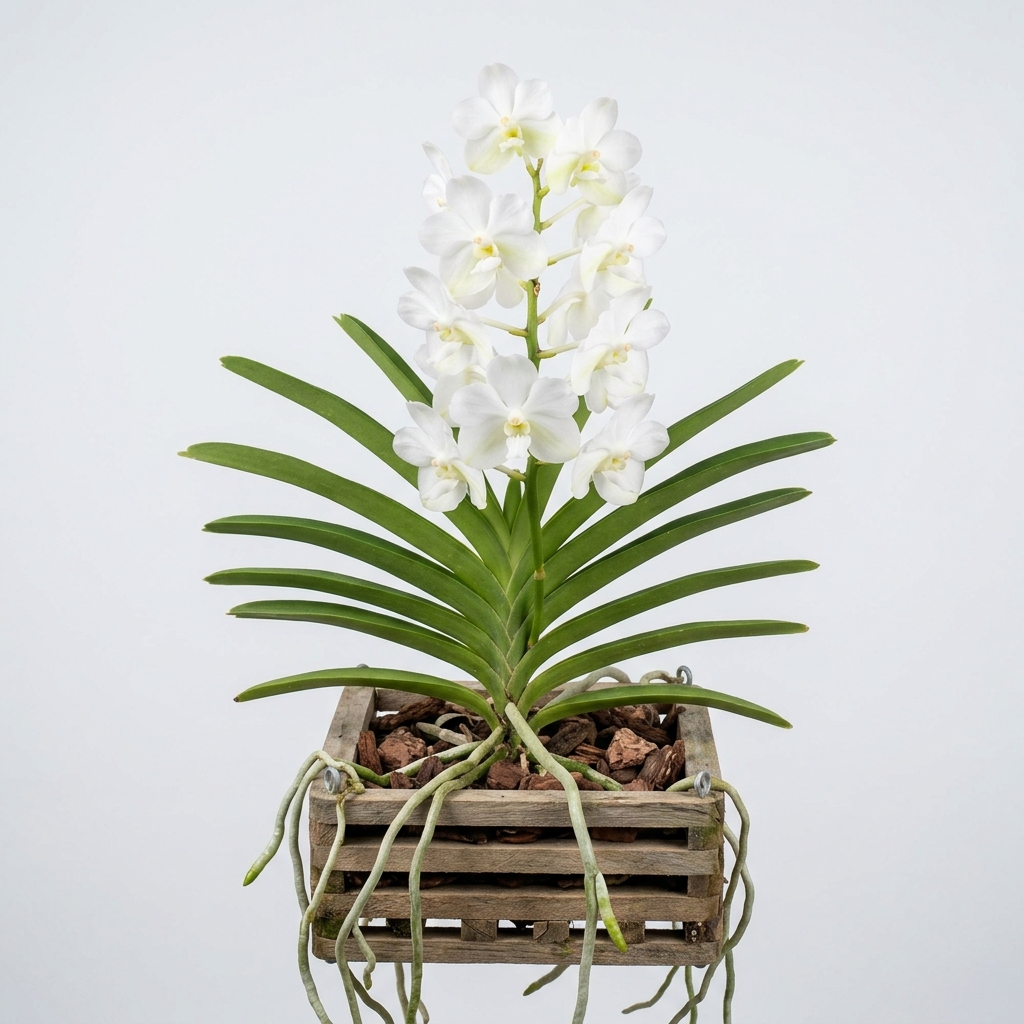
Vanda Javierae is an exquisite and rare monopodial epiphytic orchid endemic to the island of Luzon in the Philippines. Highly prized among collectors, this species is celebrated for its pristine, crystalline white blossoms, which contrast beautifully with its deep green, strap-like foliage. Unlike many of its brightly colored, warm-growing relatives in the Vanda genus, this orchid brings an understated elegance and unique cultural requirements to the greenhouse.
This species features a classic monopodial growth habit, producing upright fans of leathery, V-shaped leaves. Orchid enthusiasts value Vanda Javierae not only for its aesthetic purity but also for its relatively compact growth habit compared to giant Vanda species, making it a highly manageable treasure for dedicated indoor and greenhouse growers who can provide its required humidity and airflow.
💡 Did You Know?
Unlike the vast majority of Vanda species which display vibrant purples, blues, and pinks, Vanda Javierae is celebrated for its rare, crystalline white flowers. This species was discovered relatively recently in the northern region of Luzon, Philippines, making it a highly sought-after treasure for collectors seeking pure white blooms.
🌿 Botanical Overview
Vanda Javierae is native to the island of Luzon in the Philippines, where it grows as an epiphyte on tree trunks in medium-altitude forests. Because it originates from slightly higher elevations than lowland Vanda species, it adapted to tolerate slightly cooler night temperatures, which distinguishes its care requirements from its strictly tropical relatives.
The plant shows an upright, monopodial growth habit, meaning it grows from a single stem that continuously produces new leaves from the apex. Its root system is exceptionally robust, producing thick, fleshy aerial roots covered in a spongy velamen layer designed to rapidly absorb moisture and nutrients from the air and passing rain showers.
🌸 Flower Characteristics
The defining feature of Vanda Javierae is its striking, pristine white flowers. The blossoms are typically medium-sized, ranging from 5 to 7 centimeters in diameter, and are arranged elegantly on axillary inflorescences. Each flower spike can carry between four and ten blossoms, presenting a stunning display against the dark green foliage.
The petals and sepals are flat, rounded, and overlapping, creating a full, symmetrical appearance. The lip, or labellum, is also primarily white, but it features subtle, delicate markings of light yellow or pale green near the column base, adding a touch of depth to the otherwise stark white flower.
Fragrance & Bloom Profile
This orchid is known to produce a delicate, subtle fragrance that is most noticeable during the morning hours. The scent is often described as clean, light, and faintly sweet, though the intensity can vary depending on environmental factors such as temperature and humidity levels.
The blooms of Vanda Javierae are remarkably long-lasting. Under optimal growing conditions, a single flower spike can remain in pristine condition for four to six weeks, providing a long-lasting and elegant display in the growing area.
Parentage & Hybrid Lineage
Vanda Javierae is a distinct natural species rather than a man-made hybrid. Because of its pure white coloration and relatively compact growth habit, it has been highly valued by orchid breeders looking to introduce clean white traits and manageable sizing into modern Vanda hybrids.
While wild populations are protected and rare, line-bred nursery specimens are occasionally available to collectors. When purchasing, growers should look for established, nursery-propagated plants to ensure conservation guidelines are respected.
🌱 Growing Conditions
To cultivate Vanda Javierae successfully, mimicking its natural forest habitat is essential. It requires bright, filtered indirect light. While it enjoys high light levels, direct midday sunlight can easily scorch the leaves, so sheer curtains or shade cloth are highly recommended.
💡 Care Tip
Ensure your Vanda Javierae receives excellent air circulation. Because it requires high , stagnant air can quickly lead to fungal crown rot or leaf spotting. A small fan running nearby is highly beneficial.
This species thrives in intermediate to warm temperatures, ideally between 65 degrees Fahrenheit and 85 degrees Fahrenheit during the day. A slight temperature drop of 10 to 15 degrees at night is beneficial, as it mimics the natural elevation changes of its native habitat and helps stimulate flower spike development.
Watering, Feeding & Potting Media
Watering frequency depends heavily on how the orchid is housed. If grown bare-root in a wooden teak basket, which is highly recommended, Vanda Javierae requires daily watering or heavy misting, and may need twice-daily watering during hot summer months. The roots must be allowed to dry completely between waterings.
Feed the plant weekly using a balanced, water-soluble orchid fertilizer diluted to one-quarter strength. If potted, use an extremely coarse, fast-draining medium such as large charcoal chunks, coarse fir bark, and chunky perlite to ensure the roots never sit in stagnant moisture.
Blooming Season & Care Notes
The primary blooming season for Vanda Javierae is spring to early summer. Once a flower spike begins to emerge from the leaf axils, avoid changing the plant’s orientation to the light source, as this can cause the developing buds to twist and present poorly.
After the flowers have faded, cut the spent spike near the base using sterilized shears. Repotting or basket maintenance should only be performed when absolutely necessary, preferably in the spring when active root growth resumes, to minimize stress on the plant.
⚠️ Common Issues
⚠️ Common Mistake
The most common mistake is growing Vanda Javierae in standard, dense potting soil or fine bark. This species has thick, aerial roots that require rapid wet-dry cycles; planting them in heavy media will suffocate the roots and cause rapid rot.
- Root Rot:
Caused by compacted potting media or stagnant water around the root zone. - Dehydration:
Indicated by shriveled, leathery leaves and dry, silvery-white roots that fail to green up when watered. - Leaf Spotting: Fungal or bacterial infections arising from high humidity paired with poor air circulation.
- Bud Blast:
The premature dropping of flower buds, usually triggered by sudden temperature drops or low humidity. - Pests:
Mealybugs and scale insects can occasionally hide in the tight crevices of the leaf axils.
❓ Frequently Asked Questions
How do I encourage my Vanda Javierae to bloom?
To encourage blooming, ensure the plant receives bright, filtered light and a distinct temperature drop of 10 to 15 degrees Fahrenheit between day and night during the autumn and winter months, alongside consistent, weak fertilization.
Can Vanda Javierae be grown in a standard pot?
While it can be grown in a pot using extremely coarse, free-draining media like large bark chunks and charcoal, it thrives best bare-root in a wooden basket where its extensive aerial roots can receive maximum airflow.
Why are the leaf tips of my orchid turning brown?
Brown leaf tips are often a sign of low humidity or mineral buildup from hard water or over-fertilization. Flush the root system thoroughly with pure rainwater or distilled water and increase the surrounding humidity.
How often should I water a bare-root Vanda Javierae?
Bare-root specimens typically require thorough watering or soaking every morning. During hot, dry summer days, a second misting in the afternoon may be necessary to keep the roots hydrated.
⭐ Final Growing Notes
Vanda Javierae is a rewarding species for the dedicated orchidist willing to provide the high humidity, bright light, and exceptional air movement it craves. By maintaining a consistent watering routine and allowing its aerial roots to breathe, you will be rewarded with spectacular, long-lasting displays of pure, crystalline white blossoms year after year.
⚕️ Health, Safety & Edibility
Understanding how a plant interacts with people, pets, and the surrounding environment is part of responsible cultivation. This section uses conservative, general guidance and does not replace professional medical or veterinary advice.
Human Safety: No published evidence currently identifies species-specific toxicity concerns for Vanda Javierae during normal handling. As with most ornamental plants, it should not be intentionally consumed.
Pet Safety: Published information does not indicate that this orchid commonly poses a toxicity concern for cats or dogs. However, chewing leaves, flowers, roots, or potting media may still cause mild digestive upset.
Edibility: This orchid is cultivated for ornamental display rather than food. Ornamental plants may carry fertilizers, pesticides, or other horticultural treatments that make them unsuitable for consumption.
Skin Contact: Routine handling is not generally associated with skin irritation. Gardeners with sensitive skin may prefer wearing gloves when repotting, pruning, or handling potting media.
🌱 Propagation Tip
Propagation of Vanda Javierae is typically achieved through the separation of basal offsets, or keikis, once they have developed several strong roots of their own. Avoid dividing the plant too early, as young offsets rely heavily on the parent plant.
⭐ Expert Advice
To trigger robust spring blooming, provide a slight drop of about 10 to 15 degrees Fahrenheit between day and night during the late autumn and winter, while slightly reducing frequency.




Leave A Comment