
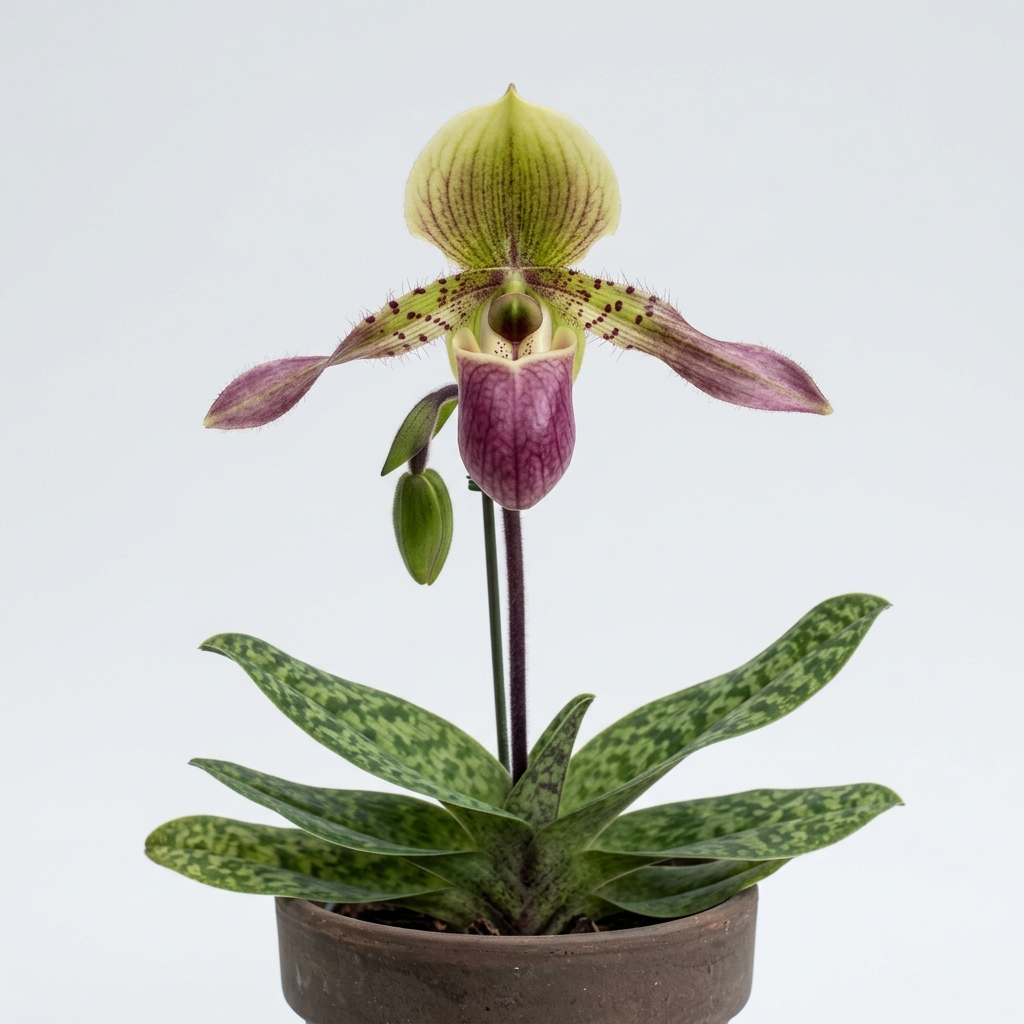
Paphiopedilum Victoria-Mariae is a highly prized slipper orchid celebrated for its unique sequential blooming habit and striking, architectural flowers. Originating from the humid, forested slopes of Sumatra, this species belongs to the Cochlopetalum section of the genus, making it a fascinating subject for both dedicated orchid collectors and indoor growers. Its distinctive pouch-shaped lip and twisted lateral petals provide an exotic focal point that stands out in any orchid collection.
Unlike many orchids that produce a single, brief flush of flowers, this resilient slipper orchid can remain in bloom for several months as it coaxes out individual blossoms one after another on a single spike. Cultivating Paphiopedilum Victoria-Mariae successfully requires an understanding of its native forest-floor habitat, where it thrives in dappled light, high humidity, and consistently moist but well-drained media. Providing these conditions rewards the grower with a reliable, long-lasting floral display year after year.
💡 Did You Know?
The sequential blooming habit of Paphiopedilum Victoria-Mariae is an evolutionary adaptation designed to maximize pollination success. By producing one flower at a time over several months rather than a single brief flush, the orchid increases its chances of encountering its specific insect pollinators in the dense Sumatra rainforest canopy, ensuring long-term survival.
🌿 Botanical Overview
Paphiopedilum Victoria-Mariae is a terrestrial or lithophytic orchid native to the tropical rainforests of Sumatra, Indonesia, where it typically grows in leaf litter on steep slopes or limestone cliffs. This species is characterized by its fan-shaped growth habit, featuring strap-like, leathery green leaves that lack the heavy mottling seen in some other Paphiopedilum species. The root system is typically thick, fleshy, and covered in fine root hairs, adapted to absorbing moisture and nutrients from the upper layers of organic debris.
As a member of the Cochlopetalum subgenus, this orchid is genetically programmed for sequential flowering. The inflorescence emerges from the center of a mature growth, slowly elongating to support a succession of buds. This evolutionary strategy ensures that the plant remains attractive to pollinators over an extended period, a trait that makes it exceptionally rewarding in a home or greenhouse environment.
🌸 Flower Characteristics
The blossoms of Paphiopedilum Victoria-Mariae are a masterclass in botanical complexity. Each flower features a prominent, hood-like dorsal sepal that is typically pale green or yellowish with faint striping and a white margin. The lateral petals are relatively narrow, spreading horizontally, and are distinctly twisted with ciliated margins, adding a dynamic texture to the bloom.
The most striking feature is the deeply inflated, pouch-shaped lip, or labellum, which typically shows rich shades of purplish-pink or magenta. This pouch serves as a highly specialized pollination trap in nature. The flowers are presented on a sturdy, dark, pubescent inflorescence that can reach up to 18 inches in height, holding each bloom aloft to maximize visibility.
Fragrance & Bloom Profile
While some orchid species entice pollinators with powerful scents, Paphiopedilum Victoria-Mariae relies primarily on its vivid visual cues and structural complexity. A noticeable fragrance is not consistently documented for this species, and most growers report that the flowers are entirely unscented.
The true appeal of its bloom profile lies in its remarkable longevity. A single inflorescence can produce upwards of ten or more flowers sequentially over a period of several months. As one flower begins to fade and drop, the next bud in line swells and opens, ensuring a continuous display of fresh color that far outlasts the blooming cycle of standard single-flower orchids.
Parentage & Hybrid Lineage
Paphiopedilum Victoria-Mariae is a naturally occurring species rather than a man-made hybrid, meaning its genetic lineage is defined by its wild ancestors in the Indonesian archipelago. In taxonomic literature, it is sometimes classified or compared closely with other members of the Cochlopetalum section, such as Paphiopedilum chamberlainianum or Paphiopedilum glaucophyllum.
Because of its desirable sequential blooming trait and robust growth habit, hybridizers have occasionally used Paphiopedilum Victoria-Mariae to introduce long-blooming characteristics into complex slipper orchid hybrids. However, pure species specimens remain highly sought after by purists who appreciate the unaltered elegance of the wild form.
🌱 Growing Conditions
To cultivate Paphiopedilum Victoria-Mariae successfully, one must replicate the shaded, humid understory of its native habitat. It thrives in low to medium indirect light, similar to the light levels preferred by Phalaenopsis orchids. Direct sunlight must be avoided, as it will quickly scorch the tender green foliage. East- or north-facing windows, or shaded grow lights, are ideal.
💡 Care Tip
Always use pure water sources like rainwater or distilled water for Paphiopedilum Victoria-Mariae. Slipper orchids lack pseudobulbs to store water and filter out impurities, making their sensitive root systems highly vulnerable to mineral salt buildup from standard tap water, which can cause root dieback.
Temperature: wise, this orchid prefers intermediate to warm conditions. Daytime temperatures should ideally range between 75F and 82F (24C to 28C), with a slight drop at night to around 60F to 65F (15C to 18C) to encourage healthy growth and spike initiation. High humidity of 50% to 70% is essential, coupled with gentle, continuous air movement to prevent fungal pathogens from settling on the leaves.
Watering, Feeding & Potting Media
Unlike epiphytic orchids that tolerate drying out between waterings, Paphiopedilum Victoria-Mariae lacks pseudobulbs for water storage and must be kept evenly moist. Water the plant thoroughly just as the top layer of the medium begins to feel dry to the touch. Rainwater, distilled water, or reverse osmosis water is highly recommended, as slipper orchids are sensitive to dissolved mineral salts in tap water.
The potting medium should be moisture-retentive yet free-draining. A mix composed of fine-grade fir bark, perlite, charcoal, and a small amount of chopped sphagnum moss works exceptionally well. Feed the orchid with a highly diluted, balanced orchid fertilizer every two to three waterings during the active growing season, flushing the pot with pure water periodically to prevent salt buildup.
Blooming Season & Care Notes
The blooming cycle of Paphiopedilum Victoria-Mariae is highly flexible and can occur at almost any time of the year, though spikes often initiate in the autumn or spring. Because the inflorescence blooms sequentially, it is crucial not to cut the flower spike while it remains green, even if the current flower has fallen. The tip of the spike will continue to produce new buds for many months.
Only remove the spike once it has turned completely brown and dry. Repotting should be performed every one to two years, preferably just after the blooming cycle has fully concluded or when new root growth is visible at the base of the fan. Use a clean pot that comfortably accommodates the root system without leaving excessive empty space, which can lead to waterlogging.
⚠️ Common Issues
⚠️ Common Mistake
A frequent error is cutting down the flower spike as soon as the first bloom drops. Because this orchid is a sequential bloomer, the green spike will continue to produce new buds at its tip. Only cut the spike at the base when it has turned entirely brown and dry.
- Root Rot: Caused by overwatering or compacted, decomposing potting media that deprives the roots of oxygen.
- Bud Blast: Sudden dropping or drying of buds, often triggered by abrupt changes in temperature, low humidity, or drafts.
- Leaf Scorch: Bleached or brown patches on the leaves resulting from exposure to direct, intense sunlight.
- Mealybugs and Scale: Pests that hide in the tight crevices at the base of the leaf fans; treat promptly with insecticidal soap or neem oil.
- Bacterial Soft Rot: Dark, watery spots on the leaves that spread rapidly in stagnant, overly humid air; cut away affected tissue with sterile tools.
❓ Frequently Asked Questions
How long do the flowers of Paphiopedilum Victoria-Mariae last?
While an individual flower on the spike typically lasts between three to four weeks, the entire sequential blooming process on a single inflorescence can continue for three to six months, or even longer, as new buds develop and open in succession.
Why are the buds on my slipper orchid falling off before opening?
This issue, known as bud blast, is usually caused by environmental stress. Common culprits include sudden drops in humidity, cold drafts from windows or air conditioners, underwatering, or moving the plant to a new location while the buds are developing.
Can I grow Paphiopedilum Victoria-Mariae under artificial LED lights?
Yes, this orchid adapts exceptionally well to artificial LED grow lights. Position the plant so it receives moderate, diffused light, ensuring the leaves do not become warm to the touch, and maintain a consistent day-night light cycle of 12 to 14 hours.
How do I know when it is time to repot my Paphiopedilum?
You should repot your orchid every one to two years when the potting medium begins to break down and retain too much water, or when the plant has outgrown its container and new leaf fans are spilling over the edge of the pot.
⭐ Final Growing Notes
Paphiopedilum Victoria-Mariae is an outstanding representative of the sequential-blooming slipper orchids, offering an unparalleled duration of floral display for the patient grower. By respecting its preference for consistent moisture, moderate warmth, and filtered light, you can enjoy its exotic, architectural blossoms for a significant portion of the year. It remains a rewarding and elegant addition to any indoor garden or greenhouse collection.
⚕️ Health, Safety & Edibility
Understanding how a plant interacts with people, pets, and the surrounding environment is part of responsible cultivation. This section uses conservative, general guidance and does not replace professional medical or veterinary advice.
Human Safety: No published evidence currently identifies species-specific toxicity concerns for Paphiopedilum Victoria-Mariae during normal handling. As with most ornamental plants, it should not be intentionally consumed.
Pet Safety: Published information does not indicate that this orchid commonly poses a toxicity concern for cats or dogs. However, chewing leaves, flowers, roots, or potting media may still cause mild digestive upset.
Edibility: This orchid is cultivated for ornamental display rather than food. Ornamental plants may carry fertilizers, pesticides, or other horticultural treatments that make them unsuitable for consumption.
Skin Contact: Routine handling is not generally associated with skin irritation. Gardeners with sensitive skin may prefer wearing gloves when repotting, pruning, or handling potting media.
🌱 Propagation Tip
Propagation of this species is achieved through division rather than stem cuttings. Wait until the plant has developed at least six to eight healthy leaf fans, then carefully divide it during repotting, ensuring each new division has at least three mature fans and a well-developed root system to support independent growth.
⭐ Expert Advice
To encourage reliable spike initiation in autumn, expose the orchid to a slight drop of about ten degrees Fahrenheit between day and night for a few weeks. Combine this with slightly reduced , but never allow the potting medium to dry out completely.




Leave A Comment