
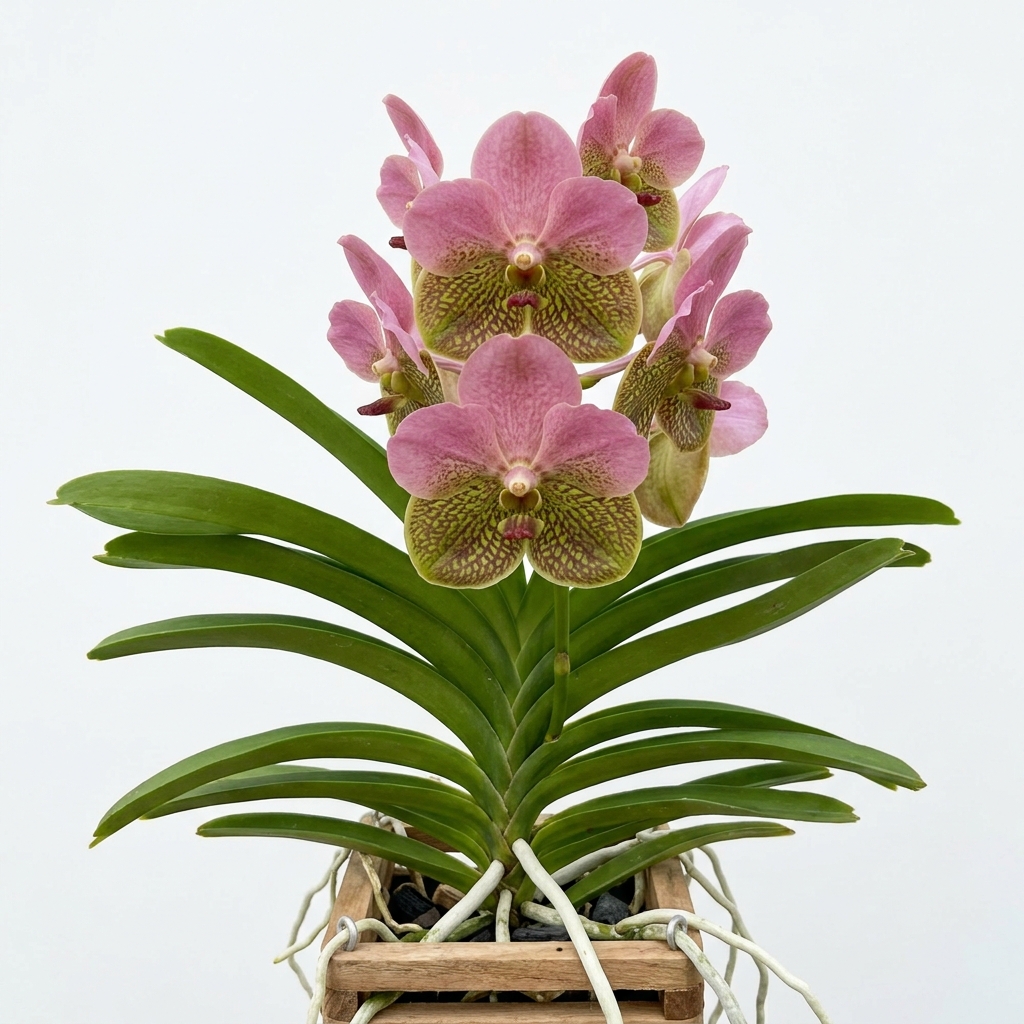
Vanda sanderiana, widely revered among orchid enthusiasts, is a magnificent epiphytic orchid celebrated for its large, flat, and strikingly patterned blossoms. Often referred to as the Queen of Orchids in its native regions, this species features a robust monopodial growth habit with strap-like leaves arranged in a dense, V-shaped fan. Cultivators highly prize this orchid for its commanding presence and its foundational role in modern warm-growing Vanda hybridization.
Successfully growing this exceptional orchid requires replicating its warm, humid, and highly illuminated natural habitat. While it can be demanding for beginners, mature specimens reward dedicated growers with spectacular, long-lasting floral displays that emerge from the leaf axils. Understanding its specific requirements for unrestricted root airflow and frequent hydration is key to unlocking its full blooming potential.
💡 Did You Know?
Vanda sanderiana is affectionately known as the Waling-waling in its native Philippines, where it is revered as a national treasure. It was discovered in 1882 by collector Carl Roebelin, who was sent by the famous nursery house of Sander. This species is so central to modern orchid breeding that nearly all large, flat-flowered Vanda hybrids in cultivation today carry its genetic legacy.
🌿 Botanical Overview
Vanda sanderiana is an epiphytic species native to the island of Mindanao in the Philippines, where it typically grows high in the canopy of old-growth trees. It shows a classic monopodial growth habit, meaning it grows upward from a single stem, producing thick, leathery, strap-shaped leaves in two alternating ranks. The plant’s extensive aerial root system is adapted to cling to tree bark while absorbing moisture and nutrients directly from the humid air.
In its natural habitat, this orchid experiences warm temperatures year-round, accompanied by high humidity and distinct wet and dry seasons. Because it lacks pseudobulbs for water storage, the plant relies on its thick, velamen-covered roots to quickly absorb water during daily rain showers. Cultivated specimens retain these ancestral traits, requiring growers to pay close attention to environmental parameters to mimic these tropical conditions.
🌸 Flower Characteristics
The flowers of Vanda sanderiana are among the largest and most visually arresting in the genus, often measuring up to four inches (ten centimeters) in diameter. The blooms are characterized by their flat, round presentation, with overlapping petals and sepals that create a nearly circular silhouette. The upper sepal and lateral petals are typically a delicate rose-pink or mauve, while the larger lateral sepals exhibit a striking greenish-yellow background heavily overlaid with intricate, dark reddish-brown veins and tessellations.
The lip, or labellum, is relatively small but highly detailed, featuring a spurless structure with a combination of yellow, red, and brown markings. Flowers are produced on stout, axillary inflorescences that emerge from between the upper leaves, with each spike bearing anywhere from seven to fifteen closely spaced blooms. This dense arrangement creates a magnificent, crowded cluster of flowers that stands out in any collection.
Fragrance & Bloom Profile
Unlike some of its close relatives, the fragrance of Vanda sanderiana is not consistently documented or highly pronounced. Many growers report that the flowers are virtually scentless, while others note a very faint, sweet, or spicy aroma that is only detectable during the warmest hours of midday. Because fragrance can be highly cultivar-dependent and influenced by environmental factors like temperature and humidity, it is generally grown for its visual splendor rather than its scent.
The blooms are exceptionally long-lasting, often remaining pristine on the plant for six to eight weeks under optimal conditions. To maximize the lifespan of the flowers, growers should avoid getting water directly on the petals, which can encourage fungal spotting, and maintain stable, moderate temperatures during the blooming cycle.
Parentage & Hybrid Lineage
Vanda sanderiana is a naturally occurring species rather than a man-made hybrid, but its impact on orchid hybridization is unparalleled. It is the primary ancestor of almost all modern, large-flowered warm-growing Vanda hybrids, prized by breeders for its ability to pass down its flat flower form, round shape, and intricate lateral sepal patterns.
In older taxonomic classifications, it was sometimes placed in its own genus, Euanthe, due to subtle structural differences in the flower lip. While some botanical references still list it as Euanthe sanderiana, modern horticultural circles almost universally treat it as a member of the genus Vanda. Its lineage is highly documented in thousands of registered grexes, making it a cornerstone of orchid breeding history.
🌱 Growing Conditions
To thrive, Vanda sanderiana demands bright, filtered light. While it can tolerate some direct morning sun, intense midday sunlight can scorch the foliage. A light level of 3,000 to 4,500 foot-candles is generally recommended, which is higher than that required for Phalaenopsis or Paphiopedilum orchids. Leaves should be a light, grassy green; dark green leaves indicate insufficient light, while yellowing or red-tinted leaves suggest excessive exposure.
💡 Care Tip
Always water your Vanda sanderiana early in the morning. This allows the foliage and the crown of the plant to dry completely before nightfall, significantly reducing the risk of crown rot and fungal leaf spot diseases.
Temperature management is critical, as this species is strictly warm-growing. Ideal daytime temperatures range from 80°F to 95°F (27°C to 35°C), with a slight drop at night to no lower than 65°F (18°C). High relative humidity of 70% to 80% is essential, coupled with strong, continuous air movement to prevent stagnant moisture from settling on the leaves and causing rot.
Watering, Feeding & Potting Media
Because Vanda sanderiana is typically grown bare-root in wooden slat baskets or suspended in the air, its watering needs are distinct from potted orchids. In warm weather, the roots should be thoroughly soaked daily—or even twice daily in dry climates—until they turn from a silvery-white to a vibrant green. This wetting-and-drying cycle mimics natural tropical rain showers and is vital for root health.
Feeding should be frequent but dilute. A balanced, water-soluble orchid fertilizer applied weekly at a quarter or half strength is highly effective during the active growing season. Because there is no potting medium to retain nutrients, the fertilizer solution must be sprayed directly onto the wet roots. If grown in a climate with lower humidity, a very coarse medium such as large charcoal chunks or chunky fir bark can be used in a highly aerated basket, but traditional potting soil or fine bark must be strictly avoided.
Blooming Season & Care Notes
The primary blooming season for Vanda sanderiana is typically in the late summer and autumn, although healthy plants can occasionally bloom at other times of the year. The development of the flower spike can take several weeks, during which stable environmental conditions are crucial. Sudden drops in temperature or drafts can cause the developing buds to yellow and drop prematurely.
Once the blooming cycle is complete, the old flower spike should be cut back close to the main stem using sterile cutting tools. Repotting or basket maintenance is best performed in the spring when active root growth resumes. Because Vandas dislike root disturbance, growers should avoid removing the plant from its original basket; instead, the entire old basket can be placed inside a larger one, filling any gaps with large charcoal or simply allowing the roots to grow freely through the slats.
⚠️ Common Issues
⚠️ Common Mistake
The most common mistake is potting this orchid in standard potting soil or fine bark. Vanda sanderiana roots require rapid wet-dry cycles and constant exposure to fresh air. Suffocating the roots in dense media will quickly lead to root rot and the eventual decline of the plant.
- Root Rot:
Occurs when roots are kept in stagnant, poorly aerated media or watered when already wet. - Bud Blast:
The premature drying and dropping of flower buds, often caused by sudden changes in temperature, low humidity, or drafts. - Dehydration:
Indicated by shriveled, leathery leaves and dry, brittle roots; usually solved by increasing watering frequency and humidity. - Leaf Spotting: Dark spots on leaves caused by water sitting on the foliage overnight; ensure watering is done early in the day.
- Pests:
Thrips, spider mites, and scale can infest the tight crevices between leaves and damage developing flower buds.
❓ Frequently Asked Questions
How do I encourage my Vanda sanderiana to rebloom?
To encourage reblooming, ensure the plant receives high light levels (bright, filtered light) and consistent warm temperatures. Regular, weak fertilization and maintaining high humidity are also key factors, as a stressed or light-deprived plant will prioritize survival over flowering.
Why are the flower buds on my Vanda dropping before opening?
This issue, known as bud blast, is typically caused by environmental stress. Common culprits include sudden temperature drops, dry indoor air, cold drafts, or moving the plant to a new location while the spike is developing. Keep conditions stable and humidity high during spike development.
Can I grow Vanda sanderiana indoors without a greenhouse?
Yes, but it requires effort. You can grow it near a bright south- or east-facing window, using a humidifier to maintain humidity levels above 60%. Daily root misting or soaking the roots in a bucket of water for 15-20 minutes is necessary to compensate for the dry indoor air.
What should healthy Vanda sanderiana roots look like?
Healthy roots should be thick, firm, and covered in a silvery-white velamen layer when dry. When watered, they should quickly turn a bright, translucent green. Dry, brown, or mushy roots indicate rot or severe dehydration and should be trimmed with sterile tools.
⭐ Final Growing Notes
While Vanda sanderiana presents a rewarding challenge for intermediate and advanced orchid hobbyists, its breathtaking floral display is well worth the effort. By prioritizing bright light, warm temperatures, high humidity, and daily watering with excellent root aeration, you can successfully cultivate this legendary orchid. Providing these consistent tropical conditions will ensure your plant remains a healthy, spectacular centerpiece of your collection for years to come.
🌱 Propagation Tip
Vanda orchids are monopodial and do not divide like sympodial orchids. Propagation is typically achieved when the plant naturally produces an offset, or keiki, at the base. Wait until the keiki has developed several strong roots of its own, at least three to four inches long, before carefully detaching it with a sterile blade.
⭐ Expert Advice
To maximize root health and bloom potential, grow this species bare-root in a wooden slat basket suspended from above. If your growing area lacks high , hang the basket over a wet gravel tray or mist the roots multiple times a day to keep them hydrated without suffocating them.




Leave A Comment