
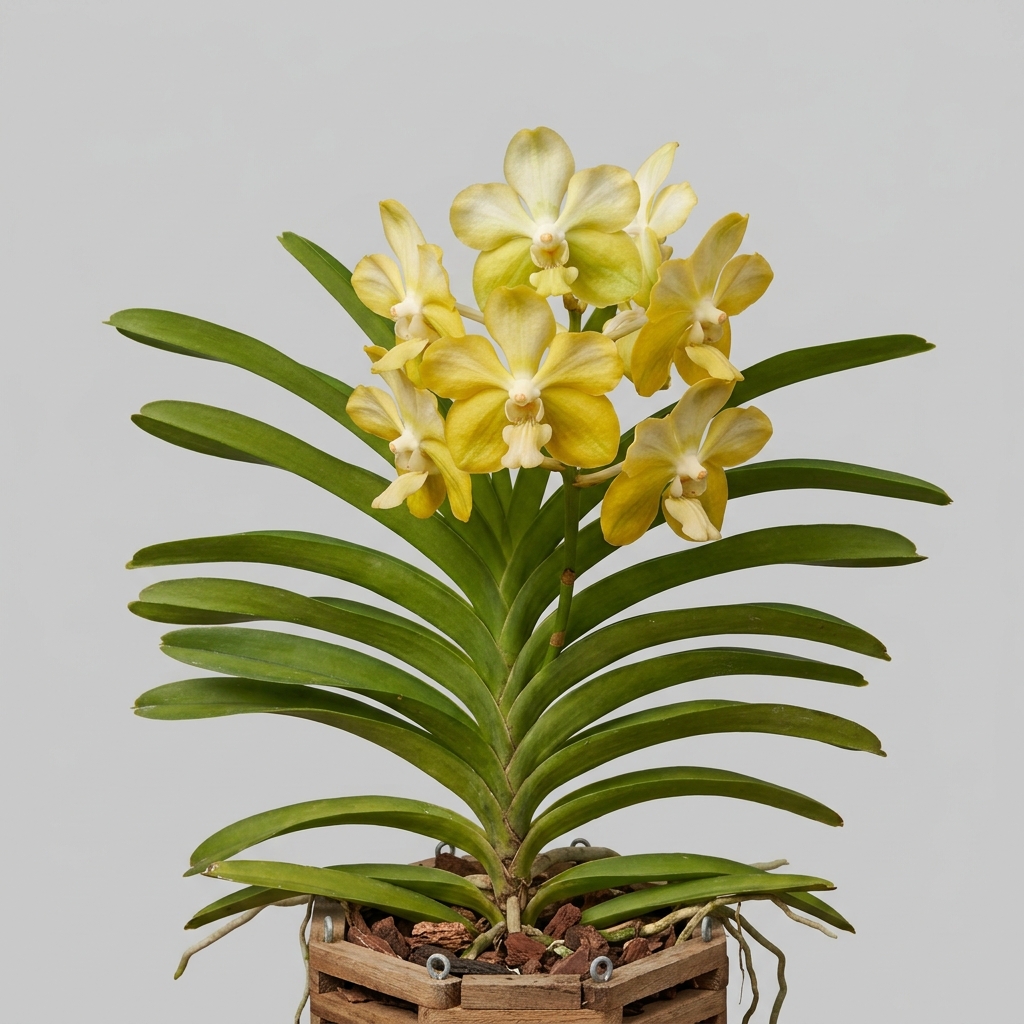
Vanda denisoniana is a highly prized monopodial epiphytic orchid species native to the montane forests of Southeast Asia, celebrated by collectors for its distinctively colored blossoms and exceptional growth habit. Unlike many of its bright blue or pink hybrid relatives, this species typically showcases elegant shades of sulfur yellow, cream, and greenish-white. Its robust, upright growth and strap-like leaves make it an architectural standout in any greenhouse or indoor growing space.
Growers particularly value Vanda denisoniana for its remarkable evening fragrance, which fills the surrounding air with a sweet, vanilla-like aroma. As a species that thrives in warm, humid environments with abundant air movement, it presents a rewarding challenge for intermediate to advanced orchid enthusiasts. When provided with bright, filtered light and consistent hydration, this orchid rewards its keeper with long-lasting, waxy blooms that epitomize tropical elegance.
💡 Did You Know?
Vanda denisoniana is named in honor of Lady Louisa Denison, an English orchid enthusiast of the nineteenth century. Unlike many modern hybrid Vandas that are bred for daytime visual appeal, this species retains its wild evolutionary adaptation of releasing its sweet, vanilla-like primarily at dusk to attract nocturnal moth pollinators in its native Southeast Asian forest canopies.
🌿 Botanical Overview
Vanda denisoniana is a medium-to-large epiphytic species native to the primary montane forests of Myanmar, Thailand, Laos, Vietnam, and Yunnan, China. In its natural habitat, it grows on tree trunks and branches at elevations ranging from 400 to 1,200 meters, where it is exposed to seasonal monsoons and high humidity. This evolutionary background dictates its preference for strong air circulation and distinct wet-dry cycles.
The plant features a classic monopodial growth habit, meaning it grows upward from a single stem. Thick, leathery, strap-shaped leaves are arranged in two alternating ranks, creating a fan-like appearance. The extensive, fleshy aerial root system is designed to cling to host trees and rapidly absorb moisture and nutrients from rain and morning dew.
🌸 Flower Characteristics
The inflorescence of Vanda denisoniana is an axillary raceme that emerges from the leaf axils, typically carrying between four and eight flowers. Each blossom measures approximately 4 to 6 centimeters in diameter and shows a waxy, durable texture. The petals and sepals are typically obovate, slightly reflexed, and range in color from pale greenish-yellow to a rich, golden sulfur hue.
The lip, or labellum, is a defining feature of this species. It is deeply trilobed, with a fiddle-shaped midlobe that often displays a lighter cream or white coloration, sometimes accented by faint brown or orange markings near the throat. The flowers are arranged loosely along the spike, presenting a graceful, natural display rather than the dense, crowded clusters seen in some modern Vanda hybrids.
Fragrance & Bloom Profile
One of the most captivating attributes of Vanda denisoniana is its intense fragrance. While many orchids emit scent during the peak daylight hours to attract diurnal pollinators, this species is primarily fragrant from late afternoon through the night. The scent is commonly described as a rich blend of sweet vanilla, musk, and subtle citrus undertones.
The blooms are exceptionally long-lasting, often remaining pristine for six to eight weeks under optimal environmental conditions. To maximize the duration of the bloom cycle, growers should avoid getting water directly on the open flowers, as excess moisture can encourage fungal spotting and premature senescence.
Parentage & Hybrid Lineage
As a naturally occurring species rather than a man-made hybrid, Vanda denisoniana possesses a pure genetic lineage that has been highly influential in orchid breeding. It has been widely utilized by hybridizers to introduce yellow coloration, compact growth tendencies, and sweet fragrance into modern Vanda and Ascocenda grexes.
While its exact historical collection details can vary across older botanical literature, it remains a recognized and stable species within the genus Vanda. When purchasing this orchid, growers should look for line-bred specimens, which often exhibit superior vigor, flatter flower form, and more intense coloration than wild-collected imports.
🌱 Growing Conditions
To cultivate Vanda denisoniana successfully, replicating its native canopy environment is essential. It requires high light levels, equivalent to bright, filtered sunlight. While it can tolerate some direct morning sun, intense midday rays can scorch the foliage, so a light sheer curtain or shade cloth is recommended for southern or western exposures.
💡 Care Tip
Ensure your Vanda denisoniana receives excellent air movement. Hanging the basket near an open window, greenhouse fan, or ceiling fan prevents moisture from pooling in the leaf axils, which drastically reduces the risk of crown rot and fungal leaf spot.
Temperature management should lean toward warm to intermediate conditions. Ideal daytime temperatures range from 75°F to 85°F (24°C to 29°C), with a nighttime drop to around 60°F to 65°F (15°C to 18°C). High relative humidity of 70% to 80% is crucial, paired with constant, gentle air movement to prevent stagnant moisture from settling on the leaves and roots.
Watering, Feeding & Potting Media
Due to their epiphytic nature, the roots of Vanda denisoniana must dry rapidly after watering. Cultivating them bare-root in slatted wooden or plastic baskets is the preferred method among experienced growers. This setup allows the thick aerial roots to hang freely, mimicking their natural arboreal habitat.
Watering frequency depends heavily on the growing environment. In warm summer months, daily or even twice-daily misting or soaking may be necessary. During the cooler winter rest period, watering should be scaled back, allowing the plant to dry out completely between light waterings. Feed weekly with a balanced, water-soluble orchid fertilizer diluted to quarter or half strength, flushing the root system with pure water periodically to prevent salt buildup.
Blooming Season & Care Notes
Vanda denisoniana typically initiates its blooming cycle in the spring or early summer, triggered by the natural increase in day length and ambient temperatures. Once the flower spike begins to emerge from the leaf axil, it is critical to maintain stable environmental conditions. Avoid moving the plant or changing its orientation to the light source, as this can cause the developing buds to twist or blast.
After the flowers have faded, the spent spike should be cut back close to the main stem using a sterilized cutting tool. Repotting or basket maintenance is best performed immediately after the blooming cycle concludes, coinciding with the onset of active new root growth.
⚠️ Common Issues
⚠️ Common Mistake
The most common mistake is potting Vanda denisoniana in standard, fine-grade orchid potting soil or dense moss. Their thick, spongy aerial roots require rapid drying and constant exposure to air. Keeping them suffocated in dense media will quickly lead to root rot and plant decline.
- Root Rot: Caused by stagnant water or compacted potting media that prevents adequate airflow to the root zone.
- Leaf Spotting: Fungal or bacterial pathogens can cause black or brown spots on the foliage, often due to high humidity without sufficient air movement.
- Bud Blast: Premature dropping or drying of flower buds, typically triggered by sudden temperature fluctuations, low humidity, or drafts.
- Dehydration: Indicated by shriveled, wrinkled leaves and dry, brittle roots, usually resulting from underwatering or low ambient humidity.
- Pests: Mealybugs, scale, and spider mites can occasionally infest the leaf axils; treat promptly with insecticidal soap or horticultural oil.
❓ Frequently Asked Questions
How do I encourage my Vanda denisoniana to bloom?
Consistent bright, filtered light is the most critical factor for blooming. Ensure the plant receives high-intensity light just short of burning the leaves, along with a distinct temperature drop of 10 to 15 degrees Fahrenheit between day and night to trigger spike development.
Can I grow Vanda denisoniana indoors without a greenhouse?
Yes, it can be grown indoors, but it requires careful attention to humidity and light. Placing the basket in a bright south- or west-facing window and using a humidifier or humidity tray, along with a small fan for air circulation, will help replicate greenhouse conditions.
Why are the lower leaves of my Vanda denisoniana turning yellow and falling off?
Occasional loss of the oldest, lowest leaves is a natural part of the aging process. However, rapid leaf drop can indicate severe dehydration, root loss, or a sudden drop in temperature. Inspect the root system immediately to ensure it is healthy and active.
What is the best way to water a bare-root Vanda denisoniana?
Thoroughly spray or soak the entire root system until the roots turn from a silvery-white to a vibrant green color. In dry indoor environments, soaking the roots in a bucket of room-temperature water for 15 to 20 minutes daily is highly effective.
⭐ Final Growing Notes
Cultivating Vanda denisoniana offers a deeply rewarding experience for any orchid enthusiast willing to accommodate its specific light and moisture requirements. Its striking sulfur-yellow blossoms, combined with a captivating nocturnal fragrance, make it a standout species that elevates any collection. By focusing on robust air circulation, high humidity, and a free-draining root environment, you can enjoy the timeless tropical beauty of this Southeast Asian treasure for many years to come.
🌱 Propagation Tip
Monopodial orchids like Vanda denisoniana do not divide like sympodial orchids. Propagation is typically achieved by waiting for the plant to naturally produce a basal offset, or keiki. Allow the keiki to develop several robust roots of its own, at least three to four inches long, before carefully detaching it with a sterile blade.
⭐ Expert Advice
To maximize root health and overall vigor, practice the "soak and dry" method. Spray the roots until they turn completely green, then allow them to dry back to a silvery-white color before again. This cycle mimics natural tropical rain showers and keeps the roots active and functional.




Leave A Comment