
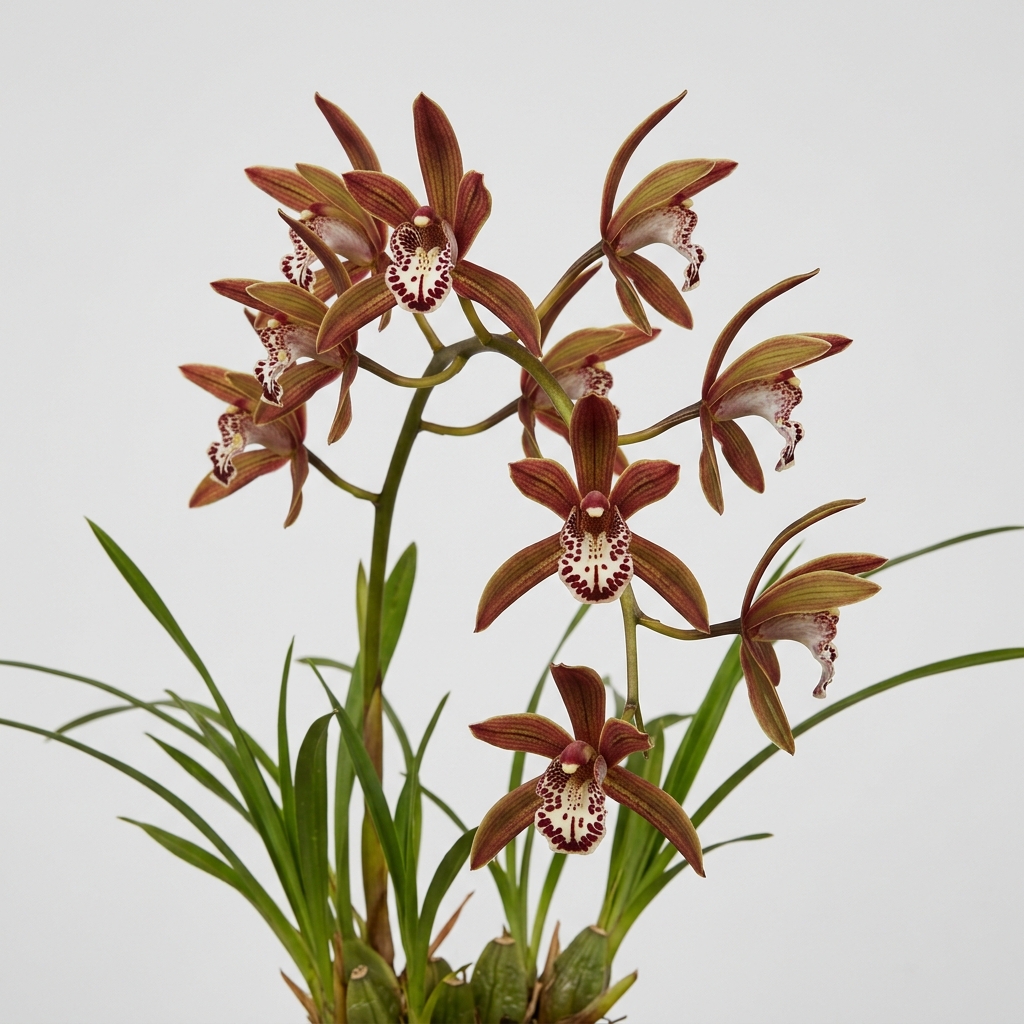
Cymbidium erythraeum is a highly prized cool-growing orchid species native to the high-altitude montane forests of the Himalayas and parts of Southeast Asia. Renowned for its elegant, arching inflorescences and slender, grass-like foliage, this species brings a refined, natural aesthetic to any collection. Unlike many mass-market hybrids, it retains the wild, graceful charm of its native habitat, making it a favorite among species collectors and intermediate growers alike.
Growers value this orchid for its striking, narrow-petaled flowers that present a dramatic contrast between olive-green or reddish-brown segments and a heavily spotted labellum. Its relative ease of care under cool-temperate conditions, combined with its long-lasting autumn and winter blooms, makes it an exceptional addition to shade houses, cool greenhouses, or bright indoor growing spaces that experience seasonal temperature drops.
💡 Did You Know?
Cymbidium erythraeum belongs to the Cymbidium orchid group, where flower presentation is often just as important as . White-flowered cultivars are especially valued indoors because their pale blooms reflect well and pair easily with many home, greenhouse, and display settings.
🌿 Botanical Overview
Cymbidium erythraeum is primarily an epiphytic or lithophytic orchid species, naturally adapted to growing on moss-covered tree trunks or damp rock faces in wet, mountainous regions. It is characterized by its tightly clustered, narrow, and slightly compressed pseudobulbs, which are enveloped by the bases of its leaves. The foliage is notably thin, linear, and arching, forming a dense, grassy clump that remains attractive even when the plant is not in bloom.
In its native habitats, which range from northeastern India and Nepal through southwestern China and Vietnam, this orchid experiences distinct seasonal shifts. It thrives in high-altitude environments where summers are wet and humid, while winters are significantly cooler and drier. Replicating these seasonal rhythms is the key to maintaining a healthy specimen and encouraging regular, robust flowering cycles in cultivation.
🌸 Flower Characteristics
The blossoms of Cymbidium erythraeum are a masterclass in elegant proportion. The flowers are typically medium-sized, measuring between 5 to 8 centimeters across, and are carried on arching or slightly pendulous inflorescences that can bear anywhere from 5 to 15 blooms. The sepals and petals are narrow, lanceolate, and gracefully tapered, presenting a wilder, more delicate form than the round, blocky shapes of modern complex hybrids.
Coloration is highly distinctive, featuring base tones of olive green, yellow-green, or light reddish-brown, decorated with fine, dark longitudinal stripes. The true highlight of the flower is the labellum, or lip. The lip is typically white or pale cream, adorned with striking, vivid red or purple spots and margins, creating an eye-catching contrast that draws pollinators and admirers alike.
Fragrance & Bloom Profile
This species is celebrated for its delicate, pleasing fragrance. The scent is typically described as sweet with subtle spicy undertones, becoming most noticeable during the warmer, brighter hours of the morning and early afternoon. The fragrance is clean and refreshing, never overpowering, adding an extra layer of sensory appeal to its visual beauty.
The blooms are exceptionally long-lasting, a characteristic trait of the Cymbidium genus. When kept in cool, stable conditions free from drafts, a single flower spike can remain pristine for six to eight weeks. The flowers open sequentially along the spike, extending the overall display period and providing a welcome splash of color during the darker autumn and winter months.
Parentage & Hybrid Lineage
Because Cymbidium erythraeum is a naturally occurring species rather than a man-made hybrid, it does not have a parentage lineage. It is a distinct botanical entity that has evolved over millennia to suit its specific ecological niche. In common grower references, its historical discovery and exact collection records can vary, but its status as a true species is universally recognized.
In orchid breeding, this species has occasionally been utilized by hybridizers aiming to introduce cool-growing tolerance, slender foliage, and highly patterned, spotted lips into modern Cymbidium grexes. However, many collectors prefer to grow the pure species to appreciate its natural, unaltered form, which stands in elegant contrast to the heavy, upright commercial hybrids commonly found in retail nurseries.
🌱 Growing Conditions
To cultivate Cymbidium erythraeum successfully, growers must provide bright, filtered light. It enjoys conditions similar to those preferred by cattleya orchids, requiring around 2,000 to 3,000 foot-candles of light. The foliage should ideally be a light, grassy green; dark green leaves suggest the plant is receiving insufficient light, which will severely limit its ability to produce flower spikes.
💡 Care Tip
For best results, grow Cymbidium erythraeum in bright filtered with steady and gentle airflow. Avoid placing the plant in harsh midday sun, but do not keep it in a dark corner; weak is one of the most common reasons cultivated orchids refuse to rebloom.
Temperature management is the most critical aspect of caring for this cool-growing species. During the spring and summer, daytime temperatures can range from 70 to 80 degrees Fahrenheit, but night temperatures should ideally drop to 55 to 60 degrees Fahrenheit. In late summer and autumn, a more pronounced night drop down to 50 to 55 degrees Fahrenheit is essential to trigger the development of flower spikes. Constant, gentle air movement is also vital to prevent fungal pathogens from taking hold on the thin foliage.
Watering, Feeding & Potting Media
During its active growing season in spring and summer, Cymbidium erythraeum requires frequent watering to keep the potting medium evenly moist but never waterlogged. As a rule of thumb, water the plant thoroughly just as the medium begins to dry. In the winter, after flowering has finished, reduce watering significantly, allowing the medium to dry out more between applications, though the pseudobulbs should never be allowed to shrivel severely.
Feed the plant weekly with a balanced, water-soluble orchid fertilizer diluted to one-quarter or one-half strength during the active growing season. To prevent mineral buildup, flush the pot thoroughly with pure water once a month. The ideal potting medium is a well-draining, moisture-retentive mix. A combination of medium-grade fir bark, perlite, and a small amount of chopped sphagnum moss or peat moss works exceptionally well to maintain the light, airy moisture these roots crave.
Blooming Season & Care Notes
The primary blooming season for Cymbidium erythraeum spans from mid-autumn through early winter. As the flower spikes begin to emerge from the base of the pseudobulbs in late summer, it is crucial to maintain stable conditions. Avoid rotating the pot or moving the plant to a different location once the buds are developing, as sudden changes in light direction or temperature can cause the buds to yellow and drop, a phenomenon known as bud blast.
Repotting should be performed only when necessary, typically every two to three years in the spring, immediately after the flowering cycle has concluded. This species resents root disturbance, so select a pot that allows for two years of future growth. When repotting, gently remove old, decomposed media, trim any dead or mushy roots, and secure the plant firmly in its new container to prevent wobbling, which can damage emerging root tips.
⚠️ Common Issues
⚠️ Common Mistake
The most common mistake is by calendar instead of root and potting-media condition. Cymbidium roots need moisture and air at the same time, so constantly wet bark or sphagnum can lead to root loss even when the leaves still look healthy.
- Root rot: Caused by overwatering or compacted, poorly draining potting media that suffocates the root system.
- Leaf tip burn: Often a result of excessive fertilizer salt accumulation or low ambient humidity.
- Bud blast: The premature dropping of flower buds, usually triggered by sudden temperature spikes, dry drafts, or moving the plant while in spike.
- Spider mites and scale: Pests that can thrive on the undersides of the thin, grassy leaves, particularly in dry, stagnant air.
❓ Frequently Asked Questions
How do I trigger my Cymbidium erythraeum to bloom?
To initiate flower spikes, this orchid requires a distinct drop in night temperatures during the late summer and early autumn. Ensure night temperatures fall to between 50 and 55 degrees Fahrenheit for several weeks, while maintaining bright, filtered daytime light.
Can I grow Cymbidium erythraeum indoors?
Yes, it can be grown indoors if placed near a bright, cool window, such as an east- or south-facing exposure with sheer curtains. However, providing the necessary cool night drop can be challenging indoors, so placing the plant outdoors in a shaded area during summer and autumn is highly recommended.
What should I do if the pseudobulbs start to shrivel?
Slight shriveling of older pseudobulbs can be normal during the winter rest period. However, severe shriveling during the active growing season indicates dehydration, which may be caused by underwatering or, conversely, root rot that has destroyed the roots’ ability to absorb moisture.
How often should I divide my Cymbidium erythraeum?
Divisions should be made sparingly. This species blooms much more reliably and spectacularly when grown into a large, specimen-sized clump. If division is necessary, ensure each new section has at least three to four healthy, leafy pseudobulbs to support new growth.
⭐ Final Growing Notes
Cymbidium erythraeum is a rewarding and elegant species that brings the natural beauty of the Himalayan cloud forests into the home or greenhouse. While its temperature requirements demand a bit more attention than standard tropical orchids, the reward of its gracefully arching, fragrant, and long-lasting autumn blooms makes it an incredibly satisfying project for any dedicated grower. By providing bright light, cool nights, and consistent moisture, you can enjoy this botanical treasure for many years to come.
🌱 Propagation Tip
Propagation should be approached patiently. Most home growers should wait for natural keikis or divide only mature, healthy plants when the orchid type allows it. Never remove a young growth until it has strong roots and enough leaves to support itself away from the parent plant.
⭐ Expert Advice
Repot after flowering when fresh root tips begin to appear. This timing helps the plant anchor quickly into new bark or sphagnum and reduces stress, especially for orchids grown indoors where airflow, , and drying speed can change from season to season.




Leave A Comment