
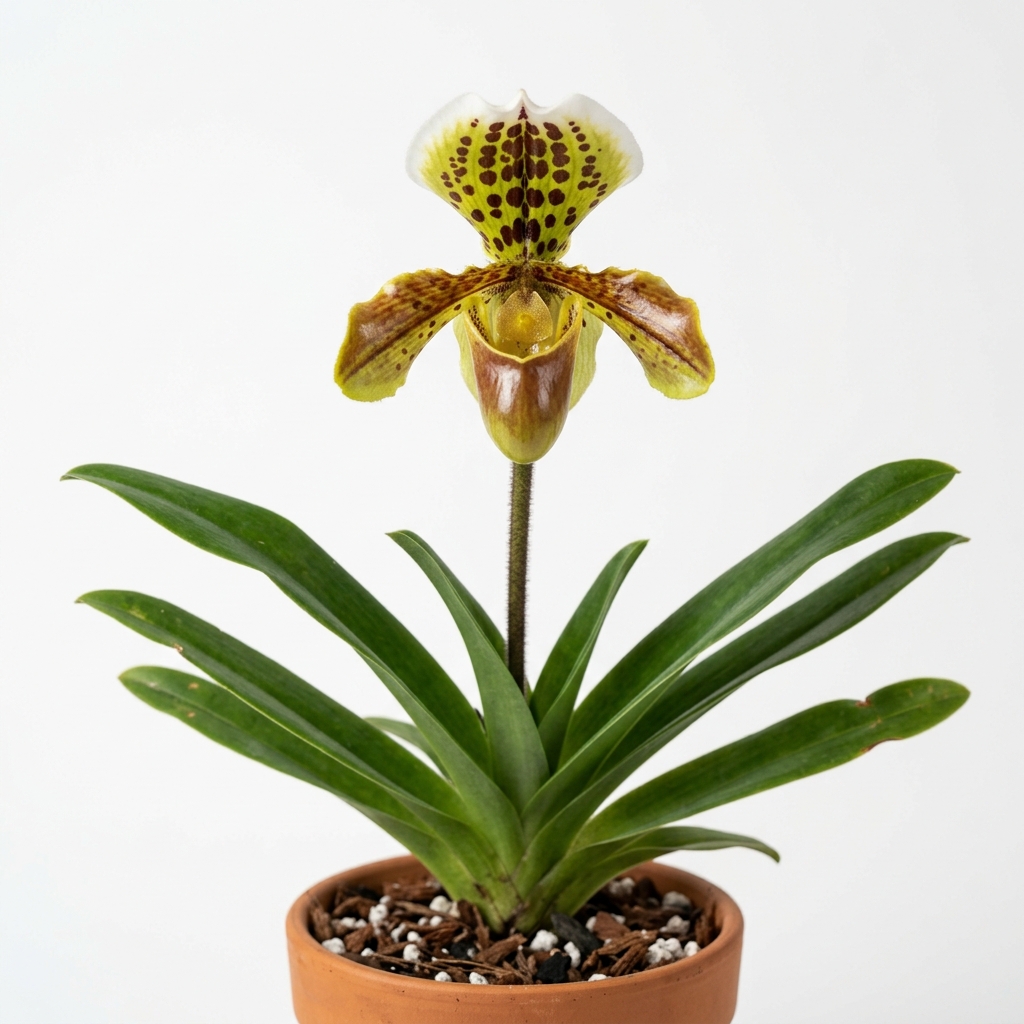
Paphiopedilum insigne, commonly known as the slipper orchid, is one of the most historically significant and widely cultivated species within the Paphiopedilum genus. Highly valued by indoor growers and orchid enthusiasts alike, this terrestrial orchid is celebrated for its distinctive, pouch-shaped flowers and remarkably resilient growth habit. Its ease of culture and tolerance for cooler temperatures make it an exceptional choice for both novice hobbyists and seasoned collectors seeking a reliable, long-lasting winter bloomer.
Characterized by its fan-shaped growth of strap-like, deep green leaves, this species produces striking, varnished-looking flowers that command attention. The blooms feature a prominent, yellowish-green dorsal sepal heavily spotted with rich mahogany, contrasted by a glossy, slipper-shaped pouch. This classic aesthetic has made the species a cornerstone of modern slipper orchid hybridization, lending its robust genetics and distinctive form to countless award-winning grexes.
💡 Did You Know?
Paphiopedilum insigne belongs to the Paphiopedilum orchid group, where flower presentation is often just as important as . White-flowered cultivars are especially valued indoors because their pale blooms reflect well and pair easily with many home, greenhouse, and display settings.
🌿 Botanical Overview
Paphiopedilum insigne is native to the subtropical forests of the eastern Himalayas, typically growing in leaf litter on limestone cliffs or steep slopes. This terrestrial or lithophytic growth habit dictates its preference for a well-drained, moisture-retentive substrate that mimics the forest floor. Unlike epiphytic orchids, it lacks pseudobulbs, meaning it relies on its thick, fleshy roots and fan-shaped foliage to store moisture and nutrients.
The vegetative growth consists of strap-shaped leaves that are uniformly green, lacking the mottled patterning found in some of its warm-growing relatives. Each growth fan produces a single, erect inflorescence from the center, which can reach up to twelve inches in height. The entire plant maintains a compact footprint, making it highly suitable for windowsill cultivation or small greenhouse spaces.
🌸 Flower Characteristics
The blossoms of Paphiopedilum insigne are renowned for their glossy, almost waxy texture, which gives them a varnished appearance. Each flower typically measures three to four inches across, presenting a bold visual display. The most striking feature is the large, rounded dorsal sepal, which is pale green or yellow with a broad white margin, heavily decorated with raised, dark brown or purple spots.
Flanking the dorsal sepal are two lateral petals that spread horizontally or slightly downward, often displaying wavy margins and a brownish-yellow hue with subtle veining. The labellum, or lip, is modified into a deep, cup-like pouch that resembles a slipper, designed in nature to aid in pollination. This pouch is typically a glossy, yellowish-green shaded with bronze or mahogany, completing a highly structured and architectural floral presentation.
Fragrance & Bloom Profile
While Paphiopedilum insigne is highly prized for its visual appeal, fragrance is not consistently documented or prominent in this species. The flowers are generally considered unscented, directing all of their evolutionary energy into their striking visual display and long-lasting structure.
What the blooms lack in scent, they more than make up for in longevity. A single flower can remain pristine on the plant for six to eight weeks, and sometimes even longer under cool, stable conditions. The sturdy, pubescent flower spikes hold the blooms well above the foliage, ensuring they remain highly visible throughout their winter blooming cycle.
Parentage & Hybrid Lineage
As a pure species, Paphiopedilum insigne has no hybrid parentage, but its historical role in orchid breeding is monumental. It was one of the earliest slipper orchids introduced to European cultivation in the early nineteenth century, quickly becoming a primary parent in early hybridizing efforts.
Its genetics are woven into the ancestry of thousands of modern complex Paphiopedilum hybrids, often referred to as bulldog paphs. Breeders have historically selected this species to introduce cold tolerance, robust growth habits, and the characteristic spotted dorsal sepal to newer cultivars. While many complex hybrids exist today, the pure species remains highly sought after for its classic, wild elegance.
🌱 Growing Conditions
To cultivate Paphiopedilum insigne successfully, growers should aim to replicate its native cool, shaded mountain environment. It thrives in low to medium light conditions, similar to those preferred by Phalaenopsis orchids. Direct sunlight should be avoided, as it can easily scorch the thin, strap-like leaves; instead, provide bright, filtered light from an east-facing window or under shaded greenhouse benches.
💡 Care Tip
For best results, grow Paphiopedilum insigne in bright filtered with steady and gentle airflow. Avoid placing the plant in harsh midday sun, but do not keep it in a dark corner; weak is one of the most common reasons cultivated orchids refuse to rebloom.
Temperature control is crucial for triggering blooms. This species prefers cool to intermediate temperatures, ideally ranging from 50°F to 60°F at night and 65°F to 75°F during the day. A distinct drop in night temperatures during the early autumn is highly beneficial, as it signals the plant to initiate flower spikes. Adequate airflow is also essential to prevent stagnant air around the foliage.
Watering, Feeding & Potting Media
Because Paphiopedilum insigne lacks water-storing pseudobulbs, it requires a consistent moisture regime. The potting medium should never be allowed to dry out completely, nor should it remain soggy or waterlogged. Water the plant thoroughly when the top half-inch of the medium begins to feel dry, using pure water such as rainwater, distilled water, or reverse osmosis water whenever possible.
A well-draining potting mix is vital to prevent root rot. A blend of fine-grade fir bark, perlite, charcoal, and a small amount of chopped sphagnum moss works exceptionally well. Feed the orchid with a balanced, highly diluted orchid fertilizer every second or third watering during the active growing season, flushing the pot with pure water periodically to prevent salt buildup.
Blooming Season & Care Notes
The primary blooming season for Paphiopedilum insigne spans from late autumn through winter. As the days shorten and temperatures cool in the autumn, keep a close eye on the center of the leaf fans for the emergence of the fuzzy flower spikes. Once the spike begins to grow, avoid changing the plant’s orientation relative to the light source, as this can cause the developing bud to twist or grow at an awkward angle.
After the bloom fades, the flower spike can be cut down to the base of the foliage. Repotting is best done in the spring, just as new vegetative growths begin to emerge. This species generally prefers to be slightly under-potted and should only be moved to a larger container when the roots have completely filled the current pot or when the potting medium begins to break down, typically every one to two years.
⚠️ Common Issues
⚠️ Common Mistake
The most common mistake is by calendar instead of root and potting-media condition. Paphiopedilum roots need moisture and air at the same time, so constantly wet bark or sphagnum can lead to root loss even when the leaves still look healthy.
- Root Rot: Caused by overwatering or compacted, poorly draining potting media, leading to mushy, brown roots and limp foliage.
- Leaf Scorch: Appears as bleached or dry, brown patches on the leaves, resulting from exposure to direct, intense sunlight.
- Bud Blast: The premature drying and dropping of flower buds before opening, often triggered by sudden temperature fluctuations, low humidity, or drafty conditions.
- Mealybugs and Scale: Common pests that hide in the tight crevices of the leaf fans and under the flower bracts; treat promptly with insecticidal soap or horticultural oil.
- Dehydration: Indicated by wrinkled, dull leaves and slow growth, occurring when the potting medium is allowed to dry out too much between waterings.
❓ Frequently Asked Questions
How do I get my Paphiopedilum insigne to rebloom?
To encourage reblooming, ensure the plant experiences a distinct drop in night temperatures down to 50°F to 55°F for several weeks in the early autumn. This temperature drop, combined with slightly reduced watering and shorter day lengths, mimics its natural seasonal cycle and triggers spike initiation.
Why are the leaf tips of my slipper orchid turning brown?
Brown leaf tips are commonly caused by a buildup of mineral salts from tap water or fertilizer in the potting medium. To resolve this, flush the pot thoroughly with pure rainwater or distilled water, and ensure you are using a highly diluted fertilizer solution. Low humidity can also contribute to dry, brown tips.
Can Paphiopedilum insigne be grown under LED lights?
Yes, this species adapts exceptionally well to artificial lighting. Place the plant under moderate-intensity LED grow lights, keeping them at a safe distance to prevent heat stress or leaf scorch. Aim for a photoperiod of 12 to 14 hours during the active growing season, reducing it slightly in autumn to simulate natural seasonal changes.
How do I know when it is time to repot my orchid?
The best time to repot is in the spring, immediately after flowering has finished and new growths are starting to appear. Repot if the potting medium has begun to decompose and hold too much water, or if the plant has outgrown its container, which typically occurs every 12 to 24 months.
⭐ Final Growing Notes
Paphiopedilum insigne remains a timeless classic in the orchid world, offering a perfect blend of historical significance, unique floral architecture, and straightforward care. By providing cool temperatures, consistent moisture, and filtered light, growers can enjoy its striking, varnished blooms year after year. Whether displayed on a cool windowsill or integrated into a diverse greenhouse collection, this resilient slipper orchid is a rewarding addition that continues to captivate generations of plant enthusiasts.
🌱 Propagation Tip
Propagation should be approached patiently. Most home growers should wait for natural keikis or divide only mature, healthy plants when the orchid type allows it. Never remove a young growth until it has strong roots and enough leaves to support itself away from the parent plant.
⭐ Expert Advice
Repot after flowering when fresh root tips begin to appear. This timing helps the plant anchor quickly into new bark or sphagnum and reduces stress, especially for orchids grown indoors where airflow, , and drying speed can change from season to season.




Leave A Comment