
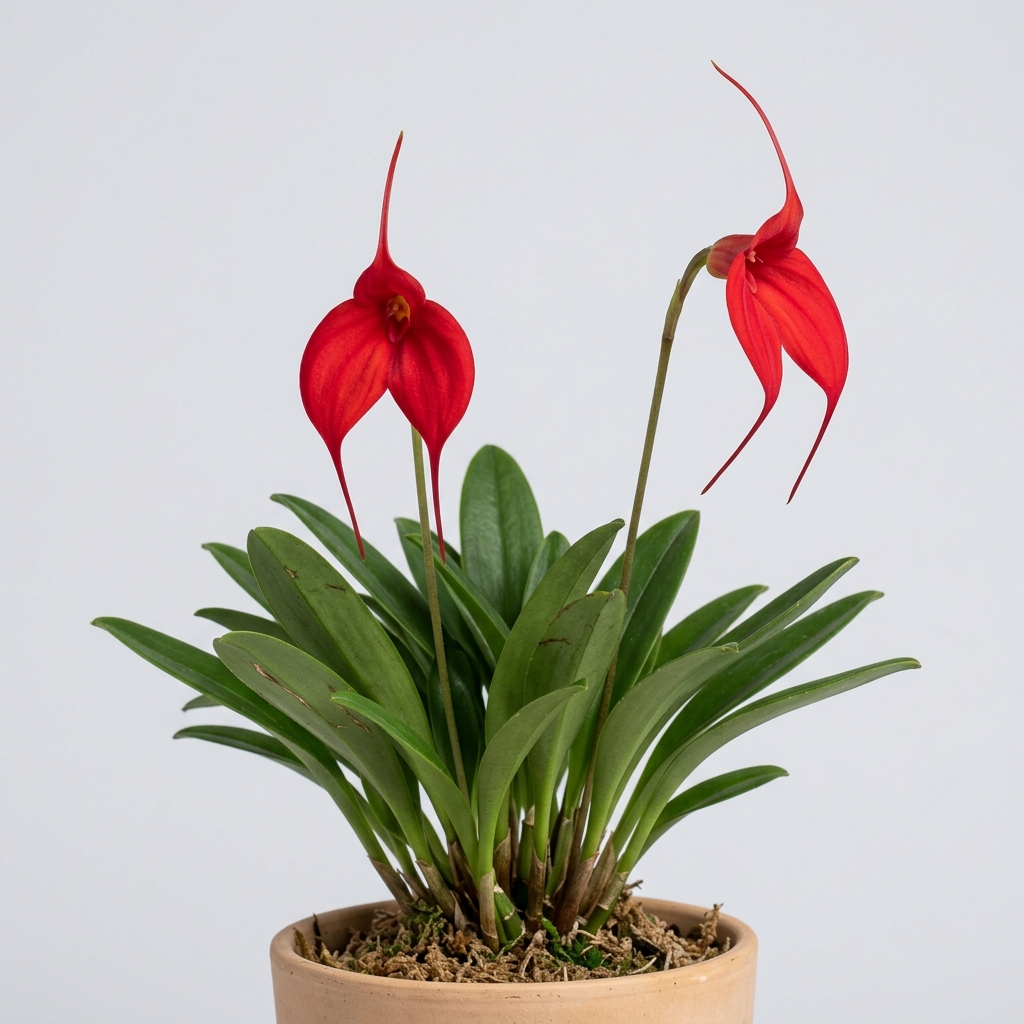
Masdevallia coccinea is a highly prized cool-growing orchid native to the high-altitude cloud forests of the Colombian Andes. Renowned for its striking, intensely colored blooms that rise elegantly above the foliage, this species is a favorite among intermediate and advanced collectors who can replicate its specific environmental needs. The plant’s compact size and dramatic floral presentation make it a standout addition to any specialized cool-house collection.
The plant features a tufted growth habit with thick, leathery leaves that lack pseudobulbs, making it entirely reliant on consistent moisture and high humidity. Its brilliant flowers, which range from vibrant magenta and scarlet to soft pink and yellow, present a unique architectural form. This combination of lush, grass-like foliage and vivid, long-lasting blossoms brings a touch of montane elegance to dedicated growing spaces.
💡 Did You Know?
In its native Colombian habitat, Masdevallia coccinea grows on exposed grassy slopes and rocky cliffs at elevations up to 3,000 meters. The bright, vivid colors of its flowers are adapted to attract hummingbirds, which serve as its primary pollinators in the misty, high-altitude cloud forests.
🌿 Botanical Overview
Masdevallia coccinea is native to the eastern cordillera of the Colombian Andes, where it thrives at elevations between 2,000 and 3,000 meters. In these montane regions, the plants are subjected to near-constant mist, cool temperatures, and brisk winds. They typically grow as terrestrials in organic litter or as lithophytes on damp, moss-covered rock faces, fully adapted to a life of high humidity and continuous moisture.
Structurally, this orchid lacks the water-storing pseudobulbs common to many other orchid genera. Instead, it produces a dense, tufted clump of erect, leathery, dark green leaves that arise from short ramicauls. Because the plant has no anatomical mechanism to store water or withstand prolonged drought, its root system must remain in a state of constant, light moisture, supported by a highly humid atmosphere.
🌸 Flower Characteristics
The blossoms of Masdevallia coccinea are visually arresting and structurally unique. The actual petals and lip are tiny and hidden deep within the flower, while the showy portion consists of three fused sepals. These sepals form a narrow, curved tube at the base before expanding into broad, dramatic lobes that taper into slender, tail-like tips known as caudae. This gives the bloom a striking, wind-swept appearance.
Each flower is borne singly on a slender, erect inflorescence that can reach up to 15 inches (38 cm) in height, lifting the brilliant bloom far above the foliage. The colors are exceptionally vivid, ranging from intense magenta and neon pink to deep scarlet, and occasionally pure white or bright yellow. The glossy texture of the sepals catches the light beautifully, making a single bloom highly visible from a distance.
Fragrance & Bloom Profile
While some members of the genus emit subtle scents to attract specific insect pollinators, a distinct fragrance is not consistently documented for Masdevallia coccinea. Most growers report that the flowers are virtually odorless, relying entirely on their brilliant, saturated coloration to attract hummingbirds in their native habitat.
What the flowers lack in scent, they make up for in longevity. A single bloom can remain pristine on the plant for several weeks, provided the growing environment remains cool and humid. The main blooming flush occurs in the spring, though healthy, well-established specimens may occasionally produce sporadic flowers at other times of the year.
Parentage & Hybrid Lineage
As a naturally occurring species, Masdevallia coccinea does not have a hybrid parentage. However, its exceptional color intensity and upright flower spikes have made it a cornerstone of Masdevallia hybridizing. It has been used extensively to breed vibrant red, pink, and purple intergeneric and intrageneric hybrids, passing on its robust stem strength and vivid pigmentation to its offspring.
In cultivation, several select color forms and clonal cultivars have been propagated and awarded by orchid societies worldwide. While the exact lineage of some highly select commercial clones can be complex, they all trace their ancestry back to the wild populations of the Colombian Andes, preserved through careful line breeding and tissue culture by dedicated nursery specialists.
🌱 Growing Conditions
Replicating the cool, misty environment of the Andes is the key to success with Masdevallia coccinea. Daytime temperatures should ideally remain between 65°F and 72°F (18°C to 22°C), with a mandatory nighttime drop to 50°F to 55°F (10°C to 13°C). Temperatures consistently exceeding 80°F (27°C) can quickly stress the plant, leading to leaf drop and decline.
💡 Care Tip
Always maintain active air circulation around your orchid. Cool, damp conditions are essential, but stagnant air quickly invites fungal pathogens. A small, continuous fan nearby can prevent leaf spotting and keep the root zone healthy.
Light levels should be kept in the low to medium range, similar to what is recommended for Phalaenopsis or Miltoniopsis. Bright, filtered light is ideal, but direct, hot sunlight must be avoided at all costs. To prevent fungal issues in this cool, damp environment, continuous and gentle air movement is absolutely vital; stagnant air is one of the primary causes of cultivation failure.
Watering, Feeding & Potting Media
Watering is the most critical aspect of caring for Masdevallia coccinea. The potting medium must remain evenly moist at all times and should never be allowed to dry out completely. Because the fine, fiber-like roots are highly sensitive to mineral salts and chlorine, growers should exclusively use pure water sources, such as rainwater, distilled water, or reverse osmosis water.
Feeding should be done with extreme caution. Use a balanced, high-quality orchid fertilizer diluted to one-quarter or even one-eighth of the recommended strength, applying it every second or third watering during the active growing season. For potting media, a mix of high-quality New Zealand sphagnum moss or a very fine bark mix with added perlite works best, providing excellent moisture retention while allowing essential oxygen to reach the roots.
Blooming Season & Care Notes
The primary blooming season for Masdevallia coccinea spans from late winter through early summer, with the peak display occurring in mid-spring. During this time, ensure that humidity remains high (70% to 90%) to support the developing flower buds. Once a flower spike has finished blooming and begins to turn yellow or brown, it can be cut back to the base of the leaf stem.
Repotting should be performed every one to two years, preferably in the early autumn when the weather cools down. This timing allows the plant to establish new roots in fresh media before the stress of the next summer heat. Avoid repotting during the heat of summer or when the plant is actively developing flower spikes in the spring.
⚠️ Common Issues
⚠️ Common Mistake
The most common mistake is letting the potting medium dry out completely. Unlike many popular orchids, this species lacks pseudobulbs to store water, and even a brief period of complete dryness can cause severe leaf drop and root death.
- Root rot:
Occurs when the potting medium becomes compacted, sour, or waterlogged, depriving the roots of oxygen. - Leaf spotting: Fungal or bacterial spots can develop rapidly if high humidity is maintained without sufficient air circulation.
- Bud blast:
Developing buds may yellow and drop prematurely due to sudden temperature spikes, dry air, or drafty conditions. - Dehydration:
Indicated by dry, pleated, or dropping leaves, which happens quickly if the potting medium is allowed to dry out. - Pests:
Aphids, thrips, and spider mites can occasionally target the tender new leaves and flower buds, requiring prompt treatment with gentle insecticidal soap.
❓ Frequently Asked Questions
How often should I water Masdevallia coccinea?
Watering frequency depends on your specific environment, but the potting medium should remain consistently moist. Typically, this means watering every two to three days, ensuring the medium never dries out completely, as these orchids lack water-storing pseudobulbs.
Can I grow Masdevallia coccinea under LED lights?
Yes, they can be grown successfully under LED lights. Position them in a low-to-medium light zone, ensuring the lights do not generate excess heat, which can quickly stress this cool-loving species.
Why are the leaf tips on my orchid turning black?
Black leaf tips are often a sign of salt buildup from tap water or over-fertilization. Because they are highly sensitive to dissolved minerals, always use pure water (such as rainwater or reverse osmosis water) and apply fertilizer at a highly diluted strength.
Is Masdevallia coccinea suitable for beginners?
This species is generally considered moderate to challenging and may not be ideal for absolute beginners. It requires strict control over cool temperatures and high humidity, making it best suited for growers with some experience or specialized setup.
⭐ Final Growing Notes
While Masdevallia coccinea demands strict adherence to its cool, moist, and airy requirements, the reward of its brilliant, architectural blooms is unmatched. By providing pure water, consistent moisture, and a reliable nighttime temperature drop, growers can successfully cultivate this Andean treasure and enjoy its spectacular, neon-bright floral display year after year.
🌱 Propagation Tip
Propagation is best achieved by careful division of mature, healthy clumps during the cool autumn repotting season. Ensure each division has at least five to eight healthy leaves and a robust root system to support new growth.
⭐ Expert Advice
To trigger robust spring blooming, ensure a distinct drop of 10 to 15 degrees Fahrenheit between day and night during the autumn and winter months. This natural diurnal swing mimics its native mountain habitat perfectly.




Leave A Comment