
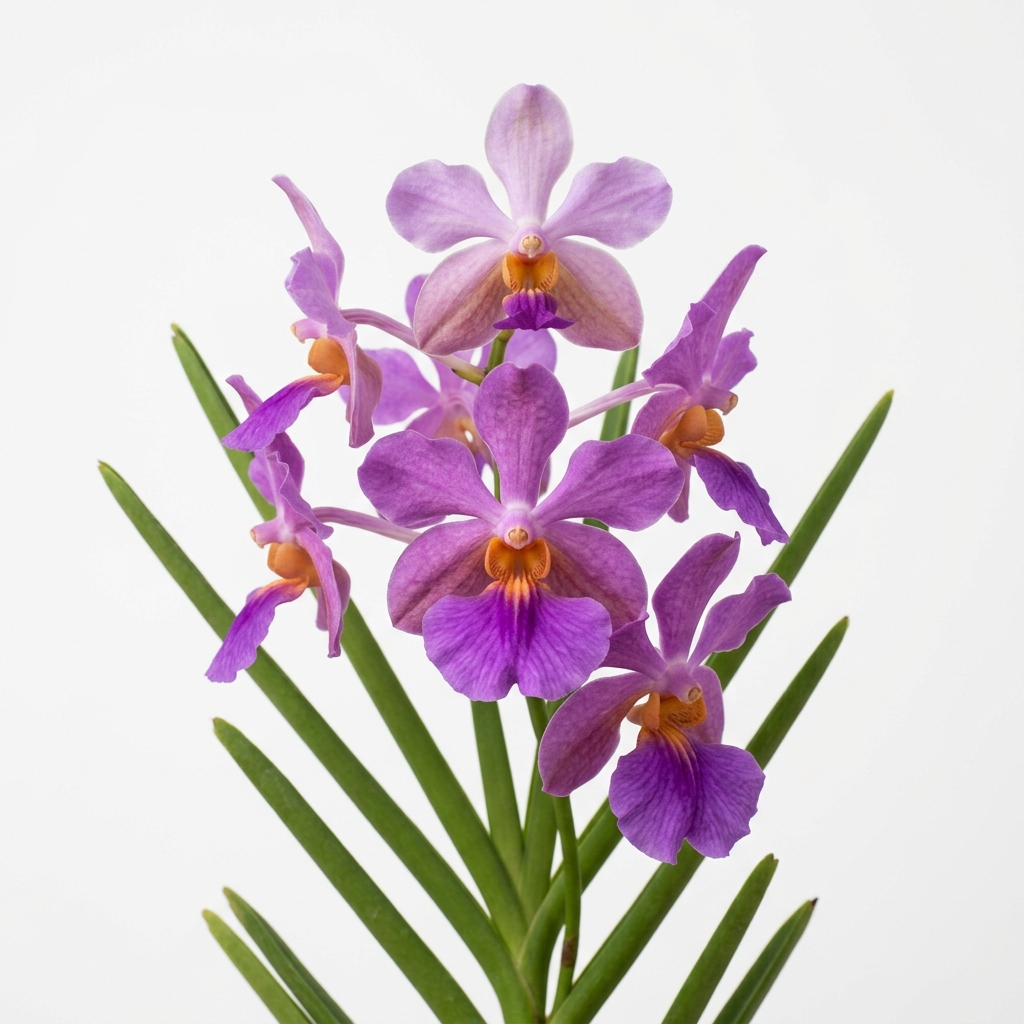
Vanda Miss Joaquim, taxonomically recognized as Papilionanthe Miss Joaquim, is a celebrated hybrid orchid renowned for its striking, vibrant blooms and robust climbing growth habit. As a classic terete-leaved orchid, this cultivar features cylindrical, pencil-like leaves that are highly adapted to intense sunlight and tropical environments. Orchid enthusiasts and landscape gardeners highly value this variety for its resilient nature, continuous blooming potential, and historical significance in tropical horticulture.
Cultivating this iconic orchid requires an understanding of its unique growth requirements, which differ significantly from typical shade-loving epiphytic orchids. With its tall, scrambling stems and aerial root system, Vanda Miss Joaquim thrives when given sturdy support and unrestricted access to bright, direct sunlight. When these conditions are met, the plant rewards growers with a succession of large, violet-rose flowers that epitomize the beauty of tropical orchid hybrids.
💡 Did You Know?
Vanda Miss Joaquim was selected as the national flower of Singapore in 1981 due to its resilience and year-round blooming quality. It was discovered in the garden of Agnes Joaquim in Singapore in the late nineteenth century, making it a historic milestone as one of the first registered tropical orchid hybrids.
🌿 Botanical Overview
Vanda Miss Joaquim is a monopodial orchid characterized by its distinctive terete, or cylindrical, leaves. Unlike broad-leaved orchids, these pencil-like leaves minimize water loss under intense sun, allowing the plant to withstand high-temperature environments. The stems are slender and can climb to heights of several meters, producing numerous thick, clinging aerial roots along their length to anchor the plant to supports.
In its native-like tropical habitats, this orchid grows as a terrestrial or semi-epiphytic climber. It relies heavily on its extensive aerial root system to absorb moisture and nutrients from the air and surrounding organic debris. Because of its tall, scrambling growth habit, it is rarely grown in standard pots and is instead cultivated against wooden posts, trellises, or wire frames where it can climb freely toward the light.
🌸 Flower Characteristics
The flowers of Vanda Miss Joaquim are visually arresting, typically measuring around five to six centimeters across. Each bloom features pale violet-rose petals and dorsal sepals, complemented by lateral sepals of a slightly deeper shade. The most prominent feature is the large, fan-shaped lip, which displays a rich violet-purple hue with a yellow and orange-flushed throat, intricately marked with dark purple spots.
The flowers are borne on ascending, simple or branched inflorescences that emerge from the upper leaf axils. Each spike can carry up to a dozen buds, which open sequentially to ensure a prolonged display. The blooms are long-lasting and held well clear of the foliage, presenting a dramatic splash of color against the green, needle-like stems.
Fragrance & Bloom Profile
While some growers report a very subtle, clean scent under warm, humid conditions, Vanda Miss Joaquim is generally considered to be non-fragrant. The primary appeal of this cultivar lies entirely in its exceptional visual presentation and its ability to bloom repeatedly throughout the year. The lack of a strong fragrance is amply compensated for by the longevity of individual flowers and the continuous production of new spikes on mature, healthy stems.
Parentage & Hybrid Lineage
This historic hybrid is documented as a cross between Vanda teres and Vanda hookeriana, both of which are now classified under the genus Papilionanthe. It was first described in the late nineteenth century and represents one of the earliest recorded artificial orchid hybrids. While some historical details regarding its exact breeding process remain subject to minor debate among botanical historians, it is universally recognized as a milestone in orchid hybridization, demonstrating the vigor and beauty achievable by crossing terete-leaved species.
🌱 Growing Conditions
To cultivate Vanda Miss Joaquim successfully, replicating its native tropical environment is essential. The most critical factor is light; this orchid requires full, unfiltered sunlight for at least six to eight hours a day to trigger blooming. Insufficient light will result in healthy-looking green stems that fail to produce flowers.
💡 Care Tip
Ensure this orchid receives at least six hours of direct, unfiltered sunlight daily. If the stems look healthy and green but fail to bloom, gradually move the plant to a brighter location to stimulate flower spike development.
Temperature: wise, this cultivar thrives in warm to hot conditions, ideally between 70°F and 95°F (21°C to 35°C). It does not tolerate cold temperatures well and should be protected or moved indoors if temperatures drop below 60°F (15°C). High humidity of 70% or more, combined with strong, continuous air movement, is vital to keep the exposed aerial roots healthy and prevent fungal pathogens from settling on the foliage.
Watering, Feeding & Potting Media
Because Vanda Miss Joaquim is typically grown with its roots completely exposed or anchored to a bare wooden stake, its watering needs are frequent. In warm weather, the roots should be thoroughly misted or doused daily, sometimes twice a day, allowing them to turn green and absorb moisture before drying rapidly.
Feeding should be done regularly using a balanced, water-soluble orchid fertilizer. Since there is no potting medium to retain nutrients, a weak fertilizer solution should be sprayed over the roots and foliage weekly during the active growing season. Traditional potting media like fine bark or peat moss should be avoided, as they will suffocate the thick aerial roots; instead, use large chunks of charcoal, coarse tree fern fiber, or simply grow the plant bare-root on a sturdy support.
Blooming Season & Care Notes
In tropical climates, Vanda Miss Joaquim can bloom continuously throughout the year, with peak flushes often occurring during the hottest, brightest months. In temperate regions, blooming is typically concentrated in the late spring and summer when light levels are highest.
After a flower spike has finished blooming, it can be cut back to the stem to encourage the plant to direct its energy into new vegetative growth and later spikes. Repotting is rarely necessary in the traditional sense; instead, maintenance involves securing new growth to the support structure and occasionally trimming back excessively long or dead roots.
⚠️ Common Issues
⚠️ Common Mistake
Avoid planting Vanda Miss Joaquim in standard potting soil or fine orchid bark. Its thick aerial roots require rapid wet-dry cycles and constant airflow; suffocating them in dense media will quickly lead to root rot.
- Bud Blast:
Sudden drops in humidity, drafts, or water stress can cause developing flower buds to yellow and drop before opening. - Root Rot:
Occurs if the roots are kept in heavy, water-retaining potting media without adequate drainage and airflow. - Dehydration:
Indicated by shriveled, wrinkled stems and dry, brittle aerial roots, usually caused by insufficient watering or low humidity. - Scale and Mealybugs: These pests can hide in the leaf axils and stem joints, sucking sap and weakening the plant.
- Fungal Leaf Spotting: Can develop during prolonged wet, cool periods with poor air circulation.
❓ Frequently Asked Questions
How do I get my Vanda Miss Joaquim to bloom?
The primary key to blooming Vanda Miss Joaquim is providing maximum sunlight. This cultivar requires full, direct sun for several hours daily. If grown indoors or in too much shade, it will grow vegetatively but will not produce flower spikes.
Can Vanda Miss Joaquim be grown indoors?
While challenging, it can be grown indoors if placed in a south-facing window that receives intense direct sunlight, or under high-intensity LED grow lights. Supplemental humidity and a fan for air circulation are essential to mimic its natural environment.
What is the best way to support this climbing orchid?
A sturdy wooden stake, bamboo pole, or trellis is ideal. Secure the main stem gently to the support using soft plant ties. Over time, the aerial roots will wrap around the support to anchor the plant naturally.
How often should I water Vanda Miss Joaquim?
When grown bare-root or on a mount, it should be watered daily in warm weather. Spray the roots thoroughly until they turn fully green. In cooler winter months, reduce watering frequency but ensure the plant does not dry out completely.
⭐ Final Growing Notes
Vanda Miss Joaquim remains an enduring favorite for growers who can provide the intense light and warmth it demands. Its unique climbing habit, coupled with its striking violet-rose blossoms, makes it a spectacular focal point in any tropical garden or bright greenhouse. By ensuring sturdy support, daily moisture, and abundant sunlight, you can enjoy the historic beauty of this classic orchid cultivar for years to come.
🌱 Propagation Tip
This climbing orchid is easily propagated by taking stem cuttings. Ensure each cutting is at least one to two feet long, possesses several healthy aerial roots, and is securely tied to a new support until it establishes.
⭐ Expert Advice
When growing in dry or temperate climates, hang a moisture-retaining material like coconut fiber or coarse sphagnum moss loosely around the support pole to help maintain around the aerial roots without suffocating them.




Leave A Comment