
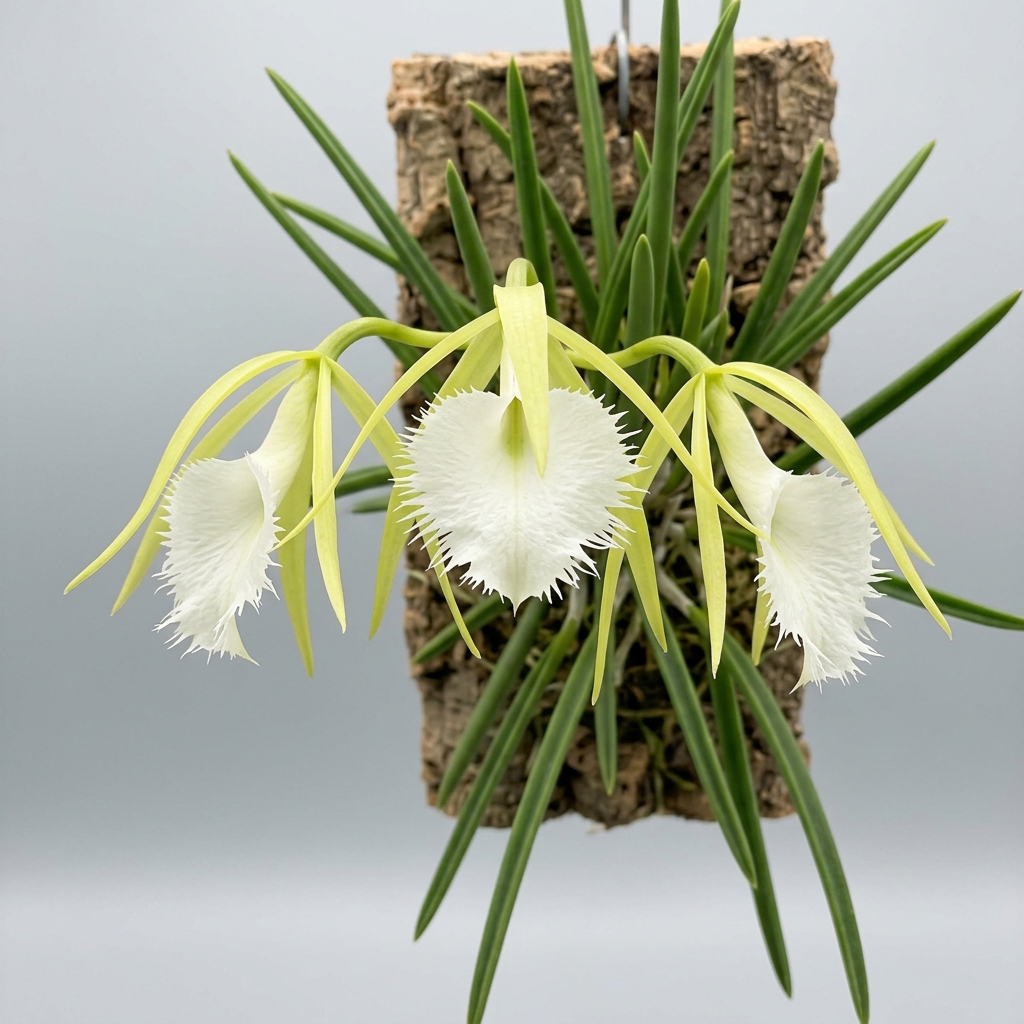
Brassavola cucullata, commonly referred to as the hooded orchid, is a distinctive epiphytic species celebrated for its unusual, spider-like floral morphology and pendulous growth habit. Native to the tropical regions of Mexico, Central America, and the Caribbean, this resilient orchid features slender, terete leaves that cascade elegantly, making it a favorite for mounted cultivation. Growers highly value this species not only for its striking, minimalist aesthetic but also for its exceptionally robust nature and ease of care.
The defining allure of this orchid lies in its nocturnal presentation, where its pale, elongated flowers emit a powerful, sweet fragrance designed to attract night-pollinating moths. Unlike many showy, highly hybridized orchids, this species maintains a wild, architectural elegance that contrasts beautifully with traditional collection specimens. Its ability to thrive in high-light environments and tolerate periods of drought makes it a rewarding choice for both novice enthusiasts and seasoned orchid collectors.
💡 Did You Know?
Brassavola cucullata is often called the daddy longlegs orchid due to its incredibly long, drooping sepals and petals that sway in the slightest breeze. This unique structure is a highly specialized evolutionary adaptation designed to mimic hanging vegetation, helping the plant blend into its native forest canopy to avoid herbivores while remaining highly visible to its nocturnal moth pollinators.
🌿 Botanical Overview
Brassavola cucullata is characterized by its thin, pencil-like pseudobulbs that transition seamlessly into narrow, terete leaves. This specialized foliage is highly adapted to conserve moisture in its native, seasonally dry habitats, giving the plant a distinctively grassy or succulent-like appearance when not in bloom. The growth habit is typically pendulous or spreading, which allows the plant to shed excess rainwater quickly and avoid crown rot.
In the wild, this species grows as an epiphyte on tree trunks and branches, or occasionally as a lithophyte on exposed rocks. Its extensive, wire-like root system is covered in a thick layer of velamen, which rapidly absorbs atmospheric moisture and nutrients. This morphological structure dictates that the plant prefers open, highly aerated growing conditions rather than dense, moisture-retaining potting media.
🌸 Flower Characteristics
The flowers of Brassavola cucullata are among the most unique in the genus, featuring long, drooping sepals and petals that can reach up to six inches in length. These segments are typically pale yellow, cream, or light green, often developing reddish-brown tips as they mature. The most prominent feature is the large, white, heart-shaped lip, which is deeply fringed or serrated along the margins and wraps tightly around the column at its base, creating a hooded appearance.
Each inflorescence usually produces a single, terminal flower, though strong plants can occasionally produce two or three blooms per spike. The flowers hang downward in a delicate, weeping fashion, creating a dramatic visual display that resembles a cluster of long-legged insects suspended in mid-air.
Fragrance & Bloom Profile
This species is renowned for its intense nocturnal fragrance, which begins to emanate at dusk and peaks during the middle of the night. The scent is typically described as a rich blend of sweet citrus, clover, and spicy vanilla, designed to attract night-flying hawkmoths for pollination. During the day, the flowers are virtually scentless, conserving energy until their specific pollinators become active.
Individual blooms are long-lasting, often remaining pristine for three to five weeks depending on environmental conditions. The combination of its dramatic, dangling form and its captivating nighttime perfume makes it a highly sensory addition to any indoor or greenhouse collection.
Parentage & Hybrid Lineage
As a distinct species, Brassavola cucullata does not have hybrid parentage, but it has been widely utilized in artificial hybridization to introduce its unique fringed lip and pendulous growth habit to other genera within the Cattleya alliance. Hybrids derived from this species often inherit the characteristic elongated petals and strong nocturnal scent.
While specific registered cultivars of this species exist, their individual award histories and registration details are not consistently documented in common grower references. Instead, growers typically select plants based on the vigor of the clone, the intensity of the floral fragrance, and the clean, symmetrical form of the fringed lip.
🌱 Growing Conditions
To cultivate Brassavola cucullata successfully, growers should mimic its bright, airy native canopy. This orchid thrives in bright, indirect light, and can tolerate some direct morning or late afternoon sun, which encourages robust blooming. If the leaves develop a light reddish-purple speckling, it indicates the plant is receiving the maximum safe limit of light, which is generally considered ideal for flower production.
💡 Care Tip
Ensure your growing area has constant, gentle air movement. Because this orchid thrives in high and is often grown mounted, stagnant air can quickly lead to fungal issues or root rot. A small oscillating fan nearby is highly beneficial.
Temperature: wise, the species is highly adaptable but prefers warm to intermediate conditions, with daytime temperatures between 75°F and 85°F, and a nighttime drop of about 10 to 15 degrees. High humidity of 50% to 70% is crucial, especially when grown mounted, and must be accompanied by continuous, gentle air movement to prevent fungal pathogens from settling on the foliage.
Watering, Feeding & Potting Media
Because of its epiphytic nature, Brassavola cucullata requires rapid wet-to-dry cycles. Mounting the orchid on a slab of cork bark or tree fern is highly recommended, as this allows the roots to remain exposed and dry quickly after watering. If pot cultivation is preferred, growers should use a very coarse, free-draining medium such as large-grade fir bark, charcoal, and perlite in a clay pot with extra drainage holes.
During the active growing season in spring and summer, the plant should be watered frequently—often daily for mounted specimens—but allowed to dry completely before the next application. Fertilize weakly weekly with a balanced, water-soluble orchid fertilizer diluted to one-quarter strength, flushing the root zone with pure water periodically to prevent salt buildup.
Blooming Season & Care Notes
The primary blooming season for Brassavola cucullata spans from mid-summer through late autumn, though well-established plants under optimal conditions may produce occasional blooms at other times of the year. The flower spikes emerge from the base of the leaves on newly matured pseudobulbs. It is important to avoid getting water on the developing buds, as trapped moisture can lead to bud rot or premature dropping.
After blooming has finished, the old flower spikes will naturally wither and can be carefully snipped near the base. Repotting or remounting should only be performed when new root growth is actively initiating, typically in early spring, to minimize transplant shock and ensure rapid establishment.
⚠️ Common Issues
⚠️ Common Mistake
The most common mistake is using standard, fine-grade potting soil or dense moss mixes. This orchid's roots are highly sensitive to suffocation and must dry out rapidly. Always use extremely coarse media or mount the plant directly onto cork bark.
- Root Rot: Caused by overwatering or compacted, water-retaining potting media that deprives the roots of oxygen.
- Dehydration: Indicated by shriveled, wrinkled terete leaves, often due to insufficient watering of mounted plants or a compromised root system.
- Bud Blast: The sudden yellowing and dropping of flower buds, usually triggered by drastic temperature fluctuations, low humidity, or drafts.
- Pests: Scale insects and mealybugs can occasionally hide in the crevices where the leaves meet the pseudobulbs; treat promptly with insecticidal soap or neem oil.
- Fungal Leaf Spotting: Dark spots on the foliage caused by stagnant air and high humidity; improve air circulation to prevent spread.
❓ Frequently Asked Questions
How do I know if my Brassavola cucullata is getting enough light?
A healthy plant receiving adequate light will have firm, upright, light green leaves, often with a subtle reddish-purple speckling. If the foliage is dark green and floppy, or if the plant fails to bloom, it requires a gradual increase in light intensity.
Can I grow Brassavola cucullata in a standard plastic pot?
While possible, standard plastic pots are not ideal because they retain moisture too long. If you must use a pot, choose a slotted clay pot filled with very coarse bark or charcoal, ensuring the medium dries out completely within a day or two of watering.
Why are the flower buds on my orchid turning yellow and falling off?
This is known as bud blast and is typically caused by sudden environmental stress, such as a sharp drop in humidity, cold drafts, or moving the plant to a new location while the buds are developing. Maintain stable conditions during the budding phase.
How often should I water a mounted Brassavola cucullata?
Mounted specimens have fully exposed roots and dry out very quickly. During the warm summer growing season, they may need to be watered or misted daily, whereas in the cooler winter months, watering should be reduced to every few days.
⭐ Final Growing Notes
Brassavola cucullata is an exceptional orchid that rewards growers with its dramatic, architectural silhouette and intoxicating nighttime fragrance. By providing bright light, excellent air circulation, and a growing setup that respects its need for rapid drying, enthusiasts can enjoy this wild, elegant species for many years. Its low-maintenance requirements and unique floral presentation make it a standout addition to any diverse orchid collection.
🌱 Propagation Tip
Propagation is best achieved by division during spring repotting. Ensure each division has at least three to four healthy pseudobulbs with active lead growth and viable roots. Avoid dividing the plant too frequently, as larger clumps produce far more dramatic floral displays.
⭐ Expert Advice
To trigger a heavy flush of blooms in the summer, provide a slight reduction in and a distinct day-to-night drop of about 15 degrees Fahrenheit during the late spring. This environmental cue closely mimics its natural seasonal transition.




Leave A Comment