
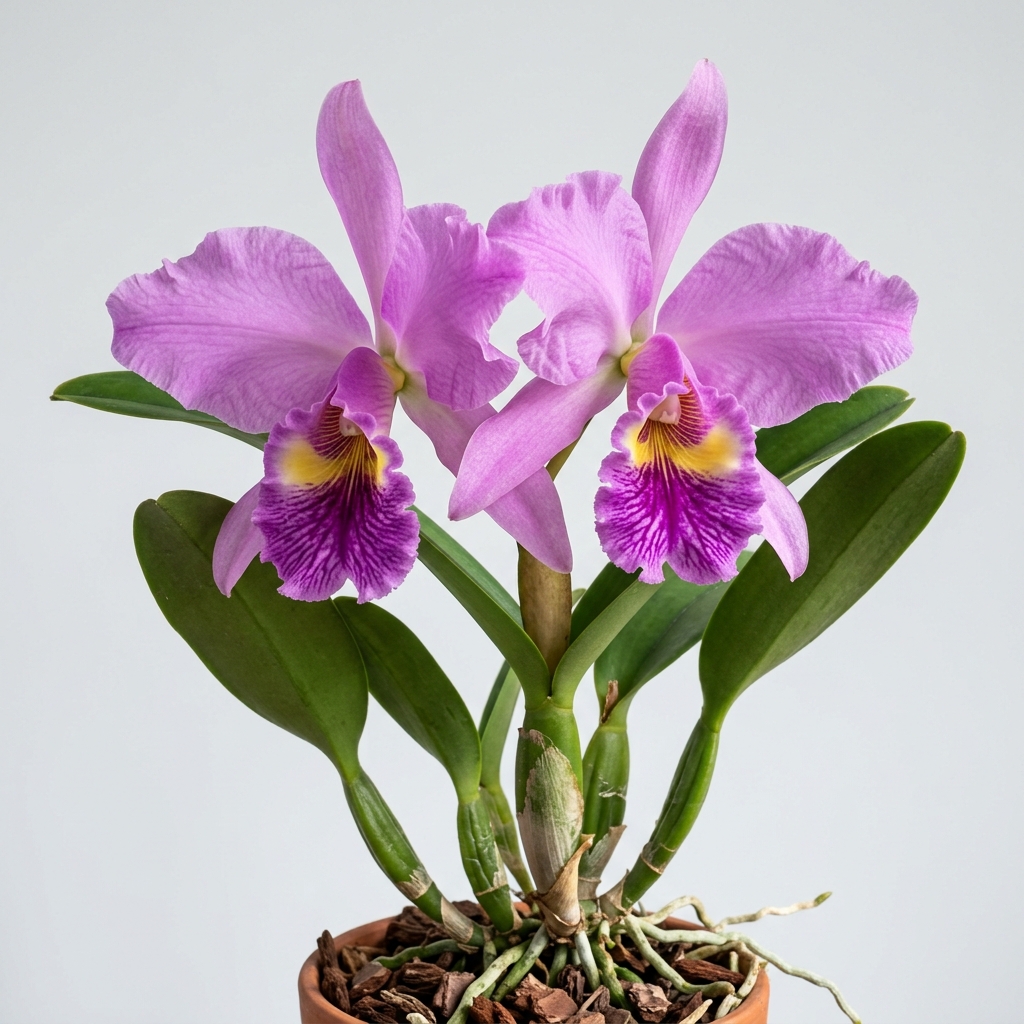
Cattleya Lueddemanniana is a highly prized species orchid native to the coastal mountain ranges of northern Venezuela. Renowned among collectors for its large, showy blooms and robust growth habit, this unifoliate Cattleya has played a significant role in the history of orchid cultivation and hybridization. Its striking presence and classic tropical form make it a centerpiece in any serious orchid collection.
In cultivation, this species is favored for its ability to produce exceptionally large flowers relative to the size of the plant. While it requires specific attention to light, temperature, and watering cycles to mimic its native seasonal habitat, intermediate to advanced growers will find its spectacular floral display and sweet fragrance highly rewarding.
💡 Did You Know?
Cattleya Lueddemanniana is named after the French orchidist M. Lueddemann, who successfully flowered the species in Paris during the mid-19th century. Unlike many other unifoliate Cattleyas, this species is known for its ability to produce flowers twice a year under optimal greenhouse conditions, making it a highly prized specimen for competitive exhibition.
🌿 Botanical Overview
Cattleya Lueddemanniana is an epiphytic species that naturally grows on trees in deciduous forests, ranging from sea level up to moderate elevations. This environment exposes the orchid to distinct seasonal variations, characterized by a wet, humid growing season followed by a cooler, drier winter rest period. Understanding these native conditions is key to successfully cultivating the plant in a home or greenhouse setting.
The growth habit of this orchid is typical of unifoliate Cattleyas. It produces stout, club-shaped pseudobulbs that support a single, thick, leathery leaf. These leaves are designed to store water and nutrients, helping the plant survive periods of drought in the wild. The root system is robust, consisting of thick, velamen-covered roots that anchor the plant to its host and rapidly absorb moisture and nutrients.
🌸 Flower Characteristics
The blossoms of Cattleya Lueddemanniana are among the most impressive in the genus, often reaching 15 to 20 centimeters in diameter. The flowers feature broad, overlapping petals and sepals that range in color from soft rose-pink to deep amethyst. Naturally occurring color variations, such as the pure white “alba” form or the bluish-toned “coerulea” form, are highly sought after by collectors.
The most striking feature of the flower is its complex labellum, or lip. The lip is tubular at the base, wrapping around the column, and flares open into a richly colored midlobe. This midlobe is typically adorned with intense purple veining or solid amethyst coloration, contrasted by two distinct pale yellow or cream-colored patches in the throat, often referred to as “eyes.” The flowers are presented on short, sturdy spikes that emerge from a protective green sheath at the apex of the newest pseudobulb.
Fragrance & Bloom Profile
This species is celebrated for its powerful and captivating fragrance. The scent is typically described as sweet, floral, and slightly spicy, filling a growing space or greenhouse during the peak of its bloom cycle. The fragrance is most intense during the morning and early afternoon hours, stimulated by rising temperatures and bright light levels.
A healthy, mature specimen can produce two to four flowers per inflorescence. Under optimal indoor or greenhouse conditions, the individual blooms can remain fresh and vibrant for three to four weeks. To maximize the longevity of the flowers, keep the plant in a slightly cooler location with stable humidity once the buds have fully opened.
Parentage & Hybrid Lineage
As a naturally occurring species, Cattleya Lueddemanniana does not have a hybrid parentage. Instead, it serves as a foundational parent in orchid breeding. Its large flower size, excellent form, and intense lip coloration have made it a valuable contributor to thousands of modern Cattleya hybrids and grexes registered over the past century.
In historical breeding programs, it has been crossed with other prominent species like Cattleya warscewiczii and Cattleya mossiae to produce classic, large-flowered lavender hybrids. While modern hybridizers continue to use it, many purists prefer to grow select line-bred cultivars of the species itself, which have been selected over generations for improved flower shape, color saturation, and ease of growth.
🌱 Growing Conditions
To thrive, Cattleya Lueddemanniana requires bright, indirect light. In a greenhouse, this equates to approximately 3,000 to 4,000 foot-candles. The leaves should be a light, grassy green color; dark green leaves indicate insufficient light, while yellowing or scorched patches suggest the light is too intense. East or shaded south-facing windows are ideal for indoor cultivation.
💡 Care Tip
To encourage robust blooming, ensure your Cattleya Lueddemanniana receives strong air movement. High air circulation not only cools the thick leaves under bright but also helps dry the potting medium rapidly, mimicking the breezy conditions of its native Venezuelan canopy.
Temperature management is crucial for this species. It prefers warm daytime temperatures between 24°C and 29°C (75°F to 85°F) and intermediate nighttime temperatures between 15°C and 18°C (60°F to 65°F). A distinct temperature drop at night is essential to stimulate healthy growth and later bud initiation. High humidity levels of 60% to 80% should be maintained, accompanied by continuous, gentle air movement to prevent stagnant air pockets.
Watering, Feeding & Potting Media
During the active growing season in spring and summer, Cattleya Lueddemanniana should be watered thoroughly. Allow the potting medium to dry out almost completely between waterings to prevent root rot. In the winter, when the plant enters its natural rest period, reduce watering significantly, providing only enough moisture to prevent the pseudobulbs from shriveling excessively.
Feed the orchid weekly during active growth with a balanced, water-soluble orchid fertilizer formulated at quarter or half strength. It is beneficial to flush the pot with pure, unfertilized water once a month to wash away accumulated mineral salts. Reduce or entirely suspend fertilization during the winter rest period.
The ideal potting medium must provide exceptional drainage and aeration. Coarse fir bark mixed with medium charcoal and perlite works exceptionally well in clay or plastic pots. Alternatively, because of its epiphytic nature, this species grows beautifully when mounted on cork slabs or tree fern plaques, provided the grower can maintain high humidity and water the plant daily during hot weather.
Blooming Season & Care Notes
The primary blooming period for Cattleya Lueddemanniana is late winter to early spring, though some exceptional clones may produce a secondary flush of flowers in late summer. The flower buds develop within a green sheath at the top of the mature pseudobulb. During bud development, avoid moving the plant or changing its orientation to the light source, as this can cause the buds to twist or fail to open properly.
Once the blooming cycle is complete, the orchid will enter a brief period of vegetative rest. This is the ideal time to evaluate the plant for repotting. Repotting should only be performed when new root growth is observed emerging from the base of the newest pseudobulb. This ensures the plant establishes quickly in its new medium with minimal transplant shock.
⚠️ Common Issues
⚠️ Common Mistake
A frequent error is overwatering during the winter rest period. When the orchid is not actively growing, its roots cannot absorb excess moisture, leading to rapid root rot. Reduce frequency significantly until new green root tips and vegetative growth appear in spring.
- Root Rot:
Caused by overwatering or a degraded, compacted potting medium that retains too much moisture. - Bud Blast:
The sudden yellowing and dropping of flower buds, often triggered by rapid temperature fluctuations, low humidity, or drafts. - Pests:
Scale insects and mealybugs can hide under the papery sheaths of the pseudobulbs; spider mites may attack the undersides of leaves in dry conditions. - Fungal Spotting: Black or brown spots on leaves or flowers, usually resulting from high humidity combined with poor air circulation.
❓ Frequently Asked Questions
How often should I water my Cattleya Lueddemanniana?
Watering frequency depends heavily on your growing environment, pot type, and medium. As a general rule, water thoroughly when the potting medium is nearly dry. During the active summer growth phase, this may be every 3 to 5 days, while in the winter rest period, it may be reduced to once every 10 to 14 days.
Why are the pseudobulbs on my orchid shriveling?
Shriveled pseudobulbs indicate dehydration, which can be caused by two opposite issues: underwatering or root loss due to overwatering. Check the root system; if the roots are firm and white, the plant simply needs more frequent watering. If the roots are brown and mushy, the plant has rotted and cannot absorb moisture.
Can I grow this orchid under LED lights indoors?
Yes, Cattleya Lueddemanniana can be successfully grown under high-intensity LED grow lights designed for plants. Ensure the lights are kept at an appropriate distance to provide the required bright light levels without overheating the foliage, and maintain a consistent 12-to-14-hour photoperiod.
When is the best time to repot Cattleya Lueddemanniana?
The absolute best time to repot is in the spring, immediately after flowering, just as new green root tips begin to emerge from the base of the newest pseudobulb. Repotting at this precise moment allows the orchid to quickly anchor itself into the fresh medium.
⭐ Final Growing Notes
Cattleya Lueddemanniana remains a timeless classic in the orchid world, offering a spectacular reward of large, fragrant blooms for those who respect its seasonal growth cycle. By providing bright light, warm temperatures, excellent air movement, and a distinct winter rest, growers can enjoy the majestic beauty of this Venezuelan treasure for many years to come.
⚕️ Health, Safety & Edibility
Understanding how a plant interacts with people, pets, and the surrounding environment is part of responsible cultivation. This section uses conservative, general guidance and does not replace professional medical or veterinary advice.
Human Safety: No published evidence currently identifies species-specific toxicity concerns for Cattleya Lueddemanniana during normal handling. As with most ornamental plants, it should not be intentionally consumed.
Pet Safety: Published information does not indicate that this orchid commonly poses a toxicity concern for cats or dogs. However, chewing leaves, flowers, roots, or potting media may still cause mild digestive upset.
Edibility: This orchid is cultivated for ornamental display rather than food. Ornamental plants may carry fertilizers, pesticides, or other horticultural treatments that make them unsuitable for consumption.
Skin Contact: Routine handling is not generally associated with skin irritation. Gardeners with sensitive skin may prefer wearing gloves when repotting, pruning, or handling potting media.
🌱 Propagation Tip
Propagate this orchid by division only when the plant has outgrown its container and possesses at least six to eight healthy pseudobulbs. Carefully divide the rhizome using sterile tools, ensuring each new division has at least three active pseudobulbs and a viable lead bud.
⭐ Expert Advice
When repotting, timing is critical. Only repot when you see new green root tips just beginning to emerge from the base of the newest pseudobulb. If you repot while the roots are inactive, the orchid may struggle to establish and suffer severe dehydration.




Leave A Comment