
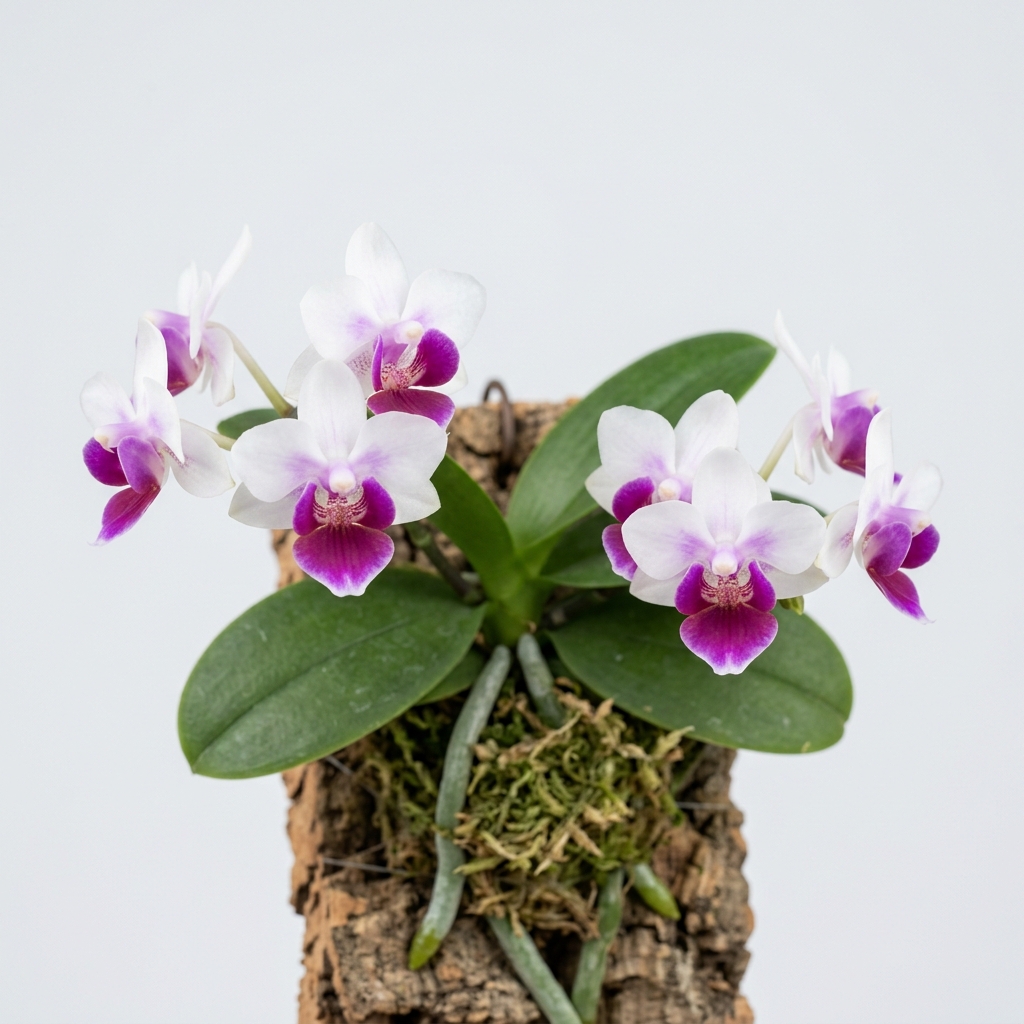
Phalaenopsis Parishii is a highly prized miniature orchid species celebrated for its diminutive size and strikingly detailed blossoms. Native to the low-elevation forests of Southeast Asia and the eastern Himalayas, this epiphyte is a favorite among collectors who appreciate compact plants that deliver maximum visual impact. Its charming growth habit and unique floral structure make it an excellent choice for terrariums, wardian cases, or dedicated indoor growing spaces.
Unlike many of the large, mass-marketed hybrid moth orchids, this species retains a wild, elegant character characterized by its short stems, fleshy roots, and deciduous tendencies in its native habitat. Cultivators value it not only for its ease of growth when mounted but also for its potential to produce multiple flowering spikes that showcase clusters of small, brilliantly colored blooms.
💡 Did You Know?
In its native Himalayan habitats, Phalaenopsis Parishii often grows on moss-covered branches hanging directly over streams. This unique microclimate provides the plant with constant, high and cool breezes, which explains why successful indoor growers emphasize excellent air circulation and consistent moisture for this miniature species.
🌿 Botanical Overview
Phalaenopsis Parishii is a true miniature orchid, characterized by an extremely short stem that is almost completely hidden by its small, fleshy, elliptic-obovate leaves. In its natural habitat, the plant grows as an epiphyte on moss-covered tree branches, often near water sources where humidity remains high year-round. The root system is relatively thick and extensive for the size of the plant, helping it cling securely to rough bark surfaces.
One of the most fascinating botanical traits of this species is its semi-deciduous nature. In the wild, it may shed its leaves during the dry winter season to conserve moisture, relying on its photosynthetic root system to survive. In home cultivation, however, providing consistent moisture usually prevents leaf drop, allowing the plant to remain evergreen throughout the year.
🌸 Flower Characteristics
The blossoms of Phalaenopsis Parishii are remarkably complex despite their small size, which typically ranges from 1.5 to 2 centimeters in diameter. The sepals and petals are a clean, stark white or cream color, providing a dramatic contrast to the highly modified lip. This presentation ensures that even a small specimen stands out in a collection.
The lip (labellum) is the defining feature of this orchid, presenting a broad, triangular or fan-shaped structure that is intensely colored in shades of magenta, purple, or deep chestnut-brown. The center of the lip often features a bright yellow or white patch, adorned with fine, hair-like appendages that draw pollinators. The flowers are produced on short, arching inflorescences that emerge from the base of the plant, carrying up to ten flowers per spike.
Fragrance & Bloom Profile
Many growers report that Phalaenopsis Parishii produces a delightful, sweet fragrance that is most noticeable during the morning hours. The scent is often described as a mix of citrus and delicate floral notes, reminiscent of lilies. This pleasant aroma adds an extra layer of sensory appeal to an already visually stunning plant.
However, fragrance intensity can be highly variable and is often dependent on environmental factors such as temperature, humidity, and light levels. While some specimens fill a small room with their perfume, others may have a faint scent or appear unscented to some individuals. The blooms typically last for several weeks, providing a long-lasting display of miniature elegance.
Parentage & Hybrid Lineage
As a naturally occurring species rather than a man-made hybrid, Phalaenopsis Parishii possesses a pure genetic lineage that has made it a valuable parent in orchid breeding. Hybridizers have long used this species to introduce miniature growth habits, compact foliage, and vibrant lip coloration into modern Phalaenopsis hybrids.
While its exact contribution to complex commercial hybrids is sometimes obscured by generations of breeding, its influence is clearly visible in many popular micro-miniature cultivars. When purchasing this orchid, ensuring it is sourced from reputable nurseries guarantees you are receiving the true species rather than a closely related hybrid lookalike.
🌱 Growing Conditions
To successfully cultivate Phalaenopsis Parishii, growers should aim to replicate its native forest canopy environment. It thrives in medium, filtered light, similar to the conditions preferred by standard moth orchids, though it can tolerate slightly lower light levels. Direct afternoon sunlight must be avoided, as it will quickly scorch the thin, delicate leaves.
💡 Care Tip
If you choose to mount this orchid on cork bark, wrap a small amount of high-quality sphagnum moss around the roots to help retain moisture, especially if your indoor growing area falls below sixty percent .
Temperature: wise, this species prefers intermediate to warm conditions, ideally ranging from 65°F to 85°F (18°C to 29°C) during the day, with a slight drop at night to stimulate healthy growth. High humidity is crucial, ideally maintained between 60% and 80%. Good air movement is essential to prevent stagnant air from causing fungal or bacterial issues on the leaves and roots.
Watering, Feeding & Potting Media
Because of its epiphytic nature, Phalaenopsis Parishii is highly sensitive to waterlogged conditions. It is most commonly grown mounted on cork bark or tree fern plaques with a small pad of sphagnum moss around the roots. Mounted plants require daily watering or misting during the warm, active growing season, as they dry out rapidly.
If grown in pots, use a very free-draining medium such as fine-grade fir bark mixed with perlite, or high-quality New Zealand sphagnum moss in small, shallow clay or plastic pots. Water thoroughly when the medium approaches dryness, but do not allow the roots to sit in standing water. Feed weakly with a balanced orchid fertilizer diluted to one-quarter strength every second or third watering during the spring and summer.
Blooming Season & Care Notes
The primary blooming season for Phalaenopsis Parishii occurs in the spring and early summer. As the winter transitions to spring, the plant responds to increasing day length and slightly warmer temperatures by initiating flower spikes from the base of the stem. Maintaining stable environmental conditions during this time is key to ensuring a successful bloom.
After the flowers fade, do not cut the green flower spike unless it turns brown and dry, as some miniature Phalaenopsis species can occasionally produce secondary blooms or keikis from the old nodes. Repotting or remounting is best done in late spring or early summer, immediately after the blooming cycle concludes and when new root growth is actively emerging.
⚠️ Common Issues
⚠️ Common Mistake
A frequent error is treating this miniature species like a standard grocery-store hybrid. Standard hybrids tolerate stagnant air and potting soil mixes far better than Phalaenopsis Parishii, which will quickly suffer from root rot if its roots do not dry out rapidly after .
- Root Rot:
Caused by overwatering or compacted, poorly draining potting media that suffocates the roots. - Dehydration:
Especially common in mounted specimens if daily watering is missed during hot summer months, leading to shriveled leaves. - Bud Blast:
The premature dropping or drying of flower buds, often triggered by sudden changes in temperature, low humidity, or drafts. - Pests:
Mealybugs and spider mites can occasionally hide in the crevices of the small leaves; treat promptly with insecticidal soap or neem oil. - Leaf Spotting: Fungal or bacterial spots can develop if water is allowed to sit on the leaves overnight without adequate air circulation.
❓ Frequently Asked Questions
Can Phalaenopsis Parishii be grown successfully in a pot?
Yes, while mounting is preferred, it can be grown in small pots using fine bark or sphagnum moss, provided the container has excellent drainage and the media is not allowed to become soggy.
Why is my Phalaenopsis Parishii losing its leaves in winter?
This species is naturally semi-deciduous. If kept dry and cool in winter, it may shed its leaves. To keep it evergreen, maintain consistent warmth and moderate humidity throughout the winter months.
How often should I water a mounted Phalaenopsis Parishii?
Mounted plants dry out very quickly. During the active growing season in spring and summer, they typically require daily watering or heavy misting, which can be reduced to every few days in winter.
Does this orchid require a cold period to trigger blooming?
No, it does not require a severe cold drop. A slight, natural drop in night temperatures during autumn and winter, combined with a slight reduction in watering, is usually sufficient to stimulate spring blooms.
⭐ Final Growing Notes
Phalaenopsis Parishii is an enchanting addition to any orchid collection, offering a masterclass in the beauty of miniature tropical flora. By providing high humidity, excellent air circulation, and a watering routine that mimics its natural wet-and-dry cycles, growers can enjoy the spectacular, intricate blooms of this tiny forest gem year after year.
⚕️ Health, Safety & Edibility
Understanding how a plant interacts with people, pets, and the surrounding environment is part of responsible cultivation. This section uses conservative, general guidance and does not replace professional medical or veterinary advice.
Human Safety: No published evidence currently identifies species-specific toxicity concerns for Phalaenopsis Parishii during normal handling. As with most ornamental plants, it should not be intentionally consumed.
Pet Safety: Published information does not indicate that this orchid commonly poses a toxicity concern for cats or dogs. However, chewing leaves, flowers, roots, or potting media may still cause mild digestive upset.
Edibility: This orchid is cultivated for ornamental display rather than food. Ornamental plants may carry fertilizers, pesticides, or other horticultural treatments that make them unsuitable for consumption.
Skin Contact: Routine handling is not generally associated with skin irritation. Gardeners with sensitive skin may prefer wearing gloves when repotting, pruning, or handling potting media.
🌱 Propagation Tip
While propagation from seed is complex, healthy plants may occasionally produce a keiki along an old flower spike or at the base of the mother plant. Allow the keiki to develop several strong roots before carefully detaching and mounting it.
⭐ Expert Advice
To encourage a robust spring bloom, slightly reduce and fertilizer during the late autumn and winter months, allowing the plant to experience a mild resting phase without letting the roots dry out completely to the point of shriveling.




Leave A Comment