
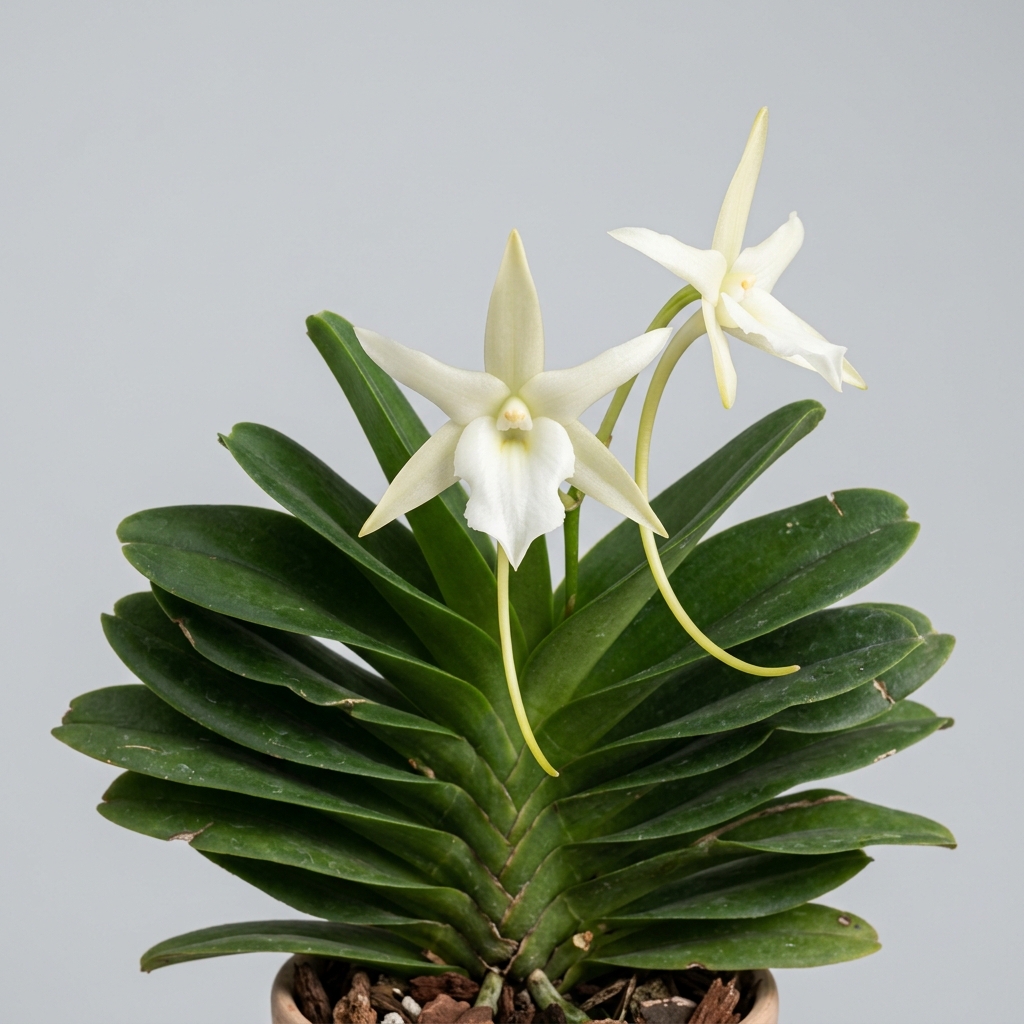
Angraecum Compactum is a highly prized miniature orchid species native to the highland forests of Madagascar, celebrated for its compact growth habit and remarkably large, pristine white flowers. As a member of the Vandeae tribe, this epiphytic gem appeals greatly to indoor growers and orchid collectors who appreciate maximum floral impact within a limited growing space. Its fan-shaped arrangement of thick, leathery leaves provides year-round structural beauty even when the plant is not in bloom.
Cultivating this species offers a rewarding experience, particularly when its star-shaped blossoms emerge to release an intense, sweet fragrance during the evening hours. While it requires specific attention to humidity and wet-to-dry cycles, its relatively robust nature makes it one of the more accessible Angraecum species for home growers. Understanding its natural montane habitat is the key to unlocking regular, successful blooming cycles year after year.
💡 Did You Know?
The long nectar spur of Angraecum Compactum is a classic example of co-evolution. In its native Madagascar, only specific species of nocturnal hawkmoths with extraordinarily long tongues can reach the sweet nectar at the bottom of the spur, pollinating the orchid in the process.
🌿 Botanical Overview
Angraecum Compactum is characterized by its slow-growing, monopodial growth habit, typically reaching only a few inches in height. The plant produces a dense, fan-like array of bilobed, fleshy leaves that are deeply channeled and dark green. These thick leaves are an evolutionary adaptation designed to store moisture and withstand temporary dry spells in its native canopy environment.
In the wild, this species grows epiphytically on moss-covered tree branches in Madagascar’s humid forests at elevations ranging from 700 to 2,000 meters. This wide elevational range gives the plant a degree of temperature tolerance, allowing it to adapt to intermediate home environments more easily than some of its strictly lowland relatives. Its root system is notably thick and velamen-covered, designed to rapidly absorb atmospheric moisture and cling securely to its mounting surface or potting substrate.
🌸 Flower Characteristics
The flowers of Angraecum Compactum are strikingly large relative to the overall size of the plant, often measuring up to three inches in diameter. Each inflorescence typically carries one to three star-shaped, crystalline white blossoms that gradually mature to a soft, warm cream color. The petals and sepals are lanceolate and sharply pointed, framing a broad, shell-like lip that dominates the floral presentation.
A defining feature of this orchid is the remarkably long, slender nectar spur extending from the back of the lip, which can reach up to five inches in length. This spur is a classic evolutionary trait of Angraecoid orchids, adapted specifically for pollination by nocturnal hawkmoths with specialized proboscises. The flowers are long-lasting, often remaining pristine for several weeks under optimal conditions.
Fragrance & Bloom Profile
The fragrance of Angraecum Compactum is one of its most alluring attributes, characterized by a powerful, spicy-sweet aroma reminiscent of citrus, jasmine, or cloves. In alignment with its evolutionary pollination strategy, the scent is virtually undetectable during the day but becomes intensely fragrant shortly after dusk. This nocturnal scent production is highly efficient, filling an entire growing room with a rich perfume.
The blooming cycle typically occurs once a year, with flowers lasting anywhere from four to six weeks. To maximize the duration of the bloom, growers should keep the plant in a slightly cooler, stable environment once the buds open and avoid spraying water directly onto the delicate crystalline petals, which can cause premature spotting or decay.
Parentage & Hybrid Lineage
Unlike many mass-market orchids, Angraecum Compactum is primarily grown and appreciated as a distinct, true species rather than a complex hybrid. Its genetic stability and unique miniature stature have made it a subject of interest for hybridizers seeking to introduce compact growth habits and large flower sizes into Angraecoid breeding lines.
While some primary hybrids involving Angraecum Compactum exist within specialty circles, they are not widely distributed in the general commercial trade. Consequently, most specimens found in cultivation are propagated via seed flasking or tissue culture from select, high-quality parent species. Growers should acquire plants from reputable nurseries to ensure they are obtaining responsibly propagated specimens rather than wild-collected plants.
🌱 Growing Conditions
To cultivate Angraecum Compactum successfully, growers should aim to replicate the bright, dappled light of its native forest canopy. It thrives in medium to bright indirect light, similar to the requirements of Cattleya orchids. A position near an east-facing window or under modern LED grow lights providing moderate intensity will promote strong leaf development and regular flowering without scorching the foliage.
💡 Care Tip
To prevent rot, always water your Angraecum Compactum in the morning so that any water trapped in the tight leaf joints has ample time to evaporate before nightfall when temperatures drop.
Temperature: wise, this species prefers intermediate to warm conditions, with daytime temperatures ranging from 70 to 80 degrees Fahrenheit and a distinct drop of 10 to 15 degrees at night. High humidity is crucial, ideally maintained between 60% and 80%. Excellent air movement is mandatory to prevent stagnant moisture from settling in the leaf axils, which can quickly lead to bacterial or fungal rot.
Watering, Feeding & Potting Media
Watering should be frequent but highly structured, allowing the potting medium to dry out almost completely between waterings. During the active growing season in spring and summer, the plant requires consistent moisture, whereas watering should be scaled back slightly during the cooler winter months. Using pure water, such as rainwater, distilled water, or reverse osmosis water, is highly recommended to prevent mineral salts from building up on the sensitive roots.
This orchid can be grown successfully in small plastic or clay pots filled with a highly draining medium, such as medium-grade orchid bark mixed with charcoal and perlite. Alternatively, many growers prefer to mount the plant on cork bark or tree fern slabs with a small pad of sphagnum moss around the roots, which mimics its natural epiphytic habit and ensures maximum root aeration. Fertilize weakly weekly with a balanced, diluted orchid fertilizer during the active growth phase, flushing the pot with pure water once a month to remove residual salts.
Blooming Season & Care Notes
Angraecum Compactum typically initiates its blooming cycle in late autumn to winter, triggered by the natural drop in night temperatures and shorter day lengths. As the flower spikes emerge from the leaf axils opposite the leaves, extra care should be taken to maintain stable environmental conditions. Sudden shifts in temperature, drafty locations, or severe dehydration during spike development can result in bud blast.
Once the flowering period has concluded, the old spikes can be carefully snipped near the base of the stem using sterilized cutting tools. Repotting or remounting should only be performed when necessary, ideally during the spring when active new root growth is observed. This species resents root disturbance, so growers should handle the root system with extreme care to avoid stalling the plant’s growth for the upcoming season.
⚠️ Common Issues
⚠️ Common Mistake
The most common mistake is overpotting this orchid in a container that is too large. Angraecum Compactum prefers tight quarters and excellent root aeration; excess retains too much moisture, quickly leading to root rot.
- Root Rot:
Caused by overwatering, poor drainage, or a decomposing potting medium that suffocates the roots. - Bud Blast:
Occurs when developing buds yellow and drop prematurely due to low humidity, cold drafts, or sudden environmental changes. - Mealybugs and Scale: These pests can hide in the tight crevices of the fan-shaped leaf axils; treat promptly with insecticidal soap or horticultural oil.
- Leaf Spotting: Fungal or bacterial spots can develop if water is allowed to sit on the foliage overnight without adequate air circulation.
- Dehydration:
Indicated by shriveled, wrinkled leaves and dry, silvery roots, usually resulting from underwatering or low ambient humidity.
❓ Frequently Asked Questions
How often should I water my Angraecum Compactum?
Watering frequency depends heavily on your growing setup. Mounted plants may require daily misting or soaking during warm weather, while potted plants in bark media typically need watering every five to seven days. Always allow the medium to approach dryness before watering again.
Can Angraecum Compactum be grown under artificial LED lights?
Yes, this species adapts exceptionally well to indoor cultivation under LED grow lights. Position the plant where it receives moderate light intensity, ensuring the leaves remain a healthy light green color without turning yellow or showing signs of sunburn.
Why are the leaves on my orchid turning yellow and dropping?
Yellowing leaves can indicate several issues, most commonly overwatering or poor root health. Inspect the root system immediately; if the roots are mushy and brown, repot the plant in fresh media and reduce watering. Natural shedding of the oldest, bottom-most leaves is normal over time.
Does Angraecum Compactum require a winter rest period?
While it does not require a severe dry rest, it benefits from a slight reduction in watering and fertilizer during the cooler winter months. Maintaining a distinct drop in night temperatures during this period is often the key catalyst for initiating flower spikes.
⭐ Final Growing Notes
Angraecum Compactum remains an exceptional choice for orchid enthusiasts seeking a manageable, highly fragrant species that delivers spectacular floral displays. By mimicking its native Madagascan montane environment with bright indirect light, high humidity, and excellent air movement, growers can enjoy the captivating beauty and nocturnal perfume of this miniature marvel for many years.
⚕️ Health, Safety & Edibility
Understanding how a plant interacts with people, pets, and the surrounding environment is part of responsible cultivation. This section uses conservative, general guidance and does not replace professional medical or veterinary advice.
Human Safety: No published evidence currently identifies species-specific toxicity concerns for Angraecum Compactum during normal handling. As with most ornamental plants, it should not be intentionally consumed.
Pet Safety: Published information does not indicate that this orchid commonly poses a toxicity concern for cats or dogs. However, chewing leaves, flowers, roots, or potting media may still cause mild digestive upset.
Edibility: This orchid is cultivated for ornamental display rather than food. Ornamental plants may carry fertilizers, pesticides, or other horticultural treatments that make them unsuitable for consumption.
Skin Contact: Routine handling is not generally associated with skin irritation. Gardeners with sensitive skin may prefer wearing gloves when repotting, pruning, or handling potting media.
🌱 Propagation Tip
This species has a monopodial growth habit and rarely produces offshoots or keikis. Propagation is almost exclusively achieved through professional seed flasking in sterile laboratory conditions, so home growers should focus on maintaining the health and vigor of their primary specimen rather than attempting division.
⭐ Expert Advice
If your orchid refuses to bloom despite receiving adequate , try increasing the differential between day and night. A drop of ten to fifteen degrees Fahrenheit in the autumn is often the exact trigger needed to initiate flower spikes.

Leave A Comment