
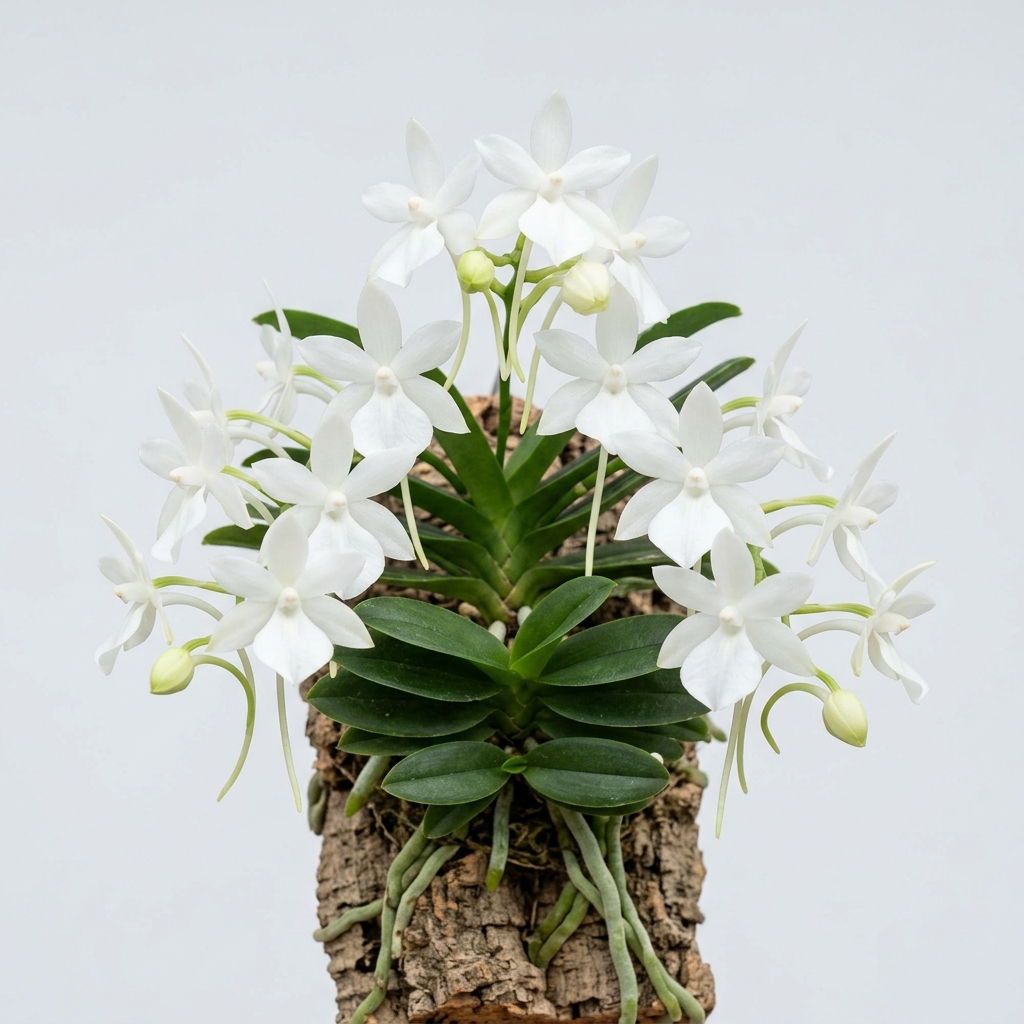
Aerangis Fastuosa is a highly prized miniature orchid species celebrated for its remarkably large, pristine white blossoms that contrast beautifully with its compact, dark green foliage. Originating from the humid, shaded forests of Madagascar, this epiphytic gem is a favorite among space-conscious collectors and orchid enthusiasts who appreciate its elegant growth habit and dramatic floral display. Despite its small stature, the plant produces flowers that can easily rival or exceed the size of the entire growth rosette, making it a true showstopper in any indoor collection.
Cultivating this exquisite orchid requires a careful balance of high humidity, moderate temperatures, and excellent air circulation to mimic its native canopy environment. While it can be grown in small pots or baskets, Aerangis Fastuosa truly thrives when mounted on cork bark or hardwood branches, allowing its vigorous aerial roots to dry quickly after watering. For growers willing to meet its specific environmental preferences, this species rewards patience with a spectacular seasonal bloom and a captivating nocturnal fragrance.
💡 Did You Know?
Aerangis Fastuosa belongs to the Aerangis orchid group, where flower presentation is often just as important as . White-flowered cultivars are especially valued indoors because their pale blooms reflect well and pair easily with many home, greenhouse, and display settings.
🌿 Botanical Overview
Aerangis Fastuosa belongs to the subtribe Angraecinae, a group of African and Madagascan orchids famous for their star-shaped flowers and elongated nectar spurs. In its native habitat, this species grows as an epiphyte on the twigs and branches of evergreen trees, where it is exposed to constant air movement and dappled sunlight. The plant features a very short stem, often completely obscured by a fan of thick, leathery, obovate leaves that possess a slightly textured or matte surface.
The growth habit is monopodial, meaning it grows upward from a single terminal point, though mature specimens may occasionally produce basal offsets over time. The roots of Aerangis Fastuosa are relatively thick and fleshy for a plant of its size, covered in a silvery velamen layer that efficiently absorbs moisture and nutrients from the surrounding air. This specialized root system highlights the plant’s adaptation to an epiphytic lifestyle, where water must be captured rapidly during rain events.
🌸 Flower Characteristics
The flowers of Aerangis Fastuosa are the defining feature of the species, characterized by their brilliant, crystalline white coloration and surprisingly large size, often measuring up to two inches (five centimeters) in diameter. Each inflorescence typically carries one to six flowers, which are presented on short, horizontal to slightly arching spikes that emerge from the leaf axils. The petals and sepals are lanceolate to ovate, spreading widely to create a starry, open form that commands immediate attention.
A prominent feature of the flower is the long, slender nectar spur that projects backward from the base of the lip, often reaching lengths of three inches or more. This spur is a classic evolutionary adaptation designed to attract specific nocturnal pollinators, such as hawkmoths, which possess long proboscises capable of reaching the nectar at the very tip. The pristine white of the blossoms remains clean and unblemished throughout the bloom cycle, providing a striking contrast against the dark, forest-green foliage.
Fragrance & Bloom Profile
One of the most enchanting attributes of Aerangis Fastuosa is its intense nocturnal fragrance, which begins to emanate as dusk falls and peaks during the middle of the night. The scent is commonly described as a sweet, rich blend resembling jasmine, gardenia, or tuberose, designed to guide night-flying pollinators to the flowers in the dark forest understory. During the day, the fragrance is typically absent or very faint, allowing the plant to conserve energy.
The blooms are remarkably long-lasting for a miniature orchid, often remaining in pristine condition for three to five weeks if kept in a cool, stable environment. To maximize the lifespan of the flowers, growers should avoid getting water directly on the petals, as excess moisture can lead to premature spotting or fungal decay. The combination of visual elegance and powerful nighttime scent makes the blooming period of this orchid a highly anticipated annual event.
Parentage & Hybrid Lineage
Unlike many commercially available orchids, Aerangis Fastuosa is primarily grown and appreciated as a distinct, naturally occurring species rather than a complex artificial hybrid. It is recognized within the horticultural community under its accepted botanical name, and while select line-bred cultivars exist to improve flower size or plant vigor, these retain the essential characteristics of the wild species.
In orchid registration databases, hybridizers have occasionally used Aerangis Fastuosa to create interspecific or intergeneric hybrids within the Angraecum alliance, aiming to introduce its compact growth habit and large flower size to other lineages. However, these hybrids remain relatively uncommon in the general trade, and the pure species continues to be the most sought-after form for collectors focusing on authentic Madagascan flora.
🌱 Growing Conditions
To cultivate Aerangis Fastuosa successfully, growers must recreate the dappled, humid conditions of its native forest canopy. It prefers moderate to low light levels, equivalent to those suitable for Phalaenopsis orchids, typically ranging from 1,000 to 1,500 foot-candles. Direct, unfiltered sunlight should be strictly avoided, as it can quickly scorch the tender, leathery leaves and cause irreversible damage to the compact growth point.
💡 Care Tip
For best results, grow Aerangis Fastuosa in bright filtered with steady and gentle airflow. Avoid placing the plant in harsh midday sun, but do not keep it in a dark corner; weak is one of the most common reasons cultivated orchids refuse to rebloom.
Temperature: wise, this species is quite adaptable but generally thrives in intermediate to warm conditions, with daytime temperatures between 70 and 85 degrees Fahrenheit (21 to 29 degrees Celsius) and a slight drop of 10 degrees at night. High relative humidity is crucial, ideally maintained between 60% and 80%. To prevent stagnant air from encouraging bacterial or fungal rot, a continuous, gentle movement of air from a small fan is highly recommended, especially in enclosed growing spaces.
Watering, Feeding & Potting Media
Watering practices for Aerangis Fastuosa depend heavily on how the plant is housed. Mounted specimens on cork bark or tree fern plaques require daily watering during the active growing season, as their roots dry out rapidly in the open air. If grown in small pots or net baskets, a highly porous medium such as premium New Zealand sphagnum moss or fine-grade fir bark should be used, allowing the roots to remain damp but never waterlogged.
During the active spring and summer growth phases, the orchid benefits from regular, weak fertilization. A balanced, water-soluble orchid fertilizer applied at one-quarter to one-half strength every two weeks is generally sufficient. It is important to flush the root system thoroughly with pure water between fertilizer applications to prevent harmful mineral salts from accumulating on the sensitive velamen of the roots.
Blooming Season & Care Notes
Aerangis Fastuosa typically initiates its blooming cycle in late winter or early spring, though variations can occur depending on local indoor climates and light cycles. The development of the flower spikes is a slow process that requires patience, often taking several weeks from the first appearance of the spike in the leaf axil to the opening of the buds. Maintaining stable humidity and avoiding sudden temperature fluctuations during this period is critical to prevent bud drop.
Once the blooming cycle is complete, the old flower spikes can be carefully snipped off near the base of the stem using sterilized cutting tools. This is also the ideal time to evaluate the potting medium or mount; if the moss has degraded or the cork plaque has deteriorated, repotting or remounting should be performed just as new root tips begin to emerge, minimizing transplant shock and allowing the plant to establish quickly.
⚠️ Common Issues
⚠️ Common Mistake
The most common mistake is by calendar instead of root and potting-media condition. Aerangis roots need moisture and air at the same time, so constantly wet bark or sphagnum can lead to root loss even when the leaves still look healthy.
- Root Rot:
Caused by overwatering or compacted, poorly draining potting media that deprives the roots of essential oxygen. - Bud Blast:
The sudden yellowing and dropping of flower buds, often triggered by low humidity, drafty conditions, or sudden temperature shifts. - Leaf Scorching: Bleached or blackened patches on the foliage resulting from exposure to direct, intense sunlight.
- Spider Mites and Mealybugs: Common pests that hide in the tight crevices of the leaf joints; treat promptly with insecticidal soap or horticultural oil.
- Dehydration:
Shriveled leaves and dry, brittle roots indicating insufficient watering frequency, particularly common in mounted specimens.
❓ Frequently Asked Questions
How often should I water my mounted Aerangis Fastuosa?
Mounted specimens typically require daily watering or heavy misting during the warm spring and summer months, as the exposed roots dry out within hours. In the cooler winter season, watering frequency can be reduced to every two to three days, depending on your indoor humidity levels.
Why are the flower buds on my orchid turning yellow and falling off?
This issue, known as bud blast, is usually caused by a sudden environmental shock, such as a drop in humidity, exposure to cold drafts, or underwatering. Ensuring a stable environment with high humidity and consistent moisture while the spikes are developing will help prevent this problem.
Can Aerangis Fastuosa be grown successfully under LED lights?
Yes, this miniature orchid adapts exceptionally well to artificial lighting. Position the plant under moderate-intensity LED grow lights, ensuring it is placed at a safe distance to prevent heat stress or leaf scorch, and maintain a consistent twelve-hour light cycle.
What is the best potting medium if I choose not to mount this orchid?
If you prefer pot culture, use a very small, well-ventilated net pot or clay pot filled with high-quality New Zealand sphagnum moss or a mix of fine bark and perlite. This setup retains necessary moisture while allowing excellent airflow around the root system.
⭐ Final Growing Notes
Aerangis Fastuosa remains one of the most rewarding miniature orchids for both intermediate and advanced growers who appreciate the unique beauty of African epiphytes. Its compact size makes it an ideal candidate for terrariums, Wardian cases, or windowsill culture, provided its humidity and airflow requirements are met. By offering consistent moisture, shaded light, and a stable environment, you can enjoy the spectacular contrast of its oversized, crystalline white blossoms and its intoxicating nighttime fragrance year after year.
⚕️ Health, Safety & Edibility
Understanding how a plant interacts with people, pets, and the surrounding environment is part of responsible cultivation. This section uses conservative, general guidance and does not replace professional medical or veterinary advice.
Human Safety: No published evidence currently identifies species-specific toxicity concerns for Aerangis Fastuosa during normal handling. As with most ornamental plants, it should not be intentionally consumed.
Pet Safety: Published information does not indicate that this orchid commonly poses a toxicity concern for cats or dogs. However, chewing leaves, flowers, roots, or potting media may still cause mild digestive upset.
Edibility: This orchid is cultivated for ornamental display rather than food. Ornamental plants may carry fertilizers, pesticides, or other horticultural treatments that make them unsuitable for consumption.
Skin Contact: Routine handling is not generally associated with skin irritation. Gardeners with sensitive skin may prefer wearing gloves when repotting, pruning, or handling potting media.
🌱 Propagation Tip
Propagation should be approached patiently. Most home growers should wait for natural keikis or divide only mature, healthy plants when the orchid type allows it. Never remove a young growth until it has strong roots and enough leaves to support itself away from the parent plant.
⭐ Expert Advice
Repot after flowering when fresh root tips begin to appear. This timing helps the plant anchor quickly into new bark or sphagnum and reduces stress, especially for orchids grown indoors where airflow, , and drying speed can change from season to season.

Leave A Comment