
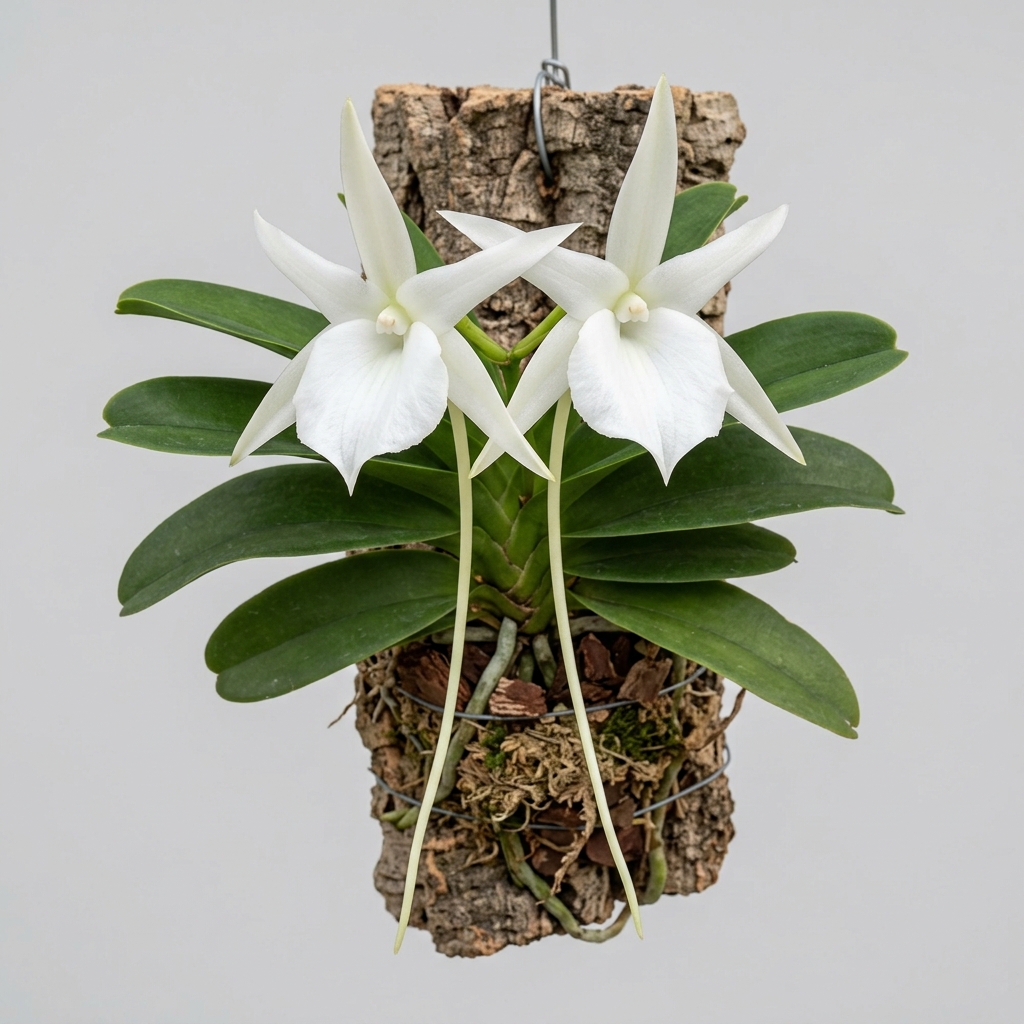
Angraecum Elephantinum, commonly known as the elephant Angraecum, is a highly prized miniature epiphytic orchid native to the montane forests of Madagascar. Despite its compact growth habit, this species is celebrated among collectors for producing remarkably large, star-shaped white blossoms that seem to dwarf the plant itself. Its elegant presentation and architectural foliage make it a standout addition to any indoor orchid collection or specialized terrarium.
As a member of the Vandeae tribe, this monopodial orchid features a fan of thick, leathery leaves that store moisture and resist dehydration. Growers value the cultivar for its manageable size and its reliable, night-fragrant blooms, which fill the growing space with a sweet, jasmine-like aroma. While it requires attentive care regarding humidity and watering, its striking floral display rewards the dedicated hobbyist with a classic representation of Madagascan orchid diversity.
💡 Did You Know?
The long nectar spur of Angraecum Elephantinum is an evolutionary adaptation for moth pollination. In the wild, only specific hawkmoths with exceptionally long proboscises can reach the nectar at the bottom of the spur, transferring pollen from flower to flower in the process.
🌿 Botanical Overview
Angraecum Elephantinum is characterized by its monopodial growth habit, meaning it grows upward from a single stem rather than spreading horizontally via pseudobulbs. The plant remains relatively small, typically reaching only a few inches in height, with tightly overlapping, distichous leaves that form a neat, fan-like arrangement. These leaves are thick, fleshy, and slightly bilobed at the tips, adapted to capture and retain moisture in its native humid environment.
In the wild, this epiphyte clings to mossy tree branches where it receives excellent air circulation and dappled sunlight. Its root system is robust and fleshy, covered in a thick layer of velamen that rapidly absorbs water and atmospheric moisture. Understanding this natural epiphytic lifestyle is key to successfully cultivating the species in a home or greenhouse setting.
🌸 Flower Characteristics
The flowers of Angraecum Elephantinum are arguably its most dramatic feature, often measuring up to three inches across, which is exceptionally large relative to the plant’s overall size. Each bloom is star-shaped, featuring narrow, pointed sepals and petals of a crystalline white or pale cream hue. The prominent lip, or labellum, is broad and shell-shaped, tapering into a long, green-tinted nectar spur that hangs down behind the flower.
Flowers typically emerge singly or in pairs from the leaf axils on short inflorescences. The heavy substance of the petals ensures that the blooms remain pristine and long-lasting, often remaining in perfect condition for several weeks. The contrast between the dark green, compact foliage and the luminous white blossoms creates a striking visual impact.
Fragrance & Bloom Profile
Consistent with many species in the genus Angraecum, Angraecum Elephantinum is highly fragrant, but its scent profile is strictly nocturnal. During the day, the flowers emit virtually no odor, conserving energy until dusk. As night falls, the blooms release a powerful, sweet fragrance reminiscent of jasmine, gardenia, or sweet spices, designed to attract night-flying sphinx moths for pollination.
The blooming cycle generally occurs once a year, with flowers lasting anywhere from three to six weeks depending on environmental conditions. To maximize the duration of the bloom and the intensity of the fragrance, growers should maintain stable temperatures and avoid spraying water directly onto the delicate petals, which can cause spotting or premature decay.
Parentage & Hybrid Lineage
Angraecum Elephantinum is a distinct, naturally occurring species rather than a man-made hybrid. While it is sometimes confused with its close relative, Angraecum didieri, it is generally distinguished by its slightly larger flower size, broader leaves, and distinct vegetative growth pattern. In orchid registry databases, it is recognized as a valid species within the section Perrierangraecum.
Although primarily grown as a species, hybridizers occasionally use Angraecum Elephantinum in breeding programs to introduce compact growth habits and large flower sizes to new intergeneric or intrageneric hybrids. However, documented registered hybrids utilizing this specific parent are relatively limited in commercial trade, making the pure species the primary focus for collectors.
🌱 Growing Conditions
To cultivate Angraecum Elephantinum successfully, growers must replicate its native montane habitat. It thrives in moderate to bright indirect light, similar to the light levels preferred by Cattleya orchids. Direct midday sun should be avoided as it can easily scorch the fleshy leaves, while too little light will inhibit flowering.
💡 Care Tip
Always water this orchid in the morning to ensure that any water trapped in the crown or leaf axils evaporates before nightfall. Stagnant water in the tight fan of leaves is a primary cause of crown rot.
Temperature ranges should ideally remain intermediate to warm, with daytime temperatures between 75°F and 85°F (24°C to 29°C) and a nighttime drop to around 60°F to 65°F (15°C to 18°C). High humidity is crucial, ideally maintained between 60% and 80%. Constant, gentle air movement is essential to prevent stagnant air pockets, which can lead to fungal infections on the leaves and roots.
Watering, Feeding & Potting Media
Watering should be frequent and thorough, allowing the potting medium to almost dry out between applications. Because the plant lacks pseudobulbs for water storage, it cannot tolerate prolonged droughts. During the active growing season in spring and summer, water the plant as soon as the media feels dry to the touch; reduce watering slightly during the cooler winter months.
This species can be grown in small plastic or clay pots filled with a highly porous, free-draining medium such as medium-grade fir bark mixed with charcoal and perlite. Alternatively, many growers prefer to mount the plant on cork bark or tree fern plaques with a small pad of sphagnum moss around the roots. Feed weekly with a highly diluted, balanced orchid fertilizer (such as a quarter-strength 20-20-20 formula) during the active growth phase, flushing the pot with pure water once a month to prevent salt buildup.
Blooming Season & Care Notes
The primary blooming season for Angraecum Elephantinum typically spans from late autumn through winter, triggered by the natural drop in night temperatures and shorter day lengths. Once the flower spikes begin to emerge from the leaf joints, avoid moving the plant or changing its orientation to the light source, as this can cause the buds to twist or fail to open properly.
After the flowering cycle is complete, the old flower spikes can be carefully snipped near the base using sterilized shears. Repotting or remounting should only be performed when new root growth is active, typically in early spring. Minimize root disturbance during this process, as Angraecums are notoriously sensitive to root damage and may take a season or two to recover if handled roughly.
⚠️ Common Issues
⚠️ Common Mistake
A frequent error is using a potting container that is far too large. This orchid prefers tight quarters; an oversized pot holds excess moisture for too long, leading to root suffocation and rapid plant decline.
- Root rot: Caused by overwatering or compacted, poorly draining potting media that suffocates the roots.
- Bud blast: Sudden dropping or yellowing of flower buds due to rapid changes in temperature, low humidity, or drafts.
- Leaf spotting: Fungal or bacterial spots arising from water sitting on the leaves overnight or inadequate air circulation.
- Spider mites and scale: Pests that can hide in the tight crevices of the fan-shaped leaves; treat promptly with insecticidal soap or horticultural oil.
- Dehydration: Indicated by wrinkled, limp leaves, usually resulting from underwatering or a compromised root system that cannot absorb water.
❓ Frequently Asked Questions
How do I encourage my Angraecum Elephantinum to bloom?
To stimulate blooming, ensure the plant receives bright, indirect light throughout the year and experiences a distinct drop in nighttime temperatures (around 10°F to 15°F lower than daytime temperatures) during the autumn months. Consistent humidity and a regular, diluted feeding schedule during the summer growing season also build the energy required for flower production.
Can Angraecum Elephantinum be grown under LED lights?
Yes, this compact orchid is highly suited for indoor cultivation under LED grow lights. Position the plant so it receives moderate to high light intensity, ensuring the lights are kept at a safe distance to prevent heat damage. A photoperiod of 12 to 14 hours during the growing season, reduced slightly in winter, works exceptionally well.
Why are the tips of my orchid’s roots turning brown and dying?
Brown, dying root tips are usually a sign of either chemical burn from fertilizer salt buildup or insufficient humidity. Ensure you dilute your fertilizer to a quarter-strength and flush the potting medium with pure, distilled, or rainwater once a month. Additionally, maintain humidity levels above 60% to keep the active root tips hydrated.
Is it better to pot or mount Angraecum Elephantinum?
Both methods can be successful depending on your growing environment. Mounting on cork bark allows the roots to dry rapidly and mimics their natural epiphytic habit, but requires daily watering in typical home environments. Potting in a small clay pot with coarse bark is often easier for indoor growers as it retains moisture longer while still providing excellent aeration.
⭐ Final Growing Notes
Angraecum Elephantinum is a rewarding and visually stunning miniature orchid that brings a touch of Madagascan exoticism to any collection. While its high humidity and precise watering requirements demand a bit of attention, its compact size makes it highly manageable even for those with limited space. By providing bright indirect light, excellent air movement, and respecting its nocturnal nature, you will be treated to spectacular, fragrant white stars that illuminate the winter months.
⚕️ Health, Safety & Edibility
Understanding how a plant interacts with people, pets, and the surrounding environment is part of responsible cultivation. This section uses conservative, general guidance and does not replace professional medical or veterinary advice.
Human Safety: No published evidence currently identifies species-specific toxicity concerns for Angraecum Elephantinum during normal handling. As with most ornamental plants, it should not be intentionally consumed.
Pet Safety: Published information does not indicate that this orchid commonly poses a toxicity concern for cats or dogs. However, chewing leaves, flowers, roots, or potting media may still cause mild digestive upset.
Edibility: This orchid is cultivated for ornamental display rather than food. Ornamental plants may carry fertilizers, pesticides, or other horticultural treatments that make them unsuitable for consumption.
Skin Contact: Routine handling is not generally associated with skin irritation. Gardeners with sensitive skin may prefer wearing gloves when repotting, pruning, or handling potting media.
🌱 Propagation Tip
Unlike sympodial orchids, Angraecum Elephantinum cannot be divided. Propagation is typically limited to the occasional production of basal offsets, known as keikis. Allow the keiki to develop a robust system of several roots at least two inches long before carefully detaching it.
⭐ Expert Advice
If growing mounted, hang the plant at a slight downward angle. This natural positioning prevents water from pooling in the crown and allows gravity to assist with drainage, significantly reducing the risk of crown rot over time.

Leave A Comment