
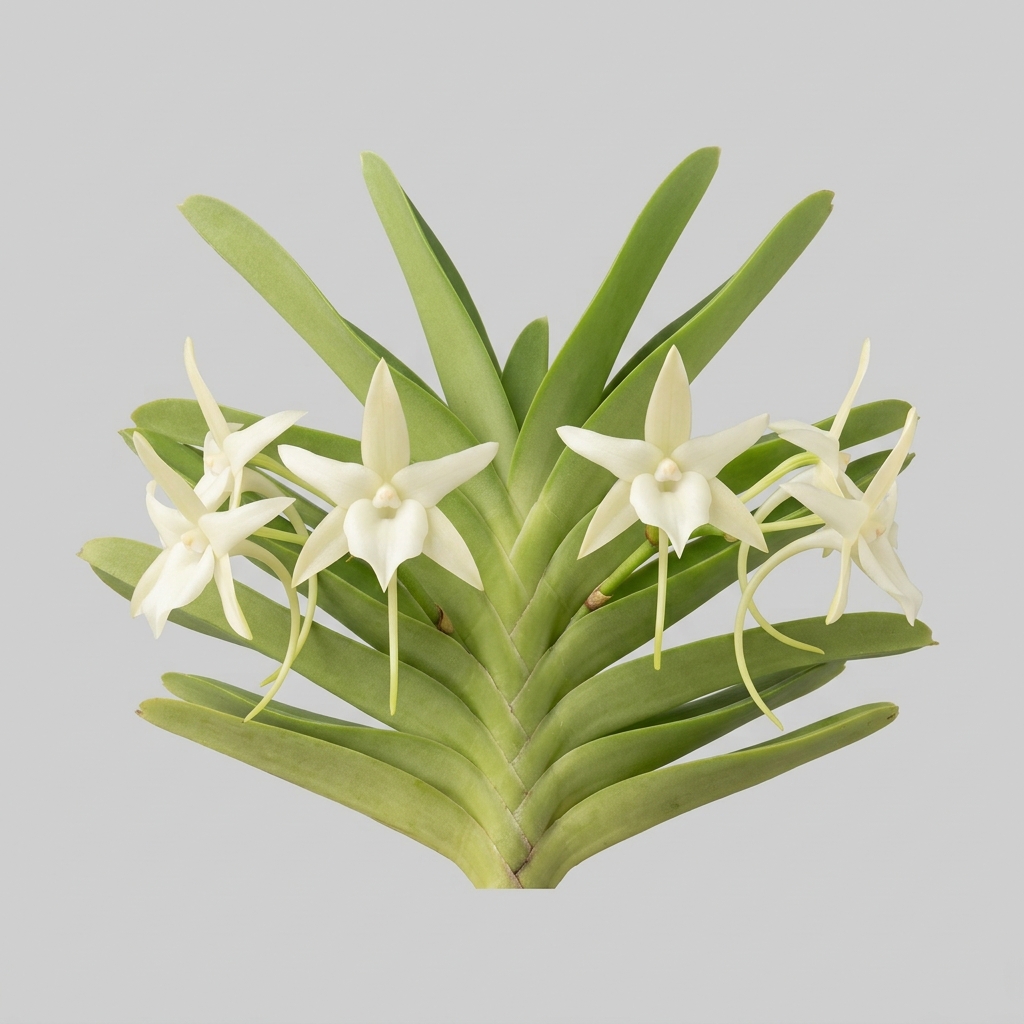
Angraecum Leonis is a highly prized species within the Angraecum genus, celebrated for its distinctive fan-like growth habit and elegant, star-shaped white blossoms. Native to Madagascar and the Comoro Islands, this compact epiphyte captures the attention of orchid enthusiasts worldwide, offering a striking architectural presence even when not in bloom.
Cultivating this orchid provides a rewarding experience for growers who can accommodate its specific environmental preferences. With its thick, succulent-like leaves and long-spurred, night-fragrant flowers, it represents a classic example of Darwin’s orchids, relying on specialized pollinators in its native habitat.
💡 Did You Know?
The species name leonis honors Leon Humblot, a French naturalist and botanical collector who was active in the Comoro Islands during the late nineteenth century. Its unique fan-shaped leaves are an evolutionary adaptation designed to shed heavy tropical rainfall quickly, preventing water from pooling in the crown and causing rot in its native forest canopy.
🌿 Botanical Overview
Angraecum Leonis is distinguished by its remarkable equitant growth habit, where the thick, fleshy leaves overlap in a single plane to form a perfect, symmetrical fan. These laterally compressed leaves are highly succulent, an evolutionary adaptation that allows the plant to store moisture and survive brief periods of drought in its native canopy environments.
In nature, this species is found in two distinct geographic regions: the high-altitude forests of Madagascar and the lower, more humid coastal areas of the Comoro Islands. This dual origin has resulted in slight variations in plant size, but both forms share the same robust, epiphytic nature, clinging to tree branches where they receive excellent air circulation and filtered sunlight.
🌸 Flower Characteristics
The flowers of Angraecum Leonis are a testament to evolutionary elegance, featuring pristine white to light cream petals and sepals that form a classic star shape. The lip, or labellum, is broad, shell-shaped, and deeply concave, serving as a visual guide for nocturnal pollinators. Each flower is equipped with a long, gracefully curved nectar spur extending from the back of the lip, measuring up to six inches in length.
The blooms are produced on short, arching inflorescences that emerge from the leaf axils. A single spike can carry anywhere from one to eight flowers, which are presented in a neat, organized row. The heavy, waxy substance of the petals ensures that the flowers remain in perfect condition for several weeks.
Fragrance & Bloom Profile
While the flowers are virtually scentless during the daylight hours, they undergo a dramatic transformation at dusk. As night falls, Angraecum Leonis releases an intense, sweet fragrance reminiscent of jasmine, gardenia, and citrus. This vespertine scent production is a highly specialized mechanism designed to attract night-flying hawkmoths, which are the primary pollinators of this genus in the wild.
The blooming cycle typically begins in late autumn and extends through the winter months. Under optimal growing conditions, individual flowers can last between four and six weeks, providing a long-lasting display of crystalline white beauty during the darkest months of the year.
Parentage & Hybrid Lineage
Angraecum Leonis is a naturally occurring species rather than an artificial hybrid. Because of its outstanding traits, including its compact size, unique foliage, and powerful nighttime fragrance, it has been used as a parent in several notable intergeneric and intrageneric hybrids. However, none of these hybrids have surpassed the popularity of the pure species among collectors.
Within the species, growers recognize two primary forms: the Madagascar form and the Comoro form. The Comoro form is generally larger with longer, more flexible leaves, while the Madagascar form remains highly compact with stiff, deeply compressed leaves. Both forms are highly valued and cared for in a similar manner.
🌱 Growing Conditions
To cultivate Angraecum Leonis successfully, growers must replicate its tropical canopy home. It thrives in bright, indirect light, similar to the conditions preferred by Cattleya orchids. A light green leaf color indicates ideal light levels, while dark green leaves suggest insufficient light, and yellowing or reddish tints indicate excessive exposure.
💡 Care Tip
To prevent crown rot, always water this orchid early in the morning so any moisture that accidentally splashes onto the fan-shaped leaves can evaporate before nightfall. Positioning a small fan nearby to maintain gentle, continuous air movement is highly beneficial.
Temperature requirements are intermediate to warm, with daytime temperatures ranging between 75 and 85 degrees Fahrenheit, and a night drop to 60 or 65 degrees Fahrenheit. High humidity of 60% to 80% is essential, but it must be accompanied by strong, continuous air movement to prevent stagnant moisture from settling in the leaf joints.
Watering, Feeding & Potting Media
Watering should be frequent and thorough during the active growing season in spring and summer, allowing the potting medium to dry out slightly but never completely dehydrate. In the winter, watering should be reduced, keeping the media just damp enough to prevent the succulent leaves from shriveling.
A balanced, water-soluble orchid fertilizer applied at one-quarter strength every second or third watering is ideal during active growth. The potting medium must offer exceptional drainage and aeration; a mix of coarse fir bark, charcoal, and perlite works well. Alternatively, this species performs exceptionally well when mounted on cork bark slabs, provided the grower can maintain high ambient humidity.
Blooming Season & Care Notes
The primary blooming season occurs from late autumn to early spring. The initiation of flower spikes is triggered by the natural seasonal drop in night temperatures and a slight reduction in day length. Once the flower spikes begin to emerge from the leaf axils, it is crucial to keep the plant in a stable position, as changing its orientation can cause the developing buds to twist or blast.
Repotting should only be performed when absolutely necessary, typically every two to three years, as this species dislikes root disturbance. The best time to repot or remount is immediately after the flowering cycle has finished, just as new root tips begin to emerge from the base of the plant.
⚠️ Common Issues
⚠️ Common Mistake
The most common mistake is using a fine, water-retaining potting mix. This orchid requires rapid drainage and high air porosity around its roots. Packing it in dense sphagnum moss without adequate aeration will quickly lead to root suffocation and rot.
- Root Rot:
Occurs when the potting medium degrades and retains too much moisture, suffocating the thick, air-loving roots. - Crown Rot:
Water trapped in the tight, overlapping leaf fan can quickly cause fungal or bacterial rot, leading to leaf loss. - Bud Blast:
Sudden drops in humidity, cold drafts, or moving the plant while buds are developing can cause them to yellow and drop. - Mealybugs and Scale: These common pests frequently hide in the deep crevices of the overlapping leaves, requiring systemic treatment or manual removal.
❓ Frequently Asked Questions
Why are the leaves on my Angraecum Leonis turning yellow?
Yellowing leaves can indicate overwatering, poor drainage leading to root rot, or excessive direct sunlight. If the lowest leaves yellow and drop naturally over time, it is normal aging, but widespread yellowing requires an immediate check of the root system and light levels.
How do I trigger blooming in Angraecum Leonis?
Blooming is typically initiated by a combination of bright light and a noticeable drop in night temperatures during the autumn months. Ensuring the plant experiences a 10-to-15-degree Fahrenheit difference between day and night will encourage spike development.
Can I grow Angraecum Leonis mounted instead of in a pot?
Yes, mounting on cork bark or tree fern slabs is highly successful and mimics its natural epiphytic habit. However, mounted plants dry out much faster and require daily watering or a dedicated high-humidity greenhouse environment to thrive.
What is the difference between the Madagascar and Comoro forms?
The Comoro Islands form is typically larger, with longer, more pliable leaves and slightly larger flowers. The Madagascar form is highly compact, with shorter, stiffer, and more deeply compressed leaves, making it ideal for growers with limited space.
⭐ Final Growing Notes
Angraecum Leonis remains one of the most rewarding orchids for intermediate and advanced growers alike. Its striking fan-shaped silhouette provides year-round visual interest, while its crystalline white, night-fragrant winter blooms offer an unparalleled sensory experience. By providing bright, filtered light, excellent air movement, and a highly porous growing medium, enthusiasts can enjoy this spectacular Madagascan treasure for many years.
⚕️ Health, Safety & Edibility
Understanding how a plant interacts with people, pets, and the surrounding environment is part of responsible cultivation. This section uses conservative, general guidance and does not replace professional medical or veterinary advice.
Human Safety: No published evidence currently identifies species-specific toxicity concerns for Angraecum Leonis during normal handling. As with most ornamental plants, it should not be intentionally consumed.
Pet Safety: Published information does not indicate that this orchid commonly poses a toxicity concern for cats or dogs. However, chewing leaves, flowers, roots, or potting media may still cause mild digestive upset.
Edibility: This orchid is cultivated for ornamental display rather than food. Ornamental plants may carry fertilizers, pesticides, or other horticultural treatments that make them unsuitable for consumption.
Skin Contact: Routine handling is not generally associated with skin irritation. Gardeners with sensitive skin may prefer wearing gloves when repotting, pruning, or handling potting media.
🌱 Propagation Tip
Angraecum Leonis is primarily propagated by seed in sterile laboratory conditions. However, mature, healthy specimens may occasionally produce basal offsets or keikis. Allow these offsets to develop a robust system of several aerial roots before carefully detaching and potting them independently.
⭐ Expert Advice
When growing this species in a pot, choose a clay pot with side slits to maximize airflow to the root zone. If you notice the roots growing out of the pot into the air, do not force them back down; these aerial roots absorb vital moisture and oxygen from the atmosphere.




Leave A Comment