
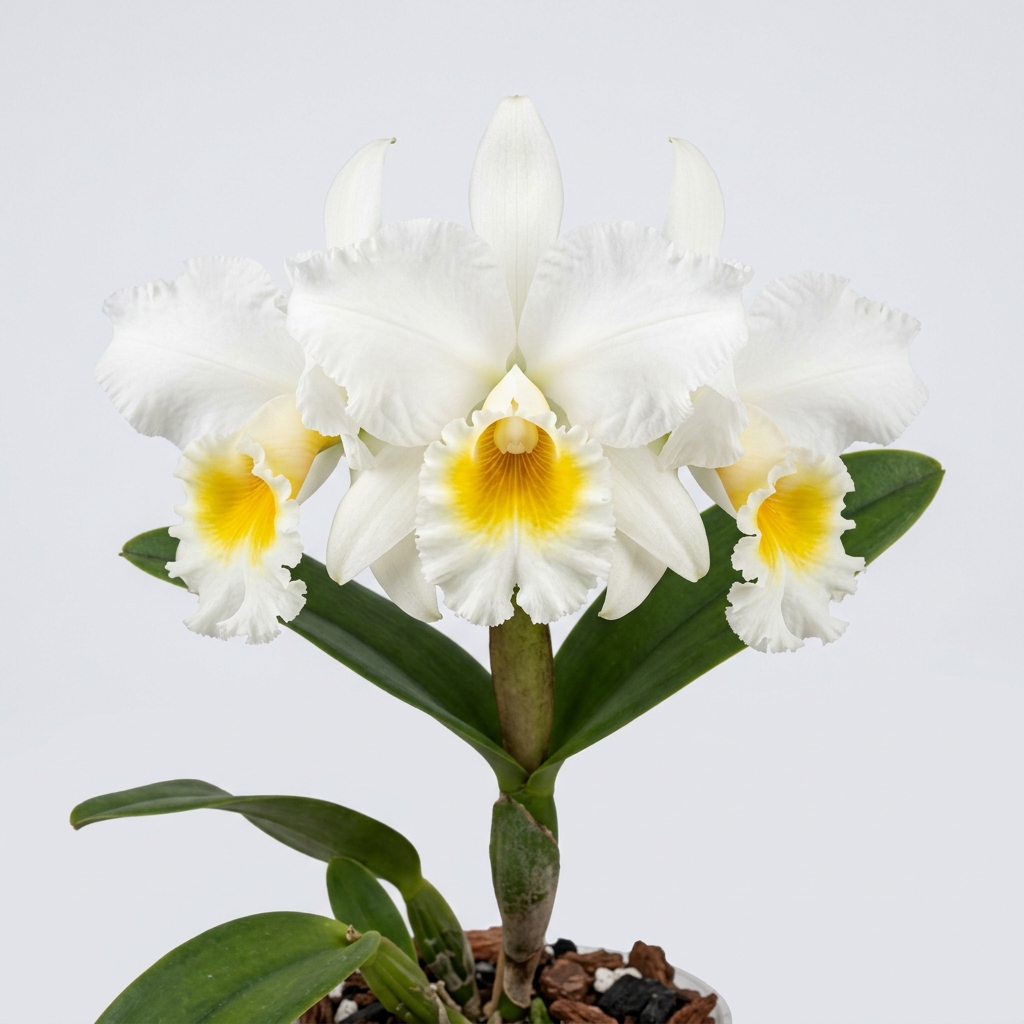
Cattleya Bob Betts is a legendary white-flowered orchid hybrid that represents the pinnacle of mid-twentieth-century Cattleya breeding. Revered for its exceptionally large, pristine white blossoms and heavy substance, this cultivar has long been a benchmark for quality in classic exhibition orchids. Its robust growth habit and elegant presentation make it a highly sought-after addition for collectors of traditional large-flowered Cattleya species and hybrids.
As an epiphyte native to the tropical canopy environments of its ancestral species, this orchid thrives under bright, filtered light and distinct wet-to-dry watering cycles. Cultivating Cattleya Bob Betts successfully requires attention to seasonal growth patterns, but the reward of its massive, fragrant blooms makes it an incredibly satisfying subject for intermediate and advanced orchid enthusiasts alike.
💡 Did You Know?
Cattleya Bob Betts is named after a prominent orchid grower and has been a parent to numerous award-winning white Cattleya hybrids. Its exceptional genetic traits, particularly the heavy substance of its petals, revolutionized the breeding of white exhibition orchids in the mid-twentieth century, setting a standard that modern hybridizers still strive to achieve.
🌿 Botanical Overview
Cattleya Bob Betts shows a sympodial growth habit, producing thick, club-shaped pseudobulbs topped by leathery, dark green leaves. These pseudobulbs serve as vital water and nutrient storage organs, allowing the plant to withstand periods of drought in its native-style environments. The sturdy foliage is designed to handle relatively high light levels, which are essential for triggering the development of flower sheaths.
The root system of this cultivar is typical of epiphytic orchids, characterized by thick, fleshy roots covered in a white, spongy layer called velamen. This velamen rapidly absorbs moisture and nutrients when wet and helps anchor the plant to its growing substrate. Healthy root development is the foundation of successful cultivation, directly influencing the size and quality of the seasonal blooms.
🌸 Flower Characteristics
The flowers of Cattleya Bob Betts are celebrated for their impressive size, often reaching six to eight inches in diameter under optimal growing conditions. The petals and sepals are broad, overlapping, and exhibit a crystalline, snowy white texture that catches the light beautifully. The ruffled labellum, or lip, is particularly striking, featuring a wide, open throat adorned with a rich, golden-yellow interior that provides a stunning contrast to the pure white segments.
Blooms are typically produced in clusters of two to four on a strong, upright inflorescence that emerges from a protective green sheath at the apex of the mature pseudobulb. The heavy substance of the petals ensures that the flowers maintain their shape and presentation for several weeks, resisting wilting and drooping even in warm indoor environments.
Fragrance & Bloom Profile
One of the most defining characteristics of Cattleya Bob Betts is its intense, sweet fragrance. The scent is typically described as a classic, rich floral perfume with subtle citrus or vanilla undertones, which becomes most pronounced during the morning hours when temperatures rise and light levels increase. This powerful aroma can easily fill an entire room or greenhouse space.
The blooming cycle generally lasts between three to five weeks, depending on ambient temperatures and humidity levels. Cooler conditions will help prolong the life of the flowers, while excessive heat or dry air can cause them to fade prematurely.
Parentage & Hybrid Lineage
Registered in the mid-twentieth century, Cattleya Bob Betts is widely documented as a primary hybrid cross between Cattleya Bow Bells and Cattleya mossiae. This lineage combines the exceptional form and pristine white color of Bow Bells with the vigor, hardiness, and classic ruffled lip of mossiae.
While historical records attribute the registration of this grex to McDade in 1950, variations in individual clonal selections exist due to decades of later meristem propagation and sibling crosses. Growers should note that while the general characteristics of the grex remain consistent, specific awarded clones may exhibit slight differences in flower size, substance, and growth rate.
🌱 Growing Conditions
To cultivate Cattleya Bob Betts successfully, providing bright, filtered light is paramount. The foliage should ideally be a light, grassy green color; dark green leaves indicate insufficient light, which will prevent blooming, while yellowing or scorched leaves suggest the light is too intense. East or shaded south-facing windows are typically ideal for indoor growers.
💡 Care Tip
To ensure optimal bud development, avoid moving the plant or changing its orientation once the flower sheath begins to swell. Sudden changes in direction can cause the developing buds to twist or fail to open properly.
Temperature ranges should mimic tropical intermediate-to-warm zones. Daytime temperatures between 75°F and 85°F (24°C to 29°C) coupled with a nighttime drop to 60°F or 65°F (15°C to 18°C) are highly beneficial. This diurnal temperature fluctuation is a key trigger for initiating flower buds within the developing sheaths. High humidity of 50% to 70% accompanied by constant, gentle air movement is essential to prevent fungal pathogens from settling on the foliage.
Watering, Feeding & Potting Media
Watering must be approached with a soak and dry strategy. The potting medium should be thoroughly saturated and then allowed to dry out almost completely before the next application. During active growth in spring and summer, the plant will require more frequent watering, whereas watering should be reduced significantly during the cooler winter resting phase.
A coarse, free-draining potting medium is critical to prevent root rot. A mix composed primarily of medium-to-large fir bark, horticultural charcoal, and coarse perlite or sponge rock works exceptionally well. Feeding should be done weekly using a balanced orchid fertilizer diluted to one-quarter or one-half strength, applying it only when the medium is already damp to avoid burning the sensitive root tips.
Blooming Season & Care Notes
Cattleya Bob Betts typically initiates its blooming cycle in the late winter or early spring, though variations can occur depending on local microclimates and cultural practices. As the new pseudobulb matures, a green sheath will form at the leaf base. Bud development inside the sheath can take several weeks, during which stable conditions should be maintained.
Once the flowers fade, the spent spike should be carefully cut back to the base of the sheath using sterilized cutting tools. Repotting is best performed immediately after flowering, just as new root tips begin to emerge from the base of the newest pseudobulb. This timing ensures the plant establishes quickly in its new medium with minimal transplant shock.
⚠️ Common Issues
⚠️ Common Mistake
A frequent error is repotting the orchid at the wrong time of year. Repotting when the plant is dormant or not actively producing new roots can lead to severe dehydration and a prolonged recovery period that delays blooming for years.
- Root rot caused by overwatering or a decomposing, compacted potting medium that suffocates the roots.
- Bud blast, where developing flower buds turn yellow and drop before opening, often triggered by sudden temperature drops, drafts, or low humidity.
- Scale insects and mealybugs, which tend to hide under the dry, papery sheaths covering the pseudobulbs.
- Fungal leaf spotting or black rot, resulting from poor air circulation combined with water sitting on the leaves overnight.
- Dehydration, characterized by shriveled pseudobulbs and wrinkled leaves, usually caused by a loss of healthy roots rather than a lack of watering.
❓ Frequently Asked Questions
How often should I water my Cattleya Bob Betts?
Watering frequency depends on your environment, but generally, you should water once the potting medium is nearly dry. In typical household conditions, this translates to once every 7 to 10 days, increasing slightly during hot summer months and decreasing during the winter rest period.
Why is my Cattleya Bob Betts not blooming?
The most common reason for a lack of blooms is insufficient light. If the leaves are a dark forest green, move the orchid to a brighter location where it receives bright, indirect sunlight. Additionally, ensure there is a distinct temperature drop of 10 to 15 degrees Fahrenheit between day and night to help trigger bud initiation.
When is the best time to repot this orchid?
The ideal time to repot is immediately after the blooming cycle has finished and you observe new green root tips beginning to emerge from the base of the lead pseudobulb. Repotting at this stage allows the orchid to quickly establish itself in the fresh medium.
Can I grow Cattleya Bob Betts under artificial LED lights?
Yes, this cultivar can be grown successfully under high-output LED grow lights. Ensure the lights are positioned close enough to provide the high light intensity required by Cattleyas, aiming for a photoperiod of 12 to 14 hours daily, while monitoring leaf temperature to prevent heat stress.
⭐ Final Growing Notes
Cattleya Bob Betts remains an enduring masterpiece of orchid hybridization, offering unparalleled elegance with its massive, fragrant white blossoms. By respecting its natural cycle of active summer growth and dry winter rest, and providing it with ample light and excellent drainage, growers can enjoy the spectacular display of this classic cultivar for decades to come.
⚕️ Health, Safety & Edibility
Understanding how a plant interacts with people, pets, and the surrounding environment is part of responsible cultivation. This section uses conservative, general guidance and does not replace professional medical or veterinary advice.
Human Safety: No published evidence currently identifies species-specific toxicity concerns for Cattleya Bob Betts during normal handling. As with most ornamental plants, it should not be intentionally consumed.
Pet Safety: Published information does not indicate that this orchid commonly poses a toxicity concern for cats or dogs. However, chewing leaves, flowers, roots, or potting media may still cause mild digestive upset.
Edibility: This orchid is cultivated for ornamental display rather than food. Ornamental plants may carry fertilizers, pesticides, or other horticultural treatments that make them unsuitable for consumption.
Skin Contact: Routine handling is not generally associated with skin irritation. Gardeners with sensitive skin may prefer wearing gloves when repotting, pruning, or handling potting media.
🌱 Propagation Tip
Propagate this cultivar by division only when the plant has outgrown its pot and has at least six to eight healthy pseudobulbs. Divide the rhizome with a sterile blade, ensuring each new division has at least three active pseudobulbs and a strong lead growth.
⭐ Expert Advice
Keep a close eye on the dry, papery sheaths on the pseudobulbs. Gently peel them away if they become loose, as they can harbor pests like scale and mealybugs. This also allows you to inspect the health of the pseudobulbs directly.

Leave A Comment