
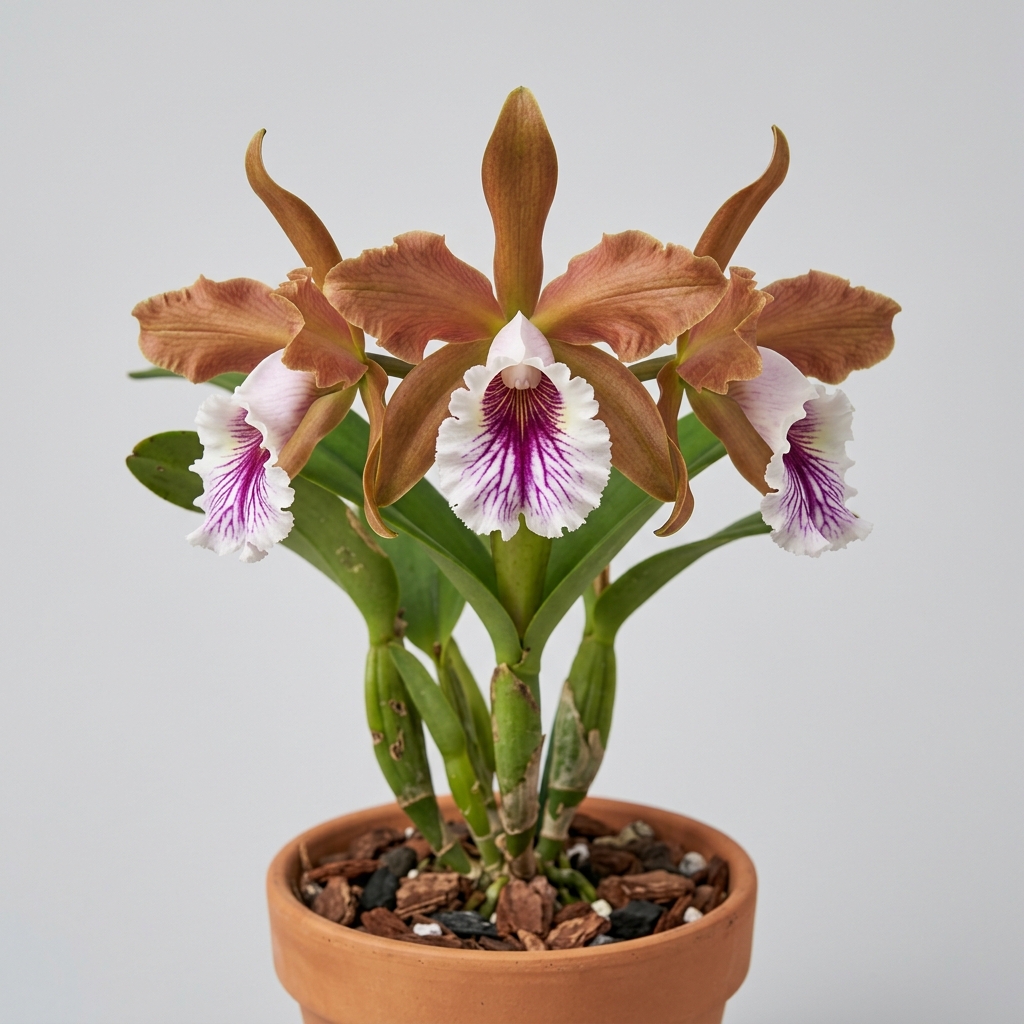
Cattleya Grandis is a striking orchid species highly prized by collectors for its unique color palette and elegant form. Characterized by its coppery-bronze petals and a beautifully contrasting ruffled lip, this orchid brings a touch of dramatic tropical flair to any indoor or greenhouse collection.
Growers value this orchid for its robust growth habit and its reliable, eye-catching summer blooms. While it requires specific attention to light and humidity to thrive, its rewarding floral display makes it a coveted centerpiece for intermediate and advanced orchid enthusiasts alike.
💡 Did You Know?
Cattleya Grandis was historically classified as a Laelia for over a century due to its eight pollinia, rather than the four typically found in Cattleyas. Modern DNA analysis eventually prompted taxonomists to transfer it to the Cattleya, though many traditional growers still affectionately refer to it by its historical name.
🌿 Botanical Overview
Cattleya Grandis is a medium-to-large epiphytic orchid native to the warm, coastal forests of Bahia, Brazil. In its natural habitat, it grows high up on tree trunks and branches, where it is exposed to bright, filtered sunlight and constant air movement. This environment has shaped its physical characteristics, allowing it to store moisture and withstand brief dry spells.
The plant features club-shaped, upright pseudobulbs that can reach up to twelve inches in height. Each pseudobulb is topped with a single, leathery, oblong leaf that is rigid and dark green. These robust structures are designed to store water and nutrients, helping the orchid survive in seasonal tropical environments.
🌸 Flower Characteristics
The flowers of Cattleya Grandis are highly distinctive, typically measuring four to six inches across. The sepals and petals are elegantly wavy, displaying a unique range of colors from pale yellow-bronze to deep coppery-brown. This earthy tone provides a dramatic backdrop for the orchid’s most striking feature: its large, ruffled labellum.
The lip, or labellum, is trumpet-shaped and primarily white or light pink. It is beautifully adorned with rich purple or violet veins that radiate outward from the throat, creating a high-contrast focal point. The flowers are produced on an erect inflorescence that emerges from a green sheath at the apex of the newest pseudobulb, typically carrying two to five blossoms per spike.
Fragrance & Bloom Profile
Cattleya Grandis is known for its pleasant, sweet fragrance, which is most noticeable during the morning hours when temperatures begin to rise. The scent is often described as a delicate mix of floral and herbal notes, though the intensity can vary depending on the specific cultivar and environmental conditions.
The blooms generally last between three to four weeks. To maximize the lifespan of the flowers, growers should keep the plant in a slightly cooler, less humid spot once the buds have fully opened. Avoid spraying water directly on the petals, as this can cause spotting and premature decay of the blossoms.
Parentage & Hybrid Lineage
Originally classified as Laelia grandis in the nineteenth century, modern botanical taxonomy has officially transferred this species to the genus Cattleya. Because it is a naturally occurring species rather than an artificial hybrid, its lineage is pure and direct, representing the wild genetics of its native Brazilian habitat.
Despite being a species, Cattleya Grandis has played an important role in orchid hybridization. Breeders have long valued it for its unusual bronze coloration and large, ruffled lip. It has been crossed with various other Cattleya species to introduce these desirable traits into modern, complex hybrids, though the pure species remains a favorite among purists.
🌱 Growing Conditions
To grow Cattleya Grandis successfully, you must replicate its native tropical canopy environment. It requires bright, indirect light to thrive and bloom. A south or east-facing window with a sheer curtain is ideal. The leaves should maintain a light green color; dark green leaves indicate insufficient light, while yellow or scorched patches suggest too much direct sun.
💡 Care Tip
To encourage robust blooming, ensure your Cattleya Grandis receives bright, dappled that turns the leaves a healthy green. If the leaves are dark green, the plant is not receiving enough to produce its signature bronze flowers.
Temperature: wise, this orchid prefers warm daytime conditions between 75°F and 85°F, with a night drop to around 60°F to 65°F. High humidity of 60% to 80% is essential for healthy growth. To prevent fungal and bacterial diseases in these humid conditions, a small fan should be used to maintain constant, gentle air circulation around the foliage.
Watering, Feeding & Potting Media
Watering should be frequent during the active growing season in spring and summer. Allow the potting medium to dry out almost completely between waterings to prevent root rot. During the winter rest period, reduce watering significantly, providing just enough moisture to keep the pseudobulbs from shriveling.
Feed the plant weekly with a diluted, balanced orchid fertilizer during the active growth phase. A coarse, free-draining potting mix is crucial. A blend of large fir bark, charcoal, and perlite works exceptionally well. Alternatively, experienced growers often cultivate this species in open wooden baskets or mounted on cork slabs to ensure maximum root aeration.
Blooming Season & Care Notes
Cattleya Grandis typically blooms in late spring or early summer, following its primary growth cycle. The flower buds develop inside a protective green sheath at the top of the mature pseudobulb. During this period, avoid moving the plant or changing its orientation to the light source, as sudden changes can cause the buds to blast.
Once the flowering cycle is complete, the orchid enters a brief period of dormancy. This is the ideal time to inspect the plant for repotting needs. Repotting should only be performed when new root tips begin to emerge from the base of the newest pseudobulb, ensuring the plant establishes quickly in its new medium.
⚠️ Common Issues
⚠️ Common Mistake
A common mistake is repotting this orchid at the wrong time. Cattleya Grandis is highly sensitive to root disturbance and should only be repotted when active new root tips are visible at the base of the newest pseudobulb.
- Root rot caused by overwatering or compacted, poorly draining potting media.
- Bud blast, where developing flower buds turn yellow and drop due to sudden temperature drops or low humidity.
- Scale insects and mealybugs, which frequently hide under the dry, papery sheaths of the pseudobulbs.
- Leaf scorch or sunburn, appearing as bleached or black patches from exposure to direct, intense midday sun.
❓ Frequently Asked Questions
How often should I water my Cattleya Grandis?
Water your Cattleya Grandis when the potting medium is almost dry. During the warm summer growing season, this may be once or twice a week, while in the winter rest period, it may only require watering once every ten to fourteen days.
Why are the leaves on my orchid turning dark green?
Dark green leaves are a sign that your orchid is not receiving enough light. To encourage blooming, gradually move the plant to a brighter location where the leaves will transition to a healthy, light green color.
Can Cattleya Grandis be grown under artificial LED lights?
Yes, this orchid can be grown successfully under high-output LED grow lights. Ensure the lights are kept at a safe distance to prevent leaf burn, and provide a photoperiod of twelve to fourteen hours to simulate natural tropical day lengths.
What should I do with the flower spike after the blooms fade?
Once the flowers have completely faded, use sterilized shears to cut the flower spike down to the base of the sheath. Be careful not to damage the main pseudobulb, and reduce watering slightly as the plant enters its resting phase.
⭐ Final Growing Notes
Cattleya Grandis is a magnificent species that rewards patient growers with some of the most uniquely colored flowers in the orchid world. By providing bright, filtered light, high humidity, and a highly porous potting medium that allows the roots to breathe, you can enjoy the dramatic bronze and purple blooms of this Brazilian treasure for many years to come.
⚕️ Health, Safety & Edibility
Understanding how a plant interacts with people, pets, and the surrounding environment is part of responsible cultivation. This section uses conservative, general guidance and does not replace professional medical or veterinary advice.
Human Safety: No published evidence currently identifies species-specific toxicity concerns for Cattleya Grandis during normal handling. As with most ornamental plants, it should not be intentionally consumed.
Pet Safety: Published information does not indicate that this orchid commonly poses a toxicity concern for cats or dogs. However, chewing leaves, flowers, roots, or potting media may still cause mild digestive upset.
Edibility: This orchid is cultivated for ornamental display rather than food. Ornamental plants may carry fertilizers, pesticides, or other horticultural treatments that make them unsuitable for consumption.
Skin Contact: Routine handling is not generally associated with skin irritation. Gardeners with sensitive skin may prefer wearing gloves when repotting, pruning, or handling potting media.
🌱 Propagation Tip
Propagate Cattleya Grandis by division only when the plant has outgrown its container and has at least six healthy pseudobulbs. Divide the rhizome carefully, ensuring each new division retains at least three active pseudobulbs and a strong lead growth.
⭐ Expert Advice
Maintain strong air circulation around your Cattleya Grandis at all times. High combined with stagnant air is a recipe for fungal infections, particularly on the tender new growths and developing flower sheaths during the humid summer months.

Leave A Comment