
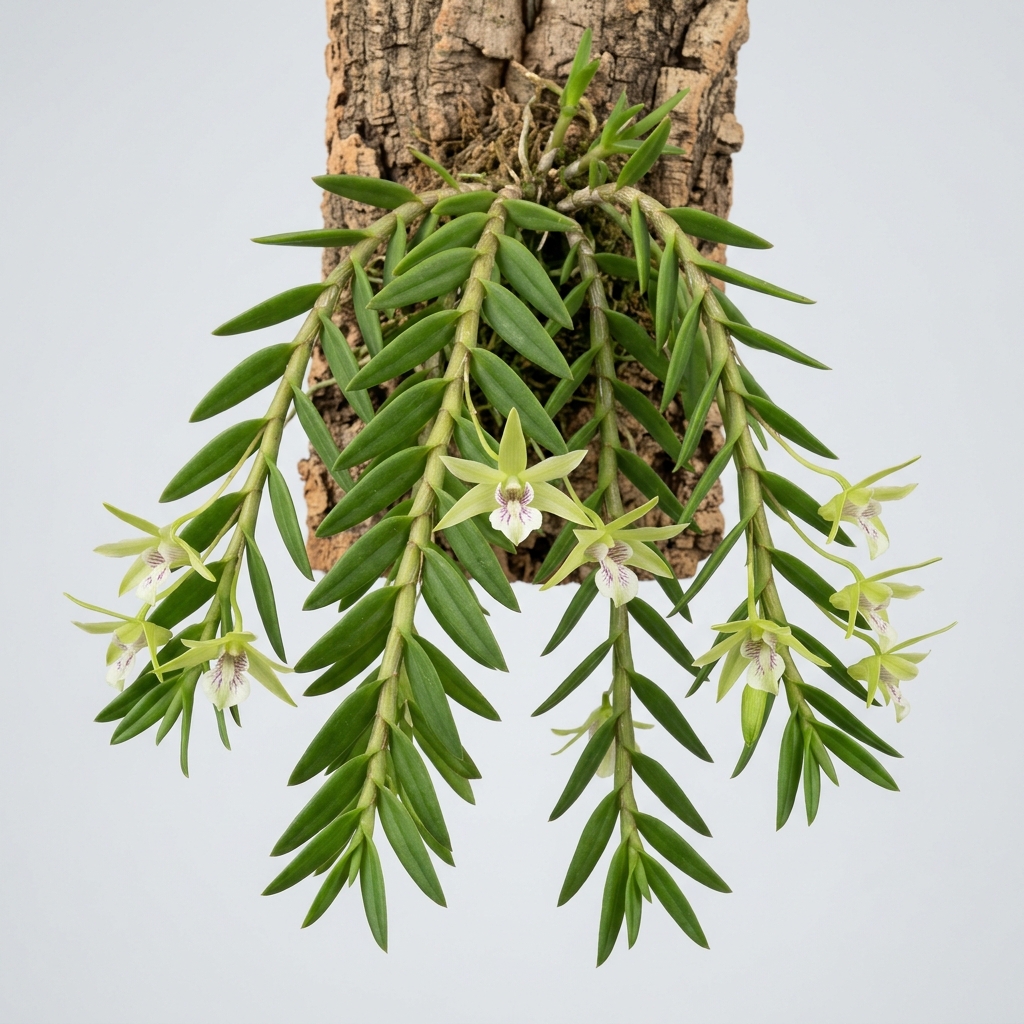
Dendrobium Pugioniforme, commonly known as the dagger orchid, is a fascinating epiphytic species native to the temperate and subtropical rainforests of eastern Australia. Highly prized by orchid enthusiasts for its unique pendulous growth habit, this orchid features thick, succulent-like leaves that taper to a sharp point, closely resembling miniature daggers. Unlike upright dendrobiums, this species cascades gracefully, making it an exceptional choice for mounted cultivation or hanging baskets where its trailing stems can be fully appreciated.
While its foliage provides year-round visual interest, the true delight of Dendrobium Pugioniforme lies in its delicate, star-shaped flowers that emerge along the pendulous stems. These small but intricate blooms feature pale green to yellowish-green segments contrasted by a striking white lip adorned with purple or reddish markings. Cultivating this species successfully requires replicating its native woodland environment, balancing consistent moisture with excellent drainage and high atmospheric humidity.
💡 Did You Know?
The common name Dagger Orchid comes from the unique shape of its leaves, which are thick, rigid, and end in a sharp point. In its native Australian habitat, these succulent leaves help the plant store water, allowing it to survive dry spells in the forest canopy where it grows suspended from tree branches.
🌿 Botanical Overview
Dendrobium Pugioniforme belongs to a specialized group of Australian dendrobiums often referred to by taxonomists under the segregate genus Dockrillia, characterized by their fleshy, non-pseudobulbous leaves. The species name pugioniforme is derived from the Latin word for dagger, directly referencing the rigid, sharply pointed leaves that grow alternately along thin, branching, wiry stems. In its native habitat, it can be found scrambling over rocks (lithophytic) or draping from the trunks and branches of rainforest trees (epiphytic) in moist, shaded environments.
The root system of this orchid is fine and highly opportunistic, clinging tightly to rough bark surfaces to absorb moisture and nutrients from passing mist and organic debris. Because it lacks traditional pseudobulbs for water storage, the succulent leaves serve as the primary reservoir, allowing the plant to withstand brief periods of dryness between rainfall events. This morphological adaptation makes it highly resilient when grown in conditions that mimic its natural wet-dry cycles.
🌸 Flower Characteristics
The blossoms of Dendrobium Pugioniforme are relatively small, typically measuring between 1.5 to 2.5 centimeters in diameter, yet they possess a refined, delicate beauty. They are borne singly or in small clusters of two to three from the nodes along the mature, pendulous stems. The sepals and petals are narrow, pointed, and range in color from a translucent pale green to a soft chartreuse or yellow-green.
The most prominent feature of the flower is the labellum, or lip, which is relatively large compared to the other floral segments. The lip is predominantly white or cream-colored, featuring a beautifully ruffled margin and intricate, contrasting veins of deep purple, magenta, or reddish-brown. This colorful patterning serves as a guide for native pollinators in its natural forest canopy habitat.
Fragrance & Bloom Profile
The fragrance of Dendrobium Pugioniforme is often described as subtle, sweet, and slightly honey-like, though its intensity can vary significantly depending on the specific clone and environmental conditions. The scent is typically most noticeable during the warmer hours of midday when bright, indirect light stimulates the release of volatile compounds.
Individual flowers are moderately long-lasting, remaining in pristine condition for two to three weeks if kept in cool, humid conditions. Because the flowers emerge along the length of the cascading stems rather than on a single terminal spike, a mature specimen in full bloom presents a spectacular, curtain-like display of delicate green and white stars nestled among the sharp, dark green foliage.
Parentage & Hybrid Lineage
As a naturally occurring species rather than a man-made hybrid, Dendrobium Pugioniforme carries a pure genetic lineage shaped by evolutionary adaptation to the Australian wilderness. In horticultural circles, it is primarily grown as a species specimen to preserve its wild characteristics and unique growth form.
While it is not as heavily hybridized as some of the larger-flowered Dendrobium species, it has occasionally been used in breeding programs within the Dockrillia group. Hybridizers value it for imparting pendulous growth habits, cold tolerance, and unique leaf shapes to its offspring. However, documented registered hybrids remain relatively uncommon in mainstream commercial trade, and most plants available to hobbyists are species selections or line-bred cultivars selected for superior flower size or vigor.
🌱 Growing Conditions
To cultivate Dendrobium Pugioniforme successfully, growers must provide conditions that mirror the humid, airy, and dappled light environments of eastern Australian forests. It thrives in bright, indirect light, equivalent to the filtered sunlight found under a medium tree canopy. Direct afternoon sun should be avoided, as it can easily scorch the fleshy leaves, turning them yellow or brown.
💡 Care Tip
Mounted specimens of this orchid thrive with high and excellent air movement. If your growing area is dry, mist the roots daily in the morning, ensuring they dry completely by nightfall to prevent fungal issues.
This species is highly adaptable regarding temperature, classified generally as a cool-to-warm grower. It tolerates winter minimums down to 10°C (50°F) and summer maximums up to 30°C (86°F), provided there is adequate humidity and air movement. High humidity levels of 60% to 80% are essential, especially during the hot summer months, to prevent the thin stems and succulent leaves from dehydrating. Continuous, gentle airflow is critical to prevent stagnant air pockets, which can encourage fungal pathogens.
Watering, Feeding & Potting Media
Because of its pendulous, creeping growth habit, Dendrobium Pugioniforme is poorly suited to traditional plastic pots. It performs exceptionally well when mounted on slabs of cork bark, tree fern fiber, or weathered hardwood, allowing its roots to run freely and dry rapidly after watering. If pot culture is preferred, it should be grown in hanging baskets using a highly porous, coarse medium consisting of medium-grade orchid bark, charcoal, and perlite.
Watering schedules must be adjusted seasonally. During the active growing season from spring through autumn, the plant should be watered frequently—often daily for mounted specimens—ensuring the roots dry out completely between applications. In the winter, watering should be reduced significantly, providing just enough moisture to prevent the succulent leaves from shriveling. Fertilize weakly with a balanced orchid fertilizer at a quarter-strength dilution every second or third watering during the active growth phase, flushing the mount with pure water periodically to prevent salt buildup.
Blooming Season & Care Notes
The primary blooming season for Dendrobium Pugioniforme occurs in late winter and early spring, triggered by the natural drop in temperature and reduction in day length during the preceding autumn and winter months. To encourage a robust bloom cycle, it is beneficial to provide a distinct winter rest period with cooler night temperatures and reduced watering for six to eight weeks.
Once the flower buds begin to emerge from the leaf axils, maintain stable environmental conditions and avoid moving the plant to prevent bud drop. After the blooming cycle concludes, the plant will enter a period of active vegetative growth, which is the ideal time for any necessary remounting or division. Repotting or remounting should be done conservatively, as this species dislikes root disturbance and may take a season to recover and resume vigorous growth.
⚠️ Common Issues
⚠️ Common Mistake
A frequent mistake is planting this orchid in a standard plastic pot with heavy soil. Because of its cascading growth habit and air-loving roots, it will quickly rot; always use a mount or a highly porous hanging basket.
- Dehydration:
Indicated by shriveled, wrinkled leaves and limp stems, usually caused by insufficient watering of mounted plants or low atmospheric humidity. - Root Rot:
Occurs when grown in heavy, water-retaining media or when potted specimens are overwatered, leading to black, mushy roots and leaf drop. - Leaf Scorch: Bleached or blackened patches on the leaves resulting from exposure to direct, intense sunlight.
- Pests:
Scale insects and mealybugs can occasionally hide in the dense, overlapping foliage; treat promptly with insecticidal soap or horticultural oil. - Lack of Blooms: Often due to insufficient light during the growing season or the absence of a cooler, drier winter rest period.
❓ Frequently Asked Questions
Can Dendrobium Pugioniforme be grown indoors?
Yes, it can be grown indoors if provided with bright, indirect light from an east or south-facing window and supplemental humidity. Using a humidifier or placing the mounted plant over a humidity tray is highly recommended to prevent dehydration in dry indoor air.
Why are the leaves on my Dagger Orchid turning yellow?
Yellowing leaves can indicate several issues, most commonly overwatering or poor drainage leading to root rot. Alternatively, sudden exposure to direct sunlight can cause localized yellowing or bleaching from sunburn.
How often should I water a mounted Dendrobium Pugioniforme?
During the warm spring and summer growing season, mounted specimens typically require watering daily or every other day, as the roots dry very quickly. In winter, reduce watering to once or twice a week, or just enough to keep the leaves plump.
Does this orchid require a winter rest to bloom?
Yes, a cooler and drier winter rest is essential to initiate bud development. Reducing water and allowing night temperatures to drop to around 10°C to 12°C (50°F to 54°F) for several weeks in late autumn will stimulate a prolific spring bloom.
⭐ Final Growing Notes
Dendrobium Pugioniforme is a rewarding and visually striking orchid that offers year-round aesthetic appeal through its unique, cascading foliage and delicate spring blossoms. While its pendulous habit and specific moisture requirements demand a bit more attention than standard potted orchids, its resilience and adaptability make it an excellent choice for intermediate growers looking to expand into mounted species. By providing bright, filtered light, high humidity, and a distinct winter rest, you can enjoy a spectacular, living curtain of dagger-like leaves and starry, fragrant blooms for many years.
⚕️ Health, Safety & Edibility
Understanding how a plant interacts with people, pets, and the surrounding environment is part of responsible cultivation. This section uses conservative, general guidance and does not replace professional medical or veterinary advice.
Human Safety: No published evidence currently identifies species-specific toxicity concerns for Dendrobium Pugioniforme during normal handling. As with most ornamental plants, it should not be intentionally consumed.
Pet Safety: Published information does not indicate that this orchid commonly poses a toxicity concern for cats or dogs. However, chewing leaves, flowers, roots, or potting media may still cause mild digestive upset.
Edibility: This orchid is cultivated for ornamental display rather than food. Ornamental plants may carry fertilizers, pesticides, or other horticultural treatments that make them unsuitable for consumption.
Skin Contact: Routine handling is not generally associated with skin irritation. Gardeners with sensitive skin may prefer wearing gloves when repotting, pruning, or handling potting media.
🌱 Propagation Tip
This species is easily propagated by division of mature clumps during the spring active growth phase. Ensure each division has at least three to four healthy stems and active root tips before mounting them onto new cork slabs.
⭐ Expert Advice
To maximize the spring flower display, mimic the natural Australian seasons by dropping night temperatures and cutting in half for six weeks during late autumn. This cool dry spell is the primary trigger for bud initiation.

Leave A Comment