
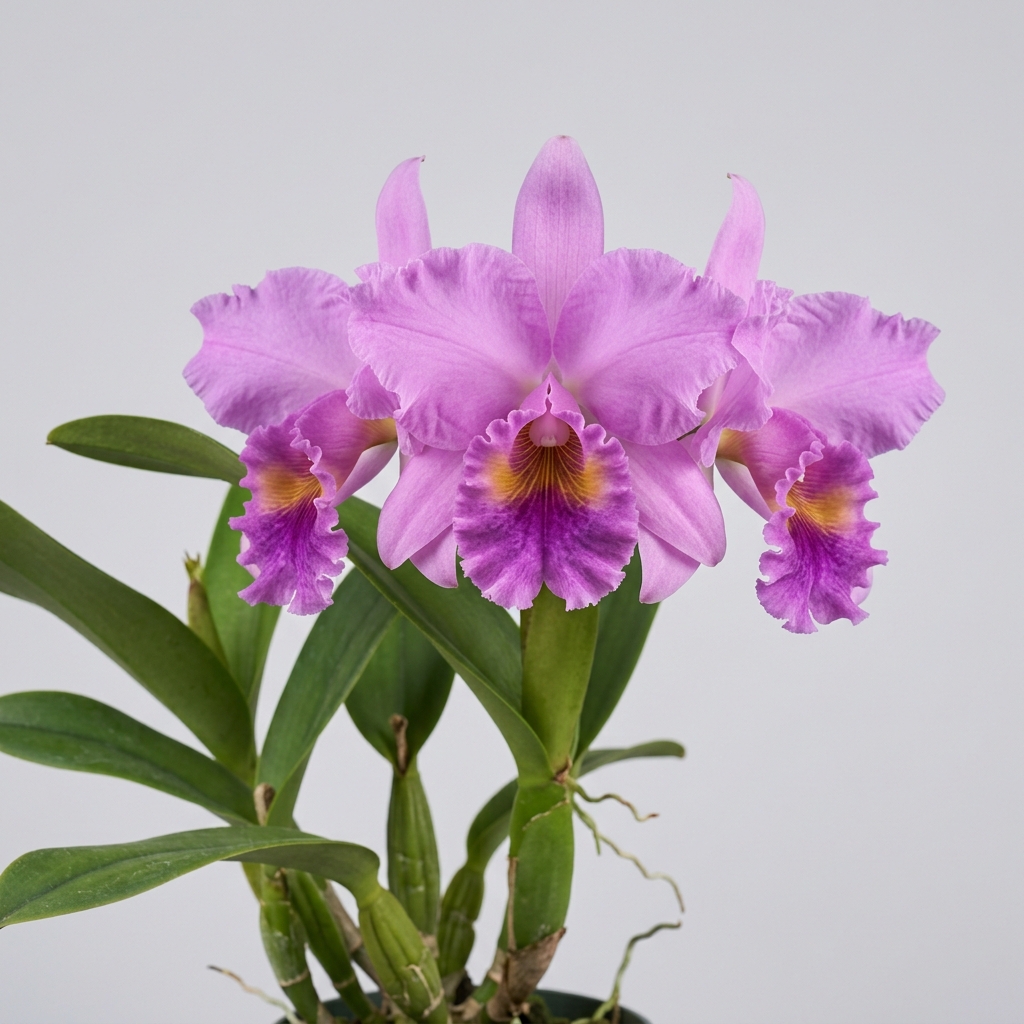
Cattleya Irene Finney is one of the most celebrated and iconic lavender-pink Cattleya orchid cultivars in the horticultural world. Highly prized for its massive, showy blooms and robust growth habit, this classic sympodial orchid represents the quintessential “corsage orchid” look that dominated mid-century floral design. Growers value this cultivar for its reliable blooming schedule, vigorous root production, and spectacular presentation that easily stands out in any greenhouse or indoor collection.
As a standard large-flowered Cattleya, this cultivar shows thick, club-shaped pseudobulbs topped with leathery, evergreen leaves that store moisture and nutrients. It is highly adaptable to intermediate and warm growing conditions, making it an excellent choice for both ambitious beginners and seasoned orchid collectors. When provided with bright, filtered light and distinct wet-to-dry watering cycles, it rewards growers with some of the most dramatic and fragrant flowers in the entire Orchidaceae family.
💡 Did You Know?
Cattleya Irene Finney is often referred to as the ultimate corsage orchid because its exceptionally large, fragrant, and durable lavender blooms were the premier choice for formal corsages during the mid-twentieth century, cementing its place in floral history.
🌿 Botanical Overview
Cattleya Irene Finney is a sympodial epiphytic orchid characterized by its upright, club-like pseudobulbs. These pseudobulbs act as water and nutrient storage organs, allowing the plant to withstand periods of drought in its native-style environments. Each mature pseudobulb is topped with a single, thick, coriaceous leaf that is dull green and highly resistant to water loss.
The growth cycle of this cultivar begins with the emergence of new leads from the rhizome at the base of the older pseudobulbs. As the new growth matures, it develops a protective green sheath at the apex, from which the flower buds will eventually emerge. A healthy root system is characterized by thick, white roots covered in velamen, with bright green or reddish growing tips indicating active development.
🌸 Flower Characteristics
The blossoms of Cattleya Irene Finney are legendary for their size, often reaching up to six to eight inches in diameter. The flowers feature broad, overlapping petals and narrower sepals, all bathed in a rich, luminous shade of lavender-pink. The most striking feature is the large, ruffled labellum, which displays a deeply saturated purple mid-lobe contrasted by a bright golden-yellow throat with delicate veining.
These flowers are borne on short, sturdy spikes that emerge from the terminal sheath of the newest pseudobulb. Typically, a single spike will carry two to four magnificent blooms, positioned well above the foliage to maximize visual impact. The heavy substance of the petals ensures that the flowers maintain their shape and presentation for several weeks under optimal conditions.
Fragrance & Bloom Profile
One of the primary reasons growers cherish Cattleya Irene Finney is its intense, sweet, and highly nostalgic fragrance. The scent is often described as a classic, powdery floral perfume with subtle spicy undertones, which becomes most pronounced during the morning hours when temperatures begin to rise.
The blooms typically last between three to five weeks, depending on ambient temperatures and humidity levels. To prolong the life of the flowers, it is advisable to keep the plant in a slightly cooler, draft-free location once the buds have fully opened, avoiding any direct misting on the delicate petals.
Parentage & Hybrid Lineage
Cattleya Irene Finney is a complex hybrid that traces its ancestry back to several prominent large-flowered Cattleya species. While exact registration details and specific parental crosses can sometimes vary across historical registries, it is widely recognized in grower circles as a premier example of mid-20th-century lavender Cattleya breeding.
The hybrid lineage combines the robust growth habits and large flower sizes of ancestral species such as Cattleya labiata, Cattleya mossiae, and Cattleya dowiana. This genetic heritage grants the cultivar its exceptional vigor, reliable spring-blooming nature, and the characteristic yellow coloration deep within the throat of the lip.
🌱 Growing Conditions
To cultivate Cattleya Irene Finney successfully, providing bright, filtered light is paramount. The foliage should ideally be a light, grassy green; dark green leaves indicate insufficient light, which will prevent blooming, while yellowing or scorched spots indicate excessive direct sun. East or shaded south-facing windows are usually ideal for indoor growers.
💡 Care Tip
Always ensure your Cattleya Irene Finney receives strong air movement. Placing a small fan near your growing area prevents stagnant air, which dramatically reduces the risk of fungal leaf spots and helps the potting medium dry out evenly between waterings.
Temperature management should mimic intermediate to warm tropical climates. Daytime temperatures between 75°F and 85°F are optimal, with a necessary night drop to around 55°F to 60°F to stimulate bud development. High humidity of 50% to 70% must be paired with constant, gentle air circulation to prevent stagnant air pockets that invite fungal pathogens.
Watering, Feeding & Potting Media
This cultivar requires a strict wet-to-dry watering regime. Water the plant thoroughly, allowing water to run freely through the pot, and then withhold water until the potting medium is completely dry. During the active growing season in spring and summer, watering frequency will increase, whereas winter rest periods require significantly less water.
A coarse, free-draining potting medium is essential to prevent root rot. A mixture of large-grade fir bark, horticultural charcoal, and coarse perlite or sponge rock works exceptionally well. Feed the orchid weekly with a diluted, balanced orchid fertilizer at one-quarter strength during active growth, flushing the pot with pure water once a month to remove accumulated salts.
Blooming Season & Care Notes
Cattleya Irene Finney typically initiates its blooming cycle in late winter to spring, as daylight hours begin to lengthen. As the flower sheath swells with developing buds, avoid moving the plant or changing its orientation to the light source, as this can cause the buds to twist or develop unevenly.
Once the blooming cycle concludes, the orchid enters a brief period of semi-dormancy before initiating new vegetative growth. This post-bloom period is the ideal time for repotting, which should only be done when new roots begin to emerge from the base of the newest pseudobulb. Avoid repotting unless the potting medium has broken down or the plant has outgrown its container.
⚠️ Common Issues
⚠️ Common Mistake
The most frequent mistake is this orchid on a strict calendar schedule without checking the medium. Cattleya roots must dry out completely between waterings; keeping them constantly damp will quickly lead to root rot and the decline of the plant.
- Root Rot: Caused by overwatering or a degraded potting medium that retains too much moisture, leading to mushy, black roots and dehydrated pseudobulbs.
- Bud Blast: The sudden yellowing and dropping of flower buds before they open, often triggered by rapid temperature fluctuations, low humidity, or drafts.
- Scale and Mealybugs: Common pests that hide under the dry sheaths of pseudobulbs and on the undersides of leaves; treat promptly with insecticidal soap or rubbing alcohol.
- Leaf Spotting: Fungal or bacterial spots caused by water sitting on the foliage overnight or poor air circulation.
- Dehydration: Shriveled pseudobulbs and wrinkled leaves, indicating either underwatering or a loss of functional roots due to rot.
❓ Frequently Asked Questions
How often should I water my Cattleya Irene Finney?
Watering frequency depends on your environmental conditions, but as a general rule, Cattleya Irene Finney should be watered thoroughly and then allowed to dry out completely. In typical household conditions, this translates to once every 7 to 10 days, though it may be more frequent during hot summer months and less frequent during the winter rest period.
Why is my Cattleya Irene Finney not blooming?
The most common reason for a lack of blooms is insufficient light. If the leaves are a dark forest green, the plant is not receiving enough energy to produce flowers. Gradually move the orchid to a brighter location where the leaves maintain a healthy light-green color. Additionally, ensure there is a 10 to 15 degree Fahrenheit drop in temperature at night to help trigger bud initiation.
When is the best time to repot this orchid?
The absolute best time to repot Cattleya Irene Finney is immediately after it finishes blooming in the spring, just as new green root tips begin to emerge from the base of the newest pseudobulb. Repotting at this specific stage allows the plant to establish itself quickly in the fresh medium with minimal transplant shock.
Can I grow Cattleya Irene Finney under LED grow lights?
Yes, Cattleya Irene Finney can be grown successfully under high-output LED grow lights. Ensure the lights are positioned close enough to provide the required 2,500 to 3,500 foot-candles of light, but monitor the foliage closely for any signs of heat stress or bleaching, adjusting the distance or duration as needed.
⭐ Final Growing Notes
Cattleya Irene Finney remains a timeless masterpiece of the orchid world, offering unparalleled floral beauty and a rich, captivating fragrance that modern hybrids struggle to match. By respecting its natural cycle of wet and dry periods, providing abundant filtered light, and ensuring excellent air movement, growers can enjoy the spectacular annual show of these magnificent lavender blooms for decades to come.
🌱 Propagation Tip
Propagate this orchid by division only when the plant has at least six to eight healthy pseudobulbs. Carefully divide the rhizome using sterile tools, ensuring that each new division retains at least three active pseudobulbs and a viable growth lead.
⭐ Expert Advice
To maximize the size and color intensity of the blooms, slightly increase the potassium and phosphorus levels in your fertilizer during late winter when the flower sheaths begin to swell, and keep the plant in a cooler spot once the buds open.




Leave A Comment