
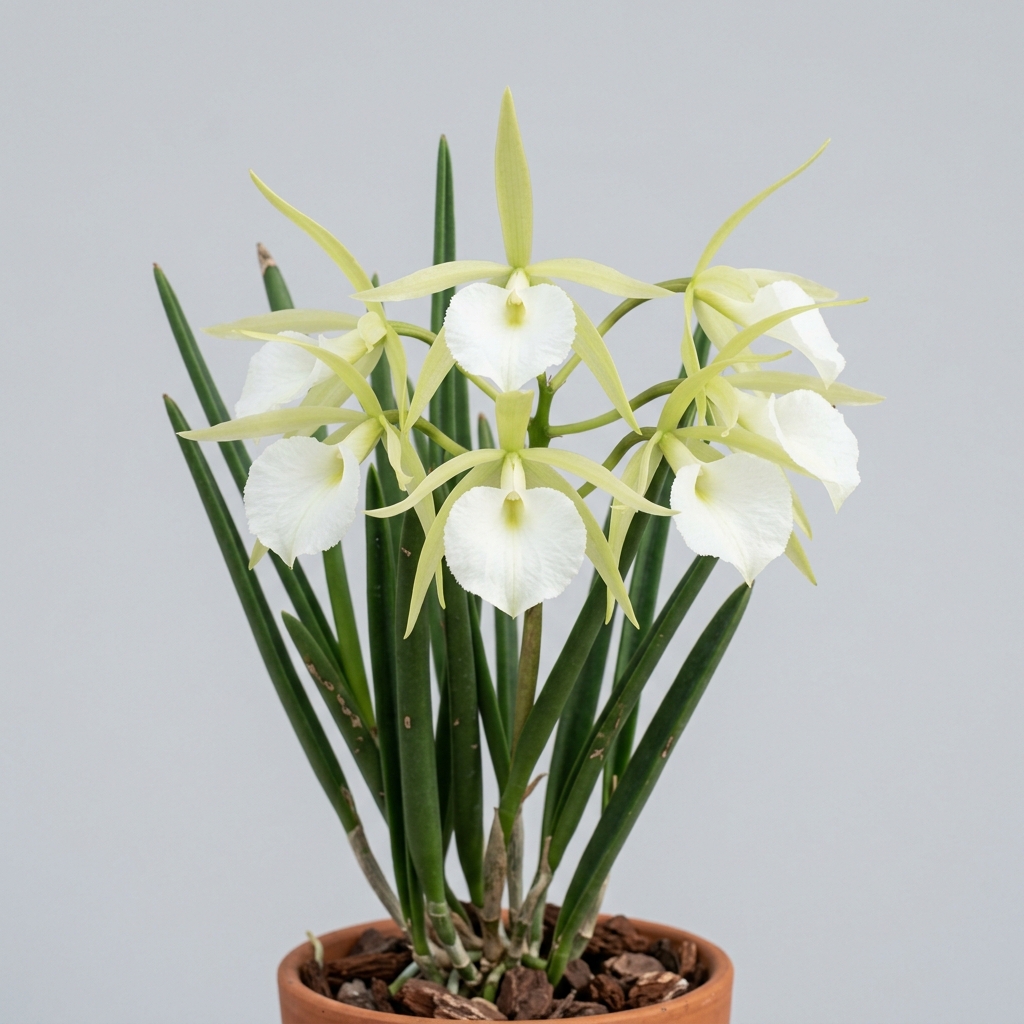
Brassavola nodosa, widely celebrated as the Lady of the Night orchid, is a resilient and highly rewarding species cherished by orchid enthusiasts worldwide. Characterized by its distinctive slender, terete leaves and elegant star-shaped blossoms, this orchid brings a touch of tropical elegance to any collection. Its compact growth habit and robust nature make it an exceptional choice for both novice growers and seasoned collectors looking for a dependable bloomer.
Beyond its striking structural appearance, this orchid is most famous for its intoxicating nocturnal fragrance, which fills the growing space with sweet, citrus-like notes after dusk. It adapts beautifully to various cultivation methods, thriving whether mounted on cork bark or potted in a highly draining medium. Its ease of care and frequent blooming cycles have secured its status as a cornerstone species in modern orchid culture.
💡 Did You Know?
The intense evening of Brassavola nodosa is a highly specialized evolutionary adaptation. The orchid produces no scent during the day to conserve energy, releasing its sweet, citrus-and-clove perfume only after dark to attract night-flying sphinx moths, which serve as its primary pollinators in the wild.
🌿 Botanical Overview
Brassavola nodosa is native to the lowlands of Central and South America, where it typically grows as an epiphyte on trees or occasionally as a lithophyte on coastal rocks. This natural habitat equips the plant with an extraordinary tolerance for intense light, wind, and periods of dry weather. Its physical structure is highly adapted to conserve moisture in these exposed environments.
The plant features slender, upright pseudobulbs that transition seamlessly into narrow, fleshy, semi-terete leaves. These dark green leaves are deeply channeled and mimic succulent foliage, allowing the orchid to store water efficiently. The root system is notably vigorous, producing thick, white, velamen-covered roots that cling tenaciously to mounting surfaces or coarse potting media.
🌸 Flower Characteristics
The blossoms of Brassavola nodosa are a masterclass in elegant simplicity. Each inflorescence typically emerges from the base of the leaf sheath, bearing between one and several star-shaped flowers. The sepals and petals are long, narrow, and pale green or creamy white, framing a dramatic, large, heart-shaped white lip.
The throat of the tubular lip often features delicate purple or reddish-brown spotting deep inside, though this can vary depending on the specific clone. The flowers generally measure around three to four inches across and are presented beautifully on upright or slightly arching spikes, creating a striking contrast against the dark, needle-like foliage.
Fragrance & Bloom Profile
The defining feature of this orchid is its remarkable fragrance profile. During the daylight hours, the flowers are completely odorless, conserving energy and resources. As darkness falls, the blooms release a powerful, sweet scent reminiscent of gardenias, citrus, and cloves, designed to attract night-flying sphinx moths for pollination.
The fragrance typically begins to intensify shortly after sunset and remains strong throughout the night. Individual flowers are long-lasting, often remaining pristine for up to four weeks. Under optimal growing conditions, mature specimens can produce multiple flushes of blooms throughout the year, rather than limiting their display to a single season.
Parentage & Hybrid Lineage
As a naturally occurring species rather than a man-made hybrid, Brassavola nodosa possesses a stable genetic profile that has made it a legendary parent in orchid breeding. It is the foundational species behind many famous intergeneric hybrids, including Brassocattleya, Brassolaelia, and Brassolaeliocattleya.
When crossed with other genera, it consistently passes on its robust growth habit, ease of culture, star-shaped floral structure, and evening fragrance. While individual cultivated clones may exhibit slight variations in flower size or lip spotting, the fundamental characteristics of the species remain highly consistent and recognizable across the horticultural world.
🌱 Growing Conditions
To cultivate Brassavola nodosa successfully, growers should aim to replicate its bright, airy native environment. This orchid thrives in high-light conditions, requiring bright, indirect sunlight or even some direct morning sun. The foliage should ideally maintain a light green hue; a slight reddish or purple speckling on the leaves is a common indicator that the plant is receiving the maximum healthy amount of light.
💡 Care Tip
To achieve the best blooming results, place your orchid in a location with excellent air movement and bright . The leaves should display a green color with a subtle reddish speckling, which indicates the plant is receiving the ideal amount of to trigger flower production.
Temperature: wise, this species prefers warm to intermediate conditions, ideally ranging from 65°F to 85°F during the day, with a slight drop at night to stimulate blooming. It requires moderate to high humidity, ideally between 50% and 70%. Crucially, high humidity must be accompanied by strong, continuous air movement to prevent stagnant moisture from settling on the foliage or roots.
Watering, Feeding & Potting Media
Watering practices must respect the orchid’s epiphytic nature. Brassavola nodosa prefers a rapid wet-and-dry cycle. If grown in pots, a highly porous, fast-draining medium such as coarse fir bark, tree fern fiber, or charcoal is essential. Many growers find the greatest success by mounting the orchid on cork bark or tree fern plaques, allowing the roots to remain completely exposed to the air.
During the active growing season, water the plant thoroughly, then allow the roots and media to dry out completely before watering again. In winter, reduce watering frequency slightly, but do not allow the pseudobulbs to shrivel excessively. Feed the orchid with a balanced, diluted orchid fertilizer every second or third watering during active growth, flushing the pot with pure water periodically to prevent salt buildup.
Blooming Season & Care Notes
While autumn is the traditional peak blooming season for Brassavola nodosa, healthy plants can bloom at almost any time of year, often producing multiple flushes of flowers. To encourage reliable reblooming, ensure the plant receives sufficient light and a distinct temperature drop of about 10°F to 15°F between day and night.
Once the flowers fade, the old flower spikes can be cut back to the base of the leaf. Repotting or remounting should only be performed when new root growth is visible, typically in the spring. This minimizes transplant shock and allows the vigorous new roots to quickly establish themselves in the fresh medium or mount.
⚠️ Common Issues
⚠️ Common Mistake
The most frequent mistake growers make is keeping the roots constantly wet. Planting this orchid in heavy, moisture-retaining soil or overwatering in a plastic pot will rapidly lead to root rot. Always allow the growing medium to dry out completely between waterings.
- Root Rot: Caused by overwatering or compacted, poorly draining potting media that suffocates the roots.
- Leaf Spotting: Fungal or bacterial spots can develop if water sits on the foliage in stagnant, low-airflow environments.
- Bud Blast: Sudden drops in humidity, extreme temperature fluctuations, or drafts can cause developing buds to yellow and drop.
- Dehydration: Shriveled leaves and wrinkled pseudobulbs indicate insufficient watering or a compromised root system unable to absorb moisture.
- Pests: Scale insects and mealybugs can occasionally hide in the crevices of the leaf sheaths or under the foliage.
❓ Frequently Asked Questions
Why is my Brassavola nodosa not blooming?
The most common reason for a lack of blooms is insufficient light. If the leaves are dark green, move the plant gradually to a brighter location. A slight temperature drop at night can also help trigger flower spike development.
Can I grow Brassavola nodosa under LED lights?
Yes, this orchid adapts exceptionally well to artificial lighting. Position the plant close to high-output LED grow lights, ensuring it receives 12 to 14 hours of light daily, while monitoring the leaves for any signs of sunburn.
How often should I water a mounted Brassavola nodosa?
Mounted plants dry out very quickly. During warm summer months, they may require daily misting or soaking. In winter, reduce watering to every few days, depending on your indoor humidity levels.
What should I do if the leaves turn reddish-purple?
A light reddish-purple speckling on the leaves is a natural response to high light levels and is generally a sign that the orchid is receiving optimal light for robust blooming. However, if the leaves turn solid red or show signs of scorching, reduce the light intensity slightly.
⭐ Final Growing Notes
Brassavola nodosa remains one of the most satisfying orchids to cultivate, offering a perfect balance of architectural beauty, ease of care, and sensory profile. By providing bright light, excellent air circulation, and allowing the roots to dry rapidly between waterings, growers will be rewarded with a healthy, vigorous specimen that fills the evening air with its legendary fragrance for years to come.
🌱 Propagation Tip
This orchid is best propagated by division during the spring when new root growth is active. Ensure each division has at least three to four healthy pseudobulbs with active eyes, and minimize root disturbance to help the new plants establish quickly.
⭐ Expert Advice
If you are struggling to maintain high in a home environment, try mounting your orchid on a cork plaque and hanging it inside a bright bathroom or near a humidifier. The rapid wet-dry cycle of a mount combined with localized mimics its natural epiphytic habitat perfectly.




Leave A Comment