
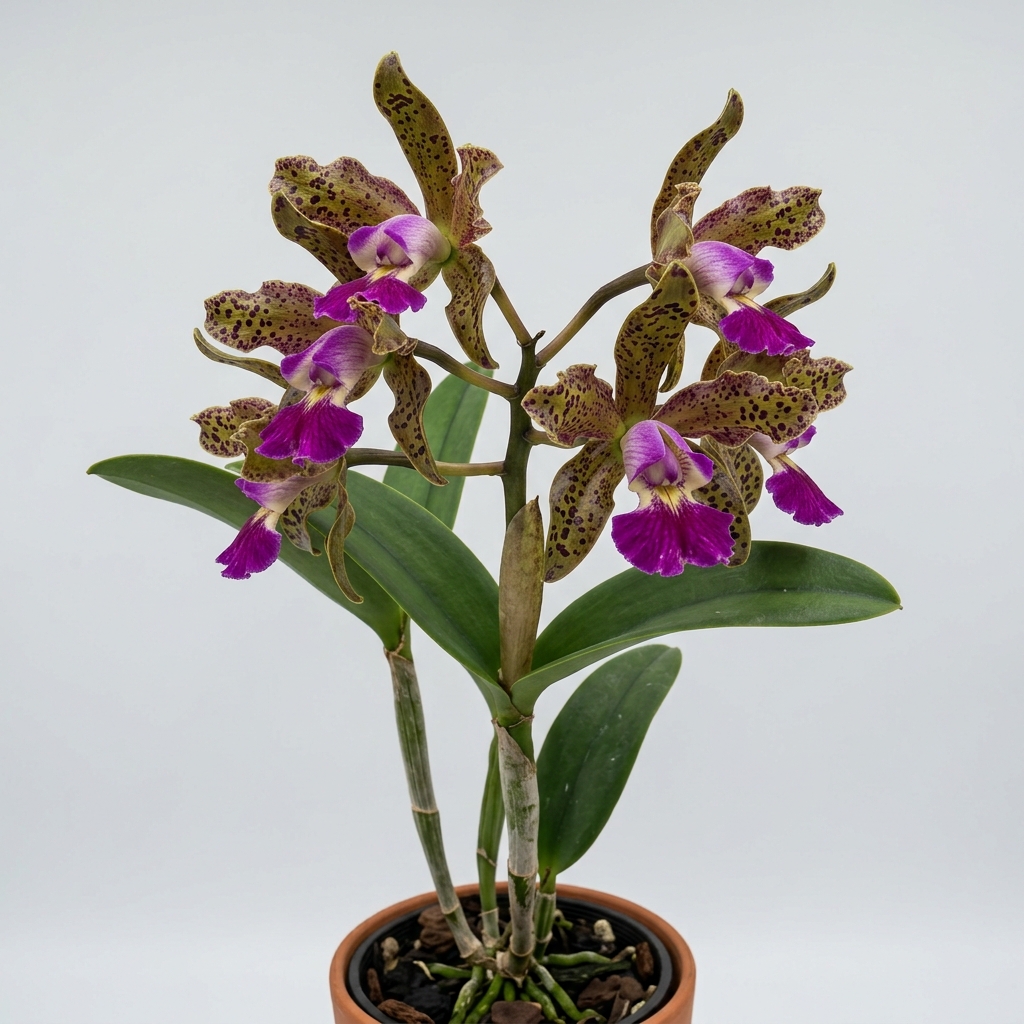
Cattleya Schofieldiana is a striking bifoliate orchid highly prized by collectors for its dramatic, spotted flowers and architectural growth habit. Originating from the coastal rainforests of Brazil, this orchid stands out within the Cattleya genus due to its tall, cane-like pseudobulbs and uniquely textured blooms.
Growers value this orchid for its impressive floral display, which typically features greenish-bronze to yellow-brown petals adorned with dense purple-brown spots, contrasted by a deeply trilobed, richly colored lip. While it requires specific attention to humidity and wet-dry cycles, successful cultivation rewards the enthusiast with long-lasting, fragrant flowers that exemplify the exotic beauty of wild Brazilian Cattleyas.
💡 Did You Know?
Cattleya Schofieldiana is famous for its exceptionally tall, cane-like pseudobulbs, which can grow up to three feet high in optimal conditions. This impressive stature makes it one of the tallest species in the Cattleya , requiring sturdy benching or hanging baskets to support its architectural growth.
🌿 Botanical Overview
Cattleya Schofieldiana is a bifoliate orchid species closely allied with Cattleya granulosa, and is sometimes classified as a variety of it. It is characterized by its tall, slender, cane-like pseudobulbs that can reach up to three feet in height under optimal conditions. These pseudobulbs are topped by two (and occasionally three) leathery, dark green leaves that provide a robust canopy for the emerging flower spikes.
In its native Brazilian habitat, this orchid grows epiphytically on trees in humid coastal forests, where it is exposed to bright, dappled sunlight and constant air movement. This environmental niche dictates its growth cycle, which features a distinct active growing season during the warm, wet months followed by a cooler, drier rest period in the winter.
🌸 Flower Characteristics
The blossoms of Cattleya Schofieldiana are among the most distinctive in the genus, measuring up to four to six inches in diameter. The sepals and petals are typically a tawny yellow, greenish-bronze, or olive-brown, heavily speckled with raised, dark purple or reddish-brown spots that give the flower a tactile, textured appearance.
The lip, or labellum, is a masterpiece of botanical architecture. It is deeply trilobed, with lateral lobes that wrap around the column and a spreading mid-lobe covered in rich magenta-purple papillae or hair-like structures. This vivid lip contrasts sharply with the darker, spotted petals, creating a highly dramatic visual presentation on a terminal inflorescence that can carry several flowers.
Fragrance & Bloom Profile
While fragrance can vary depending on individual clones and environmental factors, Cattleya Schofieldiana is widely reported to produce a pleasant, mildly sweet, and sometimes resinous scent. This fragrance is most pronounced during the morning hours when temperatures begin to rise and light levels increase.
The flowers open sequentially or simultaneously on a sturdy spike arising from a sheath at the apex of the pseudobulb. A mature, healthy plant can produce three to five flowers per spike. The blooms are remarkably long-lasting, often remaining in pristine condition for three to five weeks if kept in a cool, draft-free environment away from direct midday sun.
Parentage & Hybrid Lineage
As a naturally occurring species (or distinct variety within the Cattleya granulosa complex), Cattleya Schofieldiana does not have a hybrid parentage. However, its unique spotting, heavy substance, and dramatic lip have made it a valuable parent in orchid hybridization.
Breeders have utilized this species to introduce spotted patterns, robust growth habits, and lip coloration into complex Cattleya hybrids. Because registration records can sometimes conflate Cattleya Schofieldiana with Cattleya granulosa, tracing its exact hybrid lineage in older crosses requires careful historical documentation, and some parentage claims remain subject to ongoing botanical debate.
🌱 Growing Conditions
To cultivate Cattleya Schofieldiana successfully, growers must replicate its bright, airy native environment. It requires bright, indirect light, similar to that preferred by most bifoliate Cattleyas. A southern or eastern exposure with light shading during the hottest hours of the day is ideal to prevent leaf scorch while encouraging robust pseudobulb development.
💡 Care Tip
Ensure your orchid receives strong air movement at all times. This is especially critical for bifoliate Cattleyas like Cattleya Schofieldiana, as stagnant air combined with high can quickly lead to bacterial rot on new growths.
Temperatures should be kept in the intermediate to warm range, with daytime temperatures between 75°F and 85°F (24°C to 29°C) and a nighttime drop to 60°F or 65°F (15°C to 18°C). High humidity of 60% to 80% is essential, but it must be accompanied by strong, continuous air movement to prevent fungal pathogens from settling on the foliage or roots.
Watering, Feeding & Potting Media
During the active spring and summer growing season, Cattleya Schofieldiana requires frequent, thorough watering. The potting medium should be allowed to dry out almost completely between waterings to prevent root rot. In winter, watering should be significantly reduced, providing just enough moisture to prevent the pseudobulbs from shriveling.
A coarse, fast-draining potting medium is critical. Large-grade fir bark mixed with charcoal and perlite works well in clay pots, which allow the roots to dry rapidly. Alternatively, larger specimens can be mounted on cork bark or tree fern plaques if high humidity can be consistently maintained. Feed weekly with a balanced, diluted orchid fertilizer during active growth, flushing the pot with pure water once a month to remove accumulated salts.
Blooming Season & Care Notes
The typical blooming season for Cattleya Schofieldiana is late summer through autumn, following the completion of the current season’s pseudobulb growth. As the new growth matures, a green sheath will develop at the leaf junction, from which the flower buds will eventually emerge.
During the budding phase, avoid changing the plant’s orientation to the light source, as this can cause the buds to twist or develop unevenly. Once flowering is complete, cut the spent spike back to the sheath and prepare the plant for its winter rest period by reducing water and halting fertilizer applications until new root tips and shoots appear in the spring.
⚠️ Common Issues
⚠️ Common Mistake
A frequent error is repotting Cattleya Schofieldiana at the wrong time. Bifoliate Cattleyas are notoriously sensitive to root disturbance and should only be repotted when new root tips are actively emerging from the base of the newest pseudobulb.
- Root Rot:
Caused by overwatering or a decomposing, compacted potting medium that retains too much moisture. - Bud Blast:
Sudden dropping or yellowing of buds, often triggered by rapid temperature fluctuations, low humidity, or drafts. - Scale and Mealybugs: Common pests that hide in the dry sheaths of pseudobulbs; inspect regularly and treat with horticultural oil or insecticidal soap.
- Leaf Scorch: Bleached or blackened patches on leaves resulting from sudden exposure to direct, unshaded midday sunlight.
- Pseudobulb Shriveling: A sign of dehydration, which can be caused by underwatering or, paradoxically, root loss due to overwatering.
❓ Frequently Asked Questions
How often should I water my Cattleya Schofieldiana?
Water thoroughly when the potting medium is nearly dry. During the active summer growth phase, this may be every few days, whereas in the winter rest period, watering should be reduced to once every two weeks or just enough to keep the pseudobulbs from shriveling.
Can Cattleya Schofieldiana be grown under LED lights?
Yes, it can be grown successfully under high-output LED grow lights. Ensure the lights are positioned to provide bright, full-spectrum coverage, and monitor the leaves closely to ensure they do not overheat or burn from being too close to the fixtures.
Why are the pseudobulbs on my orchid shriveling?
Shriveling pseudobulbs usually indicate dehydration. This can be caused by simple underwatering or, more commonly, by root rot from overwatering, which destroys the roots and prevents the plant from absorbing moisture. Check the root system to diagnose the cause.
When is the best time to repot this orchid?
The best time to repot is in the spring, specifically when new root tips are just beginning to emerge from the base of the newest pseudobulb. Repotting at any other time can severely stress the plant and set back its growth for a season.
⭐ Final Growing Notes
Cattleya Schofieldiana remains a captivating choice for intermediate and advanced orchid enthusiasts who appreciate the wild, architectural elegance of Brazilian species. By providing bright light, excellent air circulation, and a strict wet-dry watering cycle, growers can enjoy the dramatic, spotted blooms of this remarkable bifoliate orchid for many years.
⚕️ Health, Safety & Edibility
Understanding how a plant interacts with people, pets, and the surrounding environment is part of responsible cultivation. This section uses conservative, general guidance and does not replace professional medical or veterinary advice.
Human Safety: No published evidence currently identifies species-specific toxicity concerns for Cattleya Schofieldiana during normal handling. As with most ornamental plants, it should not be intentionally consumed.
Pet Safety: Published information does not indicate that this orchid commonly poses a toxicity concern for cats or dogs. However, chewing leaves, flowers, roots, or potting media may still cause mild digestive upset.
Edibility: This orchid is cultivated for ornamental display rather than food. Ornamental plants may carry fertilizers, pesticides, or other horticultural treatments that make them unsuitable for consumption.
Skin Contact: Routine handling is not generally associated with skin irritation. Gardeners with sensitive skin may prefer wearing gloves when repotting, pruning, or handling potting media.
🌱 Propagation Tip
Propagate this orchid by division only when the plant has outgrown its container and has at least six to eight healthy pseudobulbs. Ensure each division has at least three active pseudobulbs and a strong lead growth to guarantee successful establishment.
⭐ Expert Advice
To encourage robust blooming, provide a distinct winter rest period. Reduce frequency and stop fertilizing from late autumn until spring, allowing the medium to dry out thoroughly between waterings to mimic its natural seasonal cycle.

Leave A Comment