
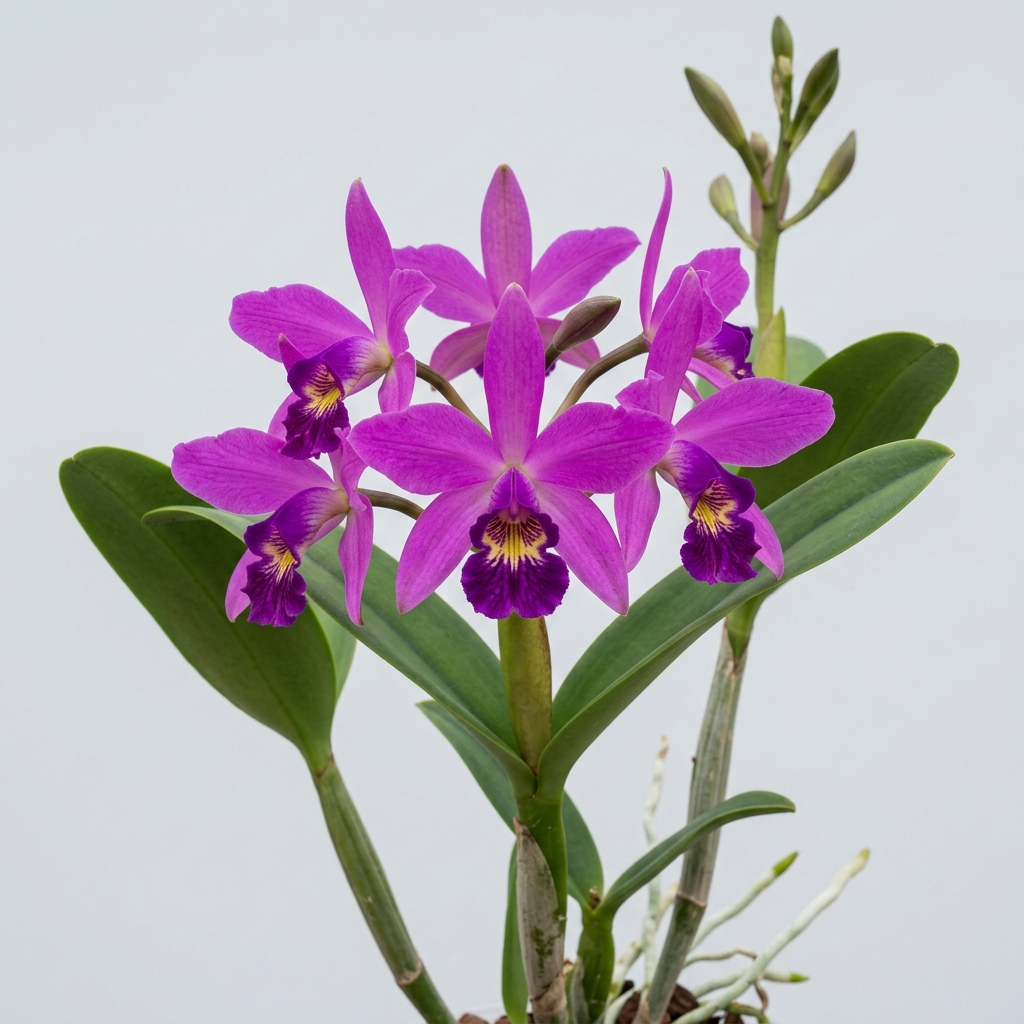
Cattleya Violacea is a striking lowland species orchid native to the tropical river basins of South America, particularly the Amazon and Orinoco regions. Highly prized by collectors, this orchid is renowned for its flat, vibrant magenta-purple flowers and its intense, sweet floral fragrance. Unlike many of its montane relatives, this species thrives in warm, humid environments, making it a unique and rewarding challenge for dedicated orchid enthusiasts.
The growth habit of Cattleya Violacea is characterized by slender, club-shaped pseudobulbs that support two thick, leathery leaves. This bifoliate structure helps the plant conserve moisture in its native canopy habitat, where it grows as an epiphyte on trees overhanging waterways. While it requires more precise environmental controls than standard hybrid orchids, providing the proper balance of heat, light, and moisture results in spectacular, long-lasting summer displays.
💡 Did You Know?
Unlike many montane Cattleya species that prefer cooler nights, Cattleya Violacea is a true lowland tropical orchid. In its native Amazonian habitat, it grows on trees overhanging rivers, where it is exposed to constant high heat, intense sunlight, and daily drenching rains, followed by rapid drying in the warm breeze.
🌿 Botanical Overview
Cattleya Violacea is a historically significant species first described in the early nineteenth century. It is widely distributed across the low-elevation river basins of northern South America, including Brazil, Venezuela, Colombia, Peru, and Guyana. In these wild habitats, the plants grow as epiphytes on trees directly overhanging rivers, where they are exposed to high light levels, constant warm breezes, and daily tropical downpours.
Physically, the orchid produces slender, slightly flattened pseudobulbs that can reach up to twelve inches in height. Each pseudobulb is topped with a pair of thick, elliptical, leathery leaves that are adapted to withstand intense sunlight. The root system is robust and adapted to clinging tightly to rough tree bark, absorbing moisture rapidly from rain and dew before drying out in the wind.
🌸 Flower Characteristics
The flowers of Cattleya Violacea are celebrated for their exceptionally flat presentation and intense coloration. Unlike some Cattleya species with nodding or cupped flowers, the petals and sepals of this species open wide and flat, showcasing their brilliant amethyst-violet or deep magenta hues. Individual flowers typically measure four to five inches in diameter, making a dramatic visual impact.
The lip, or labellum, is a defining feature of the bloom. It is deeply trilobed, with the lateral lobes wrapping around the column, while the midlobe spreads forward in a rich, velvety purple. The throat of the lip features contrasting white and yellow markings, often adorned with dark purple veins that guide pollinators. The flowers are produced on short, sturdy spikes arising from the top of the mature pseudobulb, typically carrying three to eight blooms per inflorescence.
Fragrance & Bloom Profile
This species is highly regarded for its powerful and delightful fragrance. The scent is sweet, floral, and slightly spicy, often described as reminiscent of raspberries or sweet peas. The fragrance is most intense during the morning hours when temperatures begin to rise, filling the growing area with a rich perfume.
The blooming cycle typically occurs during the warm summer months. When grown under optimal conditions, the flowers are remarkably long-lasting for a Cattleya species, remaining fresh and vibrant for three to four weeks. To maximize the lifespan of the blooms, growers often reduce ambient temperatures slightly and shield the open flowers from direct water misting.
Parentage & Hybrid Lineage
As a primary species, Cattleya Violacea does not have hybrid parentage. Instead, it represents a distinct genetic lineage shaped entirely by natural selection in its native South American habitats. It has been used extensively in orchid hybridization to introduce flat flower form, intense magenta coloration, and heat tolerance to modern Cattleya hybrids.
Within the species, several distinct color forms have been identified and cultivated by collectors. These include Cattleya Violacea f. alba, which features pure white flowers, and f. coerulea, which shows soft blue-violet tones. These naturally occurring variations are highly sought after and are propagated through tissue culture or careful sibling crosses to preserve their unique traits.
🌱 Growing Conditions
Replicating the lowland tropical habitat of Cattleya Violacea is the key to successful cultivation. This orchid requires warm to hot temperatures year-round. Ideal daytime temperatures range from 80°F to 95°F, with a modest drop to 65°F to 70°F at night. It does not tolerate cold drafts or prolonged temperatures below 60°F, which can stall growth or cause systemic rot.
💡 Care Tip
Provide constant, vigorous air movement around your Cattleya Violacea. Because this species requires exceptionally high and frequent , strong airflow is absolutely essential to prevent fungal pathogens from establishing on the damp foliage and roots.
Light levels must be bright to very bright, comparable to the conditions required by Vandas. While the orchid can tolerate some direct morning sun, it should be shaded from the harsh midday rays to prevent leaf scorch. Strong, continuous air movement is absolutely critical; it cools the leaves under high light and ensures that the plant dries quickly after watering.
Watering, Feeding & Potting Media
Watering practices must align with the orchid’s active growth cycle. During the spring and summer, when new pseudobulbs and roots are developing, Cattleya Violacea requires frequent, heavy watering. However, because its roots are adapted to rapid drying, the potting medium must be exceptionally free-draining. In the winter, watering should be reduced, allowing the plant to dry out thoroughly between light waterings.
Due to its epiphytic nature, this species performs exceptionally well when mounted on cork slabs or tree fern plaques, provided the grower can maintain high humidity. If grown in pots, use a very coarse medium consisting of large fir bark chunks, charcoal, and perlite in a clay pot. Feed the plant weekly with a highly diluted, balanced orchid fertilizer during the active growing season, and flush the medium regularly with pure water to prevent salt buildup.
Blooming Season & Care Notes
The primary blooming season occurs in late spring and summer, coinciding with the peak of the warm growing season. As the new pseudobulb matures, the flower sheath will emerge and develop rapidly. During this period, maintain stable environmental conditions, as sudden changes in humidity or temperature can cause the developing buds to blast.
After the blooming cycle concludes, the orchid may enter a semi-dormant rest period. Repotting or remounting should only be performed when active new root growth is observed at the base of the newest pseudobulb. Cattleya Violacea is notoriously sensitive to root disturbance, and repotting at the wrong time can cause the plant to decline or fail to establish for several seasons.
⚠️ Common Issues
⚠️ Common Mistake
The most common mistake is repotting Cattleya Violacea at the wrong time. This species is highly sensitive to root disturbance and can decline rapidly if repotted when dormant. Only disturb the roots when active new root tips are emerging.
- Root rot:
Caused by waterlogged, decomposing potting media or poor drainage, leading to a rapid decline in plant health. - Dehydration:
Often seen in mounted specimens if ambient humidity is too low or if watering frequency is insufficient during hot weather. - Leaf scorch: Appears as bleached or blackened patches on the foliage due to sudden exposure to direct, unshaded midday sun.
- Bud blast:
The premature drying and dropping of flower buds, usually triggered by sudden temperature drops, low humidity, or drafts. - Pests:
Scale insects, mealybugs, and spider mites can occasionally infest the crevices of pseudobulbs and the undersides of leaves.
❓ Frequently Asked Questions
Can Cattleya Violacea be grown successfully indoors under artificial lights?
Yes, Cattleya Violacea can be grown indoors under high-output LED or T5 fluorescent grow lights. Because of its high light requirements, place the plant close to the light source and monitor the leaves for warmth. Supplemental humidifiers and fans are essential to maintain the necessary humidity and air circulation in an indoor environment.
Why are the leaves on my Cattleya Violacea turning yellow?
Yellowing leaves can indicate several issues. If only the oldest, lowest leaves are yellowing and dropping, it may be a natural aging process. However, widespread yellowing often points to excessive light exposure, nitrogen deficiency, or root loss due to overwatering and later rot.
How often should I water a mounted Cattleya Violacea orchid?
Mounted specimens dry out very rapidly and typically require daily watering during the warm spring and summer months. In extremely hot or dry weather, watering twice a day may be necessary. During the cooler winter months, reduce watering to every two to three days, or when the roots appear dry and silvery.
What should I do if my orchid stops growing after repotting?
Cattleya Violacea is highly sensitive to root disturbance. If repotted at the wrong time, it may enter a prolonged period of stagnation. To encourage recovery, place the plant in a warm, highly humid, and shaded location, keep the medium slightly damp but not wet, and avoid moving or disturbing the plant further until new roots appear.
⭐ Final Growing Notes
Cattleya Violacea is a magnificent species that rewards the attentive grower with some of the most vibrant and fragrant flowers in the orchid world. By providing constant warmth, high humidity, bright light, and a fast-drying root environment, you can successfully cultivate this tropical treasure and enjoy its spectacular summer blooms for many years to come.
⚕️ Health, Safety & Edibility
Understanding how a plant interacts with people, pets, and the surrounding environment is part of responsible cultivation. This section uses conservative, general guidance and does not replace professional medical or veterinary advice.
Human Safety: No published evidence currently identifies species-specific toxicity concerns for Cattleya Violacea during normal handling. As with most ornamental plants, it should not be intentionally consumed.
Pet Safety: Published information does not indicate that this orchid commonly poses a toxicity concern for cats or dogs. However, chewing leaves, flowers, roots, or potting media may still cause mild digestive upset.
Edibility: This orchid is cultivated for ornamental display rather than food. Ornamental plants may carry fertilizers, pesticides, or other horticultural treatments that make them unsuitable for consumption.
Skin Contact: Routine handling is not generally associated with skin irritation. Gardeners with sensitive skin may prefer wearing gloves when repotting, pruning, or handling potting media.
🌱 Propagation Tip
Propagate Cattleya Violacea only by division of mature plants with at least six healthy pseudobulbs. Ensure each division has at least three active pseudobulbs and a strong lead, and perform the division only when new root growth is visible.
⭐ Expert Advice
If you struggle to keep Cattleya Violacea hydrated in a pot, try mounting it on a cork slab with a small pad of sphagnum moss. This mimics its natural epiphytic habit, allowing you to water daily without risking the root rot associated with stale .

Leave A Comment