
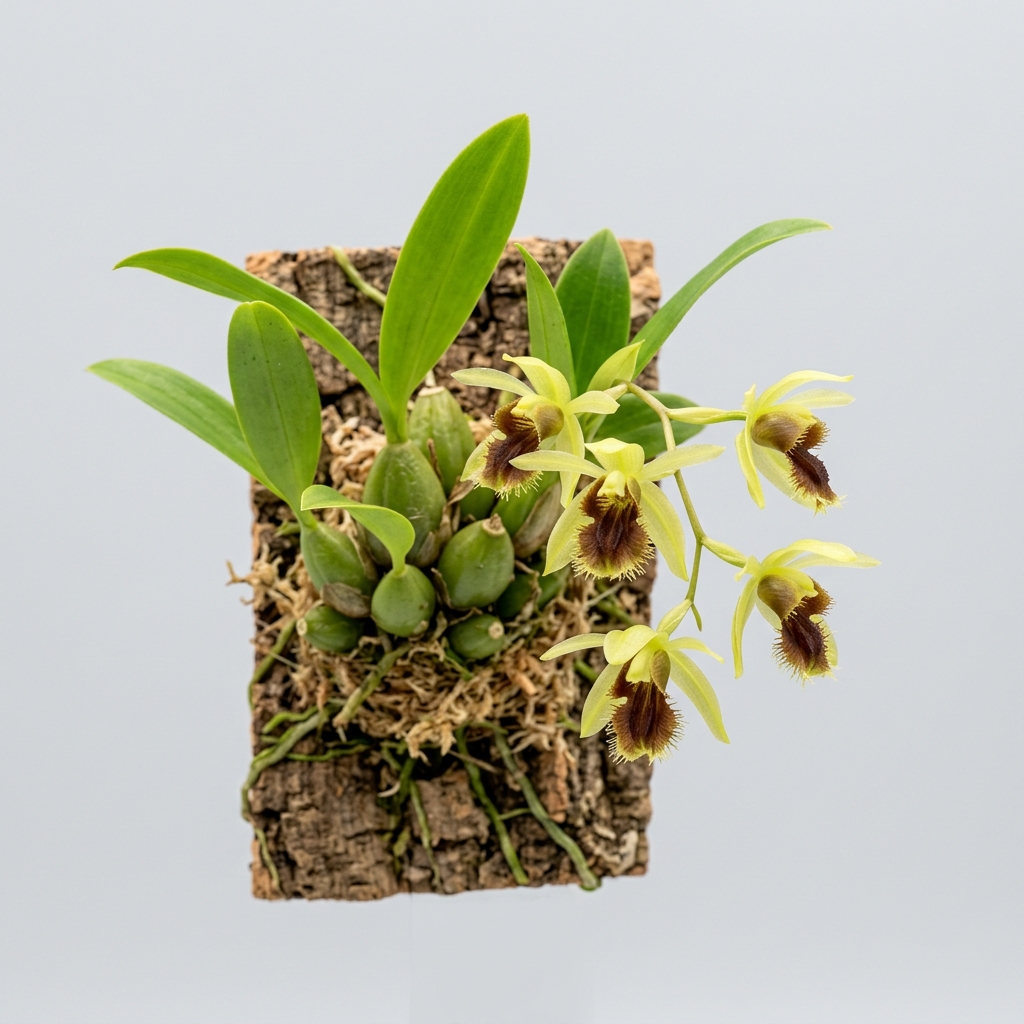
Coelogyne fimbriata is a highly rewarding miniature orchid species favored by collectors for its vigorous, creeping growth habit and distinctive fringed blossoms. Belonging to the diverse genus Coelogyne, this resilient epiphyte is celebrated for its ability to quickly scramble over mounts or overflow shallow pots, creating a lush, cascading display of foliage and flowers. Its adaptable nature and compact size make it an excellent addition to indoor growing spaces, greenhouses, and terrariums alike.
Growers value this orchid not only for its ease of culture but also for its intriguing floral morphology. The small, star-shaped blooms feature a beautifully detailed, fringed lip that gives the species its common name. Because it tolerates a wide range of temperatures and is relatively forgiving of occasional watering lapses, it serves as an ideal introduction to the Coelogyne genus for novice orchid enthusiasts while remaining a staple for advanced collectors.
💡 Did You Know?
The species name fimbriata is derived from the Latin word for fringed, directly referencing the intricate, hair-like borders on the flower's lip. This unique evolutionary adaptation is designed to attract specific insect pollinators in its native habitat across Southeast Asia, making it a fascinating study in orchid biology.
🌿 Botanical Overview
Coelogyne fimbriata is native to a broad geographic range across Southeast Asia, including parts of India, China, Nepal, Vietnam, and Thailand. In its natural habitat, it grows primarily as an epiphyte on moss-covered tree trunks and branches, or occasionally as a lithophyte on damp rocks. This wide distribution explains its inherent adaptability to varying environmental conditions in cultivation.
The growth habit of this species is characterized by small, egg-shaped to oblong pseudobulbs that are spaced along a thin, creeping rhizome. Each pseudobulb typically bears two bright green, lanceolate leaves at its apex. Because the rhizome branches freely, a single plant can quickly form a dense mat of foliage, making it highly suitable for mounting on slabs where it can ramble naturally.
🌸 Flower Characteristics
The flowers of Coelogyne fimbriata are small but remarkably intricate, typically measuring between 2 to 3 centimeters in diameter. The sepals and petals are a translucent pale yellow, light green, or warm buff-tan color, providing a soft background that highlights the dramatic labellum. The lip is the defining feature of the bloom, displaying a deeply fringed or fimbriate margin and adorned with dark brown, reddish-purple, or almost black veins and markings.
Flowers are produced on short, upright inflorescences that emerge from the top of newly matured pseudobulbs. Each spike usually carries one to three flowers, which open sequentially or simultaneously. While the individual flowers are relatively short-lived, lasting about one to two weeks, a well-grown specimen with dozens of active pseudobulbs can remain in bloom for a month or more as new spikes emerge across the plant.
Fragrance & Bloom Profile
The fragrance of Coelogyne fimbriata is a subject of mild debate among growers, as its scent profile can be highly subjective and may vary slightly depending on environmental conditions. It is most commonly described as having a mild, sweet, or slightly musky aroma that is most noticeable during the warm morning hours. Some growers detect a faint grassy or earthy undertone, while others find the scent to be virtually imperceptible.
Because the fragrance is not overpowering, it is well-suited for indoor growing spaces where stronger-scented orchids might become overwhelming. The blooming cycle typically peaks in the autumn, though healthy plants kept under stable indoor conditions may occasionally produce sporadic blooms at other times of the year.
Parentage & Hybrid Lineage
Coelogyne fimbriata is a distinct, naturally occurring species rather than a man-made hybrid. Consequently, its genetic lineage is direct and unaltered by selective laboratory breeding. In the wild, regional variations exist, leading to slight differences in flower size, color intensity, and the density of the fringing on the lip among different collected clones.
While it has not been heavily utilized in commercial hybridization compared to larger-flowered genera like Cattleya or Phalaenopsis, it has been used in a handful of primary hybrids within the Coelogyne genus. These hybrids often seek to combine the vigorous, compact growth habit of fimbriata with the larger, showier flowers of other Coelogyne species.
🌱 Growing Conditions
To thrive, Coelogyne fimbriata requires bright, indirect light. It performs exceptionally well under medium light levels, similar to those provided for Cattleyas or bright-light Miltoniopsis. Avoid direct midday sunlight, which can easily scorch the thin leaves, but ensure the light is strong enough to maintain a healthy, light-green foliage color. If the leaves turn a dark, dull green, the plant may not be receiving enough light to trigger optimal blooming.
💡 Care Tip
To maintain optimal hydration without risking root rot, mount Coelogyne fimbriata on a cork slab with a thin pad of high-quality sphagnum moss. This mimics its natural epiphytic habitat, allowing the roots to dry rapidly while retaining just enough moisture.
This species is highly adaptable regarding temperature, classified generally as an intermediate to warm grower. It prefers daytime temperatures between 70°F and 85°F (21°C to 29°C) and a night drop of about 10°F to 15°F. However, it can tolerate winter minimums down to 50°F (10°C) without harm, provided watering is reduced accordingly. High humidity of 60% to 80% combined with gentle, continuous air movement is essential to prevent fungal issues and keep the creeping root system healthy.
Watering, Feeding & Potting Media
During the active spring and summer growing season, Coelogyne fimbriata should be watered copiously. The potting medium should remain consistently moist but never waterlogged. As the pseudobulbs mature in late summer and autumn, watering can be slightly reduced, and during the cooler winter months, the plant should be allowed to dry out moderately between waterings to mimic its natural seasonal cycle.
Apply a balanced, water-soluble orchid fertilizer diluted to one-quarter or one-half strength every second or third watering during active growth. Flush the pot or mount with pure water periodically to prevent mineral salt buildup. Due to its creeping habit, this orchid is best grown mounted on cork bark or tree fern slabs with a small pad of sphagnum moss. If potted, use shallow, wide bulb pans or baskets filled with a fast-draining medium such as fine fir bark mixed with perlite and chopped sphagnum.
Blooming Season & Care Notes
The primary blooming season occurs in autumn, triggered by the shortening days and slight temperature drops of late summer. Once the new pseudobulbs have fully plumped up, keep an eye on the leaf axils at the top of the bulb, where the short flower spikes will begin to emerge. Avoid moving the plant to a drastically different environment once spikes are visible, as sudden changes in humidity or temperature can cause the buds to blast.
Repotting or remounting should only be performed in the spring, just as new growth and fresh root tips begin to emerge from the base of the leading pseudobulbs. Coelogyne species are notoriously sensitive to root disturbance and may pout or skip a bloom cycle if repotted at the wrong time. When dividing or repotting, try to disturb the main root mass as little as possible.
⚠️ Common Issues
⚠️ Common Mistake
A frequent error is growing this orchid in a deep, standard pot. Because of its long, creeping rhizomes, Coelogyne fimbriata will quickly scramble out of the pot, leaving new roots suspended in the air. Use shallow baskets or mounts instead.
- Shriveled Pseudobulbs: Often caused by under-watering during the active summer growth phase or a loss of roots due to compacted, decaying potting media.
- Leaf Tip Burn: Typically indicates low humidity or a buildup of fertilizer salts in the growing medium; flush thoroughly with pure water.
- Bud Blast:
Occurs when developing flower buds dry out due to sudden drops in humidity, drafts, or extreme temperature fluctuations. - Pests:
Mealybugs and scale insects can easily hide under the dry sheaths of the pseudobulbs and within the dense, creeping foliage. - Root Rot:
Caused by poor drainage or over-watering during the winter rest period when the plant’s metabolic activity is low.
❓ Frequently Asked Questions
How do I encourage my Coelogyne fimbriata to bloom?
To stimulate abundant blooming, ensure the plant receives bright, indirect light throughout the summer and experience a distinct drop in night temperatures during late summer and early autumn. A slight reduction in watering at this time also helps signal the plant to initiate flower spikes.
Can Coelogyne fimbriata be grown in a terrarium?
Yes, its miniature size and creeping growth habit make it an excellent candidate for larger terrariums or vivariums. Ensure it is positioned in a well-ventilated area with bright light, and avoid placing it too close to constant misting nozzles to prevent rot.
Why are the pseudobulbs on my orchid shriveling?
Slight shriveling of older pseudobulbs is normal as they transfer energy to new growths. However, severe shriveling of newer bulbs usually indicates dehydration, either from insufficient watering or from root loss caused by old, compacted potting media that has suffocated the roots.
How often should I divide my Coelogyne fimbriata?
It is best to avoid dividing this orchid frequently. Coelogyne fimbriata blooms much more spectacularly when allowed to grow into a large, specimen-sized clump. Only divide the plant when it has completely outgrown its mount or basket, ensuring each division has at least three to four healthy pseudobulbs.
⭐ Final Growing Notes
Coelogyne fimbriata remains a classic favorite among orchid hobbyists due to its vigorous growth, compact footprint, and uniquely fringed autumn blossoms. By mimicking its natural epiphytic habitat with bright indirect light, high humidity, and a free-draining mount or basket, growers can easily cultivate a stunning specimen that will reward them with a beautiful display of delicate, star-shaped flowers year after year.
🌱 Propagation Tip
Propagate this species during spring repotting by dividing the creeping rhizome. Ensure each division contains at least three to four healthy, mature pseudobulbs with active root initials to guarantee successful establishment and minimize transplant shock.
⭐ Expert Advice
To trigger a heavy autumn bloom cycle, slightly reduce and lower night temperatures by a few degrees in late summer. This subtle seasonal shift mimics its natural environment, signaling the mature pseudobulbs to initiate flower spikes.




Leave A Comment