
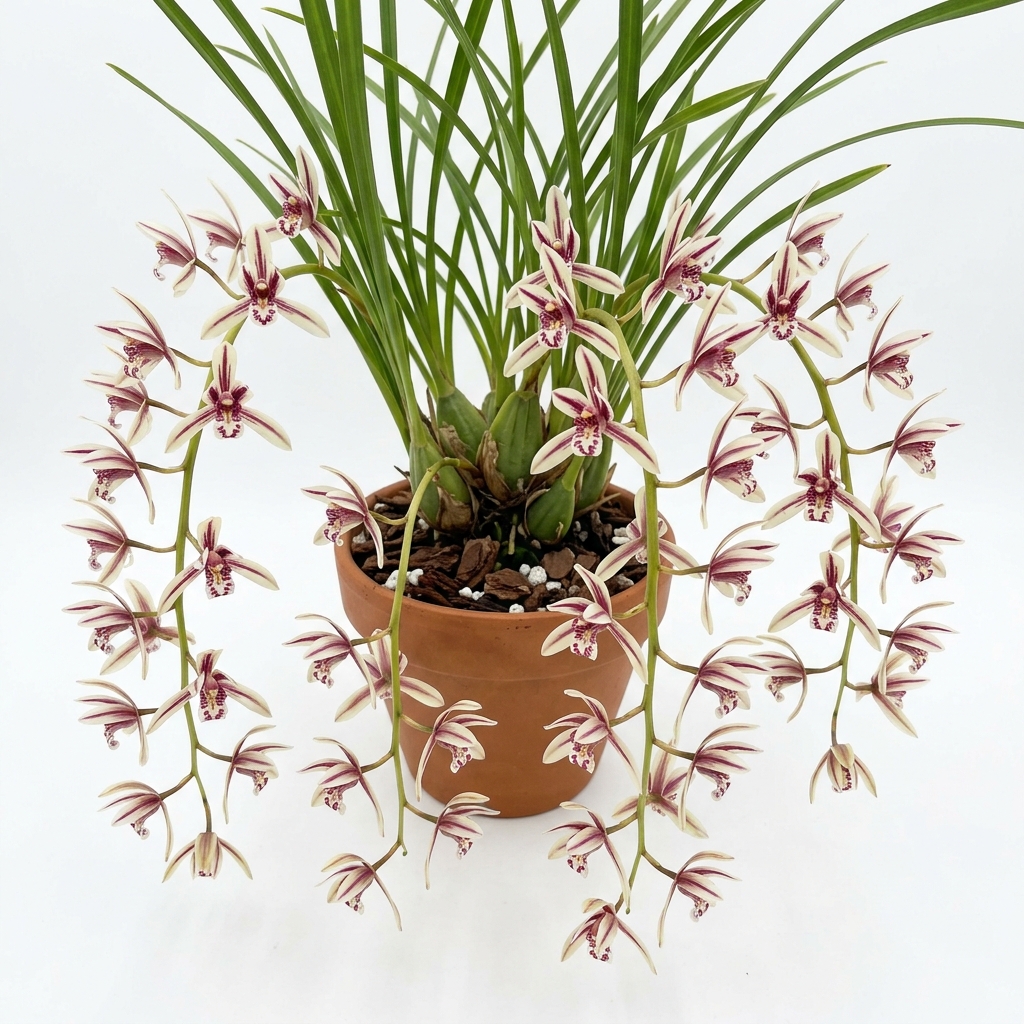
Cymbidium Dayanum, commonly known as Day’s Cymbidium, is a highly elegant orchid species widely appreciated by collectors for its graceful growth habit and striking floral display. Unlike the large, upright standard hybrids frequently seen in commercial nurseries, this species features narrow, grass-like foliage and pendulous flower spikes that cascade beautifully over the sides of its container. It brings a refined, wild aesthetic to any indoor orchid collection or temperate greenhouse.
Cultivators highly value this orchid for its reliable autumn blooming cycle and its relatively compact pseudobulbs, which allow it to fit into smaller growing spaces than many of its larger relatives. Its distinctive flowers, marked by bold central stripes on each petal, offer a dramatic visual contrast that makes it a standout specimen when grown to its full potential.
💡 Did You Know?
Named in honor of John Day, a prominent nineteenth-century English orchid collector, this species is uniquely adapted for hanging displays. Its pendulous blooming habit allows the cascading striped flowers to be viewed from below, beautifully mimicking its natural epiphytic growth on tree branches in Asian montane forests.
🌿 Botanical Overview
Cymbidium Dayanum is native to a broad range across Southeast Asia, the Himalayas, southern China, and parts of Japan. In its natural habitat, it grows primarily as an epiphyte on tree trunks or occasionally as a lithophyte on mossy rocks in wet, montane forests. This evolutionary background dictates its preference for excellent drainage, consistent humidity, and buoyant air movement in cultivation.
The vegetative structure of this orchid is characterized by small, narrow, and slightly compressed pseudobulbs that are almost entirely concealed by the bases of its leaves. The leaves themselves are long, linear, and thin, resembling a coarse ornamental grass. Over time, healthy plants form dense, multi-leaded clumps that provide an attractive green presence even when the orchid is not in bloom.
🌸 Flower Characteristics
The defining feature of Cymbidium Dayanum is its pendulous or steeply arching inflorescence. Each flower spike can carry anywhere from 5 to 15 flowers, which drape downward in a highly graceful cascade. The individual blooms are moderately sized, typically measuring between 1.5 to 2 inches in diameter, and are spaced evenly along the dark-colored stem.
The sepals and petals are lanceolate and creamy white to pale yellow. Each segment is bisected by a bold, dark reddish-brown or deep purple stripe running down the center, creating a striking pin-stripe effect. The lip, or labellum, is strongly trilobed, featuring dark purple side lobes and a white center marked with yellow ridges, which serves as a vivid landing pad for natural pollinators.
Fragrance & Bloom Profile
The fragrance of Cymbidium Dayanum is a subject of some variation among growers. While some cultivated specimens produce a delicate, sweet, or slightly citrusy scent during the warmest hours of the day, other forms are reported to be virtually odorless. This variability suggests that fragrance intensity may be highly dependent on the specific clone, light levels, and ambient temperatures during blooming.
The flowers are remarkably long-lasting, often remaining fresh for four to six weeks if the plant is kept in a cool, draft-free location. The blooming sequence typically begins in late summer, with the buds fully opening during the autumn months and occasionally lasting into early winter.
Parentage & Hybrid Lineage
Unlike many of the complex Cymbidium hybrids found in garden centers, Cymbidium Dayanum is a distinct, naturally occurring species. Because of this, it does not have a hybrid parentage. In orchid registration records, it is recognized under its species name, though select superior clones have been awarded by various orchid societies for their exceptional flower count or color intensity.
In hybridizing, this species has occasionally been used to introduce a pendulous blooming habit and warmth tolerance into modern Cymbidium lines. However, pure cultivated specimens remain highly sought after by species purists who appreciate the delicate, wild elegance of the original forest form over the heavy, upright blooms of commercial hybrids.
🌱 Growing Conditions
To cultivate Cymbidium Dayanum successfully, growers should aim to replicate its montane forest habitat. It thrives in bright, filtered light. While it can tolerate some direct morning sun, hot midday sunlight will quickly scorch the thin, grass-like foliage. A location near an east-facing window or a shaded southern exposure is ideal.
💡 Care Tip
To showcase the pendulous flower spikes of this orchid to their best advantage, grow the plant in a hanging basket or place the pot on a tall pedestal. This prevents the cascading spikes from resting on flat surfaces, which can damage the delicate blooms.
Temperature management is crucial for this species. It is generally classified as an intermediate to cool grower, preferring daytime temperatures between 70°F and 80°F, with a significant drop at night to around 55°F to 60°F. This nocturnal temperature drop, particularly in the late summer, is the primary environmental trigger required to initiate flower spikes.
Watering, Feeding & Potting Media
During the active spring and summer growing season, Cymbidium Dayanum requires frequent watering to keep the potting medium evenly moist. The roots should never be allowed to dry out completely for extended periods, as this can cause the thin leaves to develop dry, brown tips. However, the medium must never remain soggy or waterlogged, which quickly leads to root rot.
A balanced, water-soluble orchid fertilizer formulated for epiphytes should be applied weekly at a quarter or half strength during the active growth phase. In the winter, when growth slows, reduce feeding significantly. The ideal potting medium is a highly aerated, free-draining mix consisting of medium-grade fir bark, perlite, and horticultural charcoal. This structure allows water to pass through quickly while retaining just enough moisture around the roots.
Blooming Season & Care Notes
The primary blooming season occurs in autumn. As the flower spikes begin to emerge from the base of the pseudobulbs, they will naturally grow outward and then drape downward. It is highly recommended to grow this orchid in a hanging basket or on a tall pedestal so the pendulous spikes can cascade freely without touching the ground or table surface.
Once the flower buds begin to swell, avoid rotating the plant or moving it to a location with drastically different light or temperature levels. Sudden environmental changes during this sensitive stage can cause bud blast, where the immature buds yellow and drop before opening. After blooming is complete, old flower spikes should be cut back to the base of the pseudobulb.
⚠️ Common Issues
⚠️ Common Mistake
A frequent error is overwatering during the winter rest period. While the plant should not dry out completely, excess moisture when growth slows down can quickly lead to root rot and pseudobulb decay.
- Root Rot:
Caused by overwatering or a compacted potting medium that prevents oxygen from reaching the roots. - Spider Mites:
These pests favor the dry, warm conditions often found indoors and can hide easily within the dense, grass-like foliage. - Leaf Tip Burn: Often a sign of low humidity, underwatering, or a buildup of fertilizer salts in the potting medium.
- Bud Blast:
The premature dropping of flower buds, usually triggered by sudden temperature fluctuations, drafts, or low humidity. - Scale Insects:
Hard-shelled pests that attach themselves to the undersides of the leaves and the bases of the pseudobulbs.
❓ Frequently Asked Questions
How do I trigger my Cymbidium Dayanum to bloom?
To initiate flower spikes, ensure the plant experiences a distinct drop in night temperatures of about 10 to 15 degrees Fahrenheit during the late summer and early autumn, combined with bright, filtered light.
Can I grow Cymbidium Dayanum in a standard plastic pot?
While it can be grown in a standard pot, its pendulous flower spikes will drape downward. Growing it in a hanging basket or placing a tall pot on a pedestal is highly recommended to prevent the flowers from resting on flat surfaces.
Why are the leaves on my orchid turning yellow?
Yellowing leaves can indicate excessive direct sunlight, overwatering leading to root rot, or a natural shedding of older leaves from mature pseudobulbs. Inspect the roots to determine if moisture levels are correct.
How often should I repot this species?
Repotting should be done every two to three years, immediately after the blooming season ends in winter. This should be timed with the appearance of new root growth and before the old potting medium begins to break down.
⭐ Final Growing Notes
Cymbidium Dayanum is a rewarding orchid species that brings a touch of wild, cascading elegance to any collection. By providing it with bright filtered light, consistent moisture during the growing season, and the essential cool autumn nights, growers can enjoy its striking, striped blooms year after year. Its unique pendulous habit makes it an exceptional choice for hanging displays where its delicate beauty can be fully appreciated.
⚕️ Health, Safety & Edibility
Understanding how a plant interacts with people, pets, and the surrounding environment is part of responsible cultivation. This section uses conservative, general guidance and does not replace professional medical or veterinary advice.
Human Safety: No published evidence currently identifies species-specific toxicity concerns for Cymbidium Dayanum during normal handling. As with most ornamental plants, it should not be intentionally consumed.
Pet Safety: Published information does not indicate that this orchid commonly poses a toxicity concern for cats or dogs. However, chewing leaves, flowers, roots, or potting media may still cause mild digestive upset.
Edibility: This orchid is cultivated for ornamental display rather than food. Ornamental plants may carry fertilizers, pesticides, or other horticultural treatments that make them unsuitable for consumption.
Skin Contact: Routine handling is not generally associated with skin irritation. Gardeners with sensitive skin may prefer wearing gloves when repotting, pruning, or handling potting media.
🌱 Propagation Tip
Propagation is best achieved by division during repotting in early spring. Ensure each division has at least three to four healthy, mature pseudobulbs with active roots to support new growth and minimize transplant shock.
⭐ Expert Advice
Initiate blooming by providing a distinct drop of 10 to 15 degrees Fahrenheit between day and night during late summer. This environmental cue is essential for triggering the development of flower spikes.




Leave A Comment