
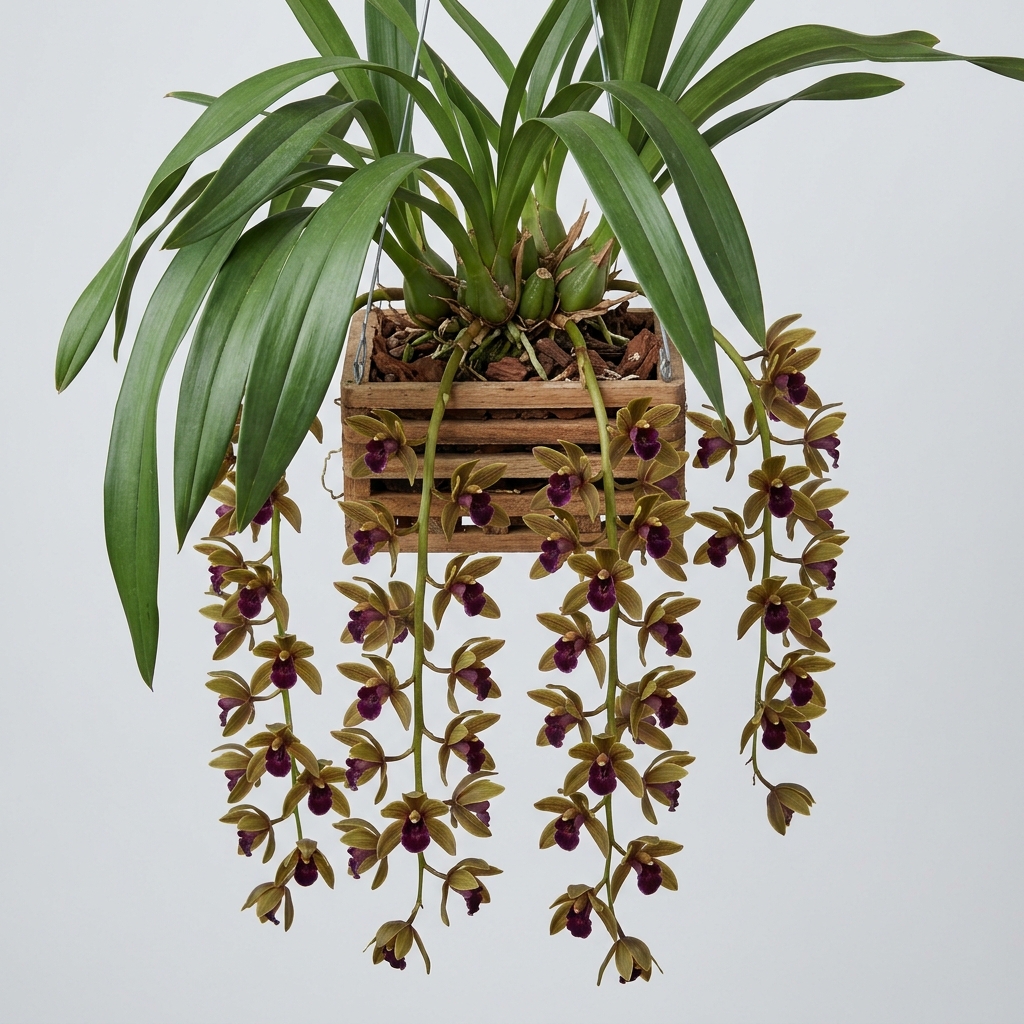
Cymbidium devonianum is a highly distinctive and coveted orchid species celebrated for its unique growth habit and dramatic floral presentation. Unlike the upright, grassy foliage of typical standard Cymbidiums, this species features unusually broad, leathery, strap-like leaves that cascade gracefully from compact pseudobulbs. This striking foliage makes the plant highly attractive even when it is not in bloom, serving as an elegant botanical accent in any collection.
The true spectacle of this orchid occurs during its blooming cycle, when it produces long, pendulous flower spikes that drape straight down over the edges of its container. Packed with dozens of small, richly colored blossoms, these cascading inflorescences have made the species a favorite among collectors and a cornerstone parent in breeding compact, hanging hybrid orchids. For growers seeking a dramatic, hanging display, this species offers an unmatched combination of structural beauty and floral abundance.
💡 Did You Know?
Cymbidium devonianum was named in honor of the Duke of Devonshire, a prominent nineteenth-century orchid enthusiast. Unlike most members of its that feature upright, grassy foliage, this species is easily recognized by its unusually broad, leathery leaves, which evolved to capture in the shaded, mossy canopies of its native Himalayan mountain habitats.
🌿 Botanical Overview
Native to the high-altitude montane forests of the Himalayas, including regions of India, Nepal, Bhutan, and southern China, Cymbidium devonianum naturally grows as an epiphyte on moss-covered tree forks or occasionally as a lithophyte in damp rock crevices. These wild habitats are characterized by cool temperatures, high humidity, and abundant rainfall during the summer monsoon season, followed by a cooler, drier winter period.
Structurally, the plant consists of small, tightly clustered, egg-shaped pseudobulbs that are largely concealed by the bases of its leaves. The leaves themselves are a major departure from the typical thin, grass-like foliage of the genus; they are thick, leathery, and broadly lanceolate, often reaching up to two or three inches in width. This robust foliage allows the plant to store moisture and withstand temporary dry spells in its natural canopy environment.
🌸 Flower Characteristics
The defining feature of this orchid is its spectacular, pendulous inflorescence. The flower spikes emerge from the base of the pseudobulbs and grow downwards, sometimes reaching up to 15 to 25 inches in length. Each spike can carry anywhere from 15 to over 40 densely packed, long-lasting flowers, creating a dense, rope-like column of color that hangs elegantly below the foliage.
Individual flowers are relatively small, typically measuring between 1 and 1.5 inches across, but their intricate coloration makes them highly captivating. The sepals and petals are generally olive-green to brownish-bronze, often adorned with delicate purplish-brown stripes or speckles. This muted background contrasts sharply with the prominent, spade-shaped lip, which is a rich, velvety dark purple or crimson-maroon, often highlighted by two darker spots near the throat.
Fragrance & Bloom Profile
While some growers report a mild, sweet, or slightly earthy scent, the fragrance of this species is generally subtle and is not consistently documented as a primary feature in common grower references. Instead, its appeal lies almost entirely in its visual impact and the sheer volume of flowers produced on a single spike.
The blooms are remarkably durable, often remaining in pristine condition for four to six weeks if the plant is kept in a cool, draft-free environment. The flowering cycle typically begins in early spring, with the spikes slowly developing over the winter months before opening in a synchronized burst of color as temperatures begin to warm.
Parentage & Hybrid Lineage
As a distinct, naturally occurring species, Cymbidium devonianum has no hybrid parentage of its own. However, its historical and modern role in orchid hybridization is monumental. Hybridizers have long utilized this species to introduce the pendulous spike habit, compact plant size, and dark, velvety lip coloration into standard upright Cymbidium lines.
When crossed with larger, upright hybrids, it reliably passes down its cascading growth habit, resulting in the popular “miniature pendulous” Cymbidiums seen in the commercial trade today. While its exact award history and specific registration timelines are best verified through official international orchid registers, it remains one of the most influential species in modern Cymbidium breeding.
🌱 Growing Conditions
To cultivate this species successfully, growers must replicate its cool, montane forest origins. It thrives in cool to intermediate temperature ranges, ideally with daytime temperatures between 65 and 75 degrees Fahrenheit and a distinct drop at night to 50 to 55 degrees Fahrenheit. This nocturnal temperature drop is particularly critical in autumn to trigger the development of flower spikes.
💡 Care Tip
To accommodate the natural downward growth of the flower spikes, always grow this orchid in a hanging basket or a pot elevated on a stand. Standard pots will trap the emerging spikes, causing them to press against the bottom and rot or fail to open.
Light levels should be bright but filtered, mimicking the dappled canopy of its native forests. Direct, intense midday sunlight will quickly scorch the broad leaves, while excessive shade will result in lush foliage but a complete lack of flowers. Gentle, continuous air movement is also essential to keep the foliage dry and prevent fungal pathogens from taking hold in the humid microclimate around the plant.
Watering, Feeding & Potting Media
During the active spring and summer growing season, this orchid requires frequent, thorough watering. The potting medium should be kept consistently damp but never waterlogged. As winter approaches and growth slows, watering should be reduced significantly, allowing the medium to dry out slightly between waterings, though the pseudobulbs should never be allowed to shrivel severely.
A balanced, water-soluble orchid fertilizer applied at quarter or half-strength every two weeks during the growing season supports robust leaf and pseudobulb development. Because of its strictly downward-growing flower spikes, standard plastic or clay pots are highly discouraged. Instead, grow this species in open-slatted wooden baskets, net pots, or wire baskets lined with coconut fiber. The potting medium should be a highly porous, well-draining mix of medium-grade fir bark, coarse perlite, and horticultural charcoal.
Blooming Season & Care Notes
The blooming season primarily spans from late winter through late spring. Because the flower spikes emerge from the base of the pseudobulbs and grow directly downward, growers must exercise extreme caution during the winter spike-initiation phase. It is easy to mistake emerging spikes for roots or to accidentally bury them under potting media.
Repotting should only be performed every two to three years, immediately after the flowering cycle has finished and before the summer heat sets in. This species resents root disturbance, so handle the thick, fleshy roots gently. Choose a basket size that allows for two to three years of future growth, as crowded plants tend to bloom more reliably than those given too much root space.
⚠️ Common Issues
⚠️ Common Mistake
A frequent error is potting this species in a deep, heavy plastic pot with standard potting soil or fine mix. This suffocates the thick roots and prevents the pendulous flower spikes from escaping the container, leading to lost blooms and root rot.
- Root Rot:
Caused by compacted, poorly draining media or overwatering during the dormant winter period. - Trapped Flower Spikes: Occurs when the plant is grown in a standard solid pot, forcing the downward spikes to press against the bottom and rot.
- Leaf Tip Burn: Often a sign of mineral buildup from hard water or excessive fertilizer; flush the media regularly with pure water.
- Bud Blast:
Sudden dropping of flower buds, usually triggered by dry indoor air, drafty heating vents, or sudden temperature spikes. - Pests:
Spider mites and scale insects can hide on the undersides of the broad, leathery leaves; inspect the foliage regularly.
❓ Frequently Asked Questions
Why are the flower spikes on my orchid growing downwards into the bench?
This is the natural, pendulous growth habit of the species. To accommodate this, the orchid must be grown in a hanging basket or elevated on a tall stand so the spikes can drape freely beneath the container without hitting the ground.
Can I grow this species indoors under artificial LED lights?
Yes, it can be grown under high-output LED setup, provided the lights are kept at a safe distance to prevent leaf scorch and you can provide the necessary cool night temperatures required to trigger blooming in autumn.
How often should I divide my mature plant?
Division should be done sparingly. This species produces the most spectacular displays when grown into large specimen plants with multiple pseudobulbs. If you must divide, ensure each division has at least three healthy, leafy pseudobulbs.
What should I do if the pseudobulbs start to shrivel in winter?
Slight wrinkling of the pseudobulbs is normal during the winter rest period. However, severe shriveling indicates extreme dehydration. Increase the humidity around the plant and give it a light watering to help the bulbs plump back up.
⭐ Final Growing Notes
Cymbidium devonianum is a rewarding and visually stunning species that brings a touch of wild Himalayan beauty to any orchid collection. While its pendulous blooming habit requires specialized basket culture and its cool-temperature preferences demand some seasonal attention, the reward of a fully mature specimen draped in cascading ropes of exotic, dark-lipped blossoms is well worth the effort for any dedicated grower.
🌱 Propagation Tip
Propagation is safest during repotting by dividing mature clumps. Ensure each division has at least three active, healthy pseudobulbs with viable roots. Avoid dividing the plant too frequently, as larger specimens produce far more dramatic, multi-spike floral displays.
⭐ Expert Advice
To ensure reliable blooming each spring, expose the plant to a distinct drop in night temperatures during the autumn months. A drop down to 50 to 55 degrees Fahrenheit for several weeks acts as the primary environmental trigger for spike initiation.




Leave A Comment