
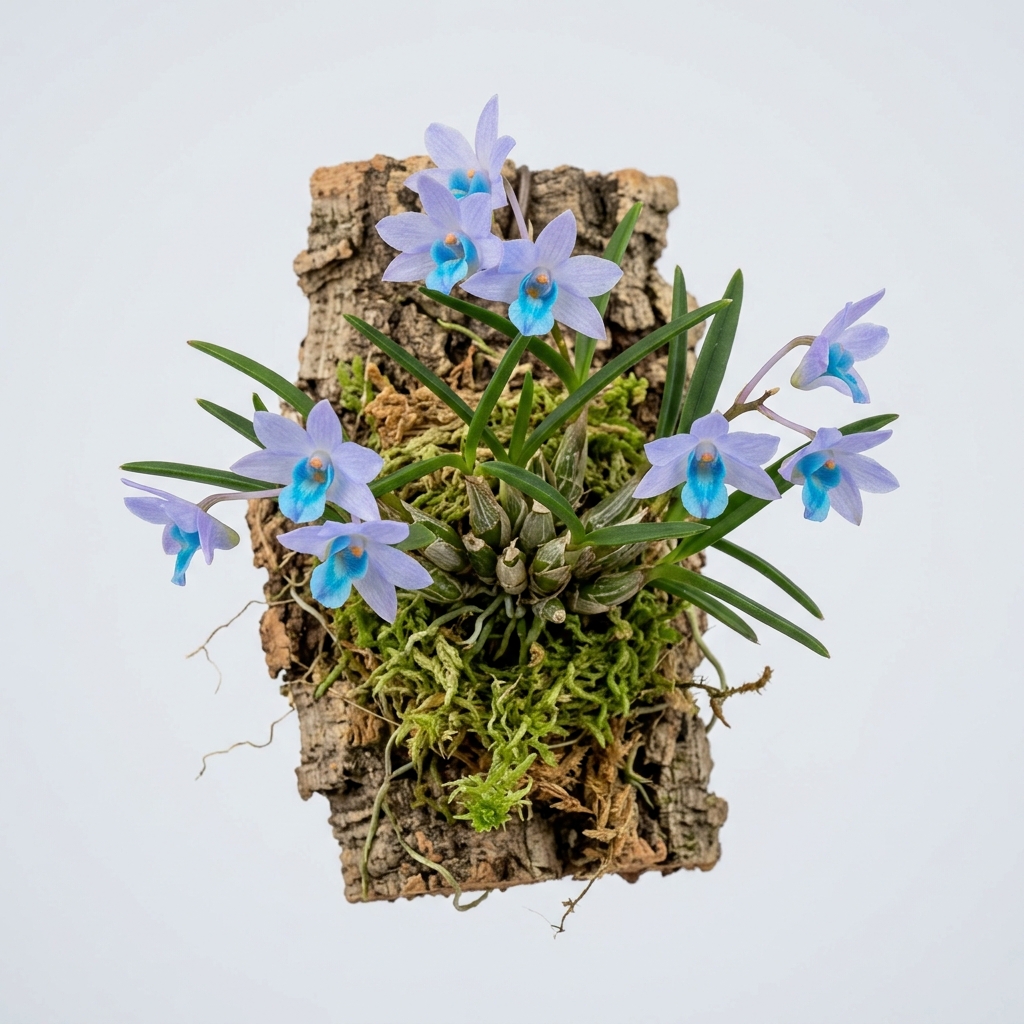
Dendrobium Cyanocentrum is a captivating miniature epiphytic orchid highly prized by collectors for its remarkably distinct floral coloration. Native to the humid, mossy forests of New Guinea, this diminutive species stands out in the vast Dendrobium genus due to its rare blue, violet, and cyan-toned blossoms. Its compact growth habit makes it an useful selection for terrarium culture, orchidariums, or specialized mount cultivation where space is limited but visual impact is highly desired.
While many Dendrobium species demand significant vertical space, this miniature gem remains exceptionally small, often maturing at just a few centimeters in height. Growers value the plant not only for its unique cool-toned palette but also for its intriguing tufted growth form. Cultivating this species successfully requires a careful balance of high humidity, consistent moisture, and gentle air movement, rewarding patient enthusiasts with delicate, jewel-like displays.
💡 Did You Know?
Dendrobium Cyanocentrum belongs to the Oxyglossum section of the , a group of miniature orchids famous for producing flowers that can last for up to nine months. This incredible floral longevity helps the plant maximize its chances of pollination in the dense, competitive canopy of the New Guinea rainforests.
🌿 Botanical Overview
Dendrobium Cyanocentrum belongs to the Oxyglossum section of the genus Dendrobium, which is highly celebrated for its miniature plants with exceptionally long-lasting flowers. It features tiny, pseudobulbs that are globose to ovoid, clustered closely together to form dense mats. The leaves are narrow, linear, and dark green, often measuring only a couple of centimeters in length. This compact vegetative structure allows the plant to hug mossy tree branches in its native canopy habitat, where it absorbs moisture and nutrients from the humid air and organic debris.
In the wild, these orchids are found at various elevations across New Guinea, spanning sea level to montane forests. This wide natural distribution means individual clones may exhibit slight variations in temperature tolerance, though most adapt well to intermediate household or greenhouse conditions. The root system is exceptionally fine and delicate, requiring a substrate that retains moisture while allowing ample oxygen to reach the root zone.
🌸 Flower Characteristics
The flowers of Dendrobium Cyanocentrum are the primary draw for orchid enthusiasts, presenting a striking contrast of cool tones. Each bloom typically measures under two centimeters, yet their vibrant coloration makes them highly visible. The sepals and petals are generally lanceolate, displaying shades ranging from pale lavender to deep violet-blue, with a distinct cyan or intense blue coloration concentrated near the center and on the labellum.
The lip, or labellum, is narrow and often features a contrasting orange, yellow, or deep blue tip, which serves as a visual guide for potential pollinators. Flowers are produced singly or in small clusters from the apex of both leafy and leafless pseudobulbs. Due to the physical characteristics of the Oxyglossum section, these tiny blossoms are remarkably long-lasting, frequently remaining in pristine condition for several weeks or even months.
Fragrance & Bloom Profile
Unlike many of its larger relatives in the Dendrobium genus, a distinct fragrance is not consistently documented for Dendrobium Cyanocentrum. Most growers report that the flowers are unscented, or possess a very faint, indiscernible herbaceous aroma that is only detectable in enclosed, warm spaces. The primary appeal of the bloom profile lies entirely in its visual presentation and the longevity of the individual flowers.
The blooming cycle can occur multiple times throughout the year under optimal conditions, though a primary flush is often observed during the spring and summer months. Because the flowers emerge from both mature and older, leafless pseudobulbs, a well-established specimen can produce a continuous scattering of blue-toned stars across its mossy mount over an extended period.
Parentage & Hybrid Lineage
Dendrobium Cyanocentrum is a naturally occurring species rather than a man-made hybrid. Its taxonomic status is well-established within the Oxyglossum section of the genus Dendrobium. While it has occasionally been utilized in specialized breeding programs aiming to introduce blue coloration and miniature growth habits to new hybrids, such crosses remain relatively rare and are not widely distributed in commercial trade.
Because parentage documentation for specific cultivated clones is often limited, growers should treat purchased plants as the straight species unless a specific, registered hybrid name is provided by a reputable nursery. Preserving the genetic purity of this species in cultivation is highly valued by orchid conservationists and miniature specialists alike.
🌱 Growing Conditions
Replicating the montane forest canopy of New Guinea is key to successfully growing Dendrobium Cyanocentrum. It thrives in moderate, filtered light, equivalent to the conditions preferred by Phalaenopsis or light-loving Paphiopedilums. Direct, unfiltered sunlight will quickly scorch the thin leaves and desiccate the tiny pseudobulbs. High-quality LED grow lights or a shaded east-facing windowsill provide excellent light levels.
💡 Care Tip
To maintain the high this miniature orchid requires without risking root rot, mount the plant on cork bark with a pad of sphagnum moss and place it near a gentle, continuous fan. This setup ensures the roots stay damp while receiving vital oxygen.
Temperature: wise, this orchid is quite adaptable but generally prefers intermediate conditions, with daytime temperatures ranging from 20°C to 26°C (68°F to 78°F) and a slight drop at night. High relative humidity is crucial, ideally maintained between 70% and 85%. To prevent stagnant air from encouraging fungal pathogens, a small circulating fan should be kept running nearby to maintain constant, gentle air movement.
Watering, Feeding & Potting Media
Because of its miniature size and fine root system, Dendrobium Cyanocentrum is highly sensitive to drying out. The potting medium or mount should remain consistently damp but never waterlogged. Mounting the orchid on a slab of cork bark or tree fern fiber with a generous backing of high-quality New Zealand sphagnum moss is highly recommended, as this closely mimics its natural epiphytic habit.
If grown in pots, use very small containers with excellent drainage, filled with a fine-grade orchid bark mix or pure sphagnum moss. Water the plant with pure water, such as rainwater, distilled water, or reverse osmosis water, as the fine roots are sensitive to mineral salt buildup. Fertilize weakly weekly with a highly diluted, balanced orchid fertilizer, ensuring you flush the medium with pure water periodically to remove any residual salts.
Blooming Season & Care Notes
While blooming can occur at almost any time of the year, the most prolific displays typically align with the warmer months of spring and summer. To encourage robust blooming, maintain consistent environmental conditions without dramatic shifts in moisture or temperature. Unlike deciduous Dendrobiums, this species does not require a severe dry winter rest; watering should be maintained year-round, though it can be scaled back slightly during cooler, darker winter days.
Avoid cutting old, leafless pseudobulbs unless they are completely dry, brown, and papery. These older structures act as vital energy reservoirs for the plant and are fully capable of producing flowers for several seasons. Repotting or remounting should be done only when the potting medium begins to break down or the plant completely outgrows its mount, preferably just as new root growth initiates.
⚠️ Common Issues
⚠️ Common Mistake
The most common mistake is allowing the fine roots of this orchid to dry out completely. Unlike larger, thick-rooted Dendrobiums, this miniature species lacks the water storage capacity to survive prolonged dry spells, which quickly leads to leaf loss and pseudobulb decline.
- Root Rot:
Caused by compacted, poorly draining media or overwatering in stagnant air conditions. - Dehydration:
Shriveled pseudobulbs and wrinkled leaves indicate insufficient humidity or inadequate watering frequency. - Bud Blast:
Sudden drops in humidity or drafts can cause developing buds to yellow and drop before opening. - Pests:
Spider mites and mealybugs can occasionally hide in the dense, tufted foliage; treat promptly with mild insecticidal soap or neem oil. - Fungal Leaf Spotting: Occurs when water sits on the foliage overnight without adequate air circulation.
❓ Frequently Asked Questions
Can Dendrobium Cyanocentrum be grown in a terrarium?
Yes, this miniature orchid is an useful selection for terrariums and vivariums. The enclosed environment naturally provides the high humidity and consistent moisture this species craves. However, adequate ventilation or an internal circulation fan is essential to prevent stagnant air and later rot.
How often should I water a mounted Dendrobium Cyanocentrum?
Mounted specimens typically require daily watering, or even twice daily during hot, dry summer weather. The sphagnum moss pad surrounding the roots should remain damp to the touch. If the moss feels dry and crispy, the plant is overdue for watering.
Why are the leaves on my orchid turning yellow and dropping?
Yellowing leaves can indicate several issues, most commonly overwatering, poor drainage, or a lack of air movement around the roots. Alternatively, severe underwatering or extremely low humidity can cause the plant to shed leaves as a survival mechanism to conserve moisture.
Does this orchid require a winter rest period to bloom?
No, Dendrobium Cyanocentrum does not require a dry winter rest like some other members of the genus. It should receive consistent moisture, warmth, and humidity throughout the year, with only a slight reduction in watering frequency during the darkest winter months when growth naturally slows.
⭐ Final Growing Notes
Dendrobium Cyanocentrum is a rewarding challenge for the dedicated orchid hobbyist, offering a rare glimpse of true blue tones in a remarkably compact package. By focusing on high humidity, consistent moisture, and gentle air circulation, you can successfully cultivate this New Guinea treasure. Its long-lasting blooms and neat, space-saving growth habit make it a prized addition to any specialized miniature orchid collection.
⚕️ Health, Safety & Edibility
Understanding how a plant interacts with people, pets, and the surrounding environment is part of responsible cultivation. This section uses conservative, general guidance and does not replace professional medical or veterinary advice.
Human Safety: No published evidence currently identifies species-specific toxicity concerns for Dendrobium Cyanocentrum during normal handling. As with most ornamental plants, it should not be intentionally consumed.
Pet Safety: Published information does not indicate that this orchid commonly poses a toxicity concern for cats or dogs. However, chewing leaves, flowers, roots, or potting media may still cause mild digestive upset.
Edibility: This orchid is cultivated for ornamental display rather than food. Ornamental plants may carry fertilizers, pesticides, or other horticultural treatments that make them unsuitable for consumption.
Skin Contact: Routine handling is not generally associated with skin irritation. Gardeners with sensitive skin may prefer wearing gloves when repotting, pruning, or handling potting media.
🌱 Propagation Tip
Propagation is best achieved by carefully dividing mature, healthy clumps during repotting. Ensure each division has at least three to four healthy pseudobulbs and active root growth. Avoid dividing small plants prematurely, as larger clumps are far more resilient.
⭐ Expert Advice
When growing this species under LED lights, monitor the leaf color closely. A healthy plant should have medium-green leaves. If the foliage begins to develop a reddish or purple tint, the intensity is too high and the plant should be moved slightly further from the source.

Leave A Comment