
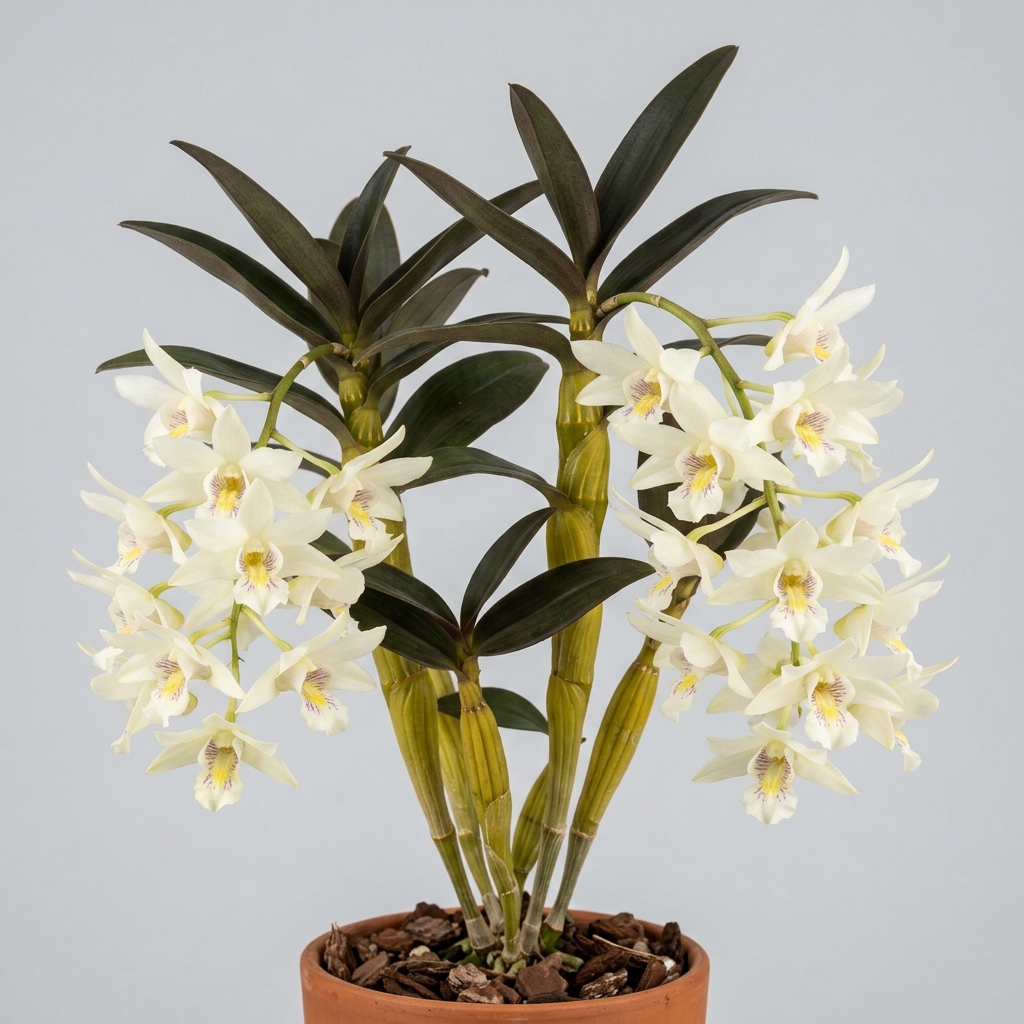
Dendrobium Falcorostrum, commonly known as the Falcon’s Beak Orchid, is a highly prized cool-growing orchid species native to the temperate rainforests of eastern Australia. Renowned for its striking, pristine white blossoms and intense, sweet fragrance, this epiphytic orchid is a standout addition to any temperate orchid collection. It naturally grows on the mossy trunks of Antarctic Beech trees, adapting it to airy, humid, and cool environments that growers strive to replicate at home.
Cultivators value this species not only for its dramatic spring floral display but also for its robust, pseudobulbous growth habit. Unlike many tropical orchids that require constant warmth, Dendrobium Falcorostrum thrives in cooler conditions, making it an excellent choice for growers in temperate regions or those with unheated greenhouses. Its ease of care, provided its seasonal temperature and moisture requirements are met, has earned it a dedicated following among both novice and experienced orchid enthusiasts.
💡 Did You Know?
In its native Australian habitat, Dendrobium Falcorostrum is almost exclusively found growing on the trunks and branches of the Antarctic Beech tree, Nothofagus moorei. This ancient tree species provides the perfect mossy, cool, and humid microclimate that this orchid needs to thrive, making their ecological relationship highly specialized.
🌿 Botanical Overview
Dendrobium Falcorostrum is a sympodial orchid characterized by its erect, yellowish-green pseudobulbs that can reach up to 30 centimeters in height. These pseudobulbs are deeply ribbed and slightly swollen, serving as vital water and nutrient storage organs during dry spells. At the apex of each pseudobulb, the plant produces two to five leathery, dark green leaves that persist for several years, providing a lush backdrop even when the orchid is not in bloom.
In its native Australian habitat, this species is almost exclusively associated with the Antarctic Beech (Nothofagus moorei), growing at elevations between 700 and 1,400 meters. This specific ecological niche exposes the plant to constant air movement, high humidity, and frequent mists. Replicating these conditions—particularly the cool, buoyant air—is key to maintaining a healthy specimen in cultivation.
🌸 Flower Characteristics
The blossoms of Dendrobium Falcorostrum are a masterclass in natural geometry. The flowers are typically 3 to 5 centimeters across, arranged in arching racemes that emerge from the upper nodes of mature pseudobulbs. Each inflorescence can carry anywhere from 4 to 20 flowers, creating a dense, snowy display. The petals and sepals are lanceolate, tapering to elegant points, and are usually a clean, crystalline white or soft cream color.
The defining feature of the flower is its labellum, or lip, which gives the species its botanical name. The lip is three-lobed and curves forward in a shape reminiscent of a falcon’s beak. It is adorned with delicate purple or reddish-brown striations and a bright yellow callus at the center. This contrasting coloration serves as a visual guide for pollinators in the dim light of the forest canopy.
Fragrance & Bloom Profile
One of the most compelling reasons to grow Dendrobium Falcorostrum is its powerful fragrance. On warm, sunny spring days, a single blooming specimen can easily fill an entire greenhouse or growing room with a rich, sweet scent often compared to honey, orange blossoms, or sweet jasmine. The fragrance is most intense during midday when temperatures rise and light levels are highest, fading slightly as dusk approaches.
The blooming period typically begins in late winter and peaks in mid-spring, lasting for approximately three to four weeks. Individual flowers are relatively long-lived if kept in cool, draft-free conditions. To maximize the lifespan of the blooms, growers should avoid getting water directly on the petals, which can cause premature spotting or decay.
Parentage & Hybrid Lineage
As a naturally occurring species rather than a man-made hybrid, Dendrobium Falcorostrum possesses a stable genetic profile. It belongs to the section Dendrocoryne, a group of Australian Dendrobium species known for their cool-growing habits and fragrant flowers. While it is a distinct species in its own right, hybridizers have frequently used it in breeding programs to introduce cold tolerance, upright growth habits, and intense fragrance to new orchid cultivars.
Some of the most successful cold-tolerant Australian Dendrobium hybrids trace their lineage back to this species. When crossed with other native species like Dendrobium speciosum or Dendrobium kingianum, it passes on its clean white coloration and sweet scent. In general cultivation, however, the pure species remains highly sought after by collectors who appreciate its natural, wild form.
🌱 Growing Conditions
To cultivate Dendrobium Falcorostrum successfully, growers must pay close attention to temperature and light. This orchid requires bright, filtered light to thrive and initiate flower buds. A location that receives morning sun and afternoon shade is ideal. In indoor settings, an east- or west-facing window, or a position under high-output LED grow lights, will provide the necessary energy without scorching the foliage.
💡 Care Tip
Always ensure excellent air movement around your Dendrobium Falcorostrum. Because it naturally grows in breezy mountain forests, stagnant air combined with high can quickly lead to fungal leaf spot or rot. A small, continuous circulating fan near your growing area works wonders.
Temperature management is critical. This is a true cool-grower, preferring daytime temperatures between 60°F and 75°F (15°C to 24°C) and night temperatures that drop significantly, ideally down to 45°F to 55°F (7°C to 13°C). It can tolerate brief drops close to freezing if kept dry, but prolonged freezing temperatures must be avoided. High humidity of 60% to 80% coupled with excellent air circulation is essential to prevent fungal pathogens.
Watering, Feeding & Potting Media
During the active growing season in spring and summer, Dendrobium Falcorostrum requires frequent and copious watering. The potting medium should be kept evenly moist but never waterlogged. As the pseudobulbs mature in late autumn, watering should be gradually reduced to initiate a semi-dry winter rest. During this rest period, water only enough to prevent the pseudobulbs from shriveling excessively.
Fertilize weekly or bi-weekly during the active growth phase with a balanced, diluted orchid fertilizer. A “weakly, weekly” approach prevents salt buildup, which can damage the sensitive roots. The ideal potting medium is a highly porous, free-draining mix consisting of medium-grade fir bark, charcoal, and perlite. Alternatively, because of its epiphytic nature, this species performs exceptionally well when mounted on cork bark or tree fern slabs, provided the grower can maintain high humidity.
Blooming Season & Care Notes
The blooming cycle of Dendrobium Falcorostrum is directly tied to its winter rest. To trigger the development of flower spikes, the plant must experience a distinct drop in night temperatures and a reduction in watering for about six to eight weeks during late autumn and early winter. Without this cool, dry period, the orchid may produce vegetative offsets, known as keikis, instead of flower buds.
Once the flower spikes begin to emerge from the upper nodes of the pseudobulbs in late winter, resume regular watering and slightly increase the ambient temperature. Avoid repotting the orchid while it is in bud or active bloom, as this can cause bud blast. The best time to repot or divide the plant is in late spring, immediately after flowering has finished and new root growth is visible at the base of the pseudobulbs.
⚠️ Common Issues
⚠️ Common Mistake
The most common mistake is failing to provide a cool, dry winter rest. Keeping this orchid warm and wet year-round will prevent it from setting flower buds, often resulting in vegetative keikis instead of the highly anticipated fragrant white blooms.
- Bud Blast:
Sudden changes in temperature, low humidity, or drafts can cause developing flower buds to yellow and drop before opening. - Pseudobulb Shriveling: While slight wrinkling is normal during the winter rest, severe shriveling during the growing season indicates underwatering or root loss due to compacted media.
- Fungal Leaf Spotting: Poor air circulation combined with high humidity can lead to black or brown spots on the leaves. Ensure fans are running to keep air moving.
- Pests:
Spider mites, scale, and mealybugs can occasionally target the tender new growth. Treat infestations promptly with insecticidal soap or horticultural oil. - Root Rot:
Overwatering or using a degraded, water-retentive potting medium will quickly suffocate the roots, leading to plant decline.
❓ Frequently Asked Questions
How do I trigger my Dendrobium Falcorostrum to bloom?
To initiate blooming, provide a distinct winter rest starting in late autumn. Reduce watering significantly and expose the plant to cool night temperatures between 45°F and 55°F (7°C to 13°C) for six to eight weeks. This mimics its natural Australian habitat and triggers flower bud development rather than vegetative growth.
Can I grow this orchid indoors without a greenhouse?
Yes, you can grow it indoors if you can provide bright, filtered light and a cool location. A bright windowsill in an unheated room, basement, or enclosed porch during the winter is often ideal for meeting its cool temperature requirements. Ensure you use a humidifier or humidity tray to maintain adequate moisture levels.
What should I do if my orchid produces keikis instead of flowers?
Keikis, or baby plantlets, often form on the pseudobulbs when the orchid does not receive a sufficiently cool or dry winter rest, or if it is over-fertilized with nitrogen. Allow the keiki to grow until it has several roots at least two inches long, then carefully detach and pot it up individually.
How often should I repot Dendrobium Falcorostrum?
This species prefers to be slightly root-bound and dislikes frequent disturbance. Repot only every two to three years, or when the potting medium begins to break down and retain too much moisture. Always perform repotting in late spring, just as new root growth begins after the blooming cycle.
⭐ Final Growing Notes
Dendrobium Falcorostrum is a rewarding and resilient orchid that brings the crisp, fragrant beauty of the Australian temperate rainforest into cultivation. By respecting its need for a cool, dry winter rest and providing bright light and excellent air movement, growers will be rewarded year after year with an abundance of snowy, sweet-scented blossoms. It stands as a testament to the diverse beauty of the genus Dendrobium and remains a must-have for any enthusiast of cool-growing species.
⚕️ Health, Safety & Edibility
Understanding how a plant interacts with people, pets, and the surrounding environment is part of responsible cultivation. This section uses conservative, general guidance and does not replace professional medical or veterinary advice.
Human Safety: No published evidence currently identifies species-specific toxicity concerns for Dendrobium Falcorostrum during normal handling. As with most ornamental plants, it should not be intentionally consumed.
Pet Safety: Published information does not indicate that this orchid commonly poses a toxicity concern for cats or dogs. However, chewing leaves, flowers, roots, or potting media may still cause mild digestive upset.
Edibility: This orchid is cultivated for ornamental display rather than food. Ornamental plants may carry fertilizers, pesticides, or other horticultural treatments that make them unsuitable for consumption.
Skin Contact: Routine handling is not generally associated with skin irritation. Gardeners with sensitive skin may prefer wearing gloves when repotting, pruning, or handling potting media.
🌱 Propagation Tip
The easiest way to propagate this orchid is by division during spring repotting. Ensure each new division has at least three to four healthy, mature pseudobulbs to support new growth. Alternatively, you can gently remove and pot up any keikis that develop roots at least two inches long.
⭐ Expert Advice
When repotting, choose a container that seems slightly too small. Dendrobium Falcorostrum thrives when its roots are snug and tightly packed. A loose, oversized pot holds too much moisture in the center, which can easily suffocate and rot the fine root system.

Leave A Comment