
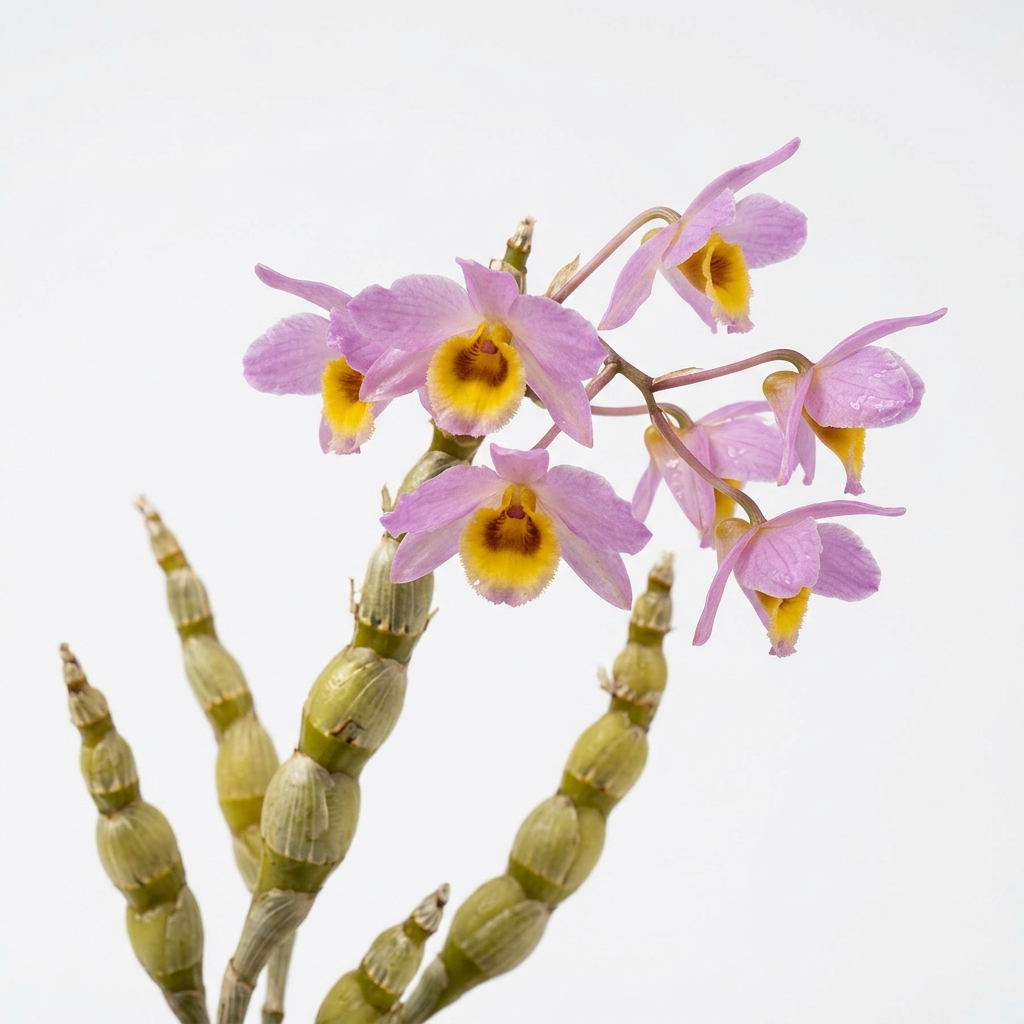
Dendrobium Findlayanum is a highly distinctive epiphytic orchid species native to the seasonal forests of Southeast Asia, prized by collectors for its unusual vegetative morphology and delicate blooms. Unlike many of its relatives, this orchid features striking, swollen pseudobulbs with prominent, bulbous nodes that resemble a series of glossy beads or jointed bamboo stems. This structural eccentricity makes the plant an architectural marvel in any collection even when it is not in active bloom.
When the blooming season arrives in late winter or early spring, the plant transforms, producing elegant clusters of pastel-colored flowers from the upper nodes of its mature, often leafless pseudobulbs. The blossoms typically display soft lavender, pink, or white petals complemented by a striking golden-yellow patch on the lip. Cultivating this species successfully requires an understanding of its seasonal growth cycle, particularly its need for a distinct winter rest period to stimulate flowering.
💡 Did You Know?
The swollen, bead-like nodes of Dendrobium Findlayanum are a specialized evolutionary adaptation to its native monsoon environment. These unique structures act as localized water reservoirs, allowing the orchid to survive prolonged periods of drought during the dry winter months when it sheds its leaves to conserve moisture.
🌿 Botanical Overview
Dendrobium Findlayanum belongs to the massive and diverse genus Dendrobium, specifically within the sections characterized by seasonal growth habits. In its native habitats of Thailand, Myanmar, Laos, and southwestern China, it grows as an epiphyte on tree trunks and branches at moderate elevations. The most defining botanical feature of this species is its pendulous or semi-erect pseudobulbs, which can reach up to 30 to 45 centimeters in length.
These pseudobulbs are uniquely segmented, featuring swollen, flattened nodes that taper sharply at the joints. This adaptation allows the plant to store water and nutrients efficiently during the prolonged dry seasons characteristic of its native monsoon climate. The leaves are lanceolate, thin, and deciduous, typically shedding from older pseudobulbs as they mature and prepare for the winter dormancy phase.
🌸 Flower Characteristics
The flowers of Dendrobium Findlayanum are borne in short racemes arising from the upper nodes of both leafy and leafless pseudobulbs. Each inflorescence usually carries two to three blossoms, which measure approximately 5 to 7 centimeters in diameter. The sepals and petals are typically a translucent pale lilac, soft pink, or pristine white, often tipped with a deeper rose-purple hue.
The most prominent feature of the blossom is its broad, scoop-shaped lip or labellum. The lip is primarily white with a vibrant, egg-yolk yellow disc in the center, creating a beautiful contrast that draws pollinators. The texture of the petals is delicate and slightly waxy, allowing the flowers to remain in pristine condition for several weeks under optimal environmental conditions.
Fragrance & Bloom Profile
The fragrance of Dendrobium Findlayanum is often described as subtle, sweet, and slightly floral, though its intensity can vary depending on temperature, humidity, and light levels. The scent is typically most pronounced during the morning hours when the flowers first receive warmth from the sun. While some growers report a distinct honey-like aroma, others find the fragrance to be very faint or virtually undetectable.
The blooms emerge in late winter and can persist well into the spring months. Individual flowers generally last between three to four weeks, provided they are kept in a cool, draft-free environment away from direct midday sun. Because the flowers often develop on leafless canes, the contrast between the knobby, bare stems and the delicate pastel blossoms creates a highly dramatic visual display.
Parentage & Hybrid Lineage
As a naturally occurring species rather than a man-made hybrid, Dendrobium Findlayanum possesses a pure genetic lineage shaped by natural selection in its native habitats. It was formally described in the late 19th century and named in honor of James Findlay, an active plant collector of the era. While it is a distinct species, it has been used occasionally in hybridization programs to introduce its unique nodular stem structure and pastel flower coloration to new Dendrobium grexes.
Because exact hybrid records and registration details for older crosses can sometimes be inconsistent or poorly documented in general grower literature, collectors value this orchid primarily for its species-purity. When purchasing this plant, growers should look for reputable nurseries that propagate specimens via tissue culture or seed to protect wild populations from unsustainable harvesting.
🌱 Growing Conditions
To cultivate Dendrobium Findlayanum successfully, growers must replicate the seasonal variations of its native Southeast Asian monsoon climate. During the active growing season from spring through autumn, the orchid thrives in bright, filtered light. A location that receives strong morning sunlight with filtered shade during the hottest afternoon hours is ideal. High-quality LED grow lights can also be used, provided they deliver sufficient intensity without overheating the foliage.
💡 Care Tip
Provide excellent air movement around your Dendrobium Findlayanum, especially during the hot, humid summer months. Strong ventilation prevents moisture from pooling in the crevices of the swollen nodes, significantly reducing the risk of fungal and bacterial rot.
Temperature management is critical for this species. In the summer, it prefers warm conditions with daytime temperatures ranging from 24 to 30 degrees Celsius. In the winter, however, the plant requires a distinct cooling period, with nighttime temperatures dropping to 10 to 15 degrees Celsius. Maintaining high humidity of 60% to 80% during the summer growth phase, coupled with excellent air circulation, will prevent stagnant air and reduce the risk of fungal infections.
Watering, Feeding & Potting Media
Watering practices must change dramatically between the growing and resting seasons. Throughout the spring and summer, Dendrobium Findlayanum should be watered copiously, keeping the potting medium consistently moist but never waterlogged. Weekly applications of a balanced orchid fertilizer diluted to quarter-strength will support the rapid development of new pseudobulbs.
As autumn approaches, watering should be gradually reduced, and fertilizer must be withheld entirely. During the winter rest, the plant should receive only enough water to prevent the pseudobulbs from shriveling excessively; a light misting every one to two weeks is often sufficient. This species is best grown in a highly porous, free-draining medium such as medium-grade fir bark mixed with perlite and charcoal, or mounted on cork bark to accommodate its naturally pendulous growth habit.
Blooming Season & Care Notes
The blooming cycle of Dendrobium Findlayanum is directly triggered by the cool, dry winter rest. Without this period of temperature drop and water restriction, the orchid may fail to produce flowers, instead generating vegetative offsets known as keikis from the nodes. Once flower buds begin to emerge from the nodes in late winter, growers can slowly resume light watering, gradually increasing the frequency as the flowers open and new root growth begins at the base of the pseudobulbs.
Repotting should only be performed when absolutely necessary, as this species resents root disturbance. The ideal time to repot or remount is immediately after flowering, just as new green root tips begin to emerge from the base of the newest pseudobulb. Always use sterilized tools and select a pot that is just large enough to accommodate the root mass for another two years.
⚠️ Common Issues
⚠️ Common Mistake
The most common mistake is this orchid normally during its winter dormancy. Overwatering during this cool rest period quickly leads to root rot, which can destroy the root system and prevent the plant from absorbing moisture when active growth resumes in spring.
- Lack of Blooms: Often caused by failing to provide a sufficiently cool and dry winter rest period, resulting in vegetative growth instead of flower buds.
- Pseudobulb Shriveling: While slight wrinkling is normal during the winter rest, severe shriveling indicates extreme dehydration or root loss due to overwatering during the active season.
- Bud Blast:
Sudden drops in humidity, cold drafts, or moving the plant while buds are developing can cause the buds to yellow and drop prematurely. - Pests:
Spider mites and scale insects can occasionally target the thin leaves and crevices of the swollen nodes; treat promptly with insecticidal soap or horticultural oil. - Root Rot:
Caused by compacted, poorly draining media or overwatering during the winter dormancy period.
❓ Frequently Asked Questions
Why is my Dendrobium Findlayanum producing baby plants instead of flowers?
This is a common response to a lack of a proper winter rest. If the orchid is kept too warm, wet, or fertilized during the winter months, the nodes that would normally produce flower buds will instead develop into vegetative offsets called keikis. To encourage blooming, ensure the plant experiences cooler temperatures and restricted watering starting in late autumn.
How dry should I keep the orchid during its winter rest period?
The winter rest should be dry but not completely desiccating. You should withhold regular watering and fertilizer entirely, providing only occasional light misting or a very light watering every ten to fourteen days if the pseudobulbs begin to shrivel severely. The goal is to mimic the dry winter monsoon season of its native habitat.
Can I grow Dendrobium Findlayanum mounted on cork bark?
Yes, mounting this species on cork bark or tree fern slabs is highly recommended. Because of its naturally pendulous growth habit and swollen, heavy pseudobulbs, a mounted presentation allows the canes to drape naturally. Mounted plants will require more frequent watering and higher humidity during the summer growing season than potted ones.
What should I do with the pseudobulbs after they lose their leaves?
Do not cut off the leafless pseudobulbs unless they are completely dry, brown, and hollow. These bare canes serve as vital energy and water storage organs for the orchid. Furthermore, Dendrobium Findlayanum frequently produces flowers from these older, leafless pseudobulbs during the late winter blooming cycle.
⭐ Final Growing Notes
Dendrobium Findlayanum is an extraordinary orchid that rewards patient growers with its architectural stems and delicate, pastel-hued blossoms. While its seasonal requirements demand a disciplined approach to watering and temperature management, the visual payoff of its unique nodular growth and spring floral display makes it a highly rewarding addition to any intermediate or advanced orchid collection.
⚕️ Health, Safety & Edibility
Understanding how a plant interacts with people, pets, and the surrounding environment is part of responsible cultivation. This section uses conservative, general guidance and does not replace professional medical or veterinary advice.
Human Safety: No published evidence currently identifies species-specific toxicity concerns for Dendrobium Findlayanum during normal handling. As with most ornamental plants, it should not be intentionally consumed.
Pet Safety: Published information does not indicate that this orchid commonly poses a toxicity concern for cats or dogs. However, chewing leaves, flowers, roots, or potting media may still cause mild digestive upset.
Edibility: This orchid is cultivated for ornamental display rather than food. Ornamental plants may carry fertilizers, pesticides, or other horticultural treatments that make them unsuitable for consumption.
Skin Contact: Routine handling is not generally associated with skin irritation. Gardeners with sensitive skin may prefer wearing gloves when repotting, pruning, or handling potting media.
🌱 Propagation Tip
If your orchid produces keikis along the canes due to a disrupted winter rest, wait to remove them until they have developed several roots that are at least five centimeters long. Gently twist them off and pot them in a fine bark mix.
⭐ Expert Advice
To achieve the best floral display, place the orchid in a location where it experiences a clear drop of about ten degrees Celsius between day and night during late autumn. This thermal shift, combined with dry conditions, is the primary trigger for bud initiation.

Leave A Comment