
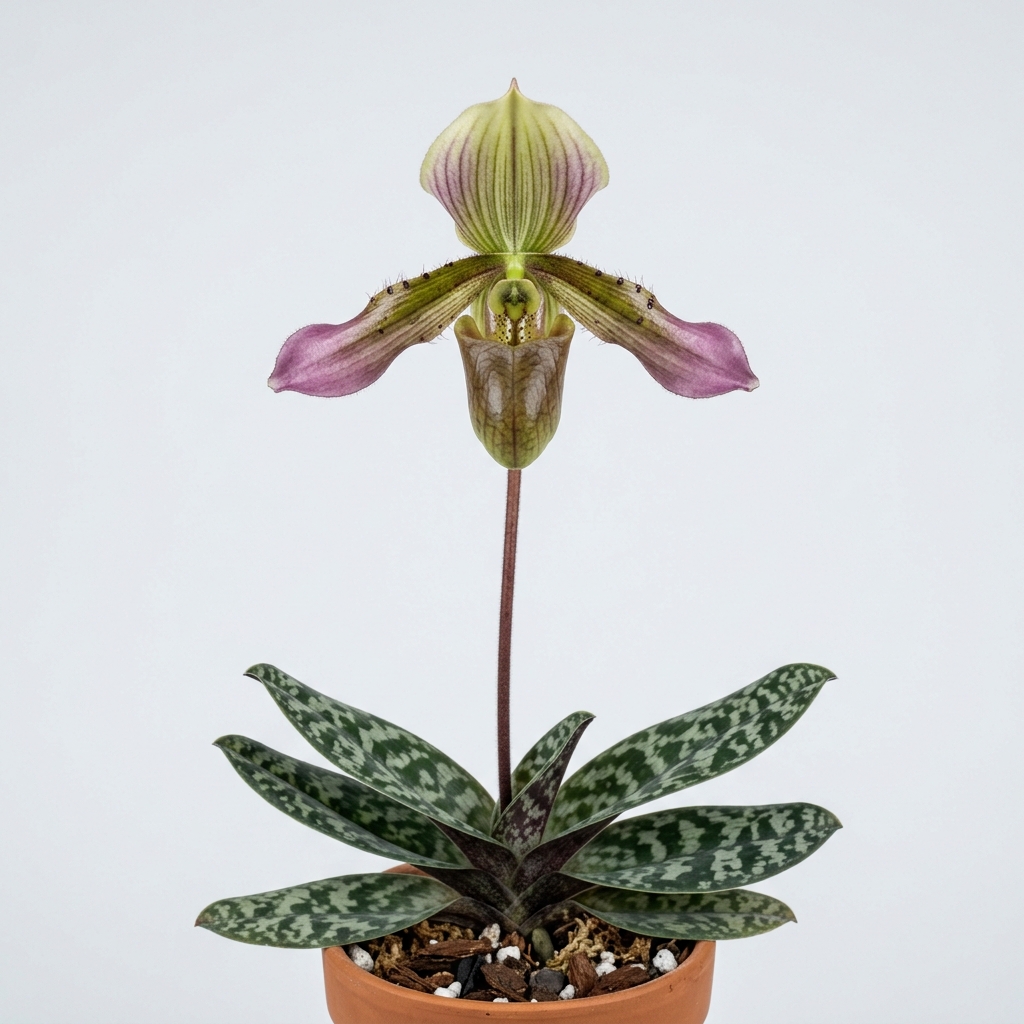
Paphiopedilum Appletonianum is a highly sought-after terrestrial slipper orchid native to the moist, shaded forest floors of Southeast Asia. Renowned for its elegant, architectural growth habit and beautifully mottled foliage, this species brings a refined, exotic presence to indoor collections. Growers particularly value its striking, long-lasting blossoms that showcase a sophisticated blend of green, mauve, and purple tones.
Unlike many epiphytic orchids that demand intense light and dry-out periods, this species thrives in lower-light environments and prefers consistent moisture. Its compact size makes it an excellent candidate for windowsill cultivation or dedicated orchid terrariums. By understanding its natural forest-floor habitat, indoor gardeners can easily replicate the humid, shaded conditions required to keep this classic slipper orchid thriving for years.
💡 Did You Know?
The mottled leaf pattern of Paphiopedilum Appletonianum is an evolutionary adaptation to its native forest floor habitat. In the wild, this dappled foliage acts as natural camouflage, helping the plant blend seamlessly into the leaf litter and shadows to avoid herbivores while maximizing absorption in low- environments.
🌿 Botanical Overview
Paphiopedilum Appletonianum is primarily native to countries such as Vietnam, Thailand, Cambodia, and Laos, where it grows as a terrestrial or lithophytic plant. It is typically found nestled in leaf litter, mossy crevices, or damp soil along steep ravines and riverbanks. This natural setting provides the plant with a highly humid microclimate, constant air movement, and protection from direct, scorching sunlight.
The vegetative structure of this orchid is highly ornamental even when the plant is not in bloom. It features attractive, strap-like leaves that exhibit a distinct tessellated or mottled pattern of dark green and pale silvery-green. Because it lacks pseudobulbs, the plant relies entirely on its fan-shaped growth habit and thick, fleshy roots to store moisture and nutrients, making consistent care essential.
🌸 Flower Characteristics
The blossoms of Paphiopedilum Appletonianum are celebrated for their unique, architectural form and subtle color transitions. Each single-flowered inflorescence emerges from the center of the leaf fan on a tall, slender, purple-toned spike that can reach up to forty centimeters in height. This upright presentation holds the flower well above the foliage, creating a dramatic visual display.
The flower itself features a prominent, pouch-like lip, or labellum, which is typically a muted brownish-green or dull pink. The dorsal sepal is broadly ovate, often displaying a green center with white or pale pink margins. The lateral petals are particularly distinctive, spreading outward and downward with slightly twisted, spatulate tips colored in shades of rose-purple or mauve, often adorned with small, dark spots along the upper margins.
Fragrance & Bloom Profile
This species is generally considered to be unscented, as fragrance is not consistently documented or reported by growers. Instead of olfactory appeal, the orchid directs its evolutionary energy into producing highly durable, visually striking flowers designed to attract specific insect pollinators. Individual blooms are exceptionally long-lasting, often remaining pristine on the plant for six to eight weeks under optimal indoor conditions.
Parentage & Hybrid Lineage
Paphiopedilum Appletonianum is a naturally occurring species rather than a man-made hybrid. While its exact natural variations and regional forms are still studied by taxonomists, it is widely recognized as a distinct species within the subgenus Sigmatopetalum. In cultivation, it has been used by hybridizers to introduce its mottled foliage, tall flower spikes, and distinctive petal coloration into modern slipper orchid breeding lines. Because documentation on early historical crosses can sometimes be limited or inconsistent in general grower references, collectors value this orchid primarily for its pure, wild-type characteristics.
🌱 Growing Conditions
Replicating the forest floor environment is key to successfully growing Paphiopedilum Appletonianum. It thrives in low to medium indirect light, similar to the light levels preferred by Phalaenopsis orchids. Direct sunlight should be strictly avoided, as it can easily scorch the sensitive, mottled leaves. East- or north-facing windows, or diffuse LED grow lights, are ideal for maintaining healthy growth.
💡 Care Tip
Keep this orchid in a location with gentle, continuous air movement. Good ventilation prevents moisture from settling on the mottled leaves overnight, which significantly reduces the risk of fungal infections and leaf spot diseases.
Temperature: wise, this orchid prefers intermediate to warm conditions, with daytime temperatures ranging between twenty-one and twenty-eight degrees Celsius, and a slight drop at night to stimulate healthy metabolic processes. High relative humidity, ideally between fifty and seventy percent, combined with gentle, continuous air movement, prevents stagnant air and mimics its native tropical ravines.
Watering, Feeding & Potting Media
Because Paphiopedilum Appletonianum lacks water-storing pseudobulbs, it must never be allowed to dry out completely. The potting medium should remain evenly moist but not waterlogged. Water the plant thoroughly when the top centimeter of the medium begins to feel slightly dry, using rainwater, distilled water, or reverse osmosis water to avoid mineral buildup.
A well-draining, moisture-retentive potting mix is essential. A combination of fine-grade fir bark, perlite, charcoal, and chopped sphagnum moss works exceptionally well. Feeding should be light and consistent; apply a balanced, highly diluted orchid fertilizer at one-quarter strength every two to three waterings during the active growing season, followed by a plain water flush to rinse away residual salts.
Blooming Season & Care Notes
The primary blooming season for Paphiopedilum Appletonianum typically occurs in late winter through spring, though environmental factors can influence the exact timing. Once the flower spike begins to emerge from the center of the leaf fan, avoid moving or rotating the plant excessively, as this can cause the developing bud to orient itself awkwardly or fail to open properly.
After the flower eventually fades, cut the spike down close to the base of the foliage using a sterile cutting tool. Repotting is best performed every one to two years immediately after the blooming cycle concludes. This timing allows the orchid to establish its roots in fresh, uncompacted media before the heat of summer arrives.
⚠️ Common Issues
⚠️ Common Mistake
A frequent mistake is allowing the potting medium to dry out completely between waterings. Because this species lacks water-storing pseudobulbs, prolonged dryness damages the roots and can cause the flower buds to blast before opening.
- Root rot: Caused by overwatering or compacted, poorly draining potting media that deprives roots of oxygen.
- Leaf scorch: Bleached or dry brown patches on the foliage resulting from exposure to direct sunlight.
- Bud blast: Premature drying and dropping of flower buds, often triggered by sudden temperature drops, low humidity, or drafts.
- Mealybugs and scale: Common pests that hide in the tight crevices of the leaf fans; treat early with horticultural soap or neem oil.
- Fungal leaf spot: Dark, sunken spots on the leaves, usually caused by water resting on the foliage overnight in stagnant air.
❓ Frequently Asked Questions
How often should I water my Paphiopedilum Appletonianum?
Water your orchid when the top centimeter of the potting medium feels slightly dry to the touch. This typically translates to once or twice a week, depending on your home’s humidity and temperature. Never let the roots sit in standing water, but do not allow the medium to dry out completely.
Why are the tips of my orchid’s leaves turning brown?
Brown leaf tips are often a sign of low humidity, underwatering, or mineral buildup from tap water. Ensure your humidity levels are above fifty percent, and consider switching to distilled, rain, or reverse osmosis water to prevent salt accumulation in the root zone.
Does Paphiopedilum Appletonianum require a cold period to bloom?
No, this species does not require a severe cold drop to initiate blooming. However, a subtle night-time temperature drop of three to five degrees Celsius during the autumn months can help stimulate the development of new flower spikes.
Can I grow this orchid under artificial LED lights?
Yes, Paphiopedilum Appletonianum adapts exceptionally well to artificial lighting. Place the plant under moderate-strength LED grow lights for twelve to fourteen hours a day, ensuring the light source is positioned far enough away to prevent heat stress or leaf bleaching.
⭐ Final Growing Notes
Paphiopedilum Appletonianum is a rewarding and relatively low-maintenance orchid that brings unique architectural beauty to any indoor garden. By maintaining consistent moisture, moderate humidity, and shaded light, growers can enjoy both its striking mottled foliage and its long-lasting, elegant blooms year after year.
⚕️ Health, Safety & Edibility
Understanding how a plant interacts with people, pets, and the surrounding environment is part of responsible cultivation. This section uses conservative, general guidance and does not replace professional medical or veterinary advice.
Human Safety: No published evidence currently identifies species-specific toxicity concerns for Paphiopedilum Appletonianum during normal handling. As with most ornamental plants, it should not be intentionally consumed.
Pet Safety: Published information does not indicate that this orchid commonly poses a toxicity concern for cats or dogs. However, chewing leaves, flowers, roots, or potting media may still cause mild digestive upset.
Edibility: This orchid is cultivated for ornamental display rather than food. Ornamental plants may carry fertilizers, pesticides, or other horticultural treatments that make them unsuitable for consumption.
Skin Contact: Routine handling is not generally associated with skin irritation. Gardeners with sensitive skin may prefer wearing gloves when repotting, pruning, or handling potting media.
🌱 Propagation Tip
Unlike sympodial orchids with pseudobulbs, Paphiopedilum Appletonianum is propagated by division. Only attempt to divide mature specimens that have at least six to eight healthy leaf fans, ensuring each new division has a strong, established root system.
⭐ Expert Advice
To encourage robust blooming, add a small amount of crushed oyster shells or agricultural lime to the potting mix. This mimics the calcium-rich limestone environments where many wild slipper orchids naturally grow, supporting strong cell wall development.

Leave A Comment