
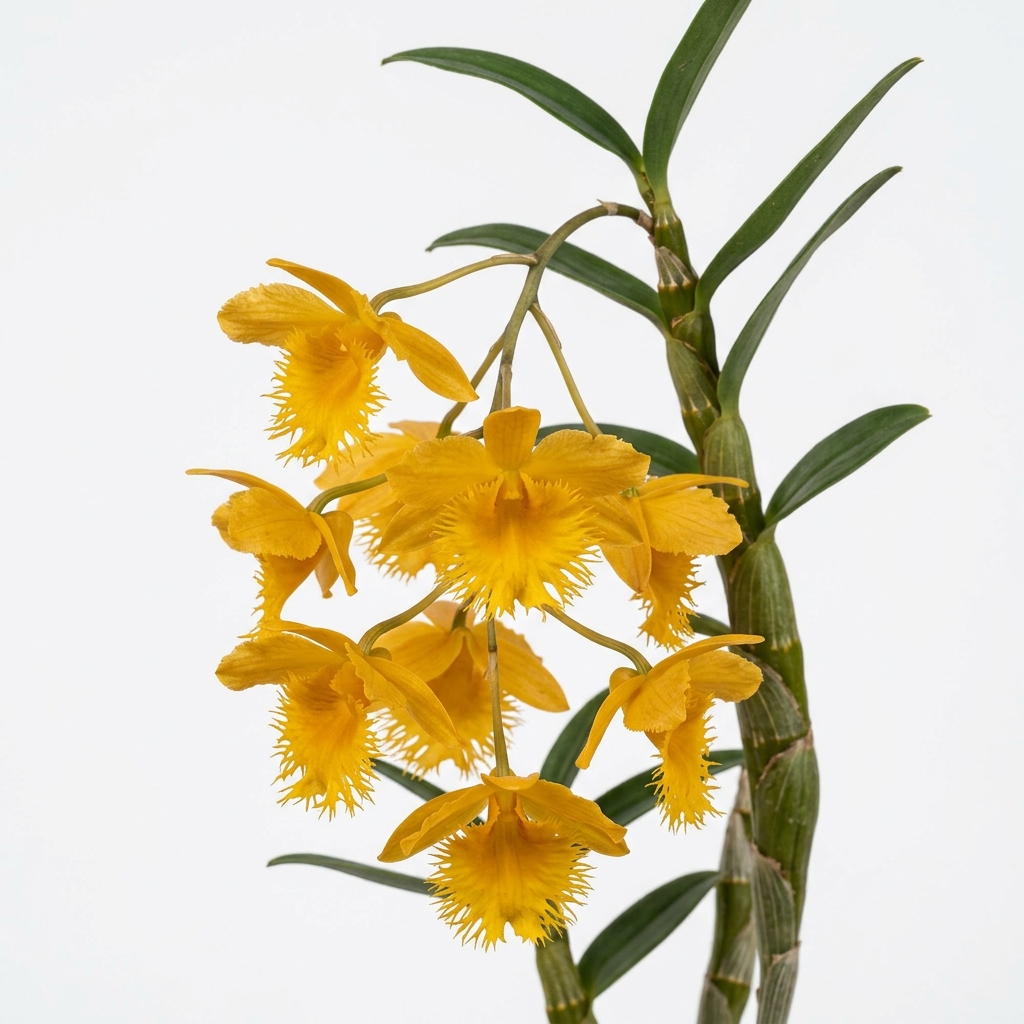
Dendrobium Harveyanum is a highly sought-after epiphytic orchid species native to the mountainous regions of Southeast Asia. Highlighted by its most striking feature, the remarkable and deeply fringed golden-yellow flowers set it apart from almost any other member of the genus Dendrobium. Collectors prize this orchid for its unique botanical architecture, exotic textures, and intricate blooms that resemble delicate lace.
In cultivation, this compact to medium-sized sympodial orchid produces spindle-shaped pseudobulbs that carry thin, leathery leaves. While it requires a bit of attention regarding seasonal moisture variations, its rewarding flowering display and relatively compact growth habit make it an excellent choice for intermediate orchid enthusiasts looking to expand their collection with a true botanical marvel.
💡 Did You Know?
Dendrobium Harveyanum is part of the Dendrobium orchid group, a favorite among growers because its flowers, growth habit, and care needs make it useful for comparing cultivated orchids within the same . Observing its leaves, roots, and bloom spikes can help growers understand how this cultivar responds to indoor conditions.
🌿 Botanical Overview
Dendrobium Harveyanum is native to wet, mossy forests across Southern China, Myanmar, Thailand, and Vietnam, typically growing at elevations between 1,100 and 1,700 meters. This elevation profile gives the orchid an intermediate temperature preference, allowing it to tolerate cooler nights than strictly lowland tropical species in its native habitat.
The plant features clustered, pseudobulbs that are somewhat swollen in the middle, resembling spindles or small clubs. These canes are grooved and typically bear two to three lanceolate, dark green leaves near the apex. The deciduous nature of the foliage means older canes may shed leaves, but they remain vital storage organs for water and nutrients and should never be cut off unless completely dry and dead.
🌸 Flower Characteristics
The defining feature of Dendrobium Harveyanum is its extraordinary floral morphology. The flowers, which measure approximately two inches across, are a solid, vibrant golden-yellow. What truly captivates growers is the intense, lace-like fringing along the margins of both the lateral petals and the labellum, or lip.
These highly fimbriate petals give the blossoms a fuzzy, delicate appearance that is rare within the genus. The flowers are borne on short, arching racemes that emerge from the upper nodes of both leafy and leafless mature pseudobulbs, presenting a dense cluster of bright color against the dark green foliage.
Fragrance & Bloom Profile
Many growers report that Dendrobium Harveyanum produces a distinct, sweet fragrance reminiscent of honey or beeswax. This scent is typically most pronounced during the morning hours when temperatures begin to rise and light levels increase in the growing area.
The blooms are moderately long-lasting, often remaining in pristine condition for three to four weeks if kept in cool, stable conditions. Because the flowers open nearly simultaneously on the inflorescence, they create a highly impactful, concentrated display of color and texture that makes the plant a standout specimen during its blooming cycle.
Parentage & Hybrid Lineage
As a naturally occurring species rather than a man-made hybrid, Dendrobium Harveyanum represents a pure evolutionary lineage. It belongs to the section Dendrobium, sharing close botanical affinities with other yellow-flowered species such as Dendrobium brymerianum, which also features a fringed lip but lacks the heavily fringed petals of Dendrobium Harveyanum.
While it has been used occasionally in hybridizing programs to introduce its unique fringed characteristics to new grexes, such hybrids remain relatively uncommon in the mass market. Most enthusiasts prefer to grow the species itself to appreciate its unaltered, wild beauty and unique evolutionary adaptations.
🌱 Growing Conditions
To cultivate this orchid successfully, provide bright, filtered light similar to that required by most Cattleyas. Direct midday sun should be avoided to prevent leaf scorch, but high light levels are essential for robust pseudobulb development and later blooming.
💡 Care Tip
For best results, grow Dendrobium Harveyanum in bright filtered with steady and gentle airflow. Avoid placing the plant in harsh midday sun, but do not keep it in a dark corner; weak is one of the most common reasons cultivated orchids refuse to rebloom.
Temperature ranges should ideally mimic its native montane habitat. During the active growing season in spring and summer, daytime temperatures of 75 to 85 degrees Fahrenheit are ideal, with a night drop to around 60 to 65 degrees. Good air circulation is paramount at all times to prevent stagnant air pockets and fungal issues on the foliage.
Watering, Feeding & Potting Media
During the active spring and summer growth phase, Dendrobium Harveyanum requires frequent watering and high humidity. The potting medium should be kept consistently moist but never waterlogged. Apply a balanced orchid fertilizer at quarter-strength weekly during this period of rapid vegetative development.
This species performs exceptionally well when mounted on cork bark or tree fern plaques, provided humidity can be kept consistently high. For pot culture, use a highly porous, free-draining medium such as medium-grade fir bark mixed with perlite and charcoal to ensure rapid drainage and excellent root aeration.
Blooming Season & Care Notes
The primary blooming season occurs from late winter through spring. To trigger successful bud initiation, growers must provide a distinct, cooler, and drier rest period starting in late autumn.
During this winter rest, reduce watering significantly, allowing the medium to dry out completely between light mistings, and withhold fertilizer entirely. This seasonal stress mimics the dry winters of its native habitat and is crucial; failing to provide a dry rest often results in vegetative keikis instead of flower buds.
⚠️ Common Issues
⚠️ Common Mistake
The most common mistake is by calendar instead of root and potting-media condition. Dendrobium roots need moisture and air at the same time, so constantly wet bark or sphagnum can lead to root loss even when the leaves still look healthy.
- Root rot caused by overwatering during the winter rest period when the plant is inactive.
- Bud blast, where developing flower buds yellow and drop prematurely due to sudden drafts or low humidity.
- Spider mites and scale insects, which can hide in the grooved pseudobulbs or under leaf sheaths.
- Lack of blooms, typically caused by insufficient light during the growing season or a failure to provide a dry winter rest.
- Leaf spotting from fungal pathogens if air circulation is inadequate in high-humidity environments.
❓ Frequently Asked Questions
Why is my Dendrobium Harveyanum not blooming?
The most common reason for a lack of flowers is the absence of a proper winter rest. Starting in late autumn, you must significantly reduce watering and stop fertilizing while keeping the plant in cooler, bright conditions to trigger bud development.
Can I grow Dendrobium Harveyanum under LED grow lights?
Yes, this orchid adapts well to indoor cultivation under high-output LED grow lights. Ensure the lights are positioned to provide bright, indirect light levels, and monitor the temperature to ensure a distinct day-night differential.
How often should I repot this orchid?
Repotting should only be done every two to three years, or when the potting medium begins to break down. Always wait until new root growth emerges from the base of the newest pseudobulb in spring before disturbing the root system.
Why are the leaves on older canes turning yellow and falling off?
It is completely natural for older, mature pseudobulbs to lose their leaves over time. As long as the newest canes remain healthy and leafy, this semi-deciduous behavior is normal and not a cause for concern.
⭐ Final Growing Notes
Dendrobium Harveyanum remains one of the most rewarding species orchids for intermediate growers who can accommodate its seasonal requirements. By balancing copious water and warmth in summer with a cool, dry rest in winter, you will be rewarded with an unparalleled display of fringed, golden blossoms that are sure to be the highlight of any orchid collection.
⚕️ Health, Safety & Edibility
Understanding how a plant interacts with people, pets, and the surrounding environment is part of responsible cultivation. This section uses conservative, general guidance and does not replace professional medical or veterinary advice.
Human Safety: No published evidence currently identifies species-specific toxicity concerns for Dendrobium Harveyanum during normal handling. As with most ornamental plants, it should not be intentionally consumed.
Pet Safety: Published information does not indicate that this orchid commonly poses a toxicity concern for cats or dogs. However, chewing leaves, flowers, roots, or potting media may still cause mild digestive upset.
Edibility: This orchid is cultivated for ornamental display rather than food. Ornamental plants may carry fertilizers, pesticides, or other horticultural treatments that make them unsuitable for consumption.
Skin Contact: Routine handling is not generally associated with skin irritation. Gardeners with sensitive skin may prefer wearing gloves when repotting, pruning, or handling potting media.
🌱 Propagation Tip
Propagation should be approached patiently. Most home growers should wait for natural keikis or divide only mature, healthy plants when the orchid type allows it. Never remove a young growth until it has strong roots and enough leaves to support itself away from the parent plant.
⭐ Expert Advice
Repot after flowering when fresh root tips begin to appear. This timing helps the plant anchor quickly into new bark or sphagnum and reduces stress, especially for orchids grown indoors where airflow, , and drying speed can change from season to season.

Leave A Comment