

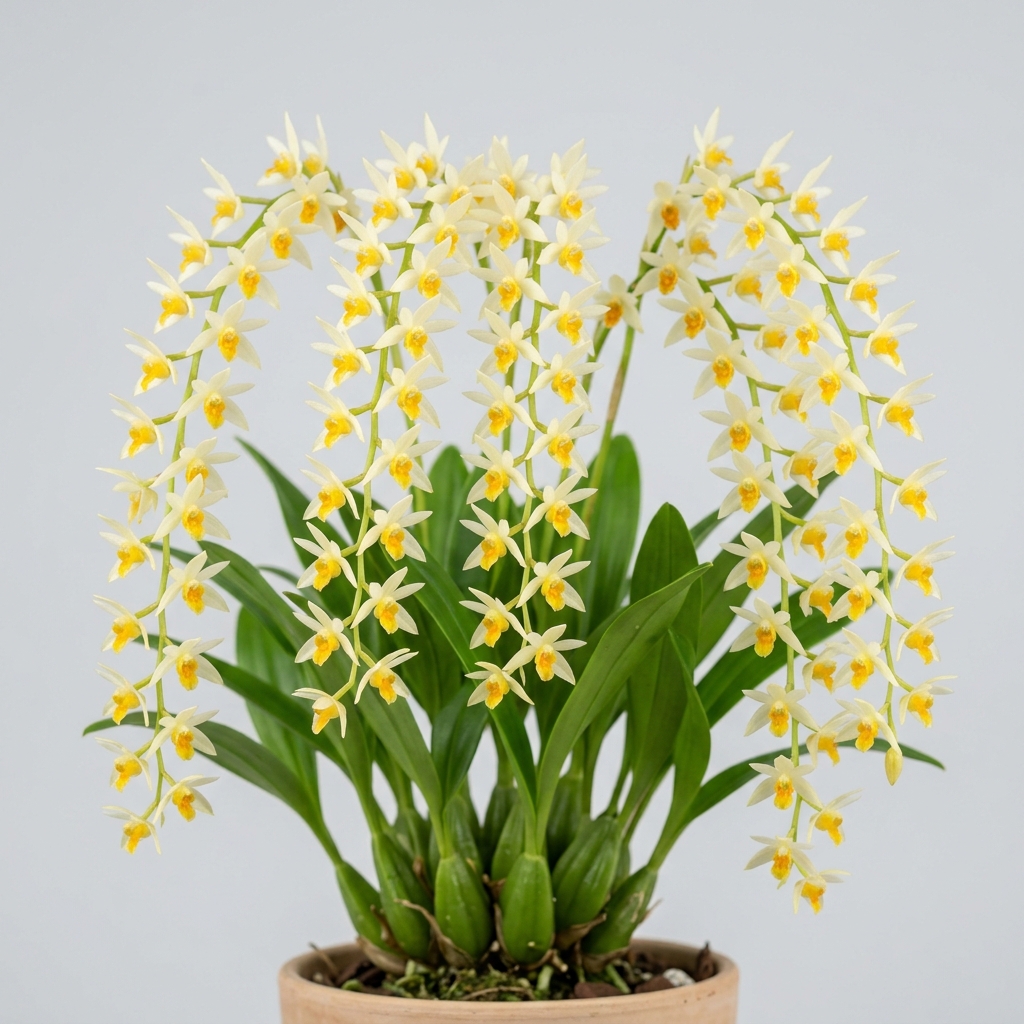
Dendrobium Johnsoniae is an elegant and highly sought-after orchid species native to the rainforests of New Guinea and surrounding islands. Belonging to the popular Latouria section of the Dendrobium genus, this orchid is celebrated for its striking, long-lasting white blossoms accented by delicate purple veining on the lip. Growers value it for its architectural growth habit and its ability to produce multiple showy blooms that remain pristine for several weeks.
Cultivating this species successfully requires an understanding of its natural epiphytic habitat, where it thrives in warm, humid conditions with excellent air movement. While it can be slightly more demanding than common mass-market hybrids, providing the correct balance of filtered light and consistent moisture rewards the enthusiast with spectacular seasonal displays. It serves as an excellent centerpiece for intermediate to advanced orchid collections.
💡 Did You Know?
Dendrobium Johnsoniae belongs to the Dendrobium orchid group, where flower presentation is often just as important as . White-flowered cultivars are especially valued indoors because their pale blooms reflect well and pair easily with many home, greenhouse, and display settings.
🌿 Botanical Overview
Dendrobium Johnsoniae is an epiphytic orchid species native to Papua New Guinea, where it grows on mossy tree branches at elevations ranging from sea level up to 1,200 meters. It features erect, club-shaped pseudobulbs that typically carry two to four leathery, dark green leaves near the apex. The pseudobulbs serve as water-storage organs, helping the plant survive brief periods of dryness in its native canopy habitat.
As a member of the Latouria section, this species shows a robust growth habit and is relatively resilient compared to other delicate forest orchids. The root system is fine but extensive, requiring a highly aerated medium to prevent suffocation. Understanding its natural environment—characterized by frequent rainfall and constant air movement—is key to successful container cultivation.
🌸 Flower Characteristics
The blossoms of Dendrobium Johnsoniae are remarkably elegant, often measuring between 3 to 5 inches (7.5 to 12.5 cm) in diameter. The sepals and petals are pure, glistening white, spreading wide to create a star-like silhouette. The most defining feature is the prominent, three-lobed lip (labellum), which is adorned with intricate, radiating purple or magenta veins that draw the eye toward the center of the flower.
Flowers are produced on upright or arching racemes that emerge from the upper nodes of both mature and newly matured pseudobulbs. Each inflorescence can carry anywhere from two to twelve flowers, presenting them beautifully above the foliage. The substance of the petals is notably thick and waxy, which contributes to their exceptional longevity on the plant.
Fragrance & Bloom Profile
While some growers report a very faint, sweet fragrance during the warmest hours of the day, Dendrobium Johnsoniae is primarily grown for its visual appeal rather than its scent. Any fragrance present is typically subtle and may vary depending on environmental factors such as temperature, humidity, and light intensity.
The bloom profile is highly regarded because the flowers can remain in pristine condition for up to two months under optimal conditions. This long-lasting nature makes it a favorite for exhibition and home display. The flowers open sequentially or nearly simultaneously, creating a dense and impactful floral presentation.
Parentage & Hybrid Lineage
As a naturally occurring species rather than a man-made hybrid, Dendrobium Johnsoniae possesses a pure genetic lineage. It has been widely used by orchid breeders to introduce large white flower size, flat presentation, and long-lasting qualities into Latouria-type hybrids.
When crossed with other species within its section, such as Dendrobium atroviolaceum or Dendrobium spectabile, it yields popular, robust hybrids that retain the striking white coloration and contrasting lip patterns. In grower literature, it is occasionally referred to under historical synonyms, but its status as a distinct species remains firmly established.
🌱 Growing Conditions
To replicate its native tropical canopy, Dendrobium Johnsoniae requires bright, filtered light. Direct midday sunlight should be avoided as it can easily scorch the foliage, but insufficient light will result in weak pseudobulbs and a lack of flowers. East- or shaded south-facing windows are often ideal, as are high-quality LED grow lights.
💡 Care Tip
For best results, grow Dendrobium Johnsoniae in bright filtered with steady and gentle airflow. Avoid placing the plant in harsh midday sun, but do not keep it in a dark corner; weak is one of the most common reasons cultivated orchids refuse to rebloom.
Temperature ranges should remain warm to intermediate, ideally between 70°F and 85°F (21°C to 29°C) during the day, with a slight drop of 10°F (5°C to 6°C) at night to stimulate healthy growth and eventual budding. High humidity levels of 60% to 80% are essential, paired with constant, gentle air circulation to prevent stagnant air pockets that encourage fungal pathogens.
Watering, Feeding & Potting Media
During the active spring and summer growing season, this orchid requires frequent watering to keep the potting medium evenly moist but never waterlogged. As growth slows in the late autumn and winter, watering should be reduced, allowing the medium to dry out slightly between waterings without letting the pseudobulbs shrivel excessively.
A balanced, diluted orchid fertilizer should be applied weekly or bi-weekly during active growth, using a “weakly, weekly” approach. Flush the pot with pure water once a month to prevent harmful salt buildup. The ideal potting medium is a highly draining mixture of medium-grade fir bark, horticultural charcoal, and perlite. Alternatively, plants can be mounted on cork bark if high humidity can be consistently maintained.
Blooming Season & Care Notes
The primary blooming season for Dendrobium Johnsoniae typically spans from late winter through late spring, though occasional blooms can occur at other times of the year. Once the flower spike begins to emerge from the top of the pseudobulb, avoid changing the plant’s orientation to the light source, as this can cause the developing buds to twist or fail to open properly.
After the flowers fade, the old flower spikes can be cut back close to the pseudobulb. Do not remove the old pseudobulbs themselves unless they are completely dry, brown, and papery, as they continue to store water and nutrients that support new growth. Repotting is best done in the spring just as new root tips begin to emerge from the base of the newest pseudobulbs.
⚠️ Common Issues
⚠️ Common Mistake
The most common mistake is by calendar instead of root and potting-media condition. Dendrobium roots need moisture and air at the same time, so constantly wet bark or sphagnum can lead to root loss even when the leaves still look healthy.
- Root Rot:
Caused by overwatering or compacted, poorly draining potting media. Ensure the pot has excellent drainage and the bark has not decomposed. - Bud Blast:
Sudden drops in humidity, drafts, or drastic temperature fluctuations can cause developing flower buds to turn yellow and drop off before opening. - Spider Mites and Mealybugs: These common pests can hide in the crevices of the leaves and pseudobulbs. Treat infestations early with insecticidal soap or horticultural oil.
- Leaf Spotting: Fungal or bacterial spots can develop if water is allowed to sit on the leaves overnight without adequate air movement.
- Shriveled Pseudobulbs: A sign of dehydration, which can be caused by either underwatering or a loss of roots due to root rot.
❓ Frequently Asked Questions
How often should I water my Dendrobium Johnsoniae?
Watering frequency depends on your home environment, but generally, you should water once or twice a week during the active growing season. Allow the top inch of the medium to dry slightly before watering again. In winter, reduce watering to once every ten to fourteen days, ensuring the pseudobulbs do not shrivel.
Why are the leaves on my orchid turning yellow and dropping?
Yellowing leaves can indicate several issues, most commonly overwatering or poor drainage leading to root rot. It can also be a natural shedding process for very old leaves on mature pseudobulbs. Check the root system; if roots are brown and mushy, repot the plant in fresh media and adjust your watering schedule.
Can I grow Dendrobium Johnsoniae under artificial lights?
Yes, this species adapts very well to indoor cultivation under LED grow lights. Position the plant so it receives bright, indirect light for 12 to 14 hours a day during the growing season, ensuring the leaves do not touch the light source to avoid heat damage.
When is the best time to repot this orchid?
The ideal time to repot is in the spring, immediately after flowering has finished and just as new green root tips begin to emerge from the base of the newest pseudobulbs. Avoid repotting while the plant is in active bloom unless the potting medium is severely decomposed.
⭐ Final Growing Notes
While Dendrobium Johnsoniae requires a bit more attention to humidity and airflow than standard grocery store orchids, its breathtaking, long-lasting white blooms make it an exceptionally rewarding species to cultivate. By mimicking its natural montane forest habitat with bright, filtered light, consistent moisture, and excellent air movement, you can enjoy its elegant floral displays year after year.
⚕️ Health, Safety & Edibility
Understanding how a plant interacts with people, pets, and the surrounding environment is part of responsible cultivation. This section uses conservative, general guidance and does not replace professional medical or veterinary advice.
Human Safety: No published evidence currently identifies species-specific toxicity concerns for Dendrobium Johnsoniae during normal handling. As with most ornamental plants, it should not be intentionally consumed.
Pet Safety: Published information does not indicate that this orchid commonly poses a toxicity concern for cats or dogs. However, chewing leaves, flowers, roots, or potting media may still cause mild digestive upset.
Edibility: This orchid is cultivated for ornamental display rather than food. Ornamental plants may carry fertilizers, pesticides, or other horticultural treatments that make them unsuitable for consumption.
Skin Contact: Routine handling is not generally associated with skin irritation. Gardeners with sensitive skin may prefer wearing gloves when repotting, pruning, or handling potting media.
🌱 Propagation Tip
Propagation should be approached patiently. Most home growers should wait for natural keikis or divide only mature, healthy plants when the orchid type allows it. Never remove a young growth until it has strong roots and enough leaves to support itself away from the parent plant.
⭐ Expert Advice
Repot after flowering when fresh root tips begin to appear. This timing helps the plant anchor quickly into new bark or sphagnum and reduces stress, especially for orchids grown indoors where airflow, , and drying speed can change from season to season.

Leave A Comment