
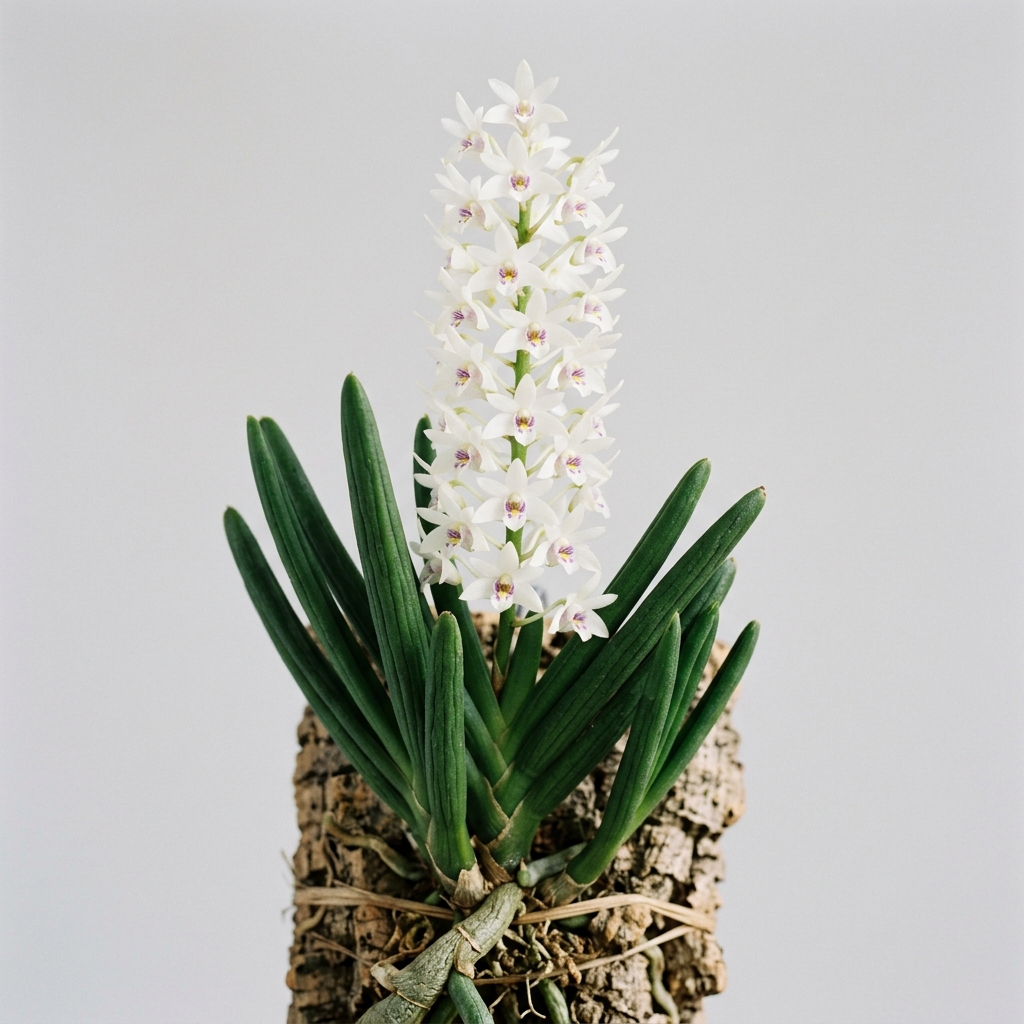
Dendrobium Wassellii is a distinctive epiphytic orchid native to the tropical regions of Queensland, Australia, highly prized by collectors for its unique succulent-like growth habit and striking floral displays. Belonging to the section Rhizobium, which some taxonomists classify under the genus Dockrillia, this species features thick, cylindrical, upright leaves that store water efficiently. This adaptation allows the plant to thrive in environments with seasonal dry periods where traditional thin-leaved orchids might struggle.
When in bloom, this orchid produces dense, upright spikes packed with numerous small, starry white flowers that contrast beautifully against its dark green, structural foliage. Its ease of care, compact growth habit, and spectacular flowering performance make it an exceptional choice for both intermediate growers and orchid enthusiasts looking to add structural diversity to their collections.
💡 Did You Know?
Dendrobium Wassellii belongs to the Dendrobium orchid group, where flower presentation is often just as important as . White-flowered cultivars are especially valued indoors because their pale blooms reflect well and pair easily with many home, greenhouse, and display settings.
🌿 Botanical Overview
Dendrobium Wassellii is characterized by its creeping rhizome from which erect, hard, deeply grooved, terete leaves emerge. These leaves are highly adapted to minimize water loss, resembling those of certain succulent plants rather than traditional thin-leaved orchids. This morphological adaptation indicates its evolutionary history in open forest canopy environments where moisture can be fleeting.
The plant spreads horizontally, forming dense mats over time when grown on mounts or in shallow baskets. Its root system is relatively fine but highly efficient at gripping rough bark surfaces and absorbing rapid flushes of atmospheric moisture and nutrients. This growth habit makes it an excellent candidate for vertical mounting.
🌸 Flower Characteristics
The inflorescence of Dendrobium Wassellii is an erect, densely packed raceme that can carry dozens of individual blossoms. Each flower is relatively small, typically measuring around one to two centimeters across, but their sheer quantity creates a dramatic, feathery effect that stands out.
The petals and sepals are narrow, linear, and pure white, radiating outward to form a star-like shape. The labellum is highly detailed, featuring a wavy or ruffled margin with subtle yellow, green, or light purple markings near the center, which serve as a guide for native pollinators in its natural habitat.
Fragrance & Bloom Profile
The fragrance of Dendrobium Wassellii is often described as sweet, light, and reminiscent of honey or clover, particularly noticeable during the warm morning hours. However, scent intensity can vary depending on environmental factors such as temperature, humidity, and light levels.
Individual flowers are relatively long-lasting for the genus, remaining fresh for several weeks if kept in cool, stable conditions. The entire spike opens nearly simultaneously, providing a brief but spectacular burst of color and scent that marks the transition into the warmer months.
Parentage & Hybrid Lineage
Dendrobium Wassellii is a naturally occurring species rather than a man-made hybrid. While it is widely accepted within the genus Dendrobium, some botanical authorities place it in the segregate genus Dockrillia due to its terete leaves and creeping growth habit.
In orchid hybridization, this species is occasionally used to introduce drought tolerance, compact growth, and upright, multi-flowered spikes to new crosses. However, registered hybrids remain relatively uncommon compared to those derived from soft-cane or phalaenanthe-type Dendrobiums.
🌱 Growing Conditions
To cultivate Dendrobium Wassellii successfully, growers should mimic its native Australian canopy habitat. It requires bright, filtered light to partial sun; a slight yellowing of the succulent leaves often indicates that the light level is optimal for flower production.
💡 Care Tip
For best results, grow Dendrobium Wassellii in bright filtered with steady and gentle airflow. Avoid placing the plant in harsh midday sun, but do not keep it in a dark corner; weak is one of the most common reasons cultivated orchids refuse to rebloom.
The orchid thrives in warm to intermediate temperatures, ideally ranging from 65°F to 85°F during the day, with a slight drop at night. High humidity combined with strong, continuous air movement is essential to prevent stagnant moisture from causing rot on the creeping rhizomes.
Watering, Feeding & Potting Media
Because of its epiphytic nature and water-storing leaves, Dendrobium Wassellii is highly sensitive to waterlogged conditions. It is best grown mounted on cork bark, tree fern plaques, or in shallow, extremely well-draining baskets filled with coarse fir bark or charcoal.
During the active growing season in spring and summer, water the plant thoroughly, allowing the roots and mount to dry out completely between waterings. Apply a highly diluted, balanced orchid fertilizer weekly. In winter, significantly reduce watering and suspend feeding to respect its natural dormant period.
Blooming Season & Care Notes
Blooming typically occurs in late spring to early summer, triggered by the increase in light and temperature. Once the flowering spike emerges from the base of the leaf, avoid moving the plant or changing its orientation, as sudden environmental shifts can cause bud drop.
After the flowers fade, the old spikes can be cut back to the base of the leaf. Repotting or remounting should only be performed in early spring as new root growth begins to emerge, minimizing disturbance to the plant’s established root system.
⚠️ Common Issues
While relatively hardy, Dendrobium Wassellii can encounter several cultivation challenges if its environmental needs are not met:
⚠️ Common Mistake
The most common mistake is by calendar instead of root and potting-media condition. Dendrobium roots need moisture and air at the same time, so constantly wet bark or sphagnum can lead to root loss even when the leaves still look healthy.
- Root rot caused by overwatering or compacted, decaying potting media.
- Dehydration, indicated by severe shriveling or wrinkling of the cylindrical leaves.
- Mealybugs and scale insects hiding in the crevices between the creeping rhizomes and leaf bases.
- Bud blast or premature flower drop due to sudden drafts, low humidity, or rapid temperature fluctuations.
- Fungal leaf spotting if air circulation is inadequate in high-humidity environments.
❓ Frequently Asked Questions
Can Dendrobium Wassellii be grown under artificial LED lights?
Yes, this species adapts well to LED grow lights, provided they offer high intensity. Position the plant close to the light source to simulate natural canopy conditions, but monitor the leaves for signs of scorching.
Why are the leaves on my orchid shriveling?
Slight wrinkling is normal during the winter dry rest. However, severe shriveling during the growing season usually indicates underwatering or root loss due to rot, which prevents the plant from absorbing water.
How often should I fertilize this orchid?
Apply a weak, balanced orchid fertilizer weekly during the active spring and summer growth phases. Flush the mount or pot with pure water once a month to prevent salt buildup, and stop fertilizing entirely in winter.
Is it better to mount this orchid or grow it in a pot?
Mounting on cork bark or tree fern is highly recommended, as it allows the creeping rhizome to grow naturally and ensures the roots dry rapidly after watering, mimicking its natural epiphytic habitat.
⭐ Final Growing Notes
Dendrobium Wassellii is a rewarding and highly sculptural orchid that brings a touch of the Australian wilderness to any collection. By providing bright light, excellent air movement, and a distinct winter rest, growers can enjoy its spectacular, feathery white blooms year after year.
⚕️ Health, Safety & Edibility
Understanding how a plant interacts with people, pets, and the surrounding environment is part of responsible cultivation. This section uses conservative, general guidance and does not replace professional medical or veterinary advice.
Human Safety: No published evidence currently identifies species-specific toxicity concerns for Dendrobium Wassellii during normal handling. As with most ornamental plants, it should not be intentionally consumed.
Pet Safety: Published information does not indicate that this orchid commonly poses a toxicity concern for cats or dogs. However, chewing leaves, flowers, roots, or potting media may still cause mild digestive upset.
Edibility: This orchid is cultivated for ornamental display rather than food. Ornamental plants may carry fertilizers, pesticides, or other horticultural treatments that make them unsuitable for consumption.
Skin Contact: Routine handling is not generally associated with skin irritation. Gardeners with sensitive skin may prefer wearing gloves when repotting, pruning, or handling potting media.
🌱 Propagation Tip
Propagation should be approached patiently. Most home growers should wait for natural keikis or divide only mature, healthy plants when the orchid type allows it. Never remove a young growth until it has strong roots and enough leaves to support itself away from the parent plant.
⭐ Expert Advice
Repot after flowering when fresh root tips begin to appear. This timing helps the plant anchor quickly into new bark or sphagnum and reduces stress, especially for orchids grown indoors where airflow, , and drying speed can change from season to season.

Leave A Comment