
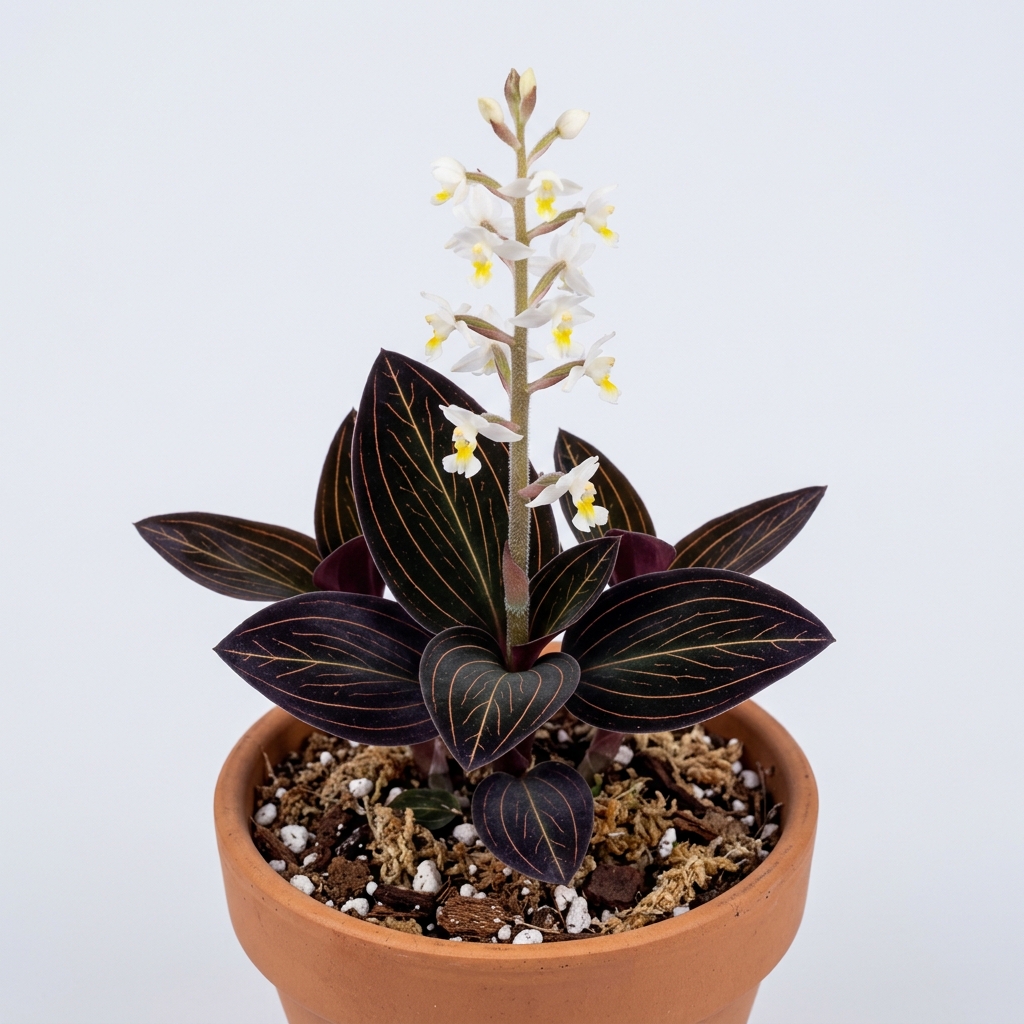
Ludisia discolor, commonly known as the jewel orchid, is a highly distinctive terrestrial orchid celebrated primarily for its breathtaking foliage rather than its blooms. Unlike the majority of epiphytic orchids that grow nestled in tree branches, this species thrives on the forest floor, spreading via fleshy, creeping rhizomes. Its velvety, deep purple-black to dark green leaves are adorned with striking, pinstriped veins of copper, red, or gold, making it a prized specimen for indoor foliage collectors and orchid enthusiasts alike.
While its foliage remains the primary attraction year-round, Ludisia discolor also produces elegant upright flower spikes during the cooler months. These spikes bear small, asymmetrical white flowers with bright yellow centers, providing a delicate contrast to the dark, moody leaves beneath. Because of its terrestrial nature and tolerance for lower light levels than typical orchids, it has earned a reputation as one of the most adaptable and grower-friendly orchids for home cultivation.
💡 Did You Know?
Unlike most orchids that are epiphytes growing on trees, Ludisia discolor is a terrestrial orchid that grows naturally in the leaf litter of shaded forest floors. This unique adaptation is why it thrives in low- home environments and prefers a potting mix that retains more moisture than standard orchid bark.
🌿 Botanical Overview
Ludisia discolor is native to the damp forest floors of Southeast Asia, including regions of southern China, Vietnam, Thailand, Malaysia, and Indonesia. In its natural habitat, it grows in deep shade, rooted in leaf litter, decaying organic matter, and moist soil along riverbanks. This terrestrial lifestyle dictates its physical structure, which features thick, succulent-like stems that creep horizontally along the ground before curving upward.
The foliage is the defining botanical feature of this species. The leaves are ovate-lanceolate, measuring roughly two to three inches in length, with a velvety texture that absorbs light efficiently in the dim forest understory. The deep coloration is caused by specialized pigments that help the plant maximize photosynthesis in low-light environments, resulting in the characteristic dark, iridescent leaves with contrasting longitudinal veins.
🌸 Flower Characteristics
The inflorescence of Ludisia discolor is an upright, pubescent (fuzzy) spike that emerges from the terminal ends of the stems, rising anywhere from six to twelve inches above the foliage. Each spike can carry between ten and thirty small, asymmetrical flowers. The individual blossoms are approximately three-quarters of an inch across, featuring pure white sepals and petals that form a hood over the column.
The most distinctive feature of the flower is its twisted, bright yellow labellum (lip). This yellow center provides a stark, eye-catching contrast to both the white petals and the dark foliage below. While the flowers are relatively small compared to showy epiphytic orchids, their sheer number and the elegant architecture of the upright spikes create a beautiful, airy display during the darkest months of the year.
Fragrance & Bloom Profile
The fragrance of Ludisia discolor is generally described as very mild or entirely absent. Some growers report a faint, clean, slightly sweet scent when the flowers are warmed by gentle morning light, but it is not a strongly aromatic orchid. The blooms are prized more for their longevity and visual contrast than for their scent, with individual flower spikes remaining attractive for several weeks.
Parentage & Hybrid Lineage
Unlike many cultivated orchids which are complex artificial hybrids, Ludisia discolor is a naturally occurring species. It is one of the few species within the monotypic genus Ludisia, though several distinct naturally occurring varieties and selected cultivars exist in the trade, such as Ludisia discolor var. dawsoniana, which features larger leaves and more pronounced red veining. Because it is a species, its genetic lineage is stable, though hybridizers have occasionally crossed it with other jewel orchid genera like Anoectochilus and Macodes to produce unique intergeneric hybrids.
🌱 Growing Conditions
Cultivating Ludisia discolor successfully requires mimicking the humid, shaded forest floor of its native habitat. It thrives in low to medium indirect light, making it an exceptional choice for north-facing windows or rooms with filtered light. Direct sunlight must be avoided, as it will quickly scorch the delicate velvety leaves, causing them to fade, turn red, or crisp at the edges.
💡 Care Tip
Keep your jewel orchid in a low- spot, such as a north-facing window or a shaded corner. Direct sunlight will quickly bleach the beautiful dark pigments in the velvety leaves, turning them a dull, washed-out red.
Temperature: wise, this orchid prefers intermediate to warm conditions, ideally ranging between 60°F and 85°F. It can tolerate brief drops in temperature but should be protected from drafts and freezing conditions. High humidity is beneficial, ideally maintained between 50% and 70%, which can be achieved through humidity trays, room humidifiers, or by growing the plant in a terrarium environment.
Watering, Feeding & Potting Media
Unlike epiphytic orchids that require their roots to dry out completely between waterings, Ludisia discolor prefers to remain consistently moist but never waterlogged. The potting medium should be kept damp, resembling a wrung-out sponge. Water thoroughly when the top half-inch of the medium begins to feel dry to the touch, using room-temperature water to avoid shocking the root system.
The ideal potting medium is a well-draining, organic-rich terrestrial mix. A blend of peat moss, perlite, fine orchid bark, and chopped sphagnum moss works exceptionally well to retain moisture while ensuring adequate aeration for the roots. Feed the plant during its active growing season in spring and summer with a balanced, water-soluble orchid fertilizer diluted to one-quarter strength every two to three weeks.
Blooming Season & Care Notes
The primary blooming season for Ludisia discolor occurs during the winter and early spring, triggered by the shorter days and cooler temperatures of autumn. Once the flower spike has finished blooming and the flowers have faded, cut the spike back near the base of the stem using sterilized pruning shears. This encourages the plant to redirect its energy into producing new vegetative growth.
Repotting is best done in the spring after the flowering cycle is complete. Because of its creeping growth habit, wide, shallow pots or pans are often more suitable than deep pots, allowing the rhizomes room to spread across the surface. Handle the fleshy stems with care during repotting, as they are brittle and can snap easily.
⚠️ Common Issues
⚠️ Common Mistake
The most frequent mistake is letting the potting medium dry out completely or, conversely, letting the plant sit in stagnant water. Both extremes lead to root loss, but soggy, airless soil will quickly cause the fleshy stems to rot.
- Root and Stem Rot: The most common issue, caused by overwatering or poorly draining media, leading to mushy, black stems and root collapse.
- Leaf Fading or Scorching: Caused by exposure to direct sunlight or excessively bright light, which bleaches the rich dark pigments of the foliage.
- Bud Blast:
Occurs when developing flower buds dry up and drop before opening, usually due to sudden drops in humidity or drafty conditions. - Dehydration:
Indicated by puckered, limp leaves and dry potting media, requiring a thorough watering and increased humidity. - Pests:
Mealybugs and spider mites can occasionally hide in the leaf axils or on the undersides of the velvety leaves; treat promptly with insecticidal soap or neem oil.
❓ Frequently Asked Questions
Can Ludisia discolor be grown in a terrarium?
Yes, Ludisia discolor is an excellent candidate for terrariums. Its compact growth habit, love for high humidity, and tolerance for low light make it perfectly suited for enclosed glass environments, provided the soil remains well-draining and there is some air circulation.
How do I propagate my jewel orchid?
Propagation is highly successful through stem cuttings. Simply cut a healthy stem segment containing at least two or three nodes, let the cut end dry for a few hours, and place it in moist sphagnum moss or water until roots develop before potting it up.
Why are the leaves on my Ludisia discolor turning red?
While some red coloration in the veins is natural, overall reddening or fading of the leaves usually indicates that the plant is receiving too much light. Move the orchid to a shadier location with filtered, indirect light to restore its deep, velvety color.
Does Ludisia discolor need high humidity to survive?
While it prefers moderate to high humidity of 50% to 70%, Ludisia discolor is much more tolerant of average home humidity levels than other jewel orchids. However, providing a humidity tray or grouping it with other plants will promote healthier, more robust growth.
⭐ Final Growing Notes
Ludisia discolor stands out as a remarkably rewarding orchid that breaks the traditional mold of orchid care. By prioritizing its foliage needs with low light, consistent moisture, and a loose, organic potting mix, growers of all experience levels can enjoy its stunning, velvety leaves year-round and its delicate white blooms in winter.
🌱 Propagation Tip
You can easily propagate Ludisia discolor by taking stem cuttings. Ensure each cutting has at least two nodes, and root them in damp sphagnum moss. They typically establish roots within a few weeks under warm, humid conditions.
⭐ Expert Advice
To encourage a bushier growth habit, pinch back the growing tips of your jewel orchid after the winter flowering period. This stimulates lateral buds along the creeping rhizome, resulting in a fuller, more attractive foliage display.




Leave A Comment