
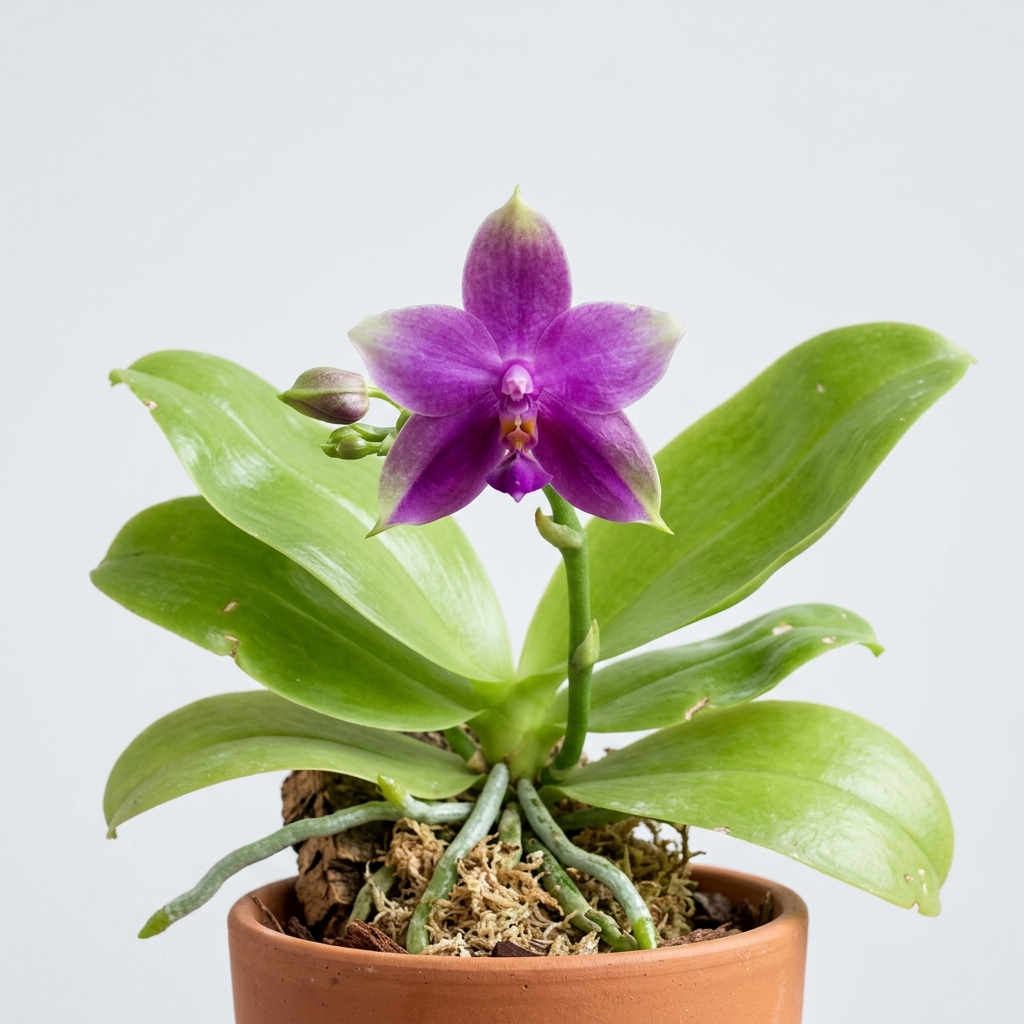
Phalaenopsis violacea is a highly coveted species orchid celebrated for its compact size, glossy foliage, and extraordinarily fragrant blossoms. Originating from the humid lowland forests of Southeast Asia, this warm-growing epiphyte has become a cornerstone of modern orchid hybridization, prized by collectors for its unique star-shaped flowers and intense, sweet-spicy aroma.
Unlike standard mass-market moth orchids, this species presents a more delicate growth habit and a sequential blooming pattern that keeps growers eagerly anticipating each new bud. Its vibrant violet-magenta to greenish-white coloration and undulating petals make it a standout specimen for indoor growers seeking to elevate their collection with a classic, fragrant treasure.
💡 Did You Know?
Unlike standard hybrid moth orchids that produce all their flowers at once on a tall branching spike, Phalaenopsis violacea is a sequential bloomer. It produces flowers one or two at a time on short, compact spikes. This means a single green spike can remain active and continue producing highly fragrant blossoms for several years if left uncut.
🌿 Botanical Overview
Phalaenopsis violacea is a monopodial epiphyte characterized by its short stems and broad, glossy, light green leaves. The foliage grows in a close, overlapping fashion, often displaying an undulating margin that distinguishes it from many other species in the genus. The leaves are relatively thin but robust, reflecting a healthy sheen when grown under optimal conditions.
The root system of this orchid is highly adapted to its native arboreal habitat, featuring thick, silvery-green roots covered in velamen. These roots are designed to cling to tree bark, absorbing moisture and nutrients rapidly from the humid air. In cultivation, maintaining a balance between root aeration and moisture retention is critical to preventing root decline.
🌸 Flower Characteristics
The blossoms of Phalaenopsis violacea are star-shaped and typically measure between 2 to 3 inches (5 to 7.5 cm) in diameter. The petals and sepals are thick and fleshy, giving the flowers a durable, waxy texture. The coloration is highly striking, often featuring a saturated violet-magenta center that gradually fades to a soft cream or greenish-yellow toward the tips of the segments.
The lip, or labellum, is deeply colored and structurally complex, featuring a small, hairy callus that serves to guide pollinators. The flowers are borne on short, arching or slightly pendent spikes that emerge from the leaf axils. Unlike many standard hybrids, the spikes are relatively short, keeping the flowers nestled close to the glossy foliage.
Fragrance & Bloom Profile
One of the most celebrated attributes of Phalaenopsis violacea is its intense and delightful fragrance. The scent is commonly described as a sweet, spicy blend of citrus and floral notes, which is most potent during the morning and early afternoon hours. This fragrance is highly sought after by breeders looking to introduce scent into modern hybrid lines.
The blooming profile of this species is sequential, meaning that flowers open one or two at a time on a single spike rather than all at once. This characteristic extends the overall blooming period over several months, as new buds slowly develop at the tip of the spike while older flowers fade. Consequently, a single plant can remain in bloom for a significant portion of the year.
Parentage & Hybrid Lineage
Phalaenopsis violacea is a true species native to the lowland forests of Sumatra, Borneo, and the Malayan Peninsula. Because of its outstanding color and fragrance, it has been used extensively in orchid hybridization since the 19th century. It is a primary parent in numerous famous grexes, contributing its intense violet hues and sweet scent to its offspring.
In cultivation, there are distinct geographical forms, most notably the Sumatran form and the Bornean form (often classified as Phalaenopsis bellina, though closely related). While line-bred cultivars have been developed to enhance flower size and color saturation, the fundamental characteristics of the species remain highly preserved in modern collections.
🌱 Growing Conditions
To grow Phalaenopsis violacea successfully, one must replicate the warm, humid conditions of its native tropical canopy. It prefers low to moderate indirect light, typically ranging from 800 to 1,200 foot-candles. Direct sunlight must be strictly avoided, as it will quickly scorch the sensitive, glossy leaves and cause irreversible damage.
💡 Care Tip
To prevent crown rot, always water this orchid in the morning so that any moisture trapped in the leaf axils can evaporate before nightfall. Using a small fan to maintain gentle air circulation around the foliage is highly effective at preventing fungal issues.
Temperature control is vital for this warm-growing species. Daytime temperatures should ideally remain between 75°F and 85°F (24°C to 29°C), with a slight drop at night to no lower than 65°F (18°C). High relative humidity of 60% to 80% is essential, and it must be accompanied by gentle, continuous air movement to prevent stagnant air from encouraging fungal pathogens.
Watering, Feeding & Potting Media
Unlike orchids with water-storing pseudobulbs, Phalaenopsis violacea requires a consistent moisture level. The potting medium should never be allowed to dry out completely, but it must also never remain soggy. A medium composed of high-quality New Zealand sphagnum moss or a fine-grade fir bark mix with perlite provides the ideal balance of moisture retention and drainage.
Fertilize the plant weakly weekly with a balanced, water-soluble orchid fertilizer diluted to one-quarter strength during the active growing season. It is highly beneficial to flush the potting medium with pure, mineral-free water once a month to wash away any accumulated fertilizer salts, which can easily damage the sensitive root tips.
Blooming Season & Care Notes
The primary blooming season for Phalaenopsis violacea occurs from late spring through the summer months, though healthy plants can produce flowers well into autumn. Because the flower spikes are sequential and long-lived, they should never be cut off as long as they remain green, as they will continue to produce new buds in later seasons.
Repotting should be performed every one to two years, preferably in the spring when new root growth is active. Care should be taken to minimize disturbance to the healthy roots. Ensure the plant is secured firmly in its new container, as any wobbling can damage emerging root tips and delay the plant’s establishment.
⚠️ Common Issues
⚠️ Common Mistake
The most common mistake growers make is cutting off the flower spikes after the initial blooms fade. Because this orchid blooms sequentially, those green spikes are still active and will produce more flowers. Cutting them prematurely deprives you of months of future fragrant blossoms.
- Root Rot:
Occurs when the potting medium decomposes or is overwatered, leading to a lack of oxygen around the roots. - Bud Blast:
Sudden environmental changes, such as a drop in humidity or exposure to drafts, can cause developing buds to yellow and fall off. - Leaf Scorch: Direct sunlight causes bleached, white, or black patches on the leaves, which can lead to secondary infections.
- Pests:
Mealybugs and spider mites can occasionally infest the undersides of the broad leaves, especially in dry environments. - Crown Rot:
Water left sitting in the crown of the plant overnight can lead to rapid bacterial decay, which is often fatal.
❓ Frequently Asked Questions
Why are the lower leaves of my Phalaenopsis violacea turning yellow?
Occasional yellowing of the oldest bottom leaf is a natural part of the plant’s growth cycle. However, if multiple leaves turn yellow rapidly, it typically indicates overwatering, root rot, or a nutrient deficiency. Inspect the root system immediately to ensure the roots are firm and healthy.
Should I cut the flower spike after the blooms fall off?
No, you should not cut the flower spike as long as it remains green. Phalaenopsis violacea is a sequential bloomer, meaning it will continue to produce new buds from the tip of the existing spike over a long period. Only cut the spike if it turns completely brown and dry.
Can I grow Phalaenopsis violacea under artificial LED lights?
Yes, this species adapts exceptionally well to indoor growing under LED setups. Position the plant so it receives moderate, diffused light, ensuring the leaves do not overheat from the fixture. A photoperiod of 12 to 14 hours daily is ideal to simulate its natural tropical environment.
How do I know if my orchid is receiving the right amount of light?
The color of the leaves is the best indicator. Healthy leaves should be a bright, grassy green with a glossy sheen. If the leaves turn dark green, the plant may need more light to bloom. If they turn yellow-green or develop red-purple tinting, the light is likely too intense.
⭐ Final Growing Notes
Cultivating Phalaenopsis violacea is a deeply rewarding endeavor for any indoor gardener or orchid enthusiast. By mimicking its warm, humid forest home and respecting its sequential blooming habit, you will be rewarded with a stunning display of vibrant, star-like flowers and an unforgettable fragrance that fills your growing space for months on end.
🌱 Propagation Tip
While this species is typically grown from seed in sterile laboratory flasks, mature plants will occasionally produce a clonal offset, known as a keiki, along the flower spike. Allow the keiki to develop at least three roots that are two inches long before carefully detaching and potting it.
⭐ Expert Advice
If your plant is healthy but refuses to bloom, try lowering the nighttime by about five to ten degrees Fahrenheit for a few weeks in the autumn. This slight drop, combined with bright but filtered , often triggers the initiation of new flower spikes.




Leave A Comment