
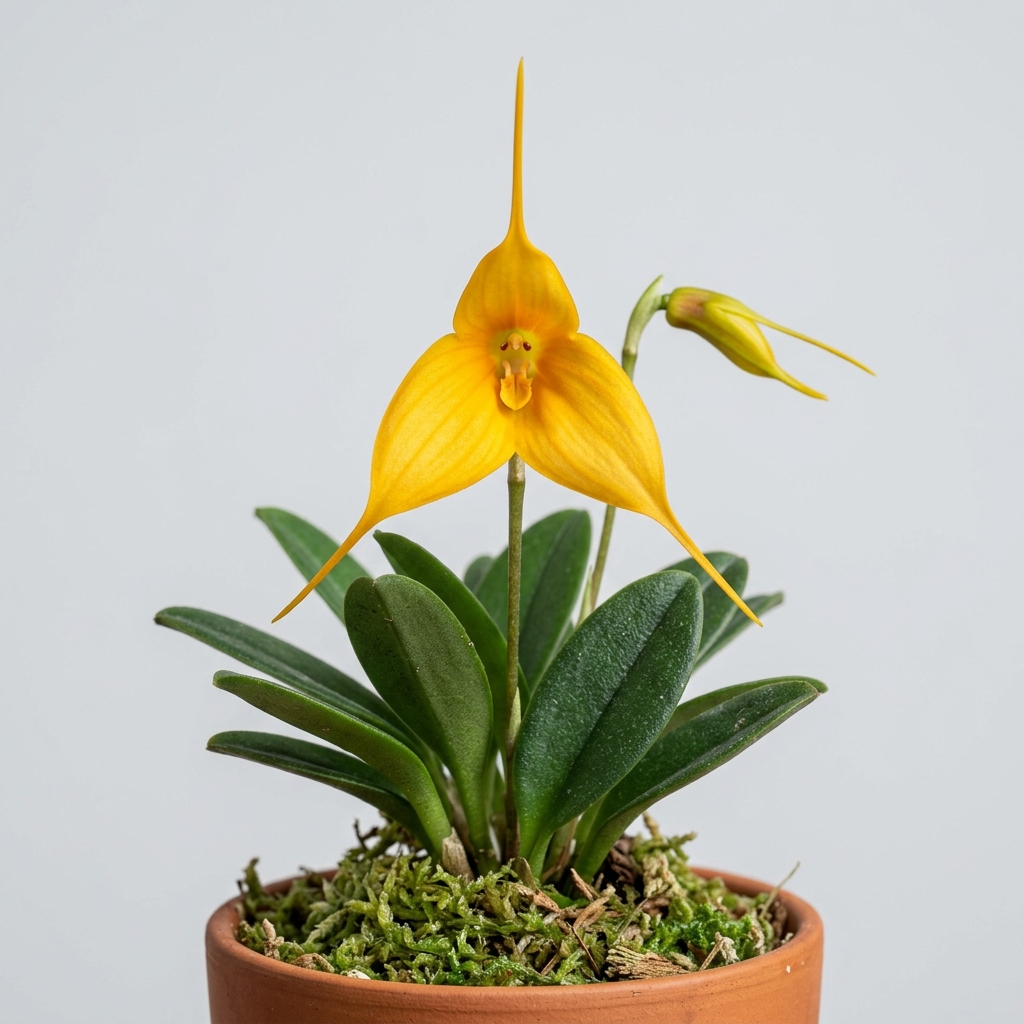
Masdevallia Davisii is a highly prized orchid species celebrated for its striking, bright yellow to golden-orange blossoms that stand out vividly against its lush green foliage. Native to the high-altitude cloud forests of the Peruvian Andes, this cool-growing miniature orchid captures the attention of collectors with its elegant, triangular flower shape and compact growth habit. It is particularly valued by growers who specialize in cool-climate orchids and seek to add a brilliant splash of sunshine-yellow to their terrariums or specialized growing areas.
As a member of the Pleurothallidinae subtribe, this orchid lacks pseudobulbs, meaning it relies on its thick, leathery leaves and a constant supply of moisture to thrive. Cultivating Masdevallia Davisii successfully requires a dedicated commitment to maintaining cool temperatures, high humidity, and consistent moisture. While it can be challenging for beginners, intermediate and advanced orchid enthusiasts find the rewarding display of its luminous, long-lasting flowers well worth the precise environmental controls required.
💡 Did You Know?
Masdevallia Davisii was discovered in the high Andes of Peru by Walter Davis, a prominent Victorian plant collector who braved rugged terrain to find it. The species was once feared lost to cultivation due to its highly specific cool-growing requirements, making modern, nursery-propagated specimens highly prized links to botanical history.
🌿 Botanical Overview
Masdevallia Davisii is a tufted, epiphytic or lithophytic orchid species native to the steep, rocky slopes of Peru, where it grows at elevations ranging from 3,000 to 3,600 meters. First collected by the Victorian plant explorer Walter Davis in the 1870s, this species is historically significant and remains a sought-after gem in modern collections. Its natural habitat is characterized by constant mist, cool breezes, and high humidity, which dictate its specific cultural requirements in cultivation.
The plant features erect, narrow, leathery leaves that arise from short ramicauls. Because it lacks water-storing pseudobulbs, the foliage is the primary reservoir for moisture and nutrients. This morphological trait makes the orchid highly sensitive to dry air and prolonged periods of drought, requiring growers to simulate the damp, buoyant atmosphere of its native Andean cloud forests.
🌸 Flower Characteristics
The flowers of Masdevallia Davisii are renowned for their brilliant yellow to deep orange-yellow coloration, which is relatively uncommon within the genus. The blooms are dominated by three large, fused sepals that taper into slender, tail-like tips, giving the flower its characteristic triangular or star-like silhouette. The actual petals and the lip (labellum) are extremely small and hidden deep within the floral tube, a common feature among Masdevallia species designed to attract specific pollinators.
Each flower is borne singly on an erect or semi-erect inflorescence that typically rises just above or level with the foliage. The texture of the sepals is somewhat fleshy, which helps the blooms maintain their shape and vibrant color for several weeks. When grown under optimal conditions, a mature specimen can produce multiple spikes simultaneously, creating a stunning contrast of golden stars against dark green leaves.
Fragrance & Bloom Profile
While some species within the Pleurothallidinae subtribe emit distinct scents to attract specific insect pollinators, Masdevallia Davisii is not consistently documented as having a strong or highly noticeable fragrance. Some growers report a very faint, clean, or grassy aroma under warm, humid morning conditions, but for most cultivation purposes, it is treated as an unscented orchid.
The primary appeal of this species lies entirely in its visual presentation. The blooms are remarkably long-lasting, often remaining fresh for three to six weeks depending on temperature and humidity levels. Because the flowers do not open all at once on a single spike but rather emerge individually, the overall blooming period of a well-established plant can extend over several months.
Parentage & Hybrid Lineage
Masdevallia Davisii is a naturally occurring species rather than a man-made hybrid or cultivar. In botanical nomenclature, it is recognized as a distinct species within the genus Masdevallia. Because of its intense yellow coloration and compact growth habit, it has been used occasionally by hybridizers looking to introduce bright yellow tones and cool-growing resilience into modern Masdevallia hybrids.
However, because species orchid documentation can sometimes vary between historical records and modern DNA sequencing, growers should approach hybrid parentage claims with cautious optimism. In most commercial and hobbyist circles, keeping the species pure is highly valued, and true Masdevallia Davisii specimens are kept distinct from its hybrid descendants to preserve its unique wild characteristics.
🌱 Growing Conditions
Replicating the cool, misty environment of the Andes is the key to success with Masdevallia Davisii. Temperature control is paramount; this orchid thrives in cool to cold conditions, with ideal daytime temperatures ranging between 60°F and 68°F (15°C to 20°C) and a nocturnal drop to 50°F to 55°F (10°C to 13°C). Temperatures consistently exceeding 75°F (24°C) can cause rapid decline, leaf drop, and vulnerability to pests.
💡 Care Tip
To keep your orchid cool during hot summer days, place the pot inside a larger clay pot filled with damp sphagnum moss. The natural evaporation of water from the clay pot will lower the immediately surrounding the orchid's roots by several degrees.
Light levels should be kept low to moderate, mimicking the dappled shade of forest understories. Bright, indirect light is acceptable, but direct sunlight will quickly scorch the thin leaves. High humidity is equally critical, ideally maintained between 70% and 80%. To prevent stagnant air from causing fungal infections in such damp conditions, continuous, gentle airflow from a small fan is absolutely essential.
Watering, Feeding & Potting Media
Watering is the most active component of Masdevallia Davisii care. Because the plant lacks pseudobulbs, the potting medium must remain consistently damp but never waterlogged. Water should be applied just as the medium begins to approach dryness. Using pure water, such as rainwater, distilled water, or reverse osmosis water, is highly recommended, as this species is extremely sensitive to dissolved salts and minerals.
A high-quality, moisture-retentive medium is necessary. High-grade New Zealand sphagnum moss or a fine-grade orchid bark mix blended with perlite and tree fern fiber works exceptionally well. If using sphagnum, ensure it is packed loosely to allow oxygen to reach the roots. Feeding should be done with a highly diluted, balanced orchid fertilizer (about one-quarter strength) every two to three weeks during active growth, followed by a thorough flushing with pure water to prevent salt buildup.
Blooming Season & Care Notes
The primary blooming season for Masdevallia Davisii typically occurs in the autumn and winter months, though occasional blooms can appear in the spring if conditions remain cool and stable. As the flower spikes begin to emerge from the base of the leaves, avoid changing the plant’s orientation or environmental conditions, as sudden shifts can lead to bud blast.
Once the flowers have faded, the spikes should be cut back close to the base of the leaf to encourage new vegetative growth. Repotting is best done in late winter or early spring, just as new root growth begins and before the heat of summer arrives. Minimize root disturbance during repotting, as the fine, delicate roots can be easily damaged, leading to a temporary setback in growth.
⚠️ Common Issues
⚠️ Common Mistake
A frequent error is allowing the potting medium to dry out completely between waterings. Because this orchid lacks pseudobulbs, even a single day of dry roots can cause severe leaf drop, bud loss, and permanent damage to the delicate root system.
- Leaf spotting and fungal infections: Often caused by high humidity combined with inadequate air circulation.
- Root rot:
Occurs when the potting medium degrades, becomes compacted, or lacks proper drainage. - Bud blast:
The premature dropping or drying of buds, usually triggered by sudden temperature spikes or low humidity. - Dehydration:
Indicated by wrinkled, limp leaves, resulting from underwatering or a damaged root system unable to absorb moisture. - Pests:
Spider mites, aphids, and mealybugs can occasionally target the tender new growth, requiring prompt treatment with insecticidal soap or neem oil.
❓ Frequently Asked Questions
Why are the leaves on my Masdevallia Davisii turning yellow and dropping?
Leaf drop in this species is most commonly caused by heat stress or root rot. If temperatures consistently exceed 75°F (24°C), the plant will struggle to transpire properly, leading to leaf loss. Alternatively, if the roots have rotted due to compacted media or overwatering, the plant cannot absorb water, causing the leaves to yellow and fall off.
Can I grow Masdevallia Davisii under artificial LED lights?
Yes, this orchid adapts well to artificial LED setups, provided the lights are kept at a moderate distance to prevent heat emission and leaf scorch. Position the plant in a lower-light zone of your grow shelf and monitor the foliage; if the leaves develop a reddish tint, the light is too intense and should be diffused or moved further away.
How often should I repot my Masdevallia Davisii?
It is generally best to repot this orchid every 12 to 18 months. Because the potting medium (especially sphagnum moss) must be kept constantly damp, it degrades faster than it would under drier conditions. Repotting in fresh, airy media prevents root suffocation and maintains the slightly acidic environment these roots prefer.
What type of water is best for watering Masdevallia Davisii?
This species is highly sensitive to mineral salts and chlorine found in typical tap water. For optimal health, always use rainwater, distilled water, or reverse osmosis water. Accumulation of minerals in the potting medium will quickly burn the delicate root tips, leading to a decline in overall plant vigor.
⭐ Final Growing Notes
While Masdevallia Davisii demands precise environmental conditions—specifically cool temperatures, high humidity, and pure water—it remains one of the most rewarding species for dedicated orchid collectors. Its brilliant golden-yellow blooms provide a spectacular visual reward that easily outshines many easier-to-grow hybrids. By focusing on consistent moisture, excellent air movement, and protection from summer heat, you can enjoy the historic beauty of this Andean treasure in your own home or greenhouse for years to come.
⚕️ Health, Safety & Edibility
Understanding how a plant interacts with people, pets, and the surrounding environment is part of responsible cultivation. This section uses conservative, general guidance and does not replace professional medical or veterinary advice.
Human Safety: No published evidence currently identifies species-specific toxicity concerns for Masdevallia Davisii during normal handling. As with most ornamental plants, it should not be intentionally consumed.
Pet Safety: Published information does not indicate that this orchid commonly poses a toxicity concern for cats or dogs. However, chewing leaves, flowers, roots, or potting media may still cause mild digestive upset.
Edibility: This orchid is cultivated for ornamental display rather than food. Ornamental plants may carry fertilizers, pesticides, or other horticultural treatments that make them unsuitable for consumption.
Skin Contact: Routine handling is not generally associated with skin irritation. Gardeners with sensitive skin may prefer wearing gloves when repotting, pruning, or handling potting media.
🌱 Propagation Tip
This species is best propagated by division during repotting in early spring. Ensure each division has at least five to eight healthy leaves and a strong, active root system. Avoid making smaller divisions, as they struggle to recover without pseudobulbs to store energy.
⭐ Expert Advice
Always pair high with constant, gentle air movement. Stagnant, damp air is an open invitation for fungal leaf spotting. A small, low-voltage computer fan running continuously near your growing area is often the secret to keeping foliage pristine.

Leave A Comment