
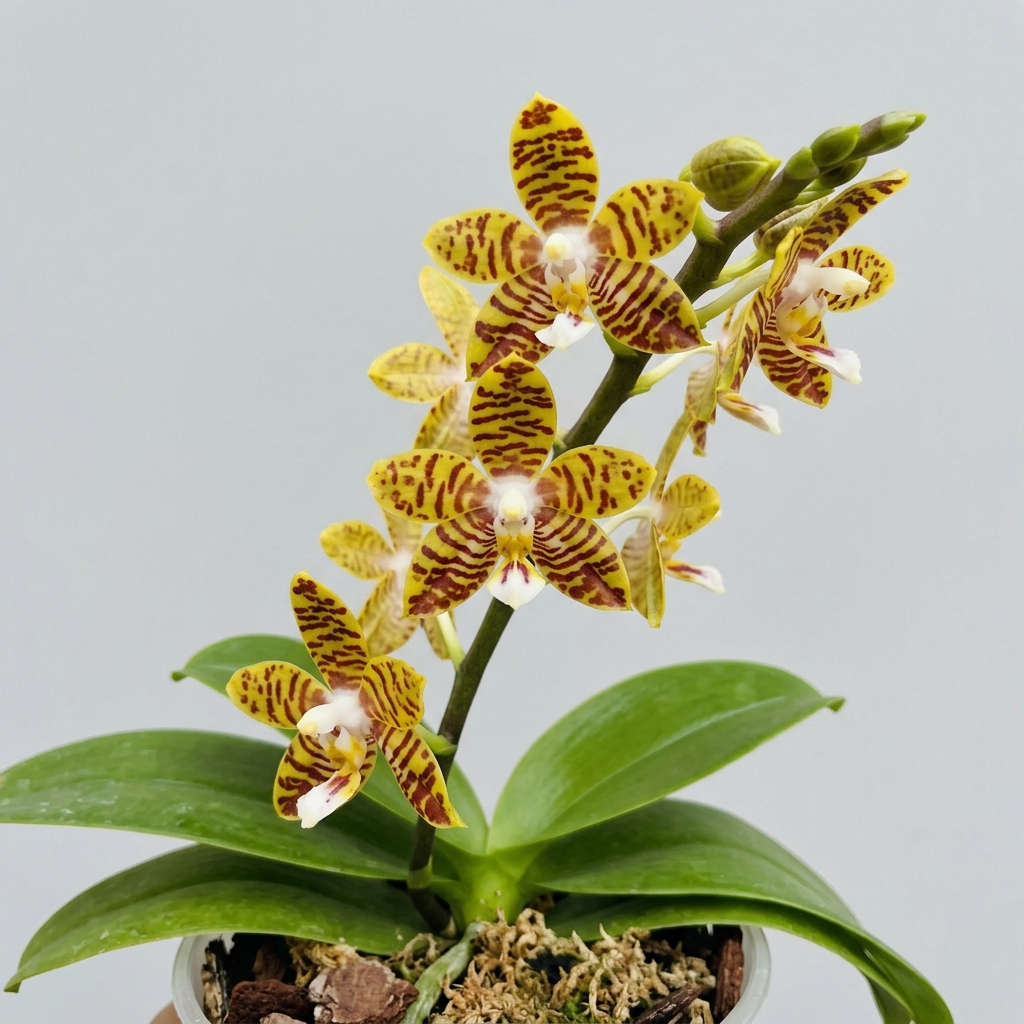
Phalaenopsis Pantherina is a highly sought-after species orchid native to the humid rainforests of Borneo. Belonging to the Polychilos section of the genus, this compact epiphyte is treasured by collectors for its distinctive star-shaped flowers. The blossoms feature a striking contrast of bright yellow to greenish-yellow petals adorned with bold, tiger-like reddish-brown bars, making it a standout addition to any specialized orchid collection.
Unlike mass-market hybrid moth orchids, this species shows a sequential blooming habit, producing flowers one after another on flattened, long-lived spikes. This growth pattern rewards patient growers with a slow but steady display of exotic blooms over several months. Its compact size and preference for warm, shaded conditions make it an excellent candidate for indoor growing under lights or in dedicated terrarium setups.
💡 Did You Know?
The species name pantherina translates directly to panther-like, a nod to the striking, dark reddish-brown spots and bars that decorate its yellow petals. This wild orchid is native exclusively to the island of Borneo, where it thrives as an epiphyte in warm, shaded canopy environments.
🌿 Botanical Overview
Phalaenopsis Pantherina is an epiphytic orchid species native to the island of Borneo. In its natural habitat, it grows on mossy tree trunks and branches in warm, humid, lowland riverine forests. These environments provide the plant with constant moisture, high humidity, and dappled, filtered sunlight beneath the dense forest canopy.
Vegetatively, the plant features a typical monopodial growth habit with a short stem and a few fleshy, obovate-oblong leaves. The leaves are rich green, slightly glossy, and can grow up to eight inches in length. Its root system is robust and adapted to clinging tightly to bark surfaces, absorbing moisture and nutrients rapidly from passing rain showers.
🌸 Flower Characteristics
The flowers of Phalaenopsis Pantherina are highly distinctive, measuring approximately one and a half to two inches across. The sepals and petals are relatively narrow, giving the bloom a star-like outline. They feature a base color of pale yellow to deep greenish-yellow, heavily marked with horizontal bars of rich mahogany or reddish-brown.
The lip, or labellum, is a complex structure that serves as a primary identifying feature for the species. It is primarily white with yellow markings, featuring a fleshy, anchor-shaped midlobe covered in fine, hair-like trichomes. The flowers are borne on a flattened, winged inflorescence that can produce blooms sequentially over several years.
Fragrance & Bloom Profile
Fragrance in Phalaenopsis Pantherina is a subject of some variation among growers. While some plants are virtually scentless, many specimens emit a subtle, sweet, or slightly citrusy fragrance during the warmest hours of the day. The scent is rarely overpowering but adds an extra layer of appeal for indoor hobbyists.
The blooming profile is characterized by its sequential nature. Rather than opening all at once, the buds mature and open one or two at a time on a single spike. This means that while you may not get a massive canopy of flowers, the plant remains in bloom for a highly extended period, often from late spring through the autumn months.
Parentage & Hybrid Lineage
Because Phalaenopsis Pantherina is a naturally occurring species, it does not have a man-made hybrid parentage. It is closely related to Phalaenopsis cornu-cervi, and the two are occasionally confused by novice growers due to their similar vegetative appearance and flattened flower spikes. However, they are distinct species with clear differences in lip morphology.
In orchid breeding, Phalaenopsis Pantherina is valued for its ability to pass on its intense yellow coloration, heavy barring, and sequential blooming habit to novelty hybrids. Breeders use it to introduce wild, star-shaped characteristics and warmth tolerance into modern Phalaenopsis lines.
🌱 Growing Conditions
To cultivate Phalaenopsis Pantherina successfully, growers should attempt to replicate its warm, humid forest home. It thrives in warm to hot temperatures, ideally ranging from 75°F to 85°F during the day, with a modest drop of 10°F at night. Temperatures should not be allowed to drop below 60°F for extended periods.
💡 Care Tip
Maintain constant air circulation around your orchid, especially if you grow it in high- environments. A small, low-powered fan running nearby prevents moisture from pooling in the crown, significantly reducing the risk of bacterial rot.
Light should be kept low to moderate. Direct sunlight will quickly scorch the thin leaves, so filtered light from an east-facing window or diffused light from artificial LED grow setups is highly recommended. High humidity of 60% to 80% is essential, paired with constant, gentle air movement to prevent fungal issues.
Watering, Feeding & Potting Media
This species does not possess pseudobulbs to store water, meaning it has a low tolerance for prolonged drought. The potting medium should be kept consistently damp but never soggy. Water the plant just as the media begins to approach dryness, using lukewarm, low-mineral water such as rainwater or reverse osmosis water.
High-quality New Zealand sphagnum moss or a fine-grade fir bark mix works exceptionally well for potting. Many growers prefer to mount this species on cork bark or tree fern plaques, which showcases its natural pendulous growth habit; however, mounted plants require daily watering in typical home environments. Feed weakly with a balanced orchid fertilizer diluted to one-quarter strength every second or third watering.
Blooming Season & Care Notes
The primary blooming season spans from spring to autumn, though healthy plants grown under stable indoor conditions can produce flowers at almost any time of year. The most critical care note for this species concerns spike management: do not cut the green flower spikes after the blossoms fall.
The spikes of Phalaenopsis Pantherina remain green and active for years, producing new buds from the tip season after season. Only prune a spike if it has turned completely brown, dry, and papery. Repotting should be done every one to two years in the spring, just as new root growth begins, to prevent the media from decomposing and suffocating the roots.
⚠️ Common Issues
⚠️ Common Mistake
The most frequent error is cutting off green flower spikes once the blossoms drop. Because this species is a sequential bloomer, those green spikes are still active and will produce more flowers over several years if left intact.
- Root rot caused by compacted, decomposing potting media or overwatering.
- Bud blast, where developing buds yellow and drop, often triggered by sudden drops in humidity or cold drafts.
- Leaf scorch, presenting as bleached or black patches on leaves exposed to direct sunlight.
- Pests such as mealybugs and spider mites, which frequently hide in the crevices of the leaf joints or under flower bracts.
- Fungal leaf spotting, which occurs when water sits on the leaves overnight in stagnant air.
❓ Frequently Asked Questions
Why is my Phalaenopsis Pantherina not blooming?
The most common reasons for a lack of blooms are insufficient light or temperatures that remain too cool. Ensure the plant receives bright, filtered light and is kept in a warm environment. A slight drop in nighttime temperatures can also help trigger bud initiation.
Should I cut the flower spike after the flowers drop?
No, do not cut green flower spikes. Phalaenopsis Pantherina is a sequential bloomer, and the same spike will continue to produce new buds and flowers for several years. Only cut the spike if it turns completely brown and dry.
Can I grow Phalaenopsis Pantherina mounted on bark?
Yes, mounting on cork bark or tree fern plaques is highly successful and mimics its natural growth habit. However, mounted plants dry out very quickly and typically require daily misting or watering to maintain adequate moisture levels.
How do I tell Phalaenopsis Pantherina apart from Phalaenopsis cornu-cervi?
While they look very similar, they can be distinguished by their flowers. Phalaenopsis Pantherina features a more complex, fleshy lip with distinct hair-like trichomes on the midlobe, whereas Phalaenopsis cornu-cervi has a smoother, more glabrous lip structure.
⭐ Final Growing Notes
Phalaenopsis Pantherina is a rewarding species for any orchid enthusiast looking to venture beyond standard commercial hybrids. By providing warm temperatures, high humidity, and leaving its long-lived green flower spikes intact, you can enjoy its exotic, tiger-striped blooms for years to come.
⚕️ Health, Safety & Edibility
Understanding how a plant interacts with people, pets, and the surrounding environment is part of responsible cultivation. This section uses conservative, general guidance and does not replace professional medical or veterinary advice.
Human Safety: No published evidence currently identifies species-specific toxicity concerns for Phalaenopsis Pantherina during normal handling. As with most ornamental plants, it should not be intentionally consumed.
Pet Safety: Published information does not indicate that this orchid commonly poses a toxicity concern for cats or dogs. However, chewing leaves, flowers, roots, or potting media may still cause mild digestive upset.
Edibility: This orchid is cultivated for ornamental display rather than food. Ornamental plants may carry fertilizers, pesticides, or other horticultural treatments that make them unsuitable for consumption.
Skin Contact: Routine handling is not generally associated with skin irritation. Gardeners with sensitive skin may prefer wearing gloves when repotting, pruning, or handling potting media.
🌱 Propagation Tip
While this species is typically propagated by professional flasking, mature plants may occasionally produce a keiki along an old flower spike. Allow the keiki to develop several roots at least two inches long before carefully detaching and potting it.
⭐ Expert Advice
If you struggle to maintain the high this species craves, try growing it in a net pot nestled inside a slightly larger clay pot filled with damp sphagnum moss. This creates a localized humid microclimate around the root zone without suffocating the roots.

Leave A Comment