
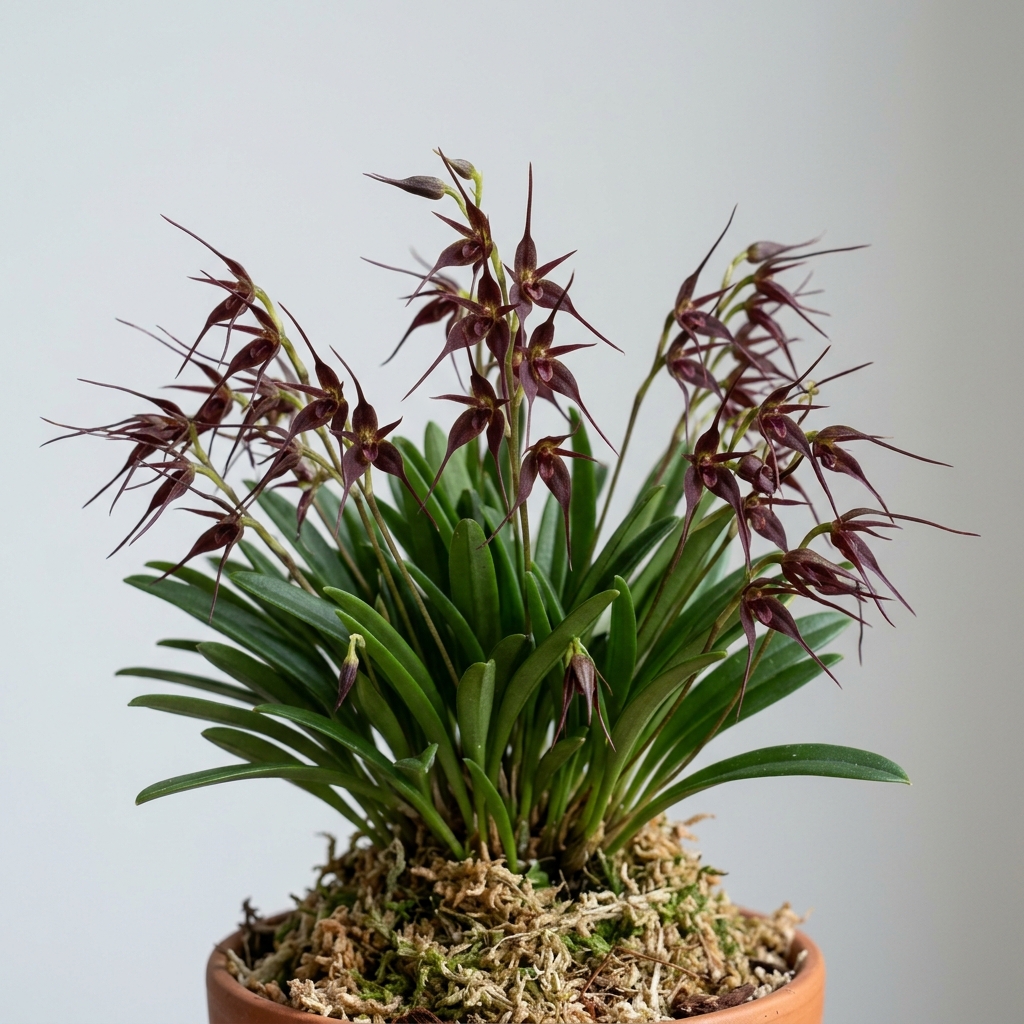
Masdevallia Herradurae is a captivating miniature orchid species highly prized by collectors for its compact growth habit and remarkably prolific blooming nature. Native to the cloud forests of Colombia, this epiphytic orchid produces dense tufts of narrow, dark green leaves that serve as an attractive backdrop for its unique, star-like blossoms. Unlike some of its temperamental relatives within the genus, this species is relatively adaptable, making it an excellent choice for orchid enthusiasts looking to venture into the diverse world of Masdevallia.
The primary appeal of Masdevallia Herradurae lies in its ability to produce a spectacular display of small, dark, brownish-purple to deep burgundy flowers that emerge in abundance from the base of the leaves. These intriguing blooms feature elongated sepaline tails that give the plant a delicate, spidery appearance. When grown into a mature specimen, a single plant can produce dozens of flowers simultaneously, creating a striking visual contrast against the lush green foliage and making it a standout addition to terrariums, vivariums, or indoor growing setups.
💡 Did You Know?
Masdevallia Herradurae is part of the Masdevallia orchid group, a favorite among growers because its flowers, growth habit, and care needs make it useful for comparing cultivated orchids within the same . Observing its leaves, roots, and bloom spikes can help growers understand how this cultivar responds to indoor conditions.
🌿 Botanical Overview
Masdevallia Herradurae is a tufted, caespitose orchid, meaning it grows in tight clumps without prominent pseudobulbs. Instead, its slender, erect leaves arise directly from short ramicauls. The leaves are narrow, linear, and coriaceous (leathery), typically reaching only a few inches in height. This compact architecture allows the plant to thrive in confined spaces, making it a favorite for indoor growers with limited space.
In its native habitat of Colombia, this species grows as an epiphyte on moss-covered tree branches in wet, montane forests at elevations ranging from 1,000 to 2,500 meters. This elevation range provides a clue to its temperature preferences, which lean toward cool to intermediate conditions. The constant moisture and high humidity of these cloud forests are critical factors that growers must replicate to achieve long-term success.
🌸 Flower Characteristics
The flowers of Masdevallia Herradurae are small but structurally fascinating. Like other members of the genus, the showy parts of the flower are actually the fused sepals, while the true petals and lip are tiny and hidden deep within the floral tube. The sepals are a deep, glossy brownish-purple or burgundy, tapering into long, slender tails (caudae) that extend outward, giving the bloom its characteristic star-like or spidery silhouette.
Each flower is borne individually on a slender, erect to suberect inflorescence that emerges from the base of the leaf stem. The flower spikes are typically shorter than or equal to the length of the leaves, causing the blooms to nestle closely within the foliage canopy. This presentation creates a highly integrated, naturalistic aesthetic during a flush bloom, where the dark flowers appear to float amidst the green leaves.
Fragrance & Bloom Profile
While some Masdevallia species are known for distinct scents, the fragrance of Masdevallia Herradurae is not consistently documented in common grower references. Some hobbyists report a very faint, sweet, or slightly musty scent detectable only in warm, still air, while others perceive no fragrance at all. Consequently, it is best grown for its exceptional visual display rather than its olfactory qualities.
The individual flowers are relatively long-lasting, often remaining in pristine condition for several weeks if cool temperatures and high humidity are maintained. Because the plant can produce multiple flushes of flowers throughout the year, a healthy specimen can remain in some stage of bloom for months at a time, providing excellent value for indoor displays.
Parentage & Hybrid Lineage
Masdevallia Herradurae is a naturally occurring species rather than a man-made hybrid. First described scientifically in the late 19th century, it remains a distinct and stable species within the Pleurothallidinae subtribe. Because of its species status, its genetic lineage is pure, representing the natural adaptation of the plant to its native Colombian cloud forest environment.
While it has occasionally been used in hybridizing programs to introduce compact growth habits and floriferousness to new Masdevallia grexes, it is most commonly grown and appreciated in its pure species form. Growers seeking this plant should look for reputable nurseries offering true-to-type species divisions or seed-grown specimens.
🌱 Growing Conditions
Replicating the cool, humid cloud forest environment is the key to successfully cultivating Masdevallia Herradurae. It thrives in low to intermediate light conditions, similar to those preferred by Phalaenopsis orchids. Direct sunlight must be avoided, as it can quickly scorch the thin leaves and overheat the plant. High-quality LED grow lights or a shaded north- or east-facing window are ideal.
💡 Care Tip
For best results, grow Masdevallia Herradurae in bright filtered with steady and gentle airflow. Avoid placing the plant in harsh midday sun, but do not keep it in a dark corner; weak is one of the most common reasons cultivated orchids refuse to rebloom.
Temperature control is vital. The plant prefers cool to intermediate temperatures, ideally ranging from 55°F to 75°F (13°C to 24°C). While it can tolerate brief periods of warmer temperatures, prolonged exposure to heat above 80°F (27°C) can cause severe stress, leaf drop, and susceptibility to disease. High humidity of 70% to 80% is essential, coupled with constant, gentle air movement to prevent stagnant air pockets and fungal issues.
Watering, Feeding & Potting Media
Unlike orchids with water-storing pseudobulbs, Masdevallia Herradurae has very little capacity to store moisture. Therefore, the potting medium must remain consistently damp and should never be allowed to dry out completely. High-quality New Zealand sphagnum moss is a popular potting medium, as it retains moisture while remaining airy. Alternatively, a fine-grade orchid bark mix containing perlite and tree fern fiber can be used.
Watering should be done with pure water, such as rainwater, distilled water, or reverse osmosis water, as this species is highly sensitive to dissolved salts and minerals. Fertilization should be extremely light. Use a balanced, urea-free orchid fertilizer diluted to one-quarter or one-eighth strength every two to three weeks during active growth, always flushing the pot with pure water between feedings to prevent salt buildup.
Blooming Season & Care Notes
Masdevallia Herradurae is known for its opportunistic blooming habit. While its heaviest flush of flowers typically occurs in the autumn and winter months, healthy plants can produce blooms sporadically throughout the year. To encourage optimal blooming, maintain stable environmental conditions and avoid disturbing the plant unnecessarily.
Repotting should be done with care and only when the potting medium begins to break down, typically every one to two years. The best time to repot is in the spring or early autumn when temperatures are moderate and the plant is actively producing new root growth. Avoid over-potting; this miniature species prefers a snug pot that accommodates its root system without leaving excess, waterlogged medium around the roots.
⚠️ Common Issues
⚠️ Common Mistake
The most common mistake is by calendar instead of root and potting-media condition. Masdevallia roots need moisture and air at the same time, so constantly wet bark or sphagnum can lead to root loss even when the leaves still look healthy.
- Root Rot: Caused by compacted, poorly draining media or overwatering in stagnant conditions. Ensure the medium remains airy.
- Leaf Spotting: Fungal or bacterial spots can develop on the leaves if humidity is high but air circulation is inadequate.
- Heat Stress: Indicated by rapid leaf drop and yellowing. Move the plant to a cooler location immediately.
- Pests: Spider mites, aphids, and mealybugs can occasionally target the tender new growth. Treat with gentle insecticidal soap or neem oil.
- Bud Blast: Premature dropping of flower buds, often caused by sudden drops in humidity or drafts.
❓ Frequently Asked Questions
Can Masdevallia Herradurae be grown in a terrarium?
Yes, Masdevallia Herradurae is an excellent candidate for terrariums and vivariums. Its miniature size, love for high humidity, and tolerance of lower light levels make it highly suited for enclosed environments, provided there is adequate ventilation or internal fan circulation to prevent stagnant air.
What is the best water to use for this orchid?
This species is highly sensitive to mineral salts. It is strongly recommended to use pure water sources such as rainwater, distilled water, or reverse osmosis water. Tap water, especially if hard, can quickly lead to root damage and leaf tip burn.
How do I know if my plant is getting too much light?
If the leaves of Masdevallia Herradurae begin to turn yellow, develop a reddish or purple tint, or show dry, brown scorch marks, the plant is receiving too much light. Healthy leaves should be a rich, medium-to-dark green color.
Does this orchid require a winter rest period?
No, Masdevallia Herradurae does not require a dry winter rest. Because it lacks pseudobulbs, it must be kept consistently moist and humid year-round, though watering frequency may naturally decrease slightly during cooler winter months when evaporation is slower.
⭐ Final Growing Notes
Masdevallia Herradurae is a delightful and rewarding miniature orchid that brings a touch of the cloud forest into the home. By prioritizing high humidity, pure water, cool temperatures, and gentle air movement, growers can enjoy a spectacular and frequent display of its unique, dark blossoms. Its compact size and floriferous nature make it a true gem for any dedicated orchid collection.
⚕️ Health, Safety & Edibility
Understanding how a plant interacts with people, pets, and the surrounding environment is part of responsible cultivation. This section uses conservative, general guidance and does not replace professional medical or veterinary advice.
Human Safety: No published evidence currently identifies species-specific toxicity concerns for Masdevallia Herradurae during normal handling. As with most ornamental plants, it should not be intentionally consumed.
Pet Safety: Published information does not indicate that this orchid commonly poses a toxicity concern for cats or dogs. However, chewing leaves, flowers, roots, or potting media may still cause mild digestive upset.
Edibility: This orchid is cultivated for ornamental display rather than food. Ornamental plants may carry fertilizers, pesticides, or other horticultural treatments that make them unsuitable for consumption.
Skin Contact: Routine handling is not generally associated with skin irritation. Gardeners with sensitive skin may prefer wearing gloves when repotting, pruning, or handling potting media.
🌱 Propagation Tip
Propagation should be approached patiently. Most home growers should wait for natural keikis or divide only mature, healthy plants when the orchid type allows it. Never remove a young growth until it has strong roots and enough leaves to support itself away from the parent plant.
⭐ Expert Advice
Repot after flowering when fresh root tips begin to appear. This timing helps the plant anchor quickly into new bark or sphagnum and reduces stress, especially for orchids grown indoors where airflow, , and drying speed can change from season to season.

Leave A Comment