
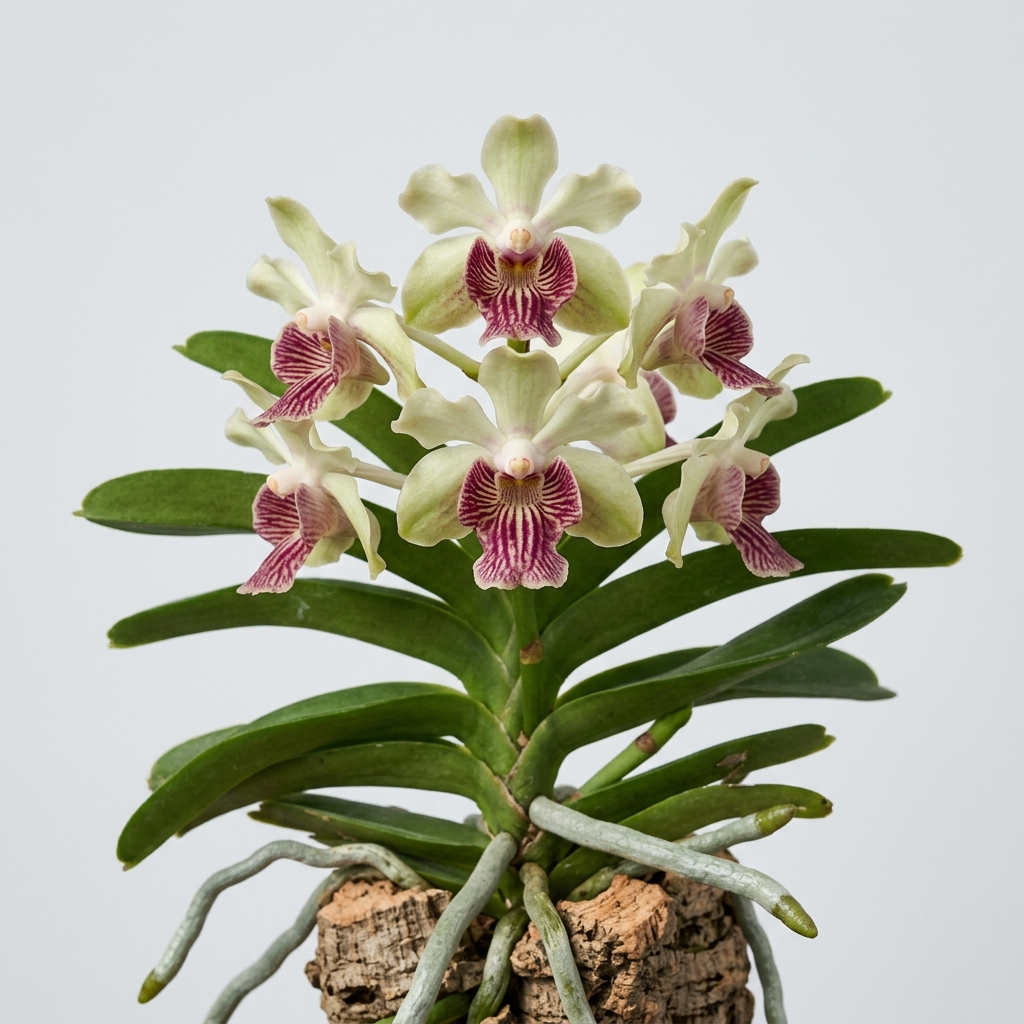
Vanda Pumila is a highly prized miniature epiphytic orchid species native to the mid-elevation forests of Southeast Asia and the Himalayan region. Renowned for its compact growth habit and remarkably fragrant blossoms, this charming orchid offers a manageable alternative to its larger, more demanding Vanda relatives. Growers particularly value its ability to produce relatively large, striking flowers on a plant that easily fits on a bright windowsill or in a modest greenhouse setup.
Unlike the sprawling giants of the genus, Vanda Pumila maintains a neat, monopodial growth form that makes it an excellent candidate for space-conscious collectors. Its flowers feature a beautiful contrast of pale, creamy-green petals and a highly detailed, striped lip, making it a captivating focal point when in bloom. Cultivating this species successfully requires a balance of bright light, consistent moisture, and exceptional air circulation around its sensitive root system.
💡 Did You Know?
Vanda Pumila was once classified under the Trudelia due to its distinct floral structure, particularly its deeply concave lip. Today, taxonomists generally group it back into Vanda, but you will still find it labeled as Trudelia pumila in older botanical literature and vintage orchid collections.
🌿 Botanical Overview
Vanda Pumila, historically classified by some taxonomists under the genus Trudelia, is a monopodial epiphyte native to elevations ranging from 500 to 1,800 meters. This wide altitudinal distribution across countries like Thailand, Vietnam, India, and southern China endows the plant with a degree of temperature tolerance not always seen in lowland Vanda species. It typically grows on the trunks and lower branches of trees in semi-deciduous and evergreen forests, where it receives dappled sunlight and frequent seasonal rainfall.
The plant features thick, leathery, strap-like leaves arranged in a distichous (two-ranked) fashion along a short, upright stem. Its growth is relatively slow but steady, producing thick, silvery aerial roots that serve both to anchor the plant to its host and to rapidly absorb moisture and nutrients from the air. Over time, mature specimens may produce basal offsets, eventually forming a handsome, multi-lead specimen.
🌸 Flower Characteristics
The inflorescence of Vanda Pumila is short, axillary, and typically carries one to three flowers that open nearly simultaneously. Despite the compact size of the plant, the individual flowers are surprisingly large, often measuring between 3 and 5 centimeters in diameter. The sepals and petals are fleshy, slightly reflexed, and present a coloration that ranges from pale cream to a delicate, translucent light green or soft yellow.
The defining feature of the bloom is its prominent, fleshy lip or labellum. The lip is deeply concave and adorned with striking, longitudinal reddish-brown or purple stripes against a white or yellow background. This intricate patterning guides pollinators toward the column. The flowers are long-lasting, often remaining in pristine condition for several weeks if kept in a stable, cool environment.
Fragrance & Bloom Profile
One of the primary reasons collectors seek out Vanda Pumila is its delightful fragrance. The blooms emit a sweet, rich scent that is commonly described as reminiscent of almonds, marzipan, or warm vanilla. This fragrance is typically most intense during the morning and early afternoon hours, coinciding with peak temperatures and light levels when natural pollinators are most active.
While the fragrance is widely celebrated, individual experiences may vary based on environmental factors such as humidity, temperature, and light intensity. In cooler or overly dry conditions, the scent may be less pronounced. The overall bloom profile is characterized by its reliability, with mature, healthy plants consistently flowering once per year, usually in the spring.
Parentage & Hybrid Lineage
As a naturally occurring species rather than a man-made hybrid, Vanda Pumila possesses a pure genetic lineage that has evolved to thrive in specific ecological niches. In the orchid trade, it is sometimes referred to under its synonym, Trudelia pumila, reflecting historical taxonomic shifts within the Vanda alliance. Because of its compact size and cold-tolerance genes, hybridizers have occasionally used Vanda Pumila in breeding programs to introduce miniature growth habits and cold hardiness to larger, warmth-loving Vanda hybrids.
When purchasing this plant, growers should look for reputable nurseries that propagate Vanda Pumila from seed or tissue culture rather than wild-collected specimens. This ensures stronger, more adaptable plants that are already acclimated to greenhouse or home cultivation conditions.
🌱 Growing Conditions
Replicating the natural habitat of Vanda Pumila is key to its long-term health. It thrives in bright, indirect light. While it requires more light than many Phalaenopsis orchids, direct midday sun can easily scorch its thick leaves. A south- or east-facing window with a sheer curtain, or shaded greenhouse benches, provides the ideal light intensity.
💡 Care Tip
To keep your Vanda Pumila happy indoors, hang its basket near an east-facing window where it receives gentle morning sun. Ensure a small fan runs nearby to provide continuous, gentle air movement, which mimics its natural mountain breeze and prevents leaf rot.
Temperature: wise, Vanda Pumila is highly adaptable due to its montane origins. It prefers intermediate to warm daytime temperatures between 21°C and 29°C (70°F to 85°F), with a distinct nighttime drop of about 6°C to 8°C (10°F to 15°F). During the winter months, the plant can tolerate cooler temperatures down to 12°C (54°F), provided it is kept relatively dry. Good air movement is absolutely critical at all times to prevent stagnant air from harboring fungal pathogens.
Watering, Feeding & Potting Media
Because Vanda Pumila is an epiphyte with exposed aerial roots, its watering regime must mimic the rapid wet-and-dry cycles of its native forest canopy. If grown bare-root in a wooden basket or mounted on cork bark, the plant should be watered daily—or even twice daily during hot summer weather. The roots should turn from a silvery-white to a vibrant green, indicating complete hydration, and then be allowed to dry completely within a few hours.
For indoor growers who struggle to maintain high humidity, potting Vanda Pumila in a highly porous medium is an alternative. A mixture of very large fir bark chunks, charcoal, and perlite in a slotted plastic or clay pot can provide the necessary moisture retention while still allowing ample oxygen to reach the roots. Feed the plant weekly with a highly diluted, balanced orchid fertilizer during the active growing season, flushing the root zone with pure water once a month to prevent salt buildup.
Blooming Season & Care Notes
The primary blooming season for Vanda Pumila occurs in the spring, though occasional off-season blooms can occur in late winter or early summer. Initiating a strong bloom cycle often depends on a slight winter rest period. During late autumn and winter, reduce watering frequency and withhold fertilizer, allowing the plant to experience cooler night temperatures and slightly drier conditions. This environmental cue mimics the dry season of its native habitat and triggers spike development.
Once the flower spike emerges from the leaf axils, maintain stable conditions and avoid moving the plant unnecessarily. Sudden changes in temperature, drafty conditions, or water droplets resting on the developing buds can cause them to yellow and drop prematurely. After the blooms fade, cut the spent flower spike close to the stem using sterilized tools.
⚠️ Common Issues
⚠️ Common Mistake
The most common mistake when growing Vanda Pumila is potting it in standard, dense potting soil or fine orchid mix. This suffocates its thick aerial roots, leading to rapid root rot. Always use extremely coarse media, or better yet, grow it bare-root in a wooden slat basket.
- Root Rot:
Occurs when the roots remain wet for extended periods without adequate airflow, leading to mushy, black roots and eventual plant decline. - Bud Blast:
The premature drying and dropping of flower buds, usually caused by sudden drops in humidity, drafts, or chemical sensitivity. - Spider Mites and Mealybugs: Common pests that hide in the tight leaf axils; treat promptly with insecticidal soap or horticultural oil.
- Leaf Spotting: Fungal or bacterial spots can develop on the foliage if water is allowed to sit on the leaves overnight or if air circulation is poor.
❓ Frequently Asked Questions
Can Vanda Pumila be grown indoors without a greenhouse?
Yes, Vanda Pumila can be successfully grown indoors. Because of its compact size, it fits well on bright windowsills. To compensate for lower indoor humidity, grow it in a slotted pot with coarse bark rather than bare-root, or use a humidifier nearby.
How often should I water my Vanda Pumila?
Watering frequency depends on your growing method. Bare-root plants in baskets usually require daily watering or misting. Plants grown in coarse bark should be watered when the medium is nearly dry, typically every two to three days depending on home temperatures.
Why are the leaves on my Vanda Pumila turning yellow?
Yellowing leaves can indicate several issues. Lower leaves naturally yellow and drop as the plant grows. However, widespread yellowing may suggest overwatering, insufficient light, or a sudden temperature shock. Inspect the roots to rule out rot.
Does Vanda Pumila require a cold winter rest to bloom?
While it does not require freezing temperatures, Vanda Pumila benefits significantly from a distinct winter rest. Reducing water and fertilizer while allowing nighttime temperatures to drop to around 12°C to 15°C (54°F to 59°F) helps stimulate spring flower spikes.
⭐ Final Growing Notes
Vanda Pumila is an exceptional choice for orchid enthusiasts seeking the exotic beauty and fragrance of a Vanda without the space requirements of larger species. By providing bright, filtered light, maintaining high humidity, and ensuring its roots dry rapidly after watering, growers can enjoy its striking, almond-scented blooms year after year. Its adaptability to intermediate temperatures makes it a resilient and rewarding addition to any diverse orchid collection.
⚕️ Health, Safety & Edibility
Understanding how a plant interacts with people, pets, and the surrounding environment is part of responsible cultivation. This section uses conservative, general guidance and does not replace professional medical or veterinary advice.
Human Safety: No published evidence currently identifies species-specific toxicity concerns for Vanda Pumila during normal handling. As with most ornamental plants, it should not be intentionally consumed.
Pet Safety: Published information does not indicate that this orchid commonly poses a toxicity concern for cats or dogs. However, chewing leaves, flowers, roots, or potting media may still cause mild digestive upset.
Edibility: This orchid is cultivated for ornamental display rather than food. Ornamental plants may carry fertilizers, pesticides, or other horticultural treatments that make them unsuitable for consumption.
Skin Contact: Routine handling is not generally associated with skin irritation. Gardeners with sensitive skin may prefer wearing gloves when repotting, pruning, or handling potting media.
🌱 Propagation Tip
Vanda Pumila is a monopodial orchid, meaning it grows from a single stem and does not divide like sympodial orchids. Propagation is typically achieved by waiting for the plant to naturally produce a basal offset, or keiki. Once the keiki has developed several strong roots of its own, it can be carefully detached and mounted.
⭐ Expert Advice
If your Vanda Pumila refuses to bloom, try increasing the differential between day and night during the autumn. A drop of about 8 degrees Celsius at night, combined with a slight reduction in , acts as a powerful natural trigger for spring spike development.

Leave A Comment