
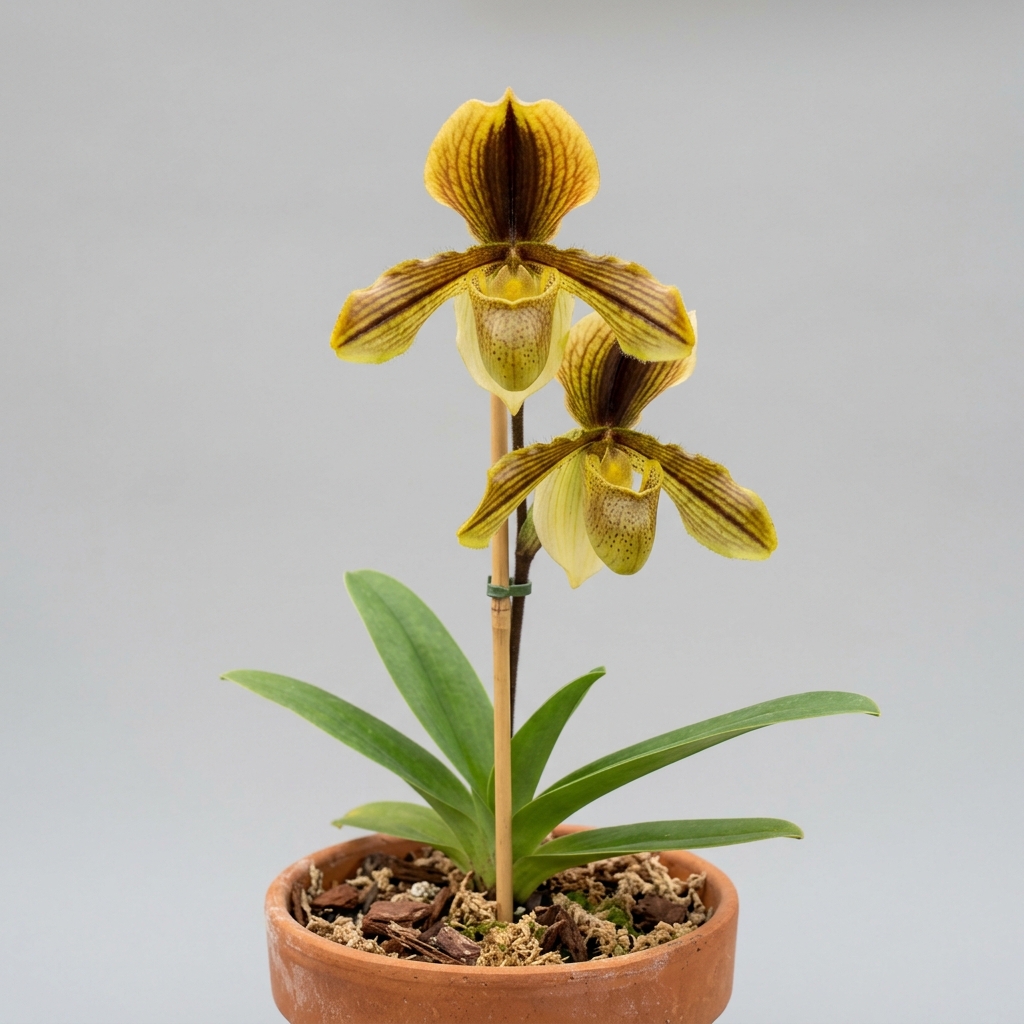
Paphiopedilum Druryi is a highly coveted and historically significant slipper orchid native to the mountainous regions of Southern India. Renowned for its striking color palette and distinct structural form, this species stands out within the genus due to its unique golden-yellow flowers marked by a bold, dark chocolate-brown stripe running down the center of its petals and dorsal sepal. Orchid enthusiasts and collectors highly value this plant for its compact growth habit, architectural foliage, and the classical elegance it brings to any indoor collection.
As a terrestrial or lithophytic orchid, Paphiopedilum Druryi adapts well to container cultivation when provided with the correct balance of moisture, shade, and humidity. Unlike many of its mottled-leaf relatives, this species features solid green, strap-like leaves that hint at its preference for slightly brighter light conditions. While once considered difficult to obtain, modern seed-grown propagation efforts have made this exquisite botanical treasure more accessible to dedicated hobbyists looking to master the art of growing slipper orchids.
💡 Did You Know?
Paphiopedilum Druryi is part of the Paphiopedilum orchid group, a favorite among growers because its flowers, growth habit, and care needs make it useful for comparing cultivated orchids within the same . Observing its leaves, roots, and bloom spikes can help growers understand how this cultivar responds to indoor conditions.
🌿 Botanical Overview
Paphiopedilum Druryi is native to a very restricted range in the Western Ghats of India, where it historically grew in pockets of leaf litter and humus among rocky crevices. This specific native habitat dictates its growth requirements in cultivation, leaning toward a terrestrial-style potting medium that retains moisture while allowing excellent drainage. The plant produces thick, fleshy roots that lack the protective velamen layer found in epiphytic orchids, making them highly sensitive to both extreme drought and stagnant water.
The foliage of this species consists of narrow, rigid, ligulate leaves of a uniform light-to-medium green color. These leaves grow in a fan-shaped arrangement, with each mature fan eventually producing a single upright inflorescence. Because it lacks pseudobulbs, the plant relies entirely on its leaves and roots to store water and nutrients, requiring a consistent care routine throughout the year to prevent stress and support healthy growth cycles.
🌸 Flower Characteristics
The blossoms of Paphiopedilum Druryi are a masterclass in botanical symmetry and contrast. Each flower typically measures between seven to nine centimeters across, presented singly on a sturdy, erect, pubescent spike that rises well above the foliage. The most defining feature of the bloom is the prominent, dark reddish-brown to black median stripe that bisects the bright greenish-yellow dorsal sepal and the similarly colored, slightly down-curved petals.
The pouch, or labellum, is a smooth, helmet-shaped structure of a warm yellow hue, often exhibiting a glossy finish that catches the light. The staminode is also yellow and serves as a central focal point within the flower. These blooms are remarkably long-lasting, often remaining in pristine condition for six to eight weeks, provided the plant is kept in a cool, stable environment during its flowering cycle.
Fragrance & Bloom Profile
While many orchids are celebrated for their intense perfumes, Paphiopedilum Druryi is generally considered to be unscented. Some growers report a very faint, earthy aroma under warm, humid conditions, but a distinct fragrance profile is not consistently documented in horticultural literature. The primary appeal of this orchid lies entirely in its graphic, high-contrast visual presentation rather than its olfactory qualities.
The blooming cycle typically occurs once per year per mature fan. Once a fan has finished flowering, it will not bloom again; instead, the plant will direct its energy into producing new vegetative leads from the base. These new leads will mature over the course of the year to provide the next season’s flowers, making consistent vegetative care essential for annual displays.
Parentage & Hybrid Lineage
As a true botanical species rather than a man-made hybrid, Paphiopedilum Druryi possesses a pure genetic lineage. It was first described in the late 19th century and named after Colonel Drury, who collected it in India. Because of its unique color pattern and dominant central stripe, it has been used extensively by hybridizers to introduce yellow coloration and bold striping into complex Paphiopedilum hybrids.
When researching this plant, growers may encounter various line-bred select clones or historical primary hybrids. However, the true species remains highly sought after by purists. Because wild populations are critically endangered and strictly protected, ethical growers should ensure they purchase only artificially propagated, nursery-grown specimens from reputable orchid nurseries.
🌱 Growing Conditions
To cultivate Paphiopedilum Druryi successfully, growers should aim to replicate its subtropical mountain habitat. This orchid thrives in moderate to bright indirect light. While it can tolerate slightly more light than mottled-leaf slipper orchids, direct midday sun must be avoided to prevent the solid green leaves from scorching. East- or shaded south-facing windows, or high-quality LED grow lights, are ideal.
💡 Care Tip
For best results, grow Paphiopedilum Druryi in bright filtered with steady and gentle airflow. Avoid placing the plant in harsh midday sun, but do not keep it in a dark corner; weak is one of the most common reasons cultivated orchids refuse to rebloom.
Temperature: wise, this species prefers intermediate to warm conditions. Daytime temperatures should ideally range between 21°C to 28°C (70°F to 82°F), with a night-time drop to around 15°C to 18°C (59°F to 64°F). This diurnal temperature fluctuation is crucial, as it helps stimulate the initiation of flower buds. Maintain moderate to high relative humidity levels between 50% and 70%, supported by good air circulation to prevent fungal pathogens.
Watering, Feeding & Potting Media
Watering is the most critical aspect of Paphiopedilum Druryi care. Because the plant lacks pseudobulbs, the potting medium should remain consistently damp but never waterlogged. Water the plant thoroughly when the top centimeter of the medium begins to feel dry to the touch. Using pure water, such as rainwater, distilled water, or reverse osmosis water, is highly recommended to prevent harmful mineral salts from building up around the sensitive roots.
A standard potting mix for this species consists of fine-to-medium grade fir bark blended with perlite, charcoal, and a small amount of chopped sphagnum moss to retain moisture. Feed the orchid with a highly diluted, balanced orchid fertilizer (such as a 20-20-20 formula at quarter-strength) every second or third watering during the active growing season. Flush the pot with pure water periodically to wash away any accumulated fertilizer salts.
Blooming Season & Care Notes
The typical blooming season for Paphiopedilum Druryi is in the spring and early summer, though variations can occur depending on local growing conditions. As the flower spike emerges from the center of the mature leaf fan, avoid getting water in the crown of the plant, as standing water can easily cause the developing bud to rot (a condition known as bud blast).
Once the flower has fully opened, keep the plant in a slightly cooler spot with lower light to prolong the life of the bloom. After the flower eventually fades, cut the spike down close to the base of the leaves using a sterile cutting tool. Repotting is best performed in the spring, immediately after flowering has finished and just as new root growth begins from the base of the developing fans.
⚠️ Common Issues
⚠️ Common Mistake
The most common mistake is by calendar instead of root and potting-media condition. Paphiopedilum roots need moisture and air at the same time, so constantly wet bark or sphagnum can lead to root loss even when the leaves still look healthy.
- Root Rot:
Caused by overwatering or compacted, decomposing potting media that suffocates the roots. - Bud Blast:
The premature yellowing and dropping of flower buds, often triggered by sudden temperature drops, low humidity, or water trapped in the crown. - Mealybugs and Scale: These pests frequently hide in the tight crevices at the base of the leaf fans and under the flower bracts.
- Leaf Scorching: Bleached or brown patches on the leaves caused by exposure to direct, unfiltered sunlight.
- Fungal Leaf Spotting: Dark spots on the foliage resulting from high humidity combined with stagnant, stagnant air.
❓ Frequently Asked Questions
How often should I repot my Paphiopedilum Druryi?
It is generally best to repot this orchid every one to two years. Slipper orchids prefer fresh, open potting media, and the bark-based mix will naturally break down over time, leading to poor drainage and potential root rot. Repot in the spring after the blooming cycle is complete.
Why are the leaves on my orchid turning yellow?
Yellowing leaves can indicate several issues. If the oldest, bottom-most leaves are yellowing and dropping one by one, it is likely a natural aging process. However, widespread yellowing can indicate excessive light, underwatering, or root damage preventing the plant from absorbing moisture.
Can I grow this orchid under artificial LED lights?
Yes, Paphiopedilum Druryi thrives under modern LED grow lights. Position the plant so it receives moderate light levels, ensuring the lights are kept at a safe distance to prevent heat stress or leaf scorching, and maintain a consistent 12-to-14-hour photoperiod.
How do I encourage my Paphiopedilum Druryi to bloom?
To trigger blooming, ensure the plant receives a distinct drop in night-time temperatures (around 5°C to 8°C lower than daytime temperatures) during the autumn and winter months. Consistent watering, appropriate light, and healthy root development are also essential prerequisites for flowering.
⭐ Final Growing Notes
Paphiopedilum Druryi is a rewarding and visually stunning addition to any serious orchid collection. While it requires a bit more attentiveness to watering and humidity than common mass-market orchids, its striking, striped yellow blooms and historical significance make the effort well worthwhile. By providing consistent moisture, intermediate temperatures, and bright indirect light, growers can enjoy the elegant presence of this rare Indian species for many years to come.
⚕️ Health, Safety & Edibility
Understanding how a plant interacts with people, pets, and the surrounding environment is part of responsible cultivation. This section uses conservative, general guidance and does not replace professional medical or veterinary advice.
Human Safety: No published evidence currently identifies species-specific toxicity concerns for Paphiopedilum Druryi during normal handling. As with most ornamental plants, it should not be intentionally consumed.
Pet Safety: Published information does not indicate that this orchid commonly poses a toxicity concern for cats or dogs. However, chewing leaves, flowers, roots, or potting media may still cause mild digestive upset.
Edibility: This orchid is cultivated for ornamental display rather than food. Ornamental plants may carry fertilizers, pesticides, or other horticultural treatments that make them unsuitable for consumption.
Skin Contact: Routine handling is not generally associated with skin irritation. Gardeners with sensitive skin may prefer wearing gloves when repotting, pruning, or handling potting media.
🌱 Propagation Tip
Propagation should be approached patiently. Most home growers should wait for natural keikis or divide only mature, healthy plants when the orchid type allows it. Never remove a young growth until it has strong roots and enough leaves to support itself away from the parent plant.
⭐ Expert Advice
Repot after flowering when fresh root tips begin to appear. This timing helps the plant anchor quickly into new bark or sphagnum and reduces stress, especially for orchids grown indoors where airflow, , and drying speed can change from season to season.

Leave A Comment