
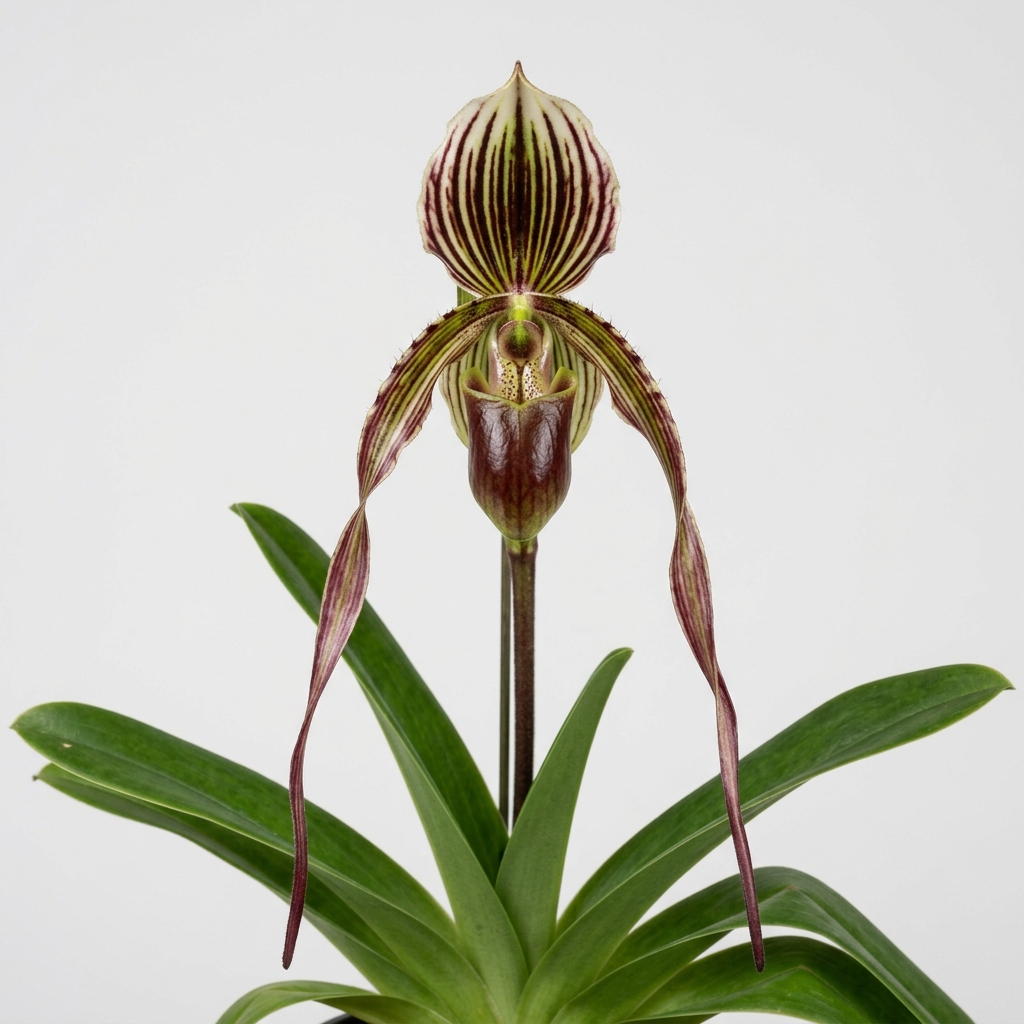
Paphiopedilum Harold Koopowitz is a highly celebrated primary hybrid orchid renowned for its dramatic, sweeping floral presentation and stately growth habit. Belonging to the slipper orchid group, this cultivar is prized by collectors for its long, ribbon-like petals that cascade elegantly from the flowering spike. Its architectural foliage and impressive multi-floral display make it a centerpiece in any dedicated orchid collection.
Growers value this hybrid not only for its striking visual impact but also for its relative vigor compared to its parent species. While it requires patience to reach blooming size, a mature specimen in full bloom offers an unparalleled tropical aesthetic. Understanding its specific cultural preferences is key to successfully cultivating this magnificent slipper orchid.
💡 Did You Know?
The parent species Paphiopedilum sanderianum, which gives this hybrid its extraordinarily long petals, was lost to cultivation for nearly a century after its discovery in 1885 before being rediscovered in the wild in the 1970s, making hybrids like Harold Koopowitz highly prized historical treasures.
🌿 Botanical Overview
Paphiopedilum Harold Koopowitz shows a robust, strap-leaf growth habit characteristic of multi-floral slipper orchids. The leaves are thick, leathery, and solid green, lacking the mottled patterns found in some other Paphiopedilum subgenera. A mature growth can produce leaves reaching up to twelve to eighteen inches in length, forming a handsome, fan-shaped rosette.
The root system of this hybrid is typical of terrestrial or lithophytic orchids, consisting of thick, hairy, brown roots that prefer a highly aerated yet moisture-retentive environment. Unlike epiphytic orchids with velamen-coated roots, these roots are sensitive to drying out and require consistent moisture to remain healthy.
🌸 Flower Characteristics
The flowers of Paphiopedilum Harold Koopowitz are a masterclass in orchid morphology. The most striking feature is the pair of lateral petals, which are extremely long, narrow, and tend to twist or spiral downward, sometimes reaching lengths of over twelve inches. These petals are typically colored in shades of greenish-yellow, heavily overlaid with rich mahogany or burgundy stripes and spots.
The dorsal sepal is tall, pointed, and proudly displayed, featuring clean vertical striping in dark maroon against a cream or pale green background. The pouch, or labellum, is deeply cupped, firm, and usually presents a glossy, bronzy-brown or mahogany hue. Multiple flowers open sequentially or simultaneously on a tall, sturdy inflorescence that rises well above the foliage.
Fragrance & Bloom Profile
While some slipper orchids possess subtle scents, a distinct fragrance is not consistently documented in common grower references for Paphiopedilum Harold Koopowitz. The primary appeal of this cultivar lies entirely in its dramatic visual architecture rather than its olfactory profile.
The blooms are exceptionally long-lasting, often remaining in pristine condition for six to eight weeks. Because it is a multi-floral hybrid, a single flower spike can support three to five large blossoms, creating a spectacular, tiered display that stands out in any exhibition space.
Parentage & Hybrid Lineage
Paphiopedilum Harold Koopowitz is a primary hybrid resulting from the cross between Paphiopedilum rothschildianum and Paphiopedilum sanderianum. This pedigree combines two of the most legendary species in the orchid world. It inherits its stately, upright dorsal sepal and robust growth habit from the former, while the latter contributes the extraordinary, elongated, twisting petals.
Because it is a primary hybrid, individual plants can exhibit slight variations in petal length, color intensity, and overall flower size. Growers often seek out specific select clones that have been recognized for exceptional flower form or particularly long petals, though all specimens of this grex carry the signature dramatic look of their parentage.
🌱 Growing Conditions
To cultivate Paphiopedilum Harold Koopowitz successfully, growers should aim to replicate a warm, humid forest understory. This hybrid thrives in bright, filtered indirect light, similar to the conditions preferred by Cattleyas, but must be shielded from direct midday sun which can easily scorch the solid green leaves.
💡 Care Tip
Maintain high around the developing flower spike. If the air is too dry, the extremely long, twisting petals can get stuck in their protective bracts or fail to unfurl to their full, dramatic length.
Temperature ranges should ideally be kept warm to intermediate, with daytime temperatures between 75°F and 85°F, and a slight drop at night to around 62°F to 68°F. High humidity of 50% to 70% is essential to support the long petals and prevent them from drying out or stalling as they develop. Gentle, continuous air movement is critical to prevent fungal pathogens in these humid conditions.
Watering, Feeding & Potting Media
Unlike many epiphytic orchids, Paphiopedilum Harold Koopowitz does not possess pseudobulbs for water storage and should never be allowed to dry out completely. The potting medium should be kept evenly moist but never soggy. Water thoroughly with pure water, such as rainwater or reverse osmosis water, as slipper orchids can be sensitive to dissolved mineral salts.
A well-draining potting mix is essential; a blend of medium-grade fir bark, perlite, charcoal, and a small amount of chopped sphagnum moss works well. Feeding should be light but regular, using a balanced, diluted orchid fertilizer at one-quarter strength every two to three waterings. Flushing the pot with pure water between feedings helps prevent salt buildup.
Blooming Season & Care Notes
The typical blooming season for Paphiopedilum Harold Koopowitz spans from late spring through summer, though variations can occur based on local growing conditions. Developing a flower spike is a slow process that can take several months from the first appearance of the sheath to the fully opened blossoms.
Once the spike begins to emerge, it is important to keep the plant in a stable position; rotating the pot during spike development can cause the flowers to face awkward directions. After blooming is complete, cut the spike down to the base of the fan. Repotting is best done every one to two years in the spring, just as new root growth begins, to ensure the media remains fresh and well-aerated.
⚠️ Common Issues
⚠️ Common Mistake
Allowing the potting medium to dry out completely is a frequent mistake made by growers. Unlike orchids with water-storing pseudobulbs, Paphiopedilums have fine, hairy roots that quickly die if left dry, leading to severe leaf dehydration and stalled growth.
- Root rot: Caused by overwatering or compacted, decomposing potting media that suffocates the roots.
- Bud blast: Occurs when sudden drops in humidity, drafts, or water stress cause developing buds to wither and die before opening.
- Leaf scorch: Appears as bleached or brown patches on the leaves due to excessive direct sunlight.
- Mealybugs and scale: Common pests that hide in the tight crevices of the leaf fans and under the flower bracts.
- Bacterial brown spot: A pathogen that can rapidly spread on wet leaves in stagnant air, requiring prompt removal of affected tissue.
❓ Frequently Asked Questions
How long do the petals of Paphiopedilum Harold Koopowitz grow?
The lateral petals of a mature, well-grown Paphiopedilum Harold Koopowitz can reach lengths of twelve to eighteen inches. They cascade downward in a graceful spiral, a trait inherited directly from its parent, Paphiopedilum sanderianum.
Can I grow Paphiopedilum Harold Koopowitz under artificial LED lights?
Yes, this hybrid adapts well to indoor cultivation under high-quality LED grow lights. Ensure the lights provide moderate to high intensity, equivalent to bright indirect sunlight, and maintain a consistent photoperiod of twelve to fourteen hours daily.
Why are the tips of my orchid leaves turning brown?
Brown leaf tips are commonly caused by a buildup of fertilizer salts in the potting medium or the use of tap water high in dissolved minerals. Flush the pot thoroughly with pure rainwater or distilled water, and reduce fertilizer concentration.
How long does it take for a young plant to reach blooming size?
Paphiopedilum Harold Koopowitz is a slow-growing hybrid. From a young seedling, it can take five to seven years to reach maturity and produce its first bloom. Purchasing a near-blooming-size or mature division is highly recommended for impatient growers.
⭐ Final Growing Notes
Cultivating Paphiopedilum Harold Koopowitz is a deeply rewarding endeavor for the patient orchid enthusiast. While its slow growth rate requires a long-term commitment, the reward of its magnificent, long-petaled blooms is unmatched in the botanical world. By providing consistent moisture, high humidity, and bright indirect light, you can enjoy the majestic presence of this premier slipper orchid hybrid for decades.
🌱 Propagation Tip
This orchid is propagated by careful division of mature clumps. Ensure each division has at least two or three mature, healthy fans with active roots, as single-fan divisions can take years to recover and resume growth.
⭐ Expert Advice
Add a small amount of oyster shell or dolomite lime to the potting mix. This hybrid benefits from a slightly alkaline to neutral root zone, mimicking the limestone cliffs where its parent species naturally grow.




Leave A Comment