
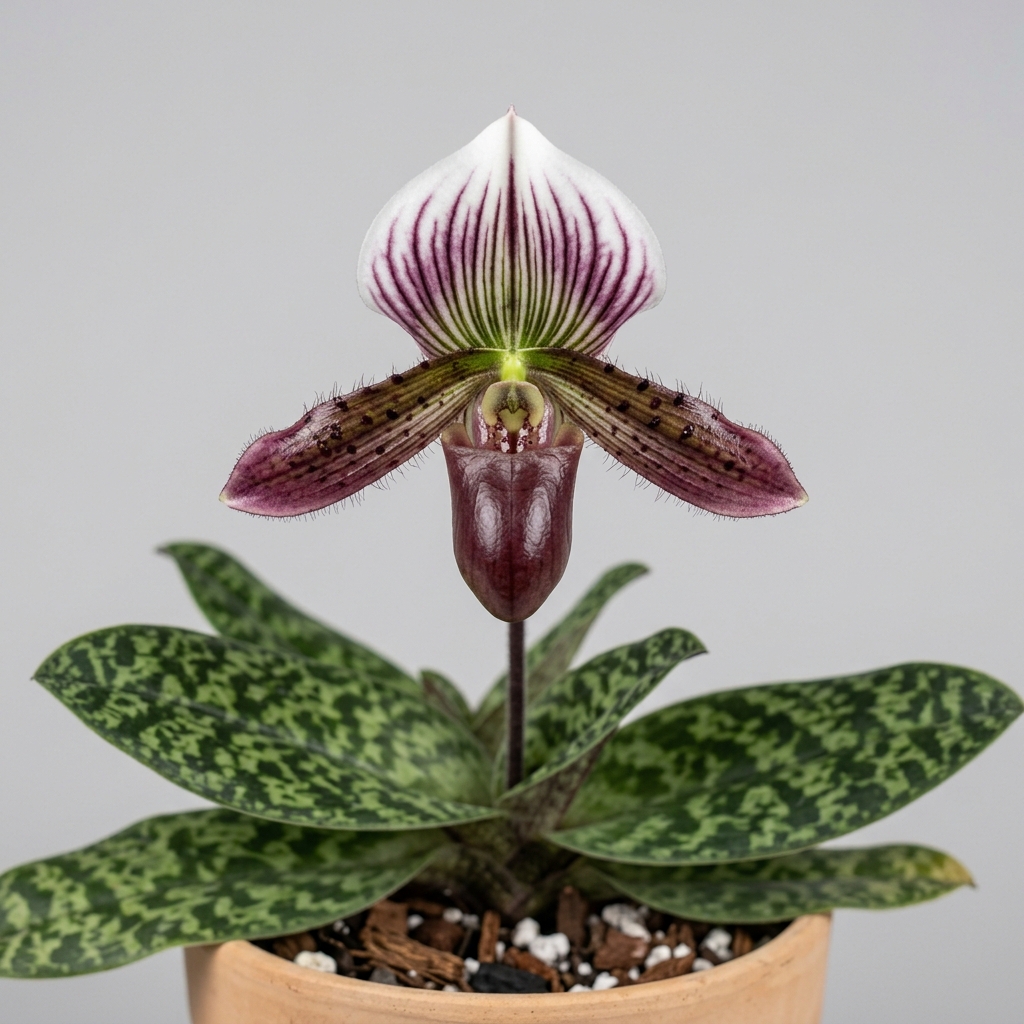
Paphiopedilum Purpuratum, commonly known as the purple-flowered slipper orchid, is a highly coveted terrestrial orchid species native to the shaded forest floors of Southeast Asia, particularly Hong Kong and southern China. Renowned for its striking, tessellated foliage and dramatic, pouch-shaped flowers, this compact grower brings an exotic elegance to indoor orchid collections. Growers highly value this species for its manageable size and its ability to thrive in lower light conditions compared to many other orchid genera.
As a member of the slipper orchid family, this plant produces long-lasting blooms that feature a distinctive pouch-like lip designed to aid in pollination. Its dark green leaves, beautifully mottled with pale green patterns, ensure the plant remains visually appealing even when not in flower. Cultivating this species successfully requires an understanding of its forest-dwelling origins, mimicking the humid, shaded, and well-drained conditions of its native habitat.
💡 Did You Know?
Unlike many orchids that grow high up in tree canopies, Paphiopedilum Purpuratum is a terrestrial and lithophytic species. It has adapted to live on the forest floor and rocky slopes, where it relies on decaying leaf litter and moss for nutrients, which is why it prefers a finer, more moisture-retentive potting mix than epiphytic orchids.
🌿 Botanical Overview
Paphiopedilum Purpuratum is a lithophytic or terrestrial orchid typically found growing in leaf litter, rocky crevices, or mossy banks near streams. In its native habitat, it is accustomed to filtered light, high humidity, and constant moisture around the root zone without being waterlogged. The plant shows a sympodial growth habit, producing fans of attractive, patterned leaves that grow close to the ground.
The foliage is a key identifying feature, showcasing a striking checkerboard or tessellated pattern of dark and light green. This adaptation allows the plant to maximize light absorption in the deep shade of forest understories. Understanding this natural environment is crucial for indoor growers, as it dictates the specific moisture, light, and potting requirements needed to keep the orchid healthy.
🌸 Flower Characteristics
The blossoms of Paphiopedilum Purpuratum are single-flowered, emerging from a dark, hairy spike that rises elegantly above the foliage. Each flower features a prominent, dorsal sepal that is typically white or pale green, heavily striped with deep purple or maroon veins. The petals extend horizontally or slightly downward, often displaying a rich brownish-purple hue with dark spots or warts along the margins.
The most defining feature is the deeply cupped, pouch-like labellum, which is usually a glossy, dark purplish-brown. This pouch serves as a temporary trap for insect pollinators, forcing them to exit past the reproductive organs. The flowers are remarkably long-lasting, often remaining pristine for six to eight weeks under optimal conditions.
Fragrance & Bloom Profile
Unlike some orchid genera celebrated for intense perfumes, Paphiopedilum Purpuratum is generally considered unscented. While some growers occasionally report a very faint, earthy aroma under warm, humid conditions, fragrance is not a primary characteristic of this species. The appeal of the bloom lies entirely in its dramatic visual presentation, complex color contrast, and exceptional longevity on the stem.
Parentage & Hybrid Lineage
As a distinct botanical species rather than a man-made hybrid, Paphiopedilum Purpuratum does not have parentage in the traditional cultivar sense. However, it has been widely used in slipper orchid hybridizing programs to introduce compact growth habits, tessellated foliage, and deep purple coloration to new grexes. In cultivation, line-bred specimens exist where growers select for superior flower size, flatter dorsal sepals, and more intense coloration over multiple generations.
🌱 Growing Conditions
To cultivate this slipper orchid successfully, provide bright, indirect light, avoiding any direct afternoon sun which can easily scorch the sensitive, mottled leaves. An east- or north-facing window is often ideal, or under shaded LED grow lights. Temperature-wise, it prefers intermediate to warm conditions, ideally ranging from 65°F to 80°F (18°C to 27°C) during the day, with a slight drop at night to stimulate blooming.
💡 Care Tip
Always water this orchid in the morning so that any water trapped in the center of the leaf fan has ample time to evaporate before nightfall. This simple practice dramatically reduces the risk of crown rot and bacterial infections.
High humidity is essential, ideally maintained between 50% and 70%. Good air movement is equally critical to prevent stagnant air from causing fungal or bacterial leaf spots. A small fan running on low nearby, without blowing directly on the plant, can help maintain the necessary air circulation.
Watering, Feeding & Potting Media
Unlike epiphytic orchids with thick pseudobulbs, Paphiopedilum Purpuratum lacks water-storage organs and should never be allowed to dry out completely. Keep the potting medium evenly moist but not soggy. Water thoroughly when the top half-inch of the medium begins to feel dry to the touch, using rainwater, distilled water, or reverse osmosis water to avoid mineral buildup.
Feed the orchid with a highly diluted, balanced orchid fertilizer (such as a quarter-strength 20-20-20 formula) every two to three waterings during the active growing season. Flush the pot with pure water periodically to wash away accumulated salts. The ideal potting medium is a well-draining, moisture-retentive mix, typically composed of fine to medium fir bark, perlite, charcoal, and a small amount of chopped sphagnum moss.
Blooming Season & Care Notes
The primary blooming season for Paphiopedilum Purpuratum typically occurs in the autumn and winter months, though occasional blooms can appear at other times of the year. Once the flower spike begins to emerge from the center of the leaf fan, avoid changing the plant’s orientation to the light source, as this can cause the bud to twist or stall. After the flower fades, cut the spike down to the base of the foliage.
Repotting is best done every one to two years, immediately after flowering has finished and new growth begins to emerge. Slipper orchids prefer slightly tight quarters, so only increase the pot size if the root system has completely outgrown the current container.
⚠️ Common Issues
⚠️ Common Mistake
Allowing the potting medium to dry out completely is a frequent mistake. Because Paphiopedilum orchids lack water-storing pseudobulbs, even a brief period of complete dryness can severely damage the roots and stall growth.
- Root Rot: Caused by overwatering or compacted, decomposing potting media that suffocates the roots.
- Leaf Spotting: Fungal or bacterial spots can develop if water sits on the leaves overnight or if air circulation is inadequate.
- Bud Blast: Sudden dropping or drying of buds before opening, often triggered by rapid temperature fluctuations, low humidity, or drafty locations.
- Mealybugs and Scale: Common pests that hide in the tight crevices of the leaf fans; treat early with insecticidal soap or horticultural oil.
- Dehydration: Indicated by limp, wrinkled leaves, usually due to underwatering or a loss of roots from rot.
❓ Frequently Asked Questions
How often should I water my Paphiopedilum Purpuratum?
Typically once or twice a week, depending on home humidity and temperature. The goal is to keep the medium consistently damp but never waterlogged.
Why are the leaves on my slipper orchid turning yellow?
Yellowing leaves can indicate excessive direct sunlight, overwatering leading to root rot, or natural aging of the oldest bottom leaves.
Can I grow Paphiopedilum Purpuratum under artificial lights?
Yes, they perform exceptionally well under LED or fluorescent grow lights placed about 12 to 18 inches above the foliage, provided the intensity is kept moderate.
Does this orchid require a cold period to bloom?
It does not require extreme cold, but a slight drop in nighttime temperatures of about 10°F (5°C) in autumn helps trigger the initiation of flower spikes.
⭐ Final Growing Notes
Paphiopedilum Purpuratum is an exceptional choice for both novice and experienced orchid enthusiasts who appreciate the unique charm of slipper orchids. By respecting its need for consistent moisture, shaded light, and moderate temperatures, growers are rewarded with spectacular, long-lasting blooms and highly ornamental foliage year-round.
⚕️ Health, Safety & Edibility
Understanding how a plant interacts with people, pets, and the surrounding environment is part of responsible cultivation. This section uses conservative, general guidance and does not replace professional medical or veterinary advice.
Human Safety: No published evidence currently identifies species-specific toxicity concerns for Paphiopedilum Purpuratum during normal handling. As with most ornamental plants, it should not be intentionally consumed.
Pet Safety: Published information does not indicate that this orchid commonly poses a toxicity concern for cats or dogs. However, chewing leaves, flowers, roots, or potting media may still cause mild digestive upset.
Edibility: This orchid is cultivated for ornamental display rather than food. Ornamental plants may carry fertilizers, pesticides, or other horticultural treatments that make them unsuitable for consumption.
Skin Contact: Routine handling is not generally associated with skin irritation. Gardeners with sensitive skin may prefer wearing gloves when repotting, pruning, or handling potting media.
🌱 Propagation Tip
Slipper orchids are propagated by division rather than stem cuttings. Wait until the plant has at least six healthy fans, then carefully divide it during repotting, ensuring each new division has at least three active fans and a viable root system.
⭐ Expert Advice
To encourage reliable autumn blooming, expose the plant to a natural drop of about 10 degrees Fahrenheit between day and night during the late summer and early fall months.

Leave A Comment