
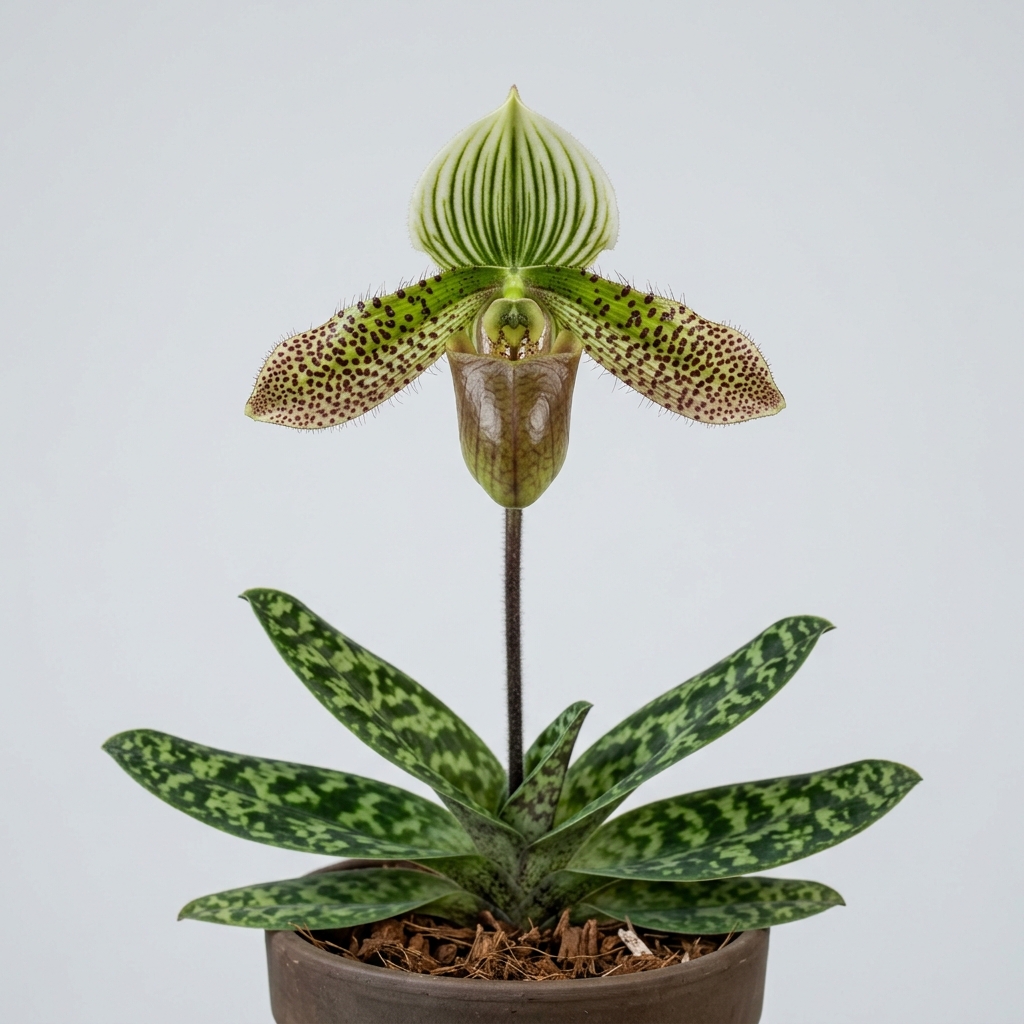
Paphiopedilum Sukhakulii is a highly celebrated slipper orchid species native to the montane forests of northeastern Thailand. Prized by collectors for its striking, exotic appearance and distinctive mottled foliage, this orchid brings a dramatic architectural presence to indoor collections. Its unique flower form, characterized by wide, speckled petals and a prominent pouch-like lip, makes it a standout representative of the genus Paphiopedilum.
Unlike many orchids that require complex greenhouse setups, this species adapts remarkably well to typical home environments. Growers value Paphiopedilum Sukhakulii not only for its reliable blooming habit but also for its attractive, tessellated leaves that provide year-round visual interest even when the plant is not in flower. Its relatively compact growth habit makes it an excellent choice for windowsill cultivation and small-space orchid collections.
💡 Did You Know?
Paphiopedilum Sukhakulii was discovered almost by accident in 1964. A batch of wild-collected orchids sent from Thailand to a nursery in Europe contained a few unrecognized plants. When they bloomed, botanists realized they had found an entirely new species, which was subsequently named in honor of the Thai orchid exporter Prasong Sukhakul.
🌿 Botanical Overview
First described in the mid-1960s, Paphiopedilum Sukhakulii is a terrestrial or lithophytic orchid that naturally grows in leaf litter and organic debris on the forest floor. It is native to elevations ranging from 200 to 1,000 meters, where it thrives in shaded, humid environments. The plant features a fan-shaped growth habit, with each growth producing a clutch of beautifully patterned, oblong leaves.
The foliage is a key botanical feature, displaying a striking tessellation of dark and light green patches. This mottled pattern is an evolutionary adaptation that helps the plant maximize light absorption in the deeply shaded understory of its native habitat. Understanding this natural environment is crucial for replicating its preferred growing conditions in cultivation.
🌸 Flower Characteristics
The blossoms of Paphiopedilum Sukhakulii are uniquely structured and instantly recognizable. Each single-flowered inflorescence rises on a tall, dark, pubescent spike, presenting a bloom that can measure up to 12 centimeters across. The dorsal sepal is broadly ovate, pale green or white, and decorated with prominent vertical dark green veins.
The petals are the most dramatic feature, spreading horizontally and slightly downward. They are pale green, heavily covered with dark purple-brown spots, and fringed with fine, dark hairs along the margins. The lip, or labellum, forms a deep, helmet-shaped pouch that is typically brownish-green with fine veining, designed to temporarily trap pollinators to ensure fertilization.
Fragrance & Bloom Profile
While Paphiopedilum Sukhakulii is celebrated for its visual drama, it is generally considered a fragrance-free orchid. Scent is not a primary characteristic of this species, and any reported aromas are typically faint, earthy, or inconsistent among individual specimens. The lack of fragrance is amply compensated for by the longevity of the blooms.
A single flower can remain pristine on the plant for six to eight weeks, and sometimes longer under optimal, cool conditions. The flowers open sequentially across different growths rather than all at once, which can extend the overall blooming display of a mature specimen over several months.
Parentage & Hybrid Lineage
As a distinct botanical species rather than a man-made hybrid, Paphiopedilum Sukhakulii does not have a complex lineage of parental cultivars. It was discovered in Thailand by Prasong Sukhakul and described by Leslie A. Garay in 1965. Since its discovery, it has been widely used as a parent in slipper orchid hybridization due to its dominant spotting, wide petal stance, and vigorous growth habit.
When crossed with other species, it frequently passes on its distinctive mottled foliage and flat, wide-petaled flower form. While individual select clones have received numerous awards from orchid societies worldwide, the species itself remains a cornerstone of modern Paphiopedilum breeding programs.
🌱 Growing Conditions
Replicating the forest understory is the key to successfully growing this orchid. It thrives in low to medium light conditions, similar to those preferred by African violets. Direct sunlight must be avoided, as it can easily scorch the delicate mottled leaves; bright, filtered light from an east-facing window is ideal.
💡 Care Tip
Always water this orchid in the morning so that any water splashed onto the foliage or into the center of the leaf fan has ample time to evaporate before nightfall. Stagnant water in the crown is a primary cause of crown rot.
Temperature: wise, Paphiopedilum Sukhakulii is classified as an intermediate to warm grower. It prefers daytime temperatures between 75 and 85 degrees Fahrenheit, with a slight drop at night to around 60 to 65 degrees Fahrenheit. Maintain relative humidity levels between 50% and 70%, supported by gentle, continuous air movement to prevent stagnant moisture on the leaves.
Watering, Feeding & Potting Media
Unlike epiphytic orchids with pseudobulbs, Paphiopedilum species do not store water and should never be allowed to dry out completely. The potting medium should remain consistently damp but never soggy. Water the plant thoroughly when the top half-inch of the medium begins to feel dry, using pure water such as rainwater, distilled water, or reverse osmosis water.
A well-draining, moisture-retentive potting mix is essential. A blend of fine-grade fir bark, perlite, charcoal, and chopped sphagnum moss works exceptionally well. Feed the orchid with a balanced, highly diluted orchid fertilizer at one-quarter strength every two to three waterings, flushing the pot with pure water periodically to prevent harmful salt buildup.
Blooming Season & Care Notes
The primary blooming season for Paphiopedilum Sukhakulii is autumn and winter, though healthy plants can occasionally bloom at other times of the year. Once the flower spike begins to emerge from the center of the leaf fan, avoid changing the plant’s orientation relative to the light source, as this can cause the developing bud to twist or stall.
After the flower eventually fades, cut the spike down to the base of the foliage. Repotting is best performed every one to two years, immediately after the blooming cycle has finished and new root growth is visible. This ensures the organic media does not decompose and suffocate the roots.
⚠️ Common Issues
⚠️ Common Mistake
A frequent mistake is treating this terrestrial orchid like an epiphytic Cattleya by letting the potting medium dry out completely between waterings. Paphiopedilum roots lack a thick velamen layer and will quickly die if subjected to prolonged dry spells.
- Root Rot:
Caused by overwatering or compacted, decomposing potting media that deprives roots of oxygen. - Leaf Spotting: Fungal or bacterial spots can develop if water is allowed to sit in the crown of the plant or on the leaves overnight.
- Bud Blast:
Developing buds may shrivel and die due to sudden changes in temperature, low humidity, or drafty conditions. - Mealybugs and Scale: These pests can hide in the tight crevices at the base of the leaves and should be treated promptly with insecticidal soap.
- Dehydration:
Wrinkled or limp leaves indicate insufficient watering or a loss of the root system due to rot.
❓ Frequently Asked Questions
How often should I water my Paphiopedilum Sukhakulii?
Watering frequency depends on your home environment, but typically ranges from once to twice a week. The goal is to keep the potting medium evenly moist but not waterlogged. Always check the moisture level of the mix before watering rather than relying on a strict calendar schedule.
Can I grow this orchid under artificial LED lights?
Yes, this species performs exceptionally well under artificial LED grow lights. Because it prefers moderate, filtered light, place the plant about 12 to 18 inches below standard LED tubes, adjusting the distance if the leaves begin to look pale or show signs of bleaching.
Why are the tips of my orchid’s leaves turning brown?
Brown leaf tips are usually caused by a buildup of fertilizer salts in the potting medium or the use of tap water high in dissolved minerals. To resolve this, flush the pot thoroughly with distilled or rainwater and reduce the strength of your fertilizer applications.
How do I get my Paphiopedilum Sukhakulii to rebloom?
To encourage reblooming, ensure the plant receives a slight drop in night temperatures during the autumn months. Providing consistent, bright indirect light, maintaining adequate humidity, and ensuring the plant is healthy enough to produce new leaf fans will naturally trigger the blooming cycle.
⭐ Final Growing Notes
Paphiopedilum Sukhakulii remains one of the most rewarding and accessible slipper orchids for growers of all experience levels. Its striking mottled foliage ensures it remains an attractive houseplant year-round, while its dramatic, long-lasting blooms provide a spectacular seasonal reward. By maintaining consistent moisture, moderate temperatures, and filtered light, you can enjoy this unique Thai species for many years to come.
⚕️ Health, Safety & Edibility
Understanding how a plant interacts with people, pets, and the surrounding environment is part of responsible cultivation. This section uses conservative, general guidance and does not replace professional medical or veterinary advice.
Human Safety: No published evidence currently identifies species-specific toxicity concerns for Paphiopedilum Sukhakulii during normal handling. As with most ornamental plants, it should not be intentionally consumed.
Pet Safety: Published information does not indicate that this orchid commonly poses a toxicity concern for cats or dogs. However, chewing leaves, flowers, roots, or potting media may still cause mild digestive upset.
Edibility: This orchid is cultivated for ornamental display rather than food. Ornamental plants may carry fertilizers, pesticides, or other horticultural treatments that make them unsuitable for consumption.
Skin Contact: Routine handling is not generally associated with skin irritation. Gardeners with sensitive skin may prefer wearing gloves when repotting, pruning, or handling potting media.
🌱 Propagation Tip
Slipper orchids cannot be propagated by leaf cuttings or stem propagation. Instead, mature plants can be carefully divided during repotting. Ensure each division has at least two or three healthy, mature leaf fans and an active root system to support successful establishment.
⭐ Expert Advice
When repotting, choose a pot that just fits the root mass rather than a larger one. Slipper orchids prefer slightly snug conditions, and excess holds too much moisture, which significantly increases the risk of root rot.

Leave A Comment