
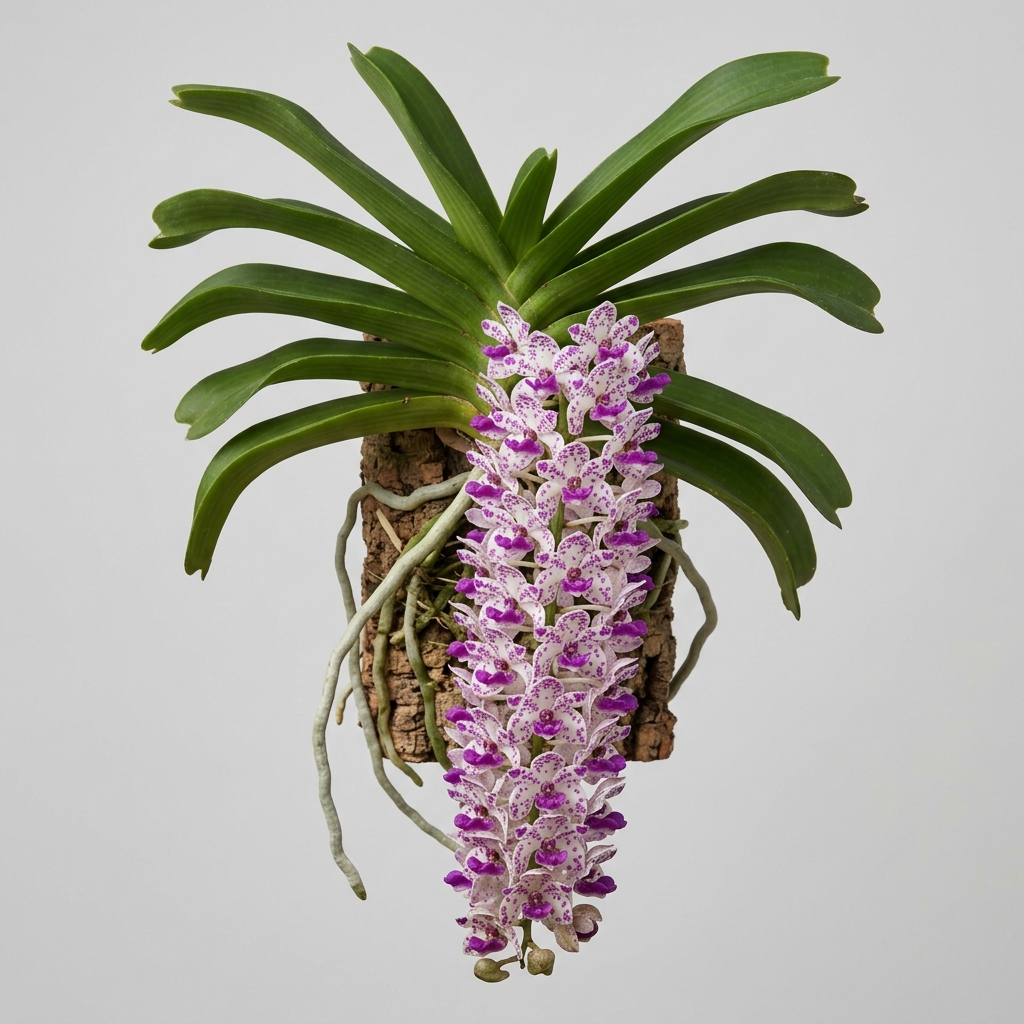
Rhynchostylis gigantea, commonly known as the foxtail orchid, is a highly prized vandaceous species native to Southeast Asia. Renowned for its spectacular, densely packed, pendulous flower spikes that resemble a fluffy fox’s tail, this orchid is a favorite among collectors for both its visual drama and its intense, sweet fragrance. Its robust growth habit features thick, leathery, strap-like leaves that grow in a compact, fan-shaped arrangement, making it an architectural marvel even when not in bloom.
Cultivating this species requires a shift from standard terrestrial or epiphytic potting techniques, as it thrives best with its thick, fleshy aerial roots exposed to open air. While it demands high humidity and consistent warmth, its resilience and breathtaking winter blooms make it an exceptionally rewarding addition to any tropical orchid collection. Growers who master its moisture and airflow requirements are treated to an annual display of long-lasting, fragrant blossoms that can perfume an entire greenhouse or living space.
💡 Did You Know?
The common name foxtail orchid perfectly describes the dense, cylindrical shape of the flower spikes, which can hold up to fifty individual blossoms on a single stem. In its native Southeast Asian habitats, these fragrant blooms are so robust they can withstand heavy tropical downpours, filling the humid forest canopy with an intense citrus-like perfume that carries for long distances.
🌿 Botanical Overview
Rhynchostylis gigantea is an epiphytic monopodial orchid, meaning it grows upward from a single stem rather than producing pseudobulbs. In its native habitats across China, India, and Southeast Asia, it clings to the trunks and branches of trees in deciduous forests, where it is exposed to distinct wet and dry seasons. The plant features thick, channeled, distichous leaves that are deeply V-shaped in cross-section, helping direct rainwater down toward the main stem and root system.
The root system of this species is particularly robust, characterized by thick, fleshy aerial roots covered in a heavy layer of velamen. This velamen acts like a sponge, rapidly absorbing moisture and nutrients from the air and rain before drying out quickly to prevent suffocation. Because of this specialized morphology, the plant is highly sensitive to stagnant moisture around its root zone, making traditional potting methods unsuitable.
🌸 Flower Characteristics
The defining feature of Rhynchostylis gigantea is its spectacular, arching to pendulous inflorescence, which can reach up to 15 inches in length. Each spike can carry dozens of closely packed, waxy flowers, creating a dense, cylindrical cluster that resembles a brush or tail. The individual blossoms are typically about one inch in diameter, featuring broad, rounded sepals and petals that frame a prominent, forward-pointing lip or labellum.
While the classic wild form displays white petals and sepals heavily speckled with amethyst-purple spots and a solid purple lip, horticultural selection has produced several distinct color forms. These include the pure white “alba” form, the deep solid red “rubra” or “illustre” form, and the warm, orange-toned “peach” or “orange” variations. The flowers are long-lasting, often remaining pristine for two to four weeks under optimal conditions.
Fragrance & Bloom Profile
The fragrance of Rhynchostylis gigantea is legendary among orchid enthusiasts. It produces an intense, sweet, and spicy perfume with distinct citrus notes that can easily fill a large room or greenhouse, especially during the morning and early afternoon when temperatures rise. This powerful scent is evolved to attract specific pollinators in its native canopy habitats.
The blooming cycle typically occurs once a year, peaking during the cool winter months or early spring. The initiation of flower spikes is highly dependent on seasonal temperature drops and a slight reduction in watering, mimicking the natural transition to the dry season in its native range.
Parentage & Hybrid Lineage
As a distinct species rather than a man-made hybrid, Rhynchostylis gigantea represents a primary genetic building block in vandaceous breeding. It has been extensively crossed with other genera within the Vanda alliance to introduce its compact growth habit, dense flower count, and exceptional fragrance.
Common intergeneric hybrids involving this species include Rhynchovanda (crossed with Vanda) and Vandachostylis (crossed with Vandachostylis parents). While many distinct color selections and cultivars exist within the species itself, their exact breeding histories and individual award records are often complex and not consistently documented in common grower references.
🌱 Growing Conditions
To cultivate Rhynchostylis gigantea successfully, growers must replicate its warm, humid, and airy native canopy environment. It thrives in bright, filtered light, similar to the conditions preferred by cattleya orchids. Direct midday sunlight should be avoided as it can easily scorch the thick leaves, but insufficient light will result in weak growth and a failure to initiate flower spikes.
💡 Care Tip
Hang your wooden basket in a location with strong, continuous air movement. This orchid thrives on rapid wet-dry cycles, and active airflow is essential to dry the thick aerial roots quickly after , preventing fungal rot.
Temperature control is critical for this tropical species. It prefers warm daytime temperatures between 75°F and 85°F, with a nighttime drop to around 65°F. High relative humidity of 60% to 80% is essential, especially when grown bare-root. Strong, continuous air movement is equally vital to prevent fungal pathogens from settling on the damp foliage and roots.
Watering, Feeding & Potting Media
Watering practices must align with the plant’s bare-root nature. When grown in open wooden baskets or mounted on cork, the orchid should be watered thoroughly—often daily during the hot summer months—by soaking or heavily misting the roots until they turn a vibrant green. In winter, watering should be reduced, allowing the plant to dry out completely between light mistings.
Feeding should be done weekly using a balanced, water-soluble orchid fertilizer diluted to quarter or half strength. It is best to apply fertilizer only after the roots have been thoroughly pre-moistened to prevent chemical burn. Because the plant has no pseudobulbs to store water or nutrients, consistent but light feeding during the active growing season is key to building the energy required for winter blooming.
Blooming Season & Care Notes
The blooming process begins in late autumn as tiny green nubs emerge from the leaf axils. During this development phase, it is crucial to maintain stable environmental conditions. Sudden drops in humidity, cold drafts, or moving the plant frequently can cause the developing buds to yellow and drop, a phenomenon known as bud blast.
Once the flowers fade, the remaining spike should be cut back close to the stem using sterilized shears. Repotting or basket maintenance is rarely needed and should only be performed when the wooden basket decays or the plant completely outgrows its mount. This is best done in late spring when active new root tips are emerging, allowing the plant to establish quickly.
⚠️ Common Issues
⚠️ Common Mistake
Avoid planting this species in standard potting soil or fine orchid bark mixes. Suffocating the thick aerial roots in dense media is the most common cause of root rot and rapid plant decline for beginners.
- Root Rot:
Caused by planting in dense, moisture-retaining media or lack of adequate airflow around the root zone. - Bud Blast:
The premature drying and dropping of flower buds, usually triggered by sudden drafts, dry air, or moving the plant during spike development. - Leaf Spotting: Fungal or bacterial spots can develop on the leaves if water is allowed to sit in the crown or leaf axils overnight without sufficient air movement.
- Spider Mites and Mealybugs: These pests can hide in the tight crevices of the strap-like leaves, sucking plant sap and weakening the orchid.
- Dehydration:
Indicated by shriveled, leathery leaves and dry, silvery roots, often due to insufficient humidity or infrequent watering.
❓ Frequently Asked Questions
How do I encourage my Rhynchostylis gigantea to bloom?
To stimulate blooming, ensure the orchid receives bright, filtered light throughout the summer and experiences a natural night-time temperature drop of 10 to 15 degrees Fahrenheit in the autumn. A slight reduction in watering during the late fall also mimics its natural dry season, prompting the initiation of flower spikes.
Can I grow this orchid in a traditional plastic pot with bark?
Growing this species in a traditional plastic pot is highly discouraged. Its thick, aerial roots require rapid wet-dry cycles and constant airflow. Growing it bare-root in a wooden slat basket, mounted on cork, or in a very coarse, open basket with large charcoal chunks is much safer and more successful.
Why are the leaves on my orchid turning yellow and dropping?
Yellowing leaves can indicate several issues. If older, bottom leaves yellow and drop slowly over time, it is likely natural aging. However, rapid yellowing of multiple leaves often points to overwatering, crown rot from standing water, or severe underwatering and low humidity.
How often should I water my bare-root Rhynchostylis gigantea?
In warm weather and high light, bare-root plants should be watered daily, sometimes twice a day if humidity is low. The roots should be thoroughly soaked until they turn dark green, then allowed to dry completely within a few hours. Reduce this frequency to every few days during the cooler winter rest period.
⭐ Final Growing Notes
While Rhynchostylis gigantea demands more attention to humidity and watering than common windowsill orchids, its unparalleled fragrance and spectacular winter blooms make it a crowning achievement for any dedicated grower. By providing bright light, warm temperatures, and allowing its magnificent aerial roots to breathe freely in a basket or mount, you will be rewarded with a lifetime of stunning, highly fragrant holiday displays.
🌱 Propagation Tip
This monopodial orchid does not produce pseudobulbs, so division is not possible. Propagation is typically achieved by carefully removing basal offsets, known as keikis, once they have developed several strong, active roots of their own.
⭐ Expert Advice
To prevent water from trapping in the crown and causing devastating crown rot, mount the orchid at a slight downward angle or hang the basket so the plant naturally tilts, allowing excess water to drain away freely.


Leave A Comment