
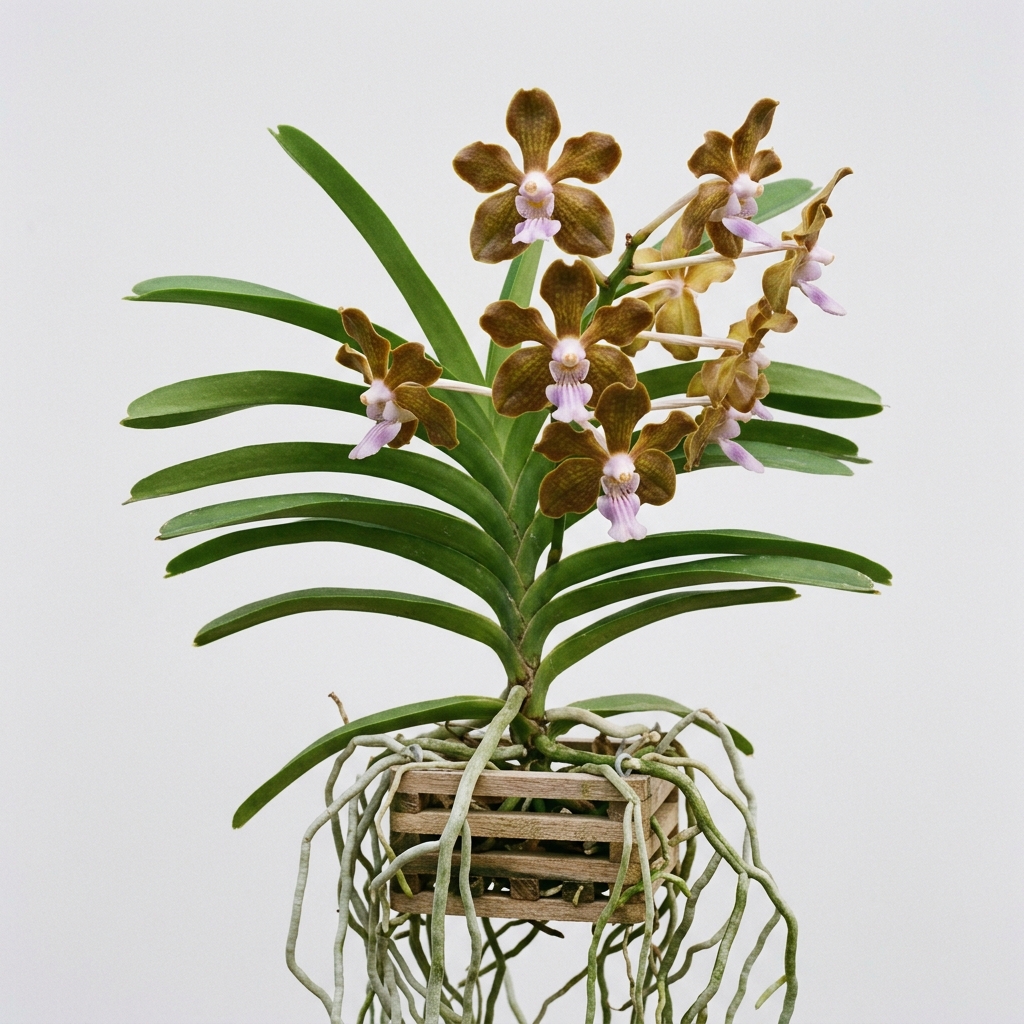
Vanda Brunnea is a highly prized orchid species within the Vanda genus, celebrated by collectors for its distinctive color palette and captivating fragrance. Native to the montane forests of Southeast Asia, this epiphytic orchid stands out in any collection due to its unusual, earthy-toned blossoms. Unlike the bright blues and pinks commonly associated with hybrid Vandas, this species offers a sophisticated display of warm, bronze, and chocolate hues that bring a natural, forest-like elegance to the growing space.
As a monopodial grower, Vanda Brunnea develops a strong, upright stem clothed in leathery, strap-like leaves. Its most dramatic feature is its extensive system of thick, silvery aerial roots that cascade far below the plant. These roots are highly adapted to absorbing moisture and nutrients directly from the air, making the plant exceptionally well-suited for basket culture. For growers who can provide the warm temperatures and high humidity it craves, this orchid rewards patience with long-lasting, fragrant blooms.
💡 Did You Know?
Vanda Brunnea is native to the montane forests of Southeast Asia, where it grows epiphytically on tree trunks. Its unique brown coloration is relatively rare among wild Vanda species, making it a highly prized parent in modern orchid hybridization programs seeking to introduce warm, earthy tones and rich fragrances.
🌿 Botanical Overview
Vanda Brunnea is a naturally occurring epiphytic species native to the tropical and subtropical forests of Southeast Asia, including parts of China, Myanmar, Thailand, and Vietnam. In its native habitat, it clings to the bark of tall trees in open forests, where it is exposed to dappled sunlight, heavy seasonal rains, and constant air movement. This evolutionary background dictates its growth requirements in cultivation, particularly its need for rapid wet-and-dry cycles.
The plant shows a monopodial growth habit, meaning it grows upward from a single stem. The leaves are thick, leathery, and arranged in a neat, alternating V-shape along the stem. This leaf structure helps the plant channel rainwater down toward the main stem and root zone. The root system is exceptionally robust, featuring thick, spongy velamen that acts like a sponge to quickly absorb moisture and atmospheric nutrients during brief rain showers.
🌸 Flower Characteristics
The blossoms of Vanda Brunnea are highly distinctive and prized for their unusual coloration. The petals and sepals are typically a rich, glossy bronze, olive-brown, or yellowish-brown, often featuring subtle tessellations or darker veins that add depth to their appearance. Individual flowers generally measure between 3 to 5 centimeters in diameter, presenting a compact yet visually striking display.
Contrasting beautifully with the dark, earthy tones of the petals is the prominent lip, or labellum. The lip is typically much lighter, ranging from cream and pale yellow to soft shades of purple or lavender, often with a small spur at the back. The flowers are produced on axillary inflorescences that emerge from between the leaf joints, with each spike carrying several well-spaced, elegantly presented blooms.
Fragrance & Bloom Profile
One of the most compelling reasons to grow Vanda Brunnea is its intense and delightful fragrance. The flowers emit a strong, sweet, and slightly spicy aroma that is most pronounced during the warm, bright hours of the morning and early afternoon. This scent is often compared to a blend of honey and exotic spices, filling the surrounding growing area with a pleasant, natural perfume.
The blooming cycle typically occurs in the spring or early summer, though healthy plants in optimal conditions may occasionally bloom at other times of the year. The individual flowers are remarkably long-lasting, often remaining fresh and fragrant on the plant for four to six weeks. To maximize the lifespan of the blooms, growers should avoid getting the flower petals wet during routine watering.
Parentage & Hybrid Lineage
Unlike many of the complex, man-made Vanda hybrids found in garden centers, Vanda Brunnea is a distinct, naturally occurring species. Because of this, its lineage is not a product of laboratory hybridization but rather thousands of years of natural evolution in the wild. This genetic purity makes it highly valued by species purists and conservation-minded collectors.
However, plant breeders have frequently utilized Vanda Brunnea in hybridization programs. Its robust growth habit, unique brown coloration, and powerful fragrance make it an excellent parent plant. When crossed with other Vanda species or hybrids, it often passes down its warm, earthy tones and rich scent, contributing to the diversity of modern Vanda grexes available today.
🌱 Growing Conditions
To successfully cultivate Vanda Brunnea, growers must replicate its native tropical forest environment. Light is a critical factor; this orchid requires bright, filtered light to thrive and bloom. While it can tolerate some direct morning sun, harsh afternoon sunlight can scorch the leaves. A location with bright, indirect light, such as a shade house or a south-facing window with a sheer curtain, is ideal.
💡 Care Tip
To maintain the high Vanda Brunnea craves without risking rot, mount the plant in a wooden slat basket and mist the roots daily, ensuring they dry completely by nightfall.
Temperature: wise, Vanda Brunnea prefers warm to intermediate conditions. Daytime temperatures should ideally range between 75°F and 85°F, with a slight drop at night to around 65°F. High humidity is also essential, ideally maintained between 60% and 80%. Excellent air circulation is mandatory to prevent stagnant moisture from lingering on the leaves and roots, which can quickly lead to fungal infections.
Watering, Feeding & Potting Media
Watering Vanda Brunnea requires a different approach than typical potted orchids. Because it is best grown bare-root in wooden slat baskets or mounted on cork, its roots dry out very quickly. During the active growing season in spring and summer, the plant should be watered daily. This can be achieved by thoroughly misting the roots until they turn from a silvery-white to a vibrant green, or by soaking the entire root system in a bucket of water for 15 to 20 minutes.
Feeding should be done regularly but weakly. A balanced, water-soluble orchid fertilizer diluted to quarter or half strength can be applied weekly during the growing season. It is best to water the plant thoroughly before applying fertilizer to prevent burning the dry roots. In the winter, when growth slows down, reduce watering frequency and limit fertilizer applications to once a month.
Blooming Season & Care Notes
As the blooming season approaches in spring, growers should monitor the leaf axils for the emergence of new flower spikes. During this time, maintaining consistent humidity and avoiding sudden temperature fluctuations is crucial to prevent bud drop. Once the flower spike begins to develop, avoid moving or rotating the plant, as this can cause the developing buds to twist or fail to open properly.
After the blooming cycle is complete, allow the flower spike to dry out naturally before cutting it back close to the stem using sterilized shears. Repotting or transferring the plant to a larger basket is rarely necessary and should only be done when the existing basket begins to decay. Vandas dislike root disturbance, so any repotting should be done with extreme care to avoid breaking the thick, active roots.
⚠️ Common Issues
⚠️ Common Mistake
The most common mistake is potting Vanda Brunnea in standard, dense potting soil or fine bark, which suffocates the thick aerial roots and rapidly leads to fatal root rot.
- Root Rot:
Occurs when the roots remain wet for too long, usually due to dense potting media or poor air circulation. - Dehydration:
Indicated by shriveled, leathery leaves and dry, brittle roots that fail to turn green when watered. - Bud Blast:
The premature drying and dropping of flower buds, often caused by low humidity, drafty conditions, or sudden temperature drops. - Pests:
Mealybugs, scale, and spider mites can occasionally infest the leaf joints and should be treated promptly with insecticidal soap or neem oil. - Leaf Spotting: Fungal or bacterial spots can develop on the leaves if water is allowed to sit on the foliage overnight without adequate airflow.
❓ Frequently Asked Questions
How often should I water Vanda Brunnea?
If grown bare-root in a wooden basket, Vanda Brunnea should be watered daily during the warm spring and summer months. Mist or soak the roots until they turn completely green. In the winter, you can reduce watering to every two to three days, depending on your indoor humidity levels.
Can Vanda Brunnea be grown indoors?
Yes, but it requires careful attention to humidity and light. Grow it near a bright south- or east-facing window and use a humidifier or humidity tray to keep the air moist. Regular misting of the aerial roots is essential to prevent dehydration in dry indoor environments.
Why are the leaves on my orchid turning yellow?
Yellowing leaves can indicate several issues. If the lower leaves are shedding naturally as the plant grows taller, this is normal. However, widespread yellowing can be a sign of overwatering, root rot, or excessive direct sunlight scorching the foliage.
Does Vanda Brunnea need a potting mix?
No, Vanda Brunnea does not require traditional potting soil or fine bark. In fact, planting it in dense media will likely cause root rot. It performs best when grown bare-root in a slatted wooden basket or mounted on a piece of cork bark, allowing the roots to hang freely in the air.
⭐ Final Growing Notes
Vanda Brunnea is a rewarding and exotic addition to any orchid collection, offering a unique departure from more common hybrid varieties. While its requirement for high humidity and daily watering can be demanding, its stunning bronze-colored flowers and rich, spicy fragrance make the effort entirely worthwhile. By providing bright light, excellent air movement, and allowing its magnificent aerial roots to breathe, you can enjoy the natural beauty of this Southeast Asian species for many years to come.
⚕️ Health, Safety & Edibility
Understanding how a plant interacts with people, pets, and the surrounding environment is part of responsible cultivation. This section uses conservative, general guidance and does not replace professional medical or veterinary advice.
Human Safety: No published evidence currently identifies species-specific toxicity concerns for Vanda Brunnea during normal handling. As with most ornamental plants, it should not be intentionally consumed.
Pet Safety: Published information does not indicate that this orchid commonly poses a toxicity concern for cats or dogs. However, chewing leaves, flowers, roots, or potting media may still cause mild digestive upset.
Edibility: This orchid is cultivated for ornamental display rather than food. Ornamental plants may carry fertilizers, pesticides, or other horticultural treatments that make them unsuitable for consumption.
Skin Contact: Routine handling is not generally associated with skin irritation. Gardeners with sensitive skin may prefer wearing gloves when repotting, pruning, or handling potting media.
🌱 Propagation Tip
Vanda Brunnea is most safely propagated by detaching a top cutting or 'keiki' (baby plant) only after it has developed at least three robust aerial roots of its own.
⭐ Expert Advice
If your Vanda Brunnea fails to bloom, gradually increase its exposure to bright, filtered . These orchids are high- lovers and often require near-maximum tolerable levels to trigger flower spikes.

Leave A Comment