
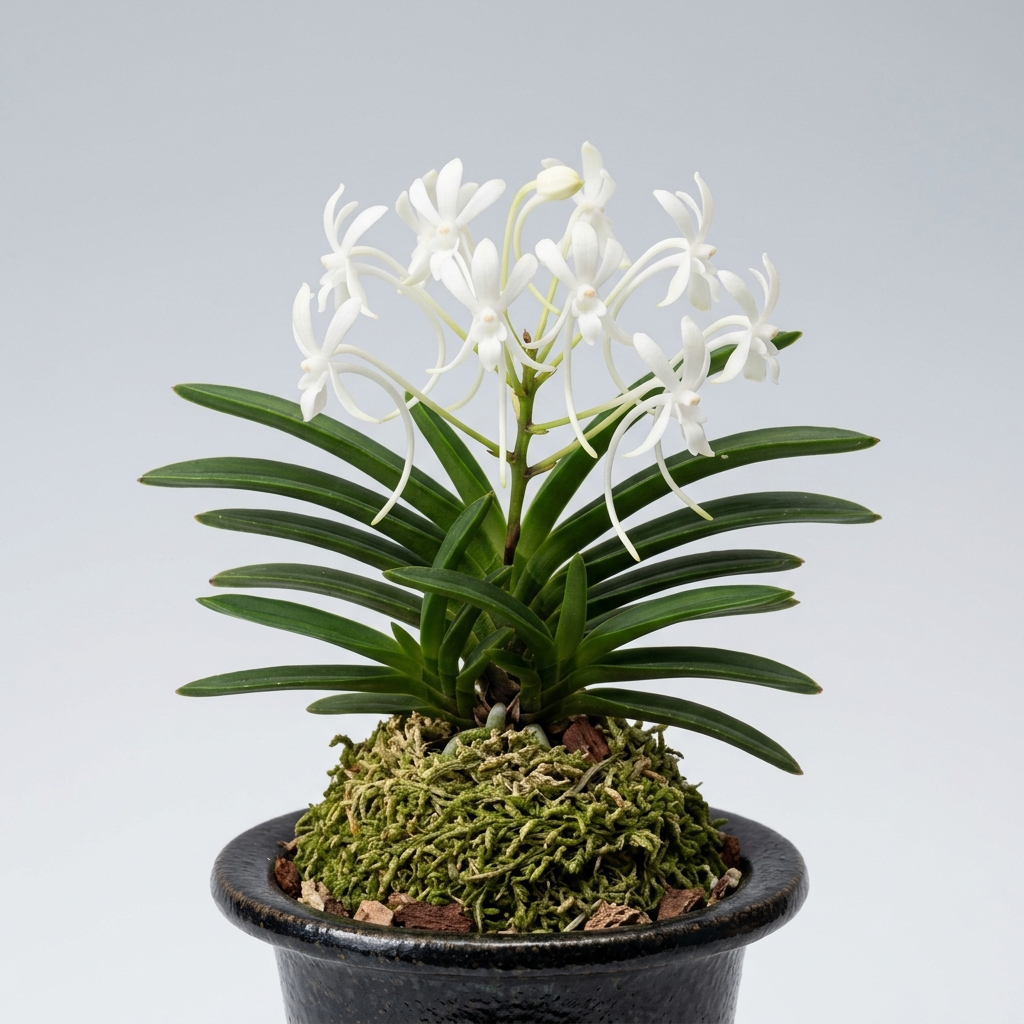
Vanda Falcata, historically known as the Wind Orchid or Fuuran, is a highly revered miniature epiphytic orchid native to the mountainous regions of Japan, Korea, and southern China. Celebrated for centuries for its elegant, fan-shaped growth habit and delicate spurred flowers, this species occupies a legendary status in traditional Asian horticulture. Modern growers cherish it not only for its historical significance but also for its compact size, making it an ideal candidate for windowsill or indoor grow-light setups.
Unlike many larger, more demanding vandaceous orchids, this miniature species adapts beautifully to home cultivation when its basic needs for airflow and humidity are met. Its pristine white blossoms emit a captivating, sweet fragrance that intensifies after dusk, filling the growing space with a delightful perfume. Whether grown in the traditional Japanese mounded style or mounted on cork bark, it remains a centerpiece of any sophisticated orchid collection.
💡 Did You Know?
In traditional Japanese culture, Vanda Falcata was highly revered by samurai warriors, who would carry these miniature orchids into battle or display them in custom-made ceramic pots as symbols of nobility, wealth, and spiritual focus. It is one of the few orchids historically grown for its foliage and growth form as much as its flowers.
🌿 Botanical Overview
Vanda Falcata is a monopodial epiphyte, meaning it grows upward from a single stem rather than producing pseudobulbs. In its native habitats across East Asia, it typically grows on deciduous trees or rocky cliffs, where it is exposed to excellent air circulation and seasonal temperature fluctuations. The plant features thick, leathery, V-shaped leaves arranged in a neat, fan-like pattern that helps it conserve moisture in windswept environments.
For generations, this species was classified under its own monotypic genus as Neofinetia falcata. Recent DNA sequencing and taxonomic revisions have integrated it into the broader Vanda genus. Despite this botanical reclassification, many traditional growers and specialized societies still refer to it by its historical name, particularly when discussing the highly curated Japanese cultivars known as Fuukiran, which are judged on leaf variegation, root tip color, and flower form.
🌸 Flower Characteristics
The flowers of Vanda Falcata are a marvel of delicate symmetry. Typically measuring about one inch across, the blossoms are pristine white, though rare and highly sought-after cultivars may display hues of pink, yellow, or green. The most defining feature of the flower is its long, slender nectar spur that curves downward and backward from the base of the lip, giving the bloom an airy, bird-like appearance as it dances on the spike.
Each inflorescence produces a loose cluster of three to ten flowers, held slightly above or nestled within the fan of foliage. The sepals and petals are narrow and reflexed, drawing immediate attention to the prominent three-lobed lip. The overall presentation is exceptionally graceful, with the pure white blossoms contrasting beautifully against the deep green of the leathery leaves.
Fragrance & Bloom Profile
One of the primary reasons growers fall in love with this orchid is its intoxicating fragrance. The scent is highly complex, often described as a sweet blend of vanilla, coconut, and jasmine. This fragrance is nocturnal, meaning it becomes significantly stronger as dusk approaches and peaks during the night hours, a biological adaptation designed to attract night-flying moth pollinators in the wild.
The blooming cycle typically occurs in late spring or early summer, with individual flowers remaining fresh and fragrant for three to five weeks under optimal conditions. Cooler temperatures and moderate humidity can help prolong the life of the blooms, allowing growers to enjoy the sweet evening perfume for more than a month.
Parentage & Hybrid Lineage
As a true species, Vanda Falcata does not have parentage in the hybrid sense. However, its exceptional traits—namely its compact size, cold tolerance, and intense fragrance—have made it an incredibly popular parent in hybridizing programs. It has been crossed extensively with larger Vandaceous species to introduce miniature growth habits and cooler temperature tolerances to modern hybrids.
Common intergeneric hybrids involving this species include Neostylis and Ascofinetia, though taxonomists now classify many of these under the genus Vanda. When purchasing hybrids, growers should note that while they often retain the charming spurred flower shape, the exact fragrance profile and ease of culture can vary depending on the other parent species involved.
🌱 Growing Conditions
Replicating the natural cliffside environment of Vanda Falcata is the key to successful cultivation. It thrives in bright, filtered indirect light, similar to the conditions preferred by Cattleya orchids. While it can tolerate some direct morning sun, harsh midday light will scorch the leaves. High-quality LED grow lights are highly effective for indoor growers who lack bright window exposures.
💡 Care Tip
Provide exceptional air movement around the root zone at all times. If you are growing in the traditional mounded sphagnum moss style, ensure the center of the mound is hollow to allow the roots to breathe and dry efficiently, preventing root rot.
Temperature management is crucial for this species. It prefers intermediate to warm temperatures during its active growing season in spring and summer, ranging from 70 to 85 degrees Fahrenheit. In the winter, it benefits from a distinct cool rest period, with night temperatures dropping into the 50s. This seasonal temperature drop is essential for triggering the next season’s flower spikes. Excellent air movement must be maintained at all times to prevent stagnant air from causing fungal issues.
Watering, Feeding & Potting Media
Watering practices should align with the orchid’s seasonal growth cycle. During the warm spring and summer months, the plant should be watered thoroughly and allowed to dry out slightly, but not completely, between waterings. In the winter rest period, watering should be reduced significantly, providing just enough moisture to prevent the leaves from shriveling.
Traditional Japanese cultivation utilizes long-fibered sphagnum moss wrapped around a hollow clay frame, creating a neat mound that sits above the pot rim. This method provides excellent aeration to the roots while retaining adequate moisture. Alternatively, growers can use a coarse, free-draining bark mix in plastic or clay pots, or mount the orchid directly onto cork bark or tree fern plaques. Feed the plant with a highly diluted, balanced orchid fertilizer every two to three waterings during the active growing season, flushing with pure water occasionally to prevent salt buildup.
Blooming Season & Care Notes
The primary blooming window opens in late spring and extends through the summer. Once the flower spikes begin to emerge from the leaf axils, avoid changing the plant’s orientation to the light source, as this can cause the developing buds to twist or blast. Keep water off the developing buds and open flowers to prevent spotting and premature decay.
After the blossoms have faded, the flower spikes will naturally dry up and turn brown. They can be snipped off close to the stem using sterilized shears. Repotting is best performed in the spring, just as the orchid enters its active growth phase and new, green root tips begin to emerge. This timing allows the roots to quickly establish in the fresh media with minimal transplant shock.
⚠️ Common Issues
⚠️ Common Mistake
Avoid overwatering during the winter rest period. While this orchid requires consistent moisture during its active summer growth, excessive dampness combined with cold winter temperatures is a common mistake that quickly leads to root rot and crown decay.
- Crown Rot: Caused by water sitting in the center of the leaf fan, especially in cool temperatures or poor airflow. Always water early in the day and use a fan to dry the foliage.
- Root Loss: Occurs when the potting medium becomes compacted, sour, or stays wet for too long, suffocating the roots. Repot annually if using sphagnum moss.
- Bud Blast: The sudden yellowing and dropping of flower buds before they open, usually triggered by rapid changes in temperature, low humidity, or drafty conditions.
- Pests: Scale and spider mites can occasionally hide in the tight crevices of the leaf fans. Treat promptly with insecticidal soap or horticultural oil.
❓ Frequently Asked Questions
How do I encourage my Vanda Falcata to bloom?
To trigger blooming, ensure the orchid receives bright indirect light and a distinct cool rest period during the winter. Dropping night temperatures to around 50 to 55 degrees Fahrenheit for several weeks in winter, combined with reduced watering, is highly effective at stimulating spring flower spikes.
Can I grow Vanda Falcata in a regular plastic pot with soil?
No, Vanda Falcata is an epiphytic orchid and will quickly suffocate and die if planted in standard potting soil. It requires an extremely airy medium such as long-fibered sphagnum moss, coarse orchid bark, or to be mounted directly on wood plaque where its roots can breathe.
Why are the leaf tips of my orchid turning brown?
Brown leaf tips are typically a sign of low humidity, underwatering, or fertilizer burn from mineral buildup in the media. Ensure your humidity levels remain above 50 percent, and flush the potting media with pure, distilled water regularly to wash away excess salts.
Does Vanda Falcata need a cold period in winter?
While it does not require freezing temperatures, a cooler winter rest with night temperatures dropping into the 50s is highly beneficial. This mimicry of its native seasonal cycle helps mature the growth and is the primary trigger for successful bud development in the spring.
⭐ Final Growing Notes
Vanda Falcata is a captivating orchid that rewards attentive growers with its elegant form, historical charm, and unforgettable evening fragrance. By providing bright indirect light, excellent air circulation, and respecting its natural seasonal rhythm of warm, wet summers and cool, dry winters, you can enjoy this miniature treasure for many years. It stands as a testament to the enduring beauty of wild orchid species in the modern home.
⚕️ Health, Safety & Edibility
Understanding how a plant interacts with people, pets, and the surrounding environment is part of responsible cultivation. This section uses conservative, general guidance and does not replace professional medical or veterinary advice.
Human Safety: No published evidence currently identifies species-specific toxicity concerns for Vanda Falcata during normal handling. As with most ornamental plants, it should not be intentionally consumed.
Pet Safety: Published information does not indicate that this orchid commonly poses a toxicity concern for cats or dogs. However, chewing leaves, flowers, roots, or potting media may still cause mild digestive upset.
Edibility: This orchid is cultivated for ornamental display rather than food. Ornamental plants may carry fertilizers, pesticides, or other horticultural treatments that make them unsuitable for consumption.
Skin Contact: Routine handling is not generally associated with skin irritation. Gardeners with sensitive skin may prefer wearing gloves when repotting, pruning, or handling potting media.
🌱 Propagation Tip
Propagation is most reliably achieved by carefully separating major basal offsets, or keikis, from the parent plant. Only attempt this division once the offset has developed several active roots of its own that are at least two inches long to ensure survival.
⭐ Expert Advice
To stimulate a heavy flush of summer blooms, expose the orchid to cooler night temperatures (around 50 to 55 degrees Fahrenheit) during the late winter and early spring, accompanied by a slight reduction in .

Leave A Comment