
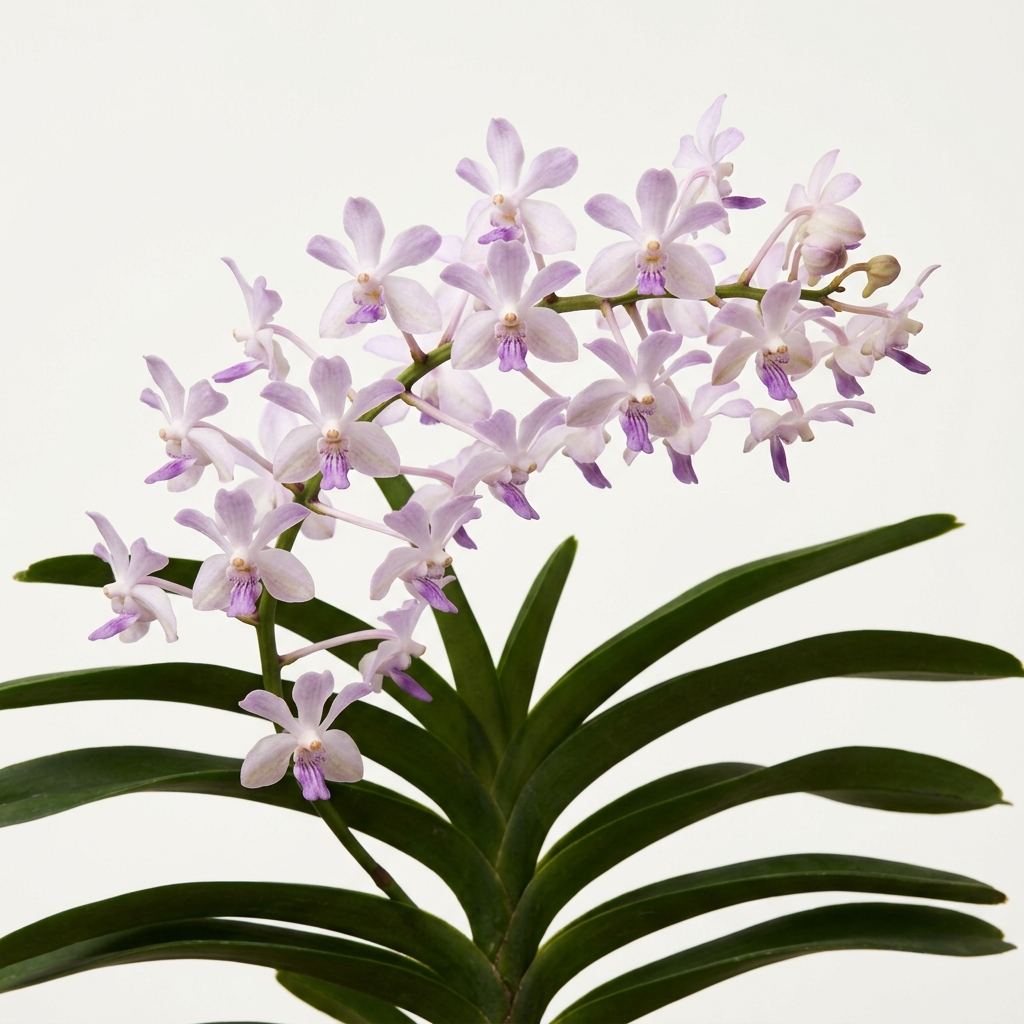
Vanda Lilacina is a highly prized monopodial epiphytic orchid species celebrated for its delicate, pastel-toned blooms and elegant growth habit. Native to the seasonal forests of Southeast Asia, this miniature to medium-sized Vanda brings a refined charm to orchid collections, standing out from its larger, more flamboyantly colored relatives. Growers value the plant for its manageable size, graceful presentation, and the relative ease with which it adapts to indoor or greenhouse cultivation when its basic environmental needs are met.
Unlike the massive strap-leaved Vanda hybrids that dominate the commercial market, Vanda Lilacina offers a more understated botanical aesthetic. Its upright, fan-like foliage produces arching inflorescences packed with numerous small, intricately detailed flowers. This species is particularly favored by intermediate and advanced hobbyists who appreciate wild orchid species that showcase the natural diversity of the Orchidaceae family without requiring excessive growing space.
💡 Did You Know?
Vanda Lilacina belongs to the Vanda orchid group, where flower presentation is often just as important as . White-flowered cultivars are especially valued indoors because their pale blooms reflect well and pair easily with many home, greenhouse, and display settings.
🌿 Botanical Overview
Vanda Lilacina is a classic monopodial orchid, meaning it grows upward from a single vegetative stem rather than spreading via pseudobulbs. In its natural habitat, it grows as an epiphyte clinging to the bark of trees in deciduous and semi-deciduous forests, where it is exposed to distinct wet and dry seasonal cycles. The plant features thick, leathery, strap-shaped leaves arranged in a neat, alternating fan pattern that channels water down toward the stem and root system.
The root system of this species is robust and highly adapted to absorbing moisture and nutrients directly from the air. These thick, aerial roots are covered in velamen, a spongy layer of dead cells that rapidly absorbs water and protects the inner vascular core from dehydration and intense sunlight. Because of this specialized anatomy, the plant relies heavily on excellent atmospheric circulation to prevent root rot and maintain physiological health.
🌸 Flower Characteristics
The blossoms of Vanda Lilacina are relatively small but highly numerous, often measuring between one to one and a half inches in diameter. They are borne on axillary, sub-erect inflorescences that emerge from between the leaf axils, with each spike carrying multiple flowers. The petals and sepals are typically a soft, translucent white or pale lilac, providing a clean background that highlights the more intensely colored labellum.
The lip, or labellum, is the defining feature of the flower, showcasing intricate markings of deep violet, magenta, or purple. This contrasting coloration serves as a visual guide for natural pollinators in the wild. The flowers are arranged symmetrically along the spike, creating a balanced, airy display that persists for several weeks under optimal environmental conditions.
Fragrance & Bloom Profile
The fragrance of Vanda Lilacina is generally described as delicate, sweet, and slightly citrusy, though the intensity can vary significantly depending on the individual specimen and environmental factors. The scent is typically most pronounced during the morning hours when warmth and light stimulate the release of volatile compounds. Some growers report a very faint aroma, while others enjoy a distinct, pleasant perfume that fills a small growing area.
The blooms are long-lasting, often remaining fresh on the plant for three to six weeks. To maximize the duration of the bloom cycle, growers should avoid getting water directly on the open petals, as excess moisture can encourage fungal spotting or premature flower drop. Maintaining stable temperatures and avoiding sudden drafts will also help preserve the integrity of the delicate blossoms.
Parentage & Hybrid Lineage
Vanda Lilacina is a distinct, naturally occurring species rather than a man-made hybrid. In botanical literature, it is recognized under the valid species name Vanda Lilacina. While it is not a complex cultivar, it has been used occasionally in breeding programs to introduce its compact growth habit, floriferous nature, and delicate pastel coloration into new Vanda hybrids.
Because it is a wild species, its genetic traits are relatively stable compared to complex multi-generic hybrids. When purchasing this orchid, growers should look for reputable nurseries that propagate plants from seed or tissue culture rather than wild-collected specimens, ensuring both the conservation of wild populations and the health of the cultivated plant.
🌱 Growing Conditions
To cultivate Vanda Lilacina successfully, growers must replicate the bright, warm, and humid conditions of its native Southeast Asian habitats. It thrives in bright, filtered light, requiring more light than Phalaenopsis but slightly less than the intense, direct sun tolerated by larger Vanda hybrids. A location near an east- or shaded south-facing window, or under high-quality LED grow lights, is generally ideal.
💡 Care Tip
For best results, grow Vanda Lilacina in bright filtered with steady and gentle airflow. Avoid placing the plant in harsh midday sun, but do not keep it in a dark corner; weak is one of the most common reasons cultivated orchids refuse to rebloom.
Temperature ranges should be kept warm to intermediate, ideally between 70°F and 85°F during the day, with a slight drop of 10°F to 15°F at night to stimulate healthy growth and eventual blooming. High humidity is crucial, ideally maintained between 60% and 80%. Excellent air movement is equally vital; stagnant air combined with high humidity is a primary cause of bacterial and fungal infections in monopodial orchids.
Watering, Feeding & Potting Media
Watering practices for Vanda Lilacina depend heavily on how the plant is housed. If grown bare-root in a wooden slat basket—the preferred method for most Vandas—the roots must be watered thoroughly, often daily or even twice a day during hot summer months. The roots should be sprayed or soaked until they turn a vibrant green, indicating complete hydration, and then allowed to dry rapidly.
If grown in a pot, a highly porous, chunky medium such as large-grade fir bark, charcoal, or volcanic rock must be used to ensure rapid drainage and maximum aeration around the roots. Fertilization should be carried out weekly using a balanced, water-soluble orchid fertilizer diluted to one-quarter or one-half strength. This “weakly, weekly” feeding regimen supports the continuous growth of the monopodial stem and the development of strong aerial roots.
Blooming Season & Care Notes
Vanda Lilacina typically initiates its blooming cycle in the late winter to early spring, though occasional off-season blooms can occur under optimal greenhouse conditions. The development of the flower spike can take several weeks, during which time environmental stability is critical. Growers should avoid moving the plant or changing its orientation relative to the light source while the spike is forming, as this can cause the buds to twist or fail to open.
Once the blooming cycle is complete, the old flower spike should be cut back close to the main stem using sterilized cutting tools. Repotting or basket maintenance is best performed in the spring, just as active root growth resumes. This minimizes transplant shock and allows the thick, active root tips to quickly adapt to their new support structure.
⚠️ Common Issues
⚠️ Common Mistake
The most common mistake is by calendar instead of root and potting-media condition. Vanda roots need moisture and air at the same time, so constantly wet bark or sphagnum can lead to root loss even when the leaves still look healthy.
- Root Rot:
Occurs when the roots remain wet for extended periods without adequate airflow, leading to mushy, black roots and systemic decline. - Dehydration:
Indicated by shriveled, leathery leaves and dry, silvery roots that fail to turn green when watered. - Bud Blast:
The premature yellowing and dropping of flower buds, usually caused by sudden temperature drops, low humidity, or drafts. - Pests:
Mealybugs, scale, and spider mites can infest the tight crevices between the strap-like leaves; treat promptly with insecticidal soap or horticultural oil. - Leaf Spotting: Fungal or bacterial spots can develop on the foliage if water is allowed to sit in the crown or leaf axils overnight.
❓ Frequently Asked Questions
How often should I water Vanda Lilacina if it is grown bare-root?
Bare-root plants require daily watering, and sometimes twice-daily misting during hot, dry summer weather. The roots should be thoroughly soaked until they turn completely green, then allowed to dry completely within a few hours to prevent rot.
Can Vanda Lilacina be grown successfully under artificial LED lights?
Yes, this species adapts well to indoor cultivation under high-output LED grow lights. Position the plant close enough to the light source to receive bright, indirect illumination, ensuring the leaves do not touch the fixtures to prevent heat damage.
Why are the flower buds on my Vanda Lilacina turning yellow and falling off?
This issue, known as bud blast, is typically caused by environmental stress such as sudden temperature fluctuations, dry indoor air, drafty locations, or inconsistent watering while the flower spike is actively developing.
Does Vanda Lilacina require a winter rest period to initiate blooms?
While it does not require a severe dry rest, reducing watering slightly and allowing cooler night temperatures in the late autumn and winter can help stimulate the plant to produce flower spikes in the spring.
⭐ Final Growing Notes
Vanda Lilacina is an exquisite species that rewards attentive growers with a spectacular display of delicate, lilac-tinted blossoms. By prioritizing high humidity, bright indirect light, and exceptional root aeration, enthusiasts can successfully cultivate this compact orchid even in modest indoor spaces. Its natural elegance and manageable growth habit make it a highly desirable addition to any diverse orchid collection.
⚕️ Health, Safety & Edibility
Understanding how a plant interacts with people, pets, and the surrounding environment is part of responsible cultivation. This section uses conservative, general guidance and does not replace professional medical or veterinary advice.
Human Safety: No published evidence currently identifies species-specific toxicity concerns for Vanda Lilacina during normal handling. As with most ornamental plants, it should not be intentionally consumed.
Pet Safety: Published information does not indicate that this orchid commonly poses a toxicity concern for cats or dogs. However, chewing leaves, flowers, roots, or potting media may still cause mild digestive upset.
Edibility: This orchid is cultivated for ornamental display rather than food. Ornamental plants may carry fertilizers, pesticides, or other horticultural treatments that make them unsuitable for consumption.
Skin Contact: Routine handling is not generally associated with skin irritation. Gardeners with sensitive skin may prefer wearing gloves when repotting, pruning, or handling potting media.
🌱 Propagation Tip
Propagation should be approached patiently. Most home growers should wait for natural keikis or divide only mature, healthy plants when the orchid type allows it. Never remove a young growth until it has strong roots and enough leaves to support itself away from the parent plant.
⭐ Expert Advice
Repot after flowering when fresh root tips begin to appear. This timing helps the plant anchor quickly into new bark or sphagnum and reduces stress, especially for orchids grown indoors where airflow, , and drying speed can change from season to season.

Leave A Comment