
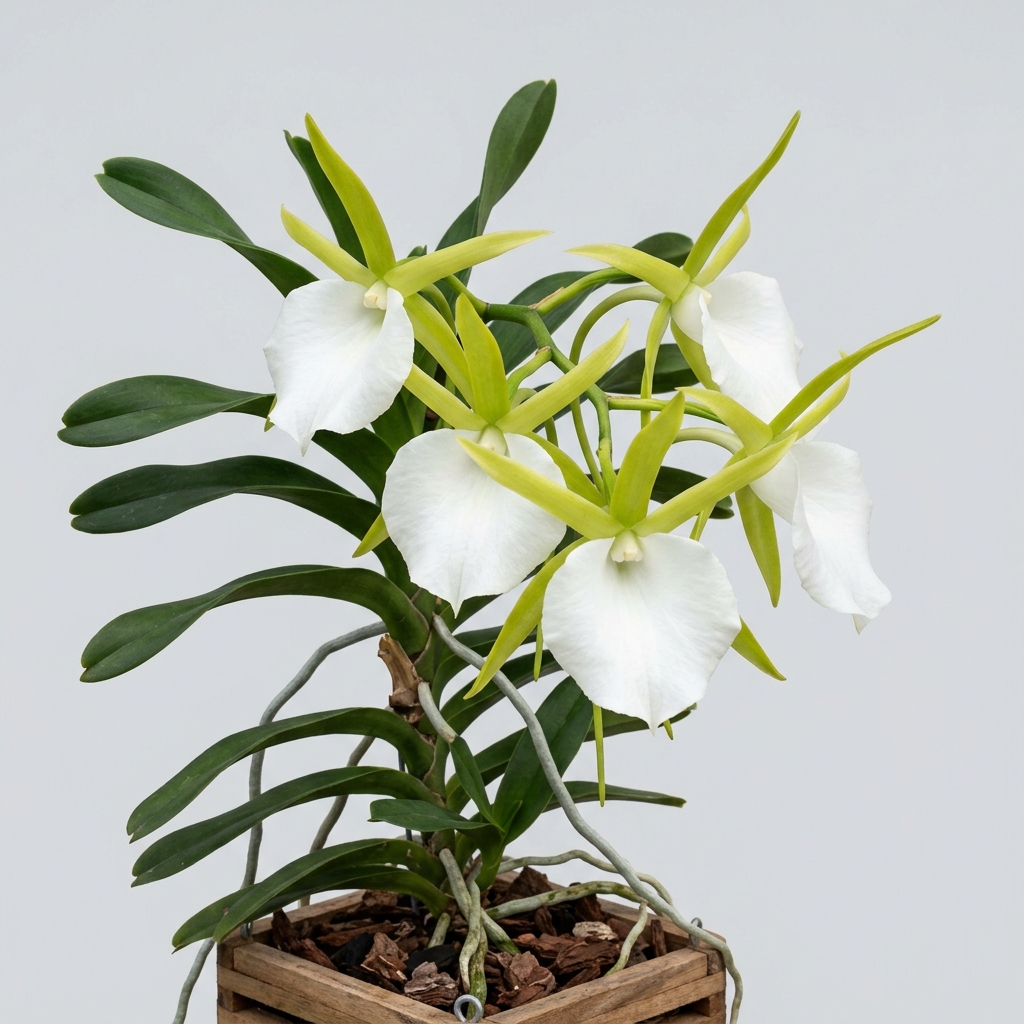
Angraecum Infundibulare, commonly known as the funnel-like Angraecum, is a striking epiphytic orchid species native to the hot, humid forests of tropical Africa. Highly prized by collectors for its dramatic, architectural growth habit and exceptionally large flowers, this monopodial orchid stands out within the Angraecum genus. Its scrambling, vine-like stems and impressive floral display make it a rewarding centerpiece for dedicated orchid enthusiasts who can accommodate its unique growth requirements.
Unlike many compact orchids, this species produces long, climbing stems that root aerially as they grow, mimicking its natural habit of scrambling up tree trunks in the wild. The remarkable flowers feature a massive, funnel-shaped white lip contrasted by slender, greenish-yellow sepals and petals, creating an elegant, predatory appearance. Cultivating this orchid successfully requires replicating its warm, humid forest canopy environment, but the reward is a spectacular botanical display and an enchanting nocturnal fragrance.
💡 Did You Know?
Angraecum Infundibulare belongs to the Angraecum orchid group, where flower presentation is often just as important as . White-flowered cultivars are especially valued indoors because their pale blooms reflect well and pair easily with many home, greenhouse, and display settings.
🌿 Botanical Overview
Angraecum Infundibulare is a monopodial epiphyte native to a broad belt of tropical Africa, including Nigeria, Cameroon, Uganda, and the Democratic Republic of Congo. In its natural habitat, it grows in warm, humid lowland forests, often near watercourses where atmospheric moisture remains consistently high. The plant shows a scrambling or climbing growth habit, with long, semi-woody stems that can reach several feet in length over time.
The foliage consists of leathery, strap-like leaves arranged alternately along the elongating stem. As the plant climbs, it produces robust, silver-gray aerial roots from the stem nodes. These roots serve a dual purpose: they anchor the climbing plant to its host tree and absorb moisture and nutrients directly from the humid air and passing rainfall.
🌸 Flower Characteristics
The blossoms of Angraecum Infundibulare are among the most spectacular in the genus, often measuring up to six inches or more in diameter. The most prominent feature is the massive, pristine white labellum, which flares dramatically into a funnel shape, giving the species its botanical name. Extending from the back of this lip is a remarkably long, slender spur that contains nectar, a classic evolutionary adaptation for moth pollination.
Surrounding the large white lip are narrow, reflexed sepals and petals that typically exhibit a pale green, bronze, or yellowish-green hue. This color contrast emphasizes the luminous quality of the central funnel. The flowers are produced singly on short inflorescences arising from the leaf axils, presenting themselves with an elegant, downward-facing posture.
Fragrance & Bloom Profile
True to its evolutionary reliance on nocturnal hawkmoths for pollination, Angraecum Infundibulare is highly fragrant after dusk. During the day, the flowers emit little to no scent, but as night falls, they release a powerful, sweet, and spicy perfume. This fragrance is often described as a blend of jasmine, gardenia, and warm spices, filling the growing space with a rich aroma.
Individual flowers are long-lasting, often remaining pristine for four to six weeks if kept in stable conditions. The blooming cycle is somewhat irregular but typically peaks in late summer to autumn, though mature, well-established plants in optimal conditions can produce flowers at various times throughout the year.
Parentage & Hybrid Lineage
Angraecum Infundibulare is a distinct, naturally occurring species rather than a man-made hybrid. While it is highly valued in its pure form by species collectors, its unique floral morphology and vigorous climbing habit have occasionally been utilized in hybridizing programs within the subtribe Angraecinae.
Because hybrid registration records for this specific species can be limited or highly specialized, growers should treat any labeled hybrids with cautious optimism. In the orchid trade, it is most commonly encountered as a species, and maintaining its genetic purity is a primary goal for conservation-minded hobbyists.
🌱 Growing Conditions
Replicating the tropical African canopy is key to maintaining a healthy Angraecum Infundibulare. It thrives in warm to intermediate temperatures, ideally ranging from 75 to 85 degrees Fahrenheit during the day, with a slight drop of 10 degrees at night to encourage robust growth and flowering.
💡 Care Tip
For best results, grow Angraecum Infundibulare in bright filtered with steady and gentle airflow. Avoid placing the plant in harsh midday sun, but do not keep it in a dark corner; weak is one of the most common reasons cultivated orchids refuse to rebloom.
Light levels should be bright but filtered, similar to the dappled sunlight found in a forest understory. Direct midday sun will quickly scorch the leathery leaves, while too much shade will inhibit flowering. High humidity is crucial, ideally maintained between 60 and 80 percent, coupled with strong, continuous air movement to prevent stagnant air from harboring fungal pathogens.
Watering, Feeding & Potting Media
This species does not possess pseudobulbs to store water, meaning it has low tolerance for prolonged drought. The potting medium should be kept consistently moist but never waterlogged. A coarse, open mix of large fir bark, charcoal, and perlite works well in baskets, allowing the roots to dry slightly between waterings while retaining adequate moisture.
Alternatively, because of its climbing nature, many growers prefer to mount the plant on large cork slabs or tree fern plaques, wrapping the base in high-quality sphagnum moss. Feed the plant weekly with a diluted, balanced orchid fertilizer during the active growing season, flushing the medium with pure water once a month to prevent salt buildup.
Blooming Season & Care Notes
The primary blooming period typically occurs in the late summer and autumn months, though environmental cues can trigger off-season blooms. To encourage bud initiation, maintain stable warm temperatures and high humidity as the new growth matures. Once a flower bud begins to emerge from the leaf axil, avoid changing the plant’s orientation to the light source, as this can cause the developing bud to twist or blast.
Repotting or remounting should be done with extreme care and only when absolutely necessary, such as when the potting medium decomposes. Angraecum species are notorious for hating root disturbance, and a disrupted root system can cause the plant to sulk or drop leaves for a season.
⚠️ Common Issues
⚠️ Common Mistake
The most common mistake is by calendar instead of root and potting-media condition. Angraecum roots need moisture and air at the same time, so constantly wet bark or sphagnum can lead to root loss even when the leaves still look healthy.
- Root Rot:
Caused by compacted, poorly draining media or overwatering, leading to limp, yellowing leaves. - Bud Blast:
Sudden drops in humidity, drafts, or moving the plant while buds are forming can cause buds to yellow and fall off before opening. - Dehydration:
Shriveled stems and wrinkled leaves indicate insufficient watering or low humidity, especially in mounted specimens. - Scale and Mealybugs: These pests can hide in the tight leaf axils and under the climbing stem joints; treat promptly with insecticidal soap or horticultural oil.
- Leaf Spotting: Fungal or bacterial spots can develop if water sits on the foliage overnight in cool, stagnant conditions.
❓ Frequently Asked Questions
How do I support the climbing growth habit of Angraecum Infundibulare?
Because of its scrambling nature, this orchid requires physical support as it grows. You can provide a tall totem made of tree fern or cork, grow it in a large wooden slat basket where it can drape, or mount it on a substantial slab. Secure the climbing stems gently with soft plant ties until the aerial roots attach themselves.
Why are the flower buds on my Angraecum Infundibulare dropping?
Bud drop, or bud blast, is usually caused by sudden environmental stress. Common culprits include a sharp drop in humidity, cold drafts, underwatering, or moving the plant to a different location with different light levels while the buds are developing. Keep conditions highly stable once spikes appear.
Can I grow Angraecum Infundibulare under LED grow lights?
Yes, this species can adapt to indoor cultivation under high-quality, full-spectrum LED grow lights. Position the plant so the upper leaves receive bright, indirect light, but monitor closely for any signs of leaf bleaching or heat stress. Ensure that humidity levels remain high around the light setup.
How often should I repot this orchid?
Repotting should be kept to an absolute minimum, typically every three to four years, or only when the potting medium has completely broken down. Angraecum roots are highly sensitive to disturbance. If growing in a wooden basket, you can often simply insert the old basket into a larger one and pack fresh bark around it to avoid disturbing the roots.
⭐ Final Growing Notes
Angraecum Infundibulare is a magnificent, rewarding orchid that brings a touch of wild African forest drama to any collection. While its large size and climbing habit require more space and structural support than typical windowsill orchids, its spectacular, funnel-shaped blooms and intoxicating night fragrance make it well worth the effort. By providing consistent warmth, high humidity, and minimizing root disturbance, growers can enjoy this botanical marvel for many years.
⚕️ Health, Safety & Edibility
Understanding how a plant interacts with people, pets, and the surrounding environment is part of responsible cultivation. This section uses conservative, general guidance and does not replace professional medical or veterinary advice.
Human Safety: No published evidence currently identifies species-specific toxicity concerns for Angraecum Infundibulare during normal handling. As with most ornamental plants, it should not be intentionally consumed.
Pet Safety: Published information does not indicate that this orchid commonly poses a toxicity concern for cats or dogs. However, chewing leaves, flowers, roots, or potting media may still cause mild digestive upset.
Edibility: This orchid is cultivated for ornamental display rather than food. Ornamental plants may carry fertilizers, pesticides, or other horticultural treatments that make them unsuitable for consumption.
Skin Contact: Routine handling is not generally associated with skin irritation. Gardeners with sensitive skin may prefer wearing gloves when repotting, pruning, or handling potting media.
🌱 Propagation Tip
Propagation should be approached patiently. Most home growers should wait for natural keikis or divide only mature, healthy plants when the orchid type allows it. Never remove a young growth until it has strong roots and enough leaves to support itself away from the parent plant.
⭐ Expert Advice
Repot after flowering when fresh root tips begin to appear. This timing helps the plant anchor quickly into new bark or sphagnum and reduces stress, especially for orchids grown indoors where airflow, , and drying speed can change from season to season.

Leave A Comment